

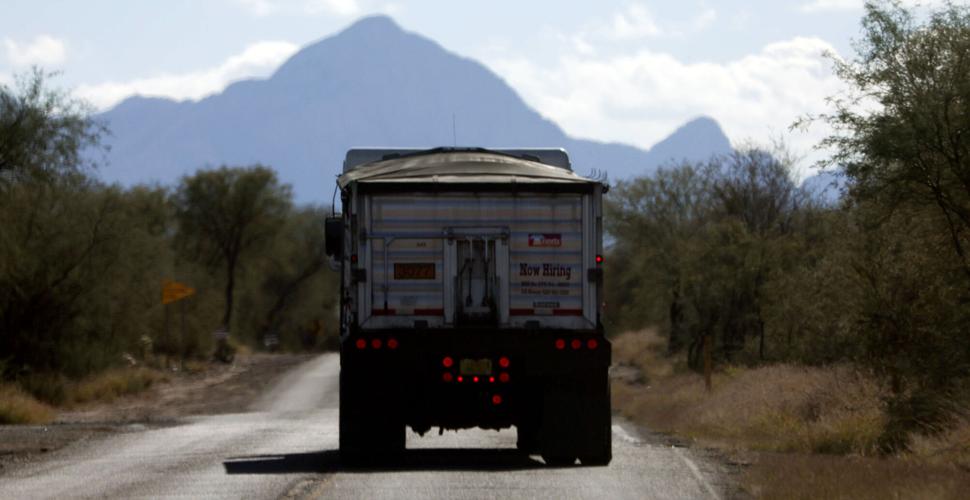

Huge mine trucks and other heavy trucks may soon face strict limits on how many can travel and how fast they can travel on dirt roads in unincorporated Pima County.
A proposed ordinance pending before the Board of Supervisors — but facing pushback from mining and trucking interests — would allow no more than 75 heavy trucks per day on any given county-owned dirt road and limit their speeds to 15 miles an hour.
County officials say the limits would help protect people from inhaling large amounts of dust that can trigger serious respiratory problems, including asthma, bronchitis, valley fever and chronic obstructive pulmonary disease.
While the ordinance would limit heavy trucks on all dirt roads, the proposal originally stemmed from concerns county officials and environmentalists have about the potential for dust on a major stretch of Santa Rita Road south of Tucson when and if the Copper World mine begins operations in the Santa Rita Mountains at the end of that road. A seven-mile stretch of dirt road leads to the planned mine site from an area south of the town of Sahuarita, where the road is paved.
Hudbay Minerals Inc., which plans to build Copper World, is among those opposing the proposed ordinance, which it says would be illegal and clearly targets its mining operation. The company says the ordinance would have a "significant impact" on the mine's operations; "the extent of this constraint is still being assessed."
The Arizona Trucking Association also says the ordinance would be illegal, conflicting with state and federal laws that guarantee the right of intrastate and interstate commerce by trucks and ensure the rights of federally regulated trucks to access local roads.

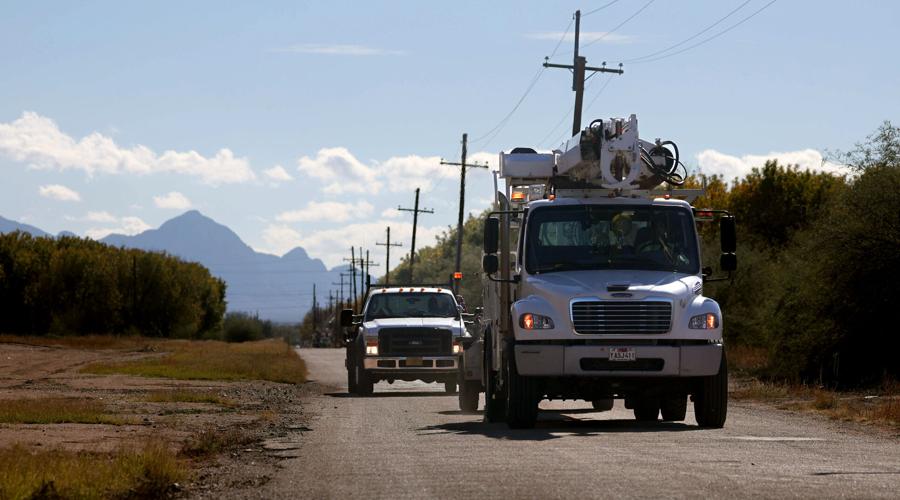
Work trucks go up and down Santa Rita Road south of Tucson. A proposed county ordinance would limit heavy trucks on all dirt roads, but the proposal originally stemmed from concerns about the potential for dust on a major stretch of Santa Rita Road when and if the Copper World mine begins operations in the Santa Rita Mountains at the end of that road.
In a letter to county officials, trucking association president Tony Bradley said that while the county does have federally delegated authority to regulate air quality, "air quality powers may not be used to regulate truck access where transportation law prohibits direct restrictions."
A number of environmentalists support the ordinance, however, saying it's needed to protect peoples' lungs and to prevent roads like Santa Rita Road from deteriorating under heavy truck traffic.
So does local physician Dr. Nina Luxenberg, who said in written comments to the county, "We are relying on the Board of Supervisors to protect the air we breathe. Air is in the public domain and we have the right to breathe clean air."
On Tuesday, the supervisors delayed a vote until Dec. 16 on the proposed ordinance at the request of the County Attorney's Office.
"There's been a lot of public feedback," Deputy County Attorney Sam Brown told the board Tuesday. "We want to see if revisions are necessary. There may or may not be a revised version."
The county did, however, hold a public hearing on the ordinance Tuesday, at which speakers opposing the ordinance, many in the mining industry, far outnumbered supporters.
But supporters said many of their allies didn't come to the hearing because they thought the entire discussion and not just the vote would be delayed. John Dougherty, director of Save the Scenic Santa Ritas, which opposes Copper World and endorses the county proposal, said a number of other supporters will attend the Dec. 16 meeting to express their views.
Mine trucks are part of the issue
The ordinance would put limits on all trucks carrying loads of at least 16,500 to 19,999 pounds a day.
Hudbay Minerals says it won't know how large or how heavy its Copper World trucks will be until it finishes and releases a final feasibility study for the mine in 2026.

Work trucks go up and down Santa Rita Road. Santa Rita Road has been identified as the most likely access route for heavy-duty truck traffic to and from the planned Copper World mine site, Pima County's administrator said in a memo.
The proposed county ordinance would impose the truck limits on all county-owned dirt roads that carry a daily average of at least 150 total vehicle trips and 75 heavy truck trips.
On Santa Rita Road, at a spot just before the paved road turns to dirt, the county recently tabulated an average of 204 total trips daily, including 27 heavy truck trips daily, meaning the limits wouldn't be in effect on that road for now if the ordinance passes, although they could later once Copper World, where five open pits are planned, goes into full operation.
County officials say they aren't specifically targeting the mine with this ordinance. They have opposed the mine continuously since the mid-2000s, and county supervisors have passed four resolutions, first opposing the plan that preceded Copper World, the Rosemont Mine previously proposed on the Santa Ritas' east slope, and subsequently the Copper World proposal on the west slope.
The county officials say the ordinance's purpose is much broader than Copper World: to "proactively prevent the degradation of air quality and health." They say they want to avoid federal regulatory requirements, such as sanctions limiting new construction or roadwork, that could hit the county if heavy truck traffic makes an area's air quality bad enough that it no longer meets federal air quality standards.
In addition, the ordinance could serve as a control measure for truck traffic in the county's only area that's now out of compliance with federal air quality rules — the Rillito area in Marana — since that area includes unpaved roads, county officials say.
But five open pits at memo acknowledged the county started work on the ordinance after receiving a request to consider one from the Copper World opposition group Save the Scenic Santa Ritas.
The request was for the county to consider drafting an ordinance similar to one existing in Patagonia and to regulate heavy truck traffic "specifically for the Santa Rita Road and other County roads across or near the Santa Rita Experimental Range," County Administrator Jan Lesher told supervisors in a Nov. 12 memo. The experimental range, through which Santa Rita Road crosses, is a 52,000-acre, state-owned area of desert and grasslands on which long-term ecological research is conducted.
Patagonia’s ordinance contains a limit of 100 heavy truck trips a week for any company using a road, but doesn't include a speed limit for heavy trucks on dirt roads. It was approved because of concerns about noise, pavement degradation and spills, Lesher's memo said.
Before drafting the Pima County ordinance, county officials had been concerned that an air quality permit issued by the state for Copper World in 2024 didn't cover dust from Santa Rita Road. Lesher's memo said Santa Rita Road has been identified as the most likely access route for heavy-duty truck traffic to and from the mine site.
Officials for the county, Hudbay and Sahuarita, meeting as part of a dust working group, came up with the idea of Hudbay voluntarily spraying a dust suppressant on the road, and it's worked so far, county officials said.
But county officials say they don't believe the dust suppressant will continue to work when and if the mine starts operating and truck traffic starts increasing significantly.
Before drafting the proposed ordinance, the county reviewed truck-related ordinances across the state so they could "more comprehensively prevent air quality degradation across the county and not just in one area," said Nicole Fyffe, a senior advisor to Lesher.
"The ordinance is much broader than the events that initiated it," she said.
Hudbay says dust control already in place
In written comments to the Star, however, Hudbay said, "If dust control were truly the county’s objective, it would continue partnering cooperatively with the voluntary Santa Rita Rd dust mitigation working group, which has been successful. Hudbay has invested over $1 million in this successful effort, with no public funds spent, and the county has recognized Hudbay's efforts as successful."
The mining company also said it's committed to employing effective solutions once the mine is fully operating to ensure dust levels remain well below regulatory limits.
"We urge Pima County not to withdraw from and to continue working in partnership with the larger dust mitigation working group to build on the success we have already achieved together and ensure that air quality is protected throughout the life of the mine," the company told the Star.
At this time, Hudbay said it doesn't know how many trucks a day will be running to and from the mine.
At Tuesday's public hearing, Dougherty of Save the Scenic Santa Ritas estimated the mine could generate as many as 110 truck trips per day. He based that estimate on what the federal Environmental Impact Statement projected would be required for the Rosemont Mine, Copper World's predecessor, while reducing the number of projected trips to account for the fact that Copper World will be producing less copper annually than Rosemont would have produced.
But traffic estimates for Copper World can't be accurately assessed by extrapolating data from a different project, Hudbay told the Star.
Also, Dougherty's estimate fails to account for plans to produce finished copper cathodes at Copper World after the mine's first few years of operation, Hudbay said.
"The production of finished copper will reduce truck traffic compared to a project designed for hauling concentrate," since the cathodes are smaller and will require fewer trucks, Hudbay said.
"Accurate traffic volume and routes are currently being assessed as part of our feasibility study, which uses verifiable engineering data and is scheduled to be completed in 2026," the company said.
Hudbay investments lauded
At Tuesday's hearing, numerous industry officials and Hudbay employees attacked the proposed ordinance.
The trucking association's Bradley, for instance, said that since Patagonia passed its law in the 2010s, two state laws have passed limiting local government authority over trucks using county roads. One specifically forbids local governments from denying reasonable access or requiring permits for trucks to use local roads, he said.
Pima County noted that the Arizona attorney general wrote an opinion in 2018 saying the Patagonia ordinance was legal. But Bradley said the ordinance conflicts with recent state laws and that attorney general's opinions are advisory and non-binding.
He said the county ordinance would also violate the federal Surface Transportation Assistance Act, which says local governments must provide reasonable access for certain kinds of vehicles. The ordinance would also impose undue limits on interstate and intrastate commerce, he said.
Copper World represents some of the most significant investments Pima County has seen, said Brian Arrington, regional mining manager for Sundt Construction in Tucson. "It will be one of the nation's largest producers of copper and crucial for our nation's security. Despite that, the county is considering an ordinance that will severely limit it," he said.
"These restrictions are based on dust concerns and standards designed for" areas that don't meet federal air quality standards, not for this mining complex, and they're not providing any measurable environmental gains, Arrington said.
Lee Maes, calling himself a third-generation copper miner and a county resident since 1987, said Hudbay is going to drop hundreds of millions of dollars into the state economy via tax revenue and good-paying jobs.
"The people will buy houses and vehicles in Pima County, goods for their families and groceries, which generates more tax revenue," said Maes, adding, "The schools in Pima County could certainly use an influx of some money. Pima County and this board have been opposed to Copper World. It's time to get this out of the way, put this aside and let it be built."
Roxanne Morales, who has lived in Pima County 44 years and 20 years in Sahuarita, said she's a "proud employee of Copper World" who opposes the ordinance.
"i chose to work and build a family in my community. I have also chosen to work for the mining industry. As many are aware, copper is a critical mineral, utilized in everyday life. I have no concern about Copper World nor have I ever heard any concerns from neighbors. If anything, I've only heard enthusiasm," Morales said.
Dust pollution dangerous, doctor says
Luxenberg, the physician, framed the issue in health-care terms, meanwhile.
She said that when heavy trucks kick up dirt on unpaved roads, "we unknowingly breathe in very tiny dust particles, which make their way down deep into our lungs, reaching our tiny air sacs."
"Being so tiny, these particles may not stimulate a cough to get rid of them and so they stay lodged in the air sacs, where they can damage immune cells, induce inflammation and oxidative stress, and impair lung function. This can lead to chronic lung conditions such as asthma, obstructive pulmonary disease, and bronchitis," she said.
Air pollution from dust emissions is analogous to how microplastics, also very tiny particles, can adversely affect our health and lead to cancer, Luxenberg said.
"At least we have some control over our ingestion of microplastics. But we cannot control how many microplastics nor how many tiny dust particles we breathe in. The answer is not to get these potentially toxic particles in our air in the first place," she said.
Dougherty of Save the Scenic Santa Ritas said Hudbay made a major mistake in selecting a mine site in the Santa Rita Mountains where there's "no rail, no trains."
"The impact pf heavy truck traffic is going to destroy the road and will destroy the Santa Rita Experimental Range, which is been there since 1903," Dougherty said. "Hudbay wants to turn Santa Rita Road into an industrial corridor. Pima County controls the right-of-way on these roads. There's authority to protect its roads from being destroyed."
That statement is baseless, Hudbay said later to the Star.
"Hudbay will operate safely and responsibly in cooperation with local governments to ensure that roads are safe, maintained, and upgraded," the company said.
Erick Meza of the Sierra Club said Hudbay's push for Copper World is one example of how extractive industries want to move into rural communities and find loopholes to be able to continue polluting the environment. "Most people in these communities want clean air and to be away from potential harms in the middle of the city," he said.
It's very unclear how the dust suppressant Hudbay has sprayed on Santa Rita Road is going to work for the long term, especially with lots of heavy equipment going through it, said Meza, the Sierra Club's borderlands coordinator.
Russ McSpadden of the Tucson-based Center for Biological Diversity said he's seen trucks kicking up big plumes of dust all over the county, including borderland areas where heavy trucks have come in to work on building the border wall.
"That’s the stuff that harms local communities. It can settle on ephemeral streams on desert wildlands. I know it causes real damage to desert ecosystems," said McSpadden. "Places out towards Ajo, you have border wall trucks going through and you'll see cactus die alongside the road."
"I was really able to experience this in Organ Pipe Monument, when they were building the border wall in 2019 and 2020," he said. "The more trucks went by, the first two layers of desert and cacti were getting coated and coated with dust. In a couple of years, I saw cacti drying up."
Passing this ordinance would be a "breath of fresh air" for the county, McSpadden said.
Get your morning recap of today's local news and read the full stories here: tucne.ws/morning

