


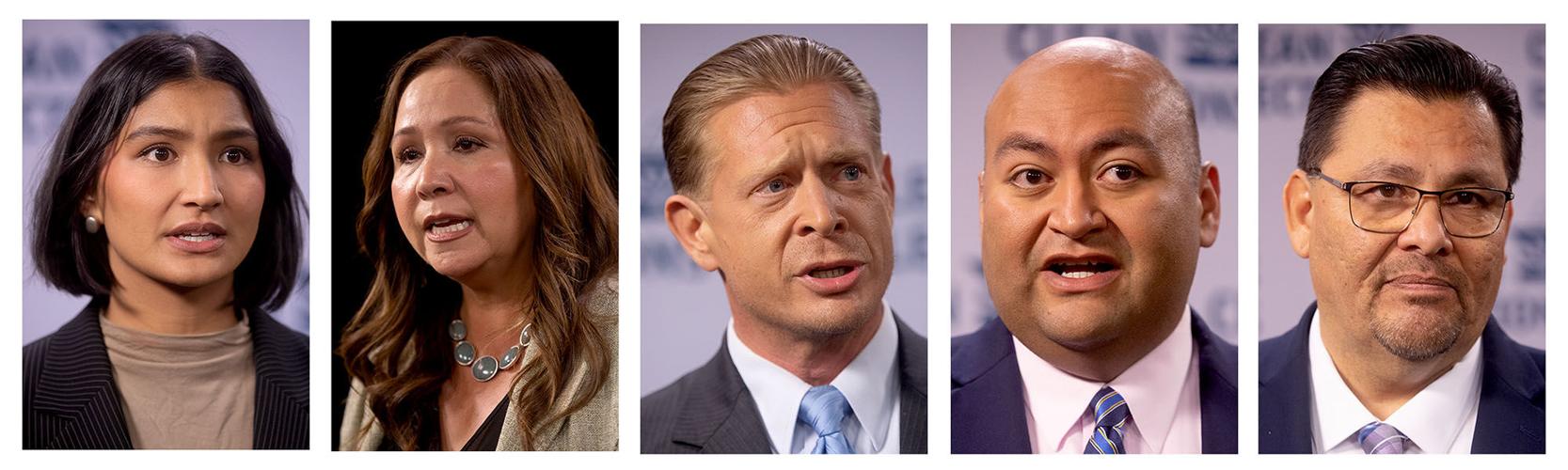

Democratic candidate Daniel Hernandez says when it comes to mining projects, it’s not a binary choice between creating good-paying jobs or protecting the environment.
“If we don’t mine here in Arizona, where we are creating good union-paying jobs ... we will have to get those things to modernize our green economy from somewhere else,” he said during a debate Tuesday night of the five Democrats running for the vacant Arizona congressional seat in District 7.
Hernandez was responding to a question about the Oak Flat mining project, in which the federal government is attempting a land transfer for a massive mining project near Superior. On Monday, a federal judge in Phoenix prevented the U.S. Forest Service from proceeding with the land exchange until 60 days after the agency issues a required environmental review, weeks after the Supreme Court rejected an appeal from Apaches who are attempting to halt the project on federal land they hold sacred, the Associated Press reported.
The other Democratic candidates running all disagreed with Hernandez on the mining project. They are Adelita Grijalva, Patrick Harris Sr., Deja Foxx and José Malvido Jr.
The seat, which represents parts of Tucson, had been held by an ardent environmental advocate, Democrat Rep. Raúl Grijalva, who was elected to 12 terms in the U.S. House. He died in March of complications from cancer treatments at age 77 while in office.
Adelita Grijalva, the late congressman’s daughter, said she will oppose the Oak Flat land transfer, and if elected, will seek to revisit 1970s-mining laws on the books and to emphasize “mandatory consultations with tribal nations and impacted communities.”
Harris said he has a problem with mining due to the harm it causes to the environment and the potential safety risks it entails, as his brother was left paralyzed in a mining accident in Montana.
Malvido, too, said he opposes the mining project, as his support, “for years,” lies with the Indigenous people at Oak Flat.
Foxx also indicated she opposes the Oak Flat land transfer.

From left to right, Democratic congressional candidates Deja Foxx, Adelita Grijalva, Patrick Harris Sr., Daniel Hernandez Jr. and José Malvido Jr.
Campaign funding, political tenures
Foxx said her campaign has been funded “99%” by small donors and working families.
Since campaign finance statements won’t be filed until the primary race has been settled, she said, Foxx made a “commitment to not take corporate PAC money,” raising her hand and asking her fellow Democrats to do the same.
Hernandez appeared to be the only one to not put his hand in the air. He told reporters after the debate the “biggest problem in politics” currently isn’t corporate funding, but “dark money” flooding into politics, something he alleged Adelita Grijalva of taking.
It wasn’t the only issue the five Democrats were not aligned on.
“We need people and we need leadership (from people) that are not career politicians, Malvido said, adding: “Daniel and Adelita have been doing this for 20-some years.”
Hernandez is a former state legislator and Grijalva was a Pima County supervisor and a Tucson Unified School District board member.
“For progressive action, Daniel has voted with MAGA Republicans 52 times,” Malvido said. “Adelita and Daniel both support the genocide in Israel. ... We need new leadership, and when we’re talking about steering the party ahead we need to have truth, we need to be united and we need to have a progressive agenda.”
Grijalva took issue on both fronts.
“I find it disappointing that we’re talking about career politicians when I was on the (TUSD) board for 20 years in a volunteer, unpaid position. ... I have no idea what Mr. Hernandez is referring to as far as ‘dark money,’ I have no corporate PAC, no oil or fossil fuel money coming,” she said. “We have not had a conversation about Israel, or Gaza, and so I’m happy to have that conversation, but that’s also inaccurate information.”
Tuesday’s debate, moderated by Steve Goldstein and Nohelani Graf and held in the Arizona Public Media studio in Tucson, was the second held in the lead-up to the July 15 primary election.
Whoever wins the Democratic contest will run in the Sept. 23 general election against the winner of the Republican primary. The three GOP candidates, Daniel Butierez, Jorge Rivas and Jimmy Rodriguez, faced off Monday in a debate.
Denouncing Trump policies
The five Democrats all denounced the recent orders by President Donald Trump to deploy the National Guard and Marines to Los Angeles in response to protests, and shared similar views on Trump’s tariff policies and what the president calls the “One Big Beautiful Bill.”
The bill combines multiple priorities pushed by the Trump administration including work requirements for food assistance and Medicaid, tax breaks, and billions for the U.S.-Mexico border wall and immigration enforcement.
But that legislation might not have made it out of the House if the Democratic Party had a “hard conversation” internally about policy and age, Foxx said.
The bill “passed by a single vote. We have three vacancies in the House, three Democrats who have passed away while in office, it’s why we’re all standing here today,” said 25-year-old Foxx. “We failed to have a hard conversation about our party, about age, failed to bring in a new generation of leaders, and now it is working-class families like mine that are going to have to live with the consequences.”
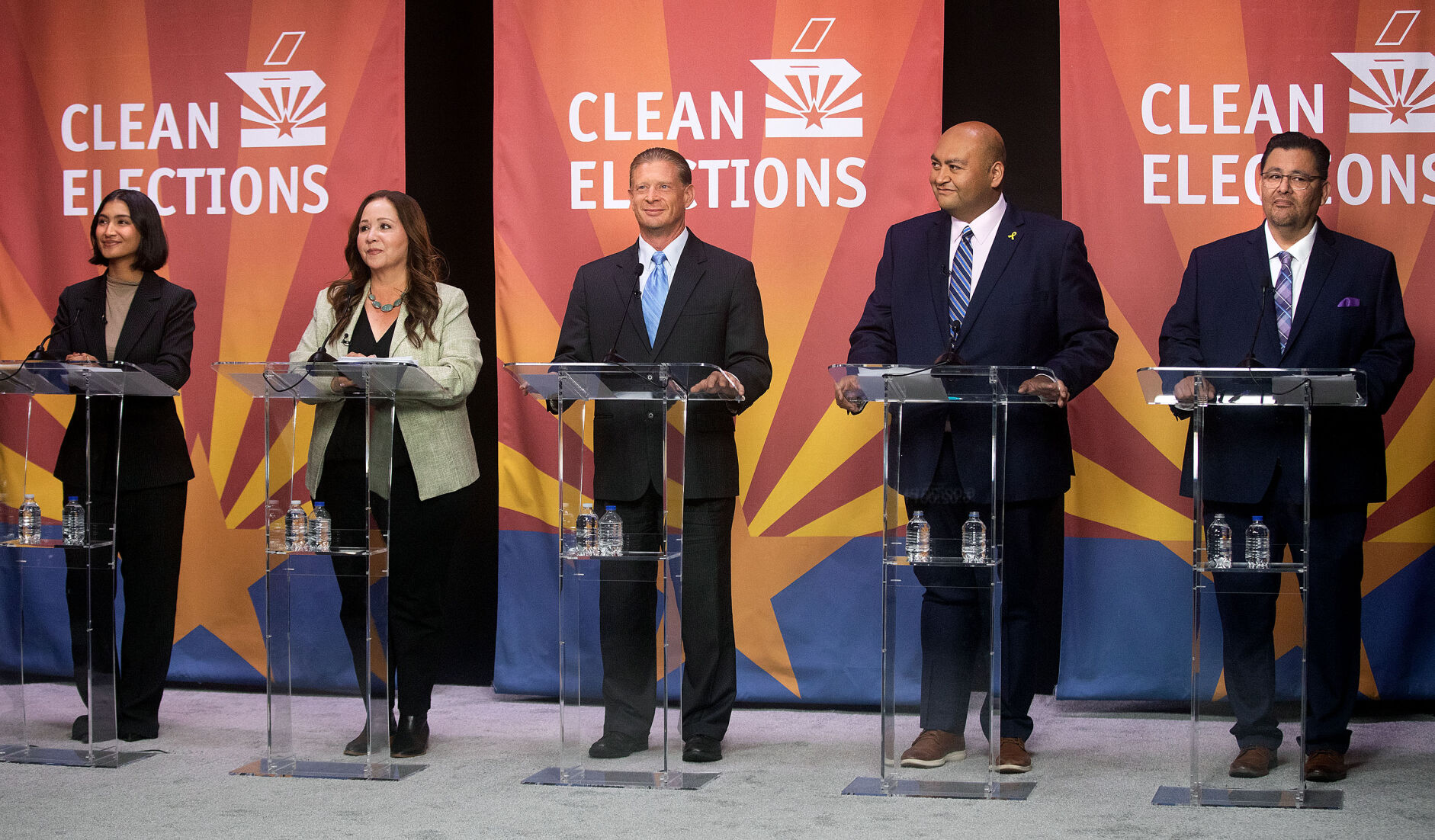
From left to right, Democratic candidates Deja Foxx, Adelita Grijalva, Patrick Harris Sr., Daniel Hernandez Jr. and José Malvido Jr. debate Tuesday night. They are vying for their party’s nomination for the vacant seat in Congressional District 7.
“Let’s get progressives in there to do the hard work of advocates to pull our party toward moral clarity, but let’s also bring in a new generation,” Foxx said.
If elected, Grijalva said she would sign a discharge position on Day One to overturn Trump’s national emergency declaration that has allowed him to implement the sweeping tariff plans.
Malvido said he would organize Congress to restore a corporate tax rate of 28%, while Hernandez said Medicaid and Medicare cuts would be a “non-negotiable” when working on any legislation.
To combat issues facing the economy, Harris proposes a constitutional amendment he titles “Capitulated Capitalism.” He said he would be prepared to present it on Day One if elected.
His “Cap the Cap” plan would cap personal wealth at $1 billion, and U.S. billionaires would need to “reinvest into society” anything over that amount within one year. It was a phrase Harris used often during Tuesday night’s debate.
“Build schools, hospitals, cure cancer — I don’t know, fix the roads locally here — ‘Cap the Cap’ puts trillions of dollars back into the economy,” Harris said. “There are 800 billionaires in the U.S. that hoard $6 trillion.”
Congressional District 7 has about 176,000 registered Democrats, compared with fewer than 93,000 registered Republicans. It stretches from Douglas through Nogales into parts of Pinal and Maricopa counties and west to Yuma.
The registration deadline to vote in the July 15 primary is next Monday, June 16. Early voting begins next week on June 18.

