


Born in Flagstaff on May 25, 1902, Bessie Kidd Best spent almost her entire life in northern Arizona, improving the education of children from diverse backgrounds.
The fifth and youngest child of Robert and Eva Kidd, Bessie was the only member of the family born in Arizona. Her older brother and sisters arrived with their parents from Ohio around the beginning of the 20th century. Her mother died when Bessie was 10, leaving Bessie and her sister Lucille to run the household.
In 1920, Bessie graduated from Northern Arizona Normal School and went on to obtain her teaching certificate in 1922. Her first teaching job was in Winslow.
On June 12, 1923, Bessie married Elihu (Hugh) Best. Her father, serving as justice of the peace at the time, performed the ceremony.
As a married woman, Bessie could no longer teach, as only men and single women were considered for teaching positions. Rural schools, however, were more than willing to hire any teacher who would live in sparse, isolated surroundings. Bessie accepted a position in a one-room school on the Apache Indian Reservation at Whiteriver, teaching 40 children in grades one through eight.
Sharing her time between Arizona and California, where her husband was working, plus giving birth to son Robert Huge Best in 1927, Bessie continued teaching until the position of Coconino County school superintendent became vacant in 1928.
By now, Bessie knew her marriage was faltering (the couple divorced in 1930), and she had to find more stable employment. On the recommendation of friends, she decided to run for the superintendent position.
Borrowing the family car, Bessie set out to canvas the school district territory, all 18,623 square miles, the second largest county in the country. She learned to maneuver rough, rutted roads that ran through dry, barren deserts. She traipsed up and down mountainous trails, logging paths that meandered through forests in which she sometimes lost her way, and canyon depths that often found her wondering where in the world she was. The farthest school in the district was over 200 miles from Flagstaff, but she was determined to visit every school within the county.
She also honed her automotive skills on these bumpy adventures, learning how to repair just about anything that broke or fell off the car. A good amount of bailing wire usually solved the problem. She could change a tire within minutes, and the canteens of water she carried usually quenched the car’s thirst, not her own.
No one was more surprised than Bessie when she won the election.
Starting her new job on Jan. 1, 1929, Bessie oversaw Coconino County’s 19 one-teacher schools, 4 two-teacher schools, 2 four-teacher schools, plus larger schools in Flagstaff and Williams, the only two communities of noticeable size.
Because of climate conditions in northern Arizona, some of the schools were open from March through November while others ran September through May, keeping Bessie on the road throughout the year. She estimated she traveled 10,000 miles annually.
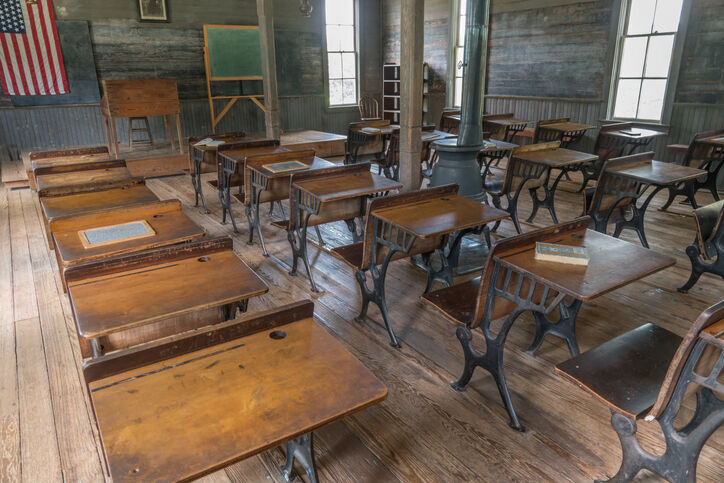
Many of the schools in her district were small, one-room buildings not particularly well-built. Pot-bellied stoves heated the classrooms, bathroom facilities were down a path, and drinking water was hauled from the nearest water source.
Logging site schools were usually located in boxcars that could be moved onto sidings as loggers relocated, sometimes leaving Bessie to wonder where her school went. In her first annual report on the operation of her district, she described one of these boxcar schools that “moved from place to place with the camp. The attendance is large and the car is very crowded. It is hoped another teacher and another car will be added this year.”
School superintendent positions were two-year jobs. Bessie ran for her second term in 1930 and would continue to serve Coconino County for over 40 years, often running unopposed — on both sides of the ticket. Yet even with no adversary, she campaigned “because I want everyone to know I appreciate the office,” she said.
Her own educational goals continued to advance as she earned her bachelor’s degree in 1935 and master’s degree in 1948, all from Flagstaff Normal School (now Northern Arizona University).
But her chief concern was the education of students within her district. She was constantly on the search for good teachers who would brave the wilderness to educate children with limited resources. Without libraries in some of these small communities, she was instrumental in opening the county library system to rural schools.
In 1941, Bessie was appointed to the advisory committee of the statewide school lunch program. She helped get water piped into some of the schools, and eventually, restroom facilities were added. When school buses started appearing in the district, she instituted a two-way radio system between bus drivers and the U.S. Forest Service so that stranded buses in bad weather could be rescued, along with the students.
Bessie also took charge of the county spelling bee program. “The first event was very tense,” she said. “I felt so sorry for the children. I almost cried every time one misspelled a word. I wanted them all to win.”
Proudly boasting that she knew every Arizona governor since statehood, Bessie also worked closely with prominent individuals such as U.S. Senators Carl Hayden and Barry Goldwater, often traveling with them on their political campaigns. She also met with government officials in Washington, D.C., soliciting funds for under-financed schools.
Retiring in 1973, Bessie continued to serve her community until her death on Aug. 3, 1983. She is buried in Flagstaff’s Citizen’s Cemetery.
Over the years, Bessie knew as many as three generations of families within her jurisdiction.
As one reporter noted upon watching her interact with students, “Mrs. Best had gathered the children around her and was telling them a story, in her high-pitched, somewhat nasal voice. They were fascinated, and, obviously, in love for the moment with this grandmotherly, bespectacled lady wearing the brightly-colored dress.”
But Bessie would be the first to say it was not her efforts that made the difference in Flagstaff schools. “Good schools do not happen,” she said, “people working together build them.”
The Redington School northeast of Tucson was founded in 1907. It had no electricity or running water. The small number of students traveled long distances to get to school. Archive photos by Tucson Citizen. Produced by Rick Wiley / Arizona Daily Star

