

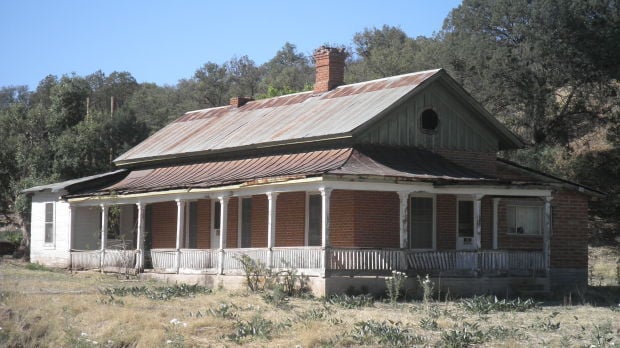
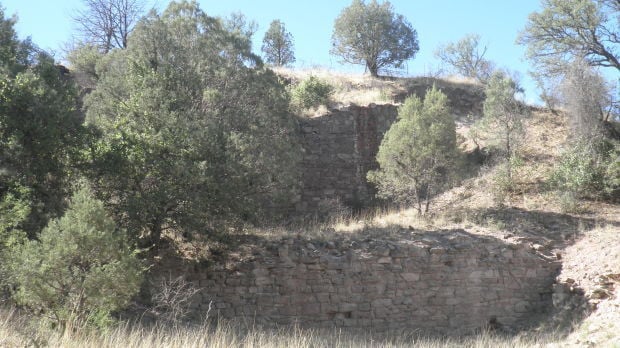
The Harshaw district in the Patagonia Mountains covers 40 square miles, but it produced 1.3 million tons of ore between the 1850s and early 1960s — including an abundance of zinc, lead, silver and gold.
The area’s namesake rancher, David Tecumseh Harshaw, prospected for placer gold in 1875. Near the Trench mine, he discovered a vein of silver ore valued at 95 ounces of silver per ton.
Harshaw worked several claims in the vicinity, including the Hardshell and the Harshaw, which were just a quarter-mile apart. By 1879, Harshaw sold both claims; the latter to the Hermosa Mining Co. of New York, whose Hermosa mine produced $1 million in silver chloride ore, which was amalgamated on site and shipped by Wells Fargo stage as bullion over an 18-month period.
Established in 1880, the town of Harshaw — 10 miles southeast of Patagonia — prospered with 2,000 residents, at least 150 of them miners, and over 35 producing mines. A 20-stamp mill capable of crushing 75 tons of ore a day operated in Harshaw and was connected to the Hermosa mine by rail. The town’s three-quarter mile main street consisted of 200 buildings, including seven saloons, boarding houses, a livery stable and a newspaper, “The Arizona Bullion,” owned by C.D. Reppy and Co. According to the director of the U.S. Mint, the mine produced $365,654 of silver during a short span of four months.
Additional lead-silver mines found in the area included the Flux, Trench and World’s Fair. The Trench mine, one of the oldest in southern Arizona, was originally operated by the Spanish who noted the area for its oxidized, rich, lead-silver ores.
Profits from the silver vein around Harshaw declined in 1881 as the high-grade material was exhausted. The following year, the Hermosa Mining Co. halted all mining operations in the area. Satisfied with their gains of $500,000, the company left Arizona to pursue mining ventures in the La Colorado mine in Sonora, Mexico, under the name of the Prietus Mining Co.
The town of Harshaw survived despite torrential flooding from cloudbursts, thanks to surrounding mining activity. Renewed interest in the mines around Harshaw occurred in 1888 when James Finley of Tucson purchased the Hermosa claim for $600. Installing a 5-foot Huntington reduction mill, Finley successfully mined $150,000 of silver chloride ore between 1889 and 1891, working near the surface above the earlier stopes of the Hermosa Mining Co.
Worked by multiple lessees in the next decade, the Hermosa mine (on Hermosa Hill, 2 miles south of Harshaw) had 7,000 feet of drifts, stopes and tunnels on five levels at a depth of 500 feet.
Declining silver prices and over-speculation hindered the growth of the Harshaw district. The residential population declined and, after Finley’s death in 1903, the Hermosa mine shut down. It was briefly reopened in 1908 by James Cochran, who acquired the Finley estate, and again in 1949-1950.
Between 1939 and 1964, the American Smelting & Refining Co. (ASARCO) operated the Trench and Flux mines near Harshaw. Since 2006, ASARCO has been part of a $3 million land remediation at the 250-acre Trench mine, 12 miles south of Patagonia.
Mining ventures continue in the Patagonia Mountains with exploratory drilling underway since 2006 at the Hermosa deposit by Arizona Minerals Inc. a subsidiary of Wildcat Silver. An estimated reserve of 145 million ounces of silver and 7.2 billion pounds of manganese exists on mining claims both patented and unpatented, encompassing 13,500 acres.

