The number of new weekly COVID-19 cases in Arizona recently rose to its highest point since the first week in August.
The increase has been gradual statewide, unlike the exponential growth the state saw in June.
The number of weekly cases increased by 23% to 4,764 from the week ending Oct. 3 to the week ending Oct. 10, according to the Arizona Department of Health Services’ chart of COVID-19 cases by date, as of Friday.
This number will likely increase over the next week. It takes up to seven days for COVID-19 test results to trickle in, according to ADHS, although sometimes it takes longer.
“What’s happening here in Arizona, it’s more like a slow boil.” said Dr. Joe Gerald, an associate professor with the University of Arizona’s Zuckerman College of Public Health. “It’s not like what we’re seeing in other parts of the country, like North Dakota, South Dakota, Wisconsin. Those states look like Arizona did in June, where there’s this rapid uptick.”
While Arizona saw big increases in cases among 15- to 24-year-olds when universities reopened earlier in the year, this recent increase has occurred across all age groups, Gerald said.
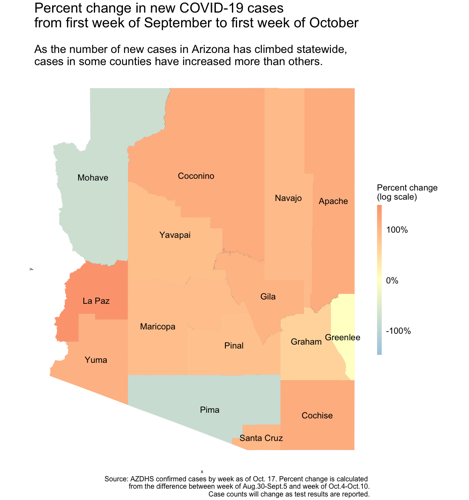
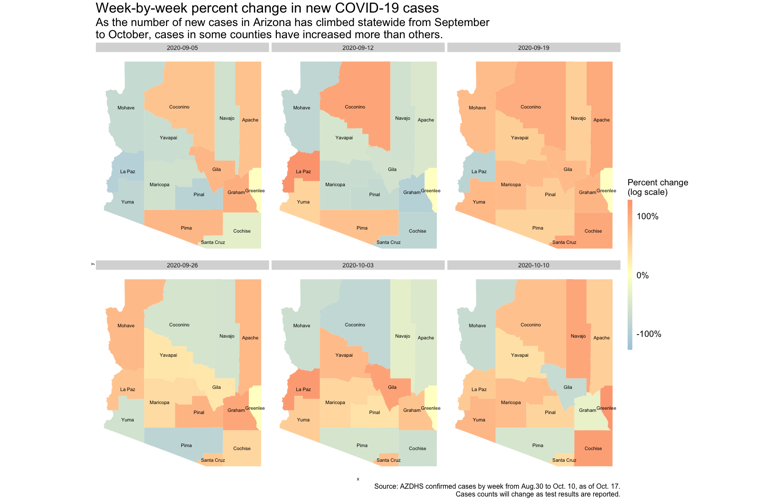
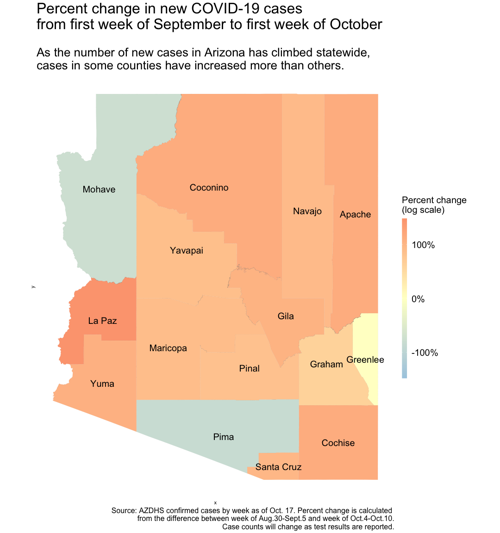
But these increases aren’t happening everywhere. Some counties in Arizona are faring better than others.

Case counts in Pima County are in better shape than the statewide average. Recently, they have been relatively steady from week to week, showing a slight overall decrease.
Dr. Francisco Garcia, the county’s chief medical officer, said the combination of the county’s decreasing numbers of new cases, robust contact-tracing, and increasing testing numbers puts Pima County better than what’s happening throughout the rest of the country.
Pima County had about a 3% percent positive in testing last week.
While diagnostic testing for COVID-19 has increased in Arizona and Pima County in recent weeks, the percent of tests coming back positive for the virus has remained relatively consistent.
“We have been largely spared,” he said. “This is starting to look more like it’s supposed to look. I’m feeling a lot better about this.”
But, he cautioned, based on what other parts of the country — and the globe — are seeing, he is waiting “for the other shoe to drop.”
As cases have risen statewide, so have COVID-19-related hospitalizations.
These hospitalizations dipped to 6% of total inpatient hospital capacity in mid September, but as of Friday, they had risen to 9%.
“So there’s a definite trend upwards in COVID-related hospitalization,” Gerald said. “Again it’s nowhere near the levels of concern that we had back in June and July.”
In Pima County, there was recently “a teeny uptick” in the number of cases going to the hospital, Garcia said, reiterating that hospital capacity here is fine.
Garcia admitted that there is fatigue about mitigation practices, including wearing masks. He said that mask adherence needs to be about 80% in public places to start seeing a population effect to slow the spread of the virus. And that county residents have been good with that.
But he said where there is a risk for the spread is obviously in larger gatherings, but also in smaller social gatherings, where people might not wear a mask because they don’t feel they are at risk in familiar company.
Ultimately, he said those trends around the country are “highly concerning,” especially for Pima County, where students are moving back or getting ready to move back in a hybrid setting at K-12 public schools. Additional University of Arizona students also have gone back in person.
“We could be looking like the Midwest if we are not careful,” he said.