



Weed warriors have unleashed a new weapon in the battle against buffelgrass on “A” Mountain: a herd of hungry sheep.
Under a pilot project led by the Arizona-Sonora Desert Museum, 15 domestic sheep have been brought in to eat their way through patches of the unwanted plants at the City of Tucson’s Sentinel Peak Park.
“We need another tool to deal with the invasion of this fire-prone invasive buffelgrass,” said Sonya Norman, who has one of the more unusual job descriptions at the Desert Museum. Her official title is public programs coordinator, but for the moment, she is “grazing project lead” for the world-famous desert zoo.
Surrounded by a temporary electric fence, the sheep are currently finishing up their third of eight targeted buffelgrass patches, totaling about 16 acres on the flank of “A” Mountain and a nearby hill to the north of Sentinel Peak Road.
Each area is roughly two acres in size and has the invasive plant covering at least 60% of it. Once the sheep have sufficiently grazed the area they are in, they and their fence will be moved to the next patch.
As far as Norman knows, this is the first time such targeted grazing has been used to control buffelgrass on Sentinel Peak or anywhere else in the Tucson area.
The experiment is being paid for with a $47,500 grant from the Arizona Department of Fire and Forestry Management. The Desert Museum has partnered on the work with the city’s Parks and Recreation Department and the University of Arizona’s Cooperative Extension and School of Natural Resources and the Environment.
Parks and Recreation Director Lara Hamwey said the project is “a natural fit” for city officials, since they were already working with the Desert Museum on “A” Mountain’s buffelgrass problem.

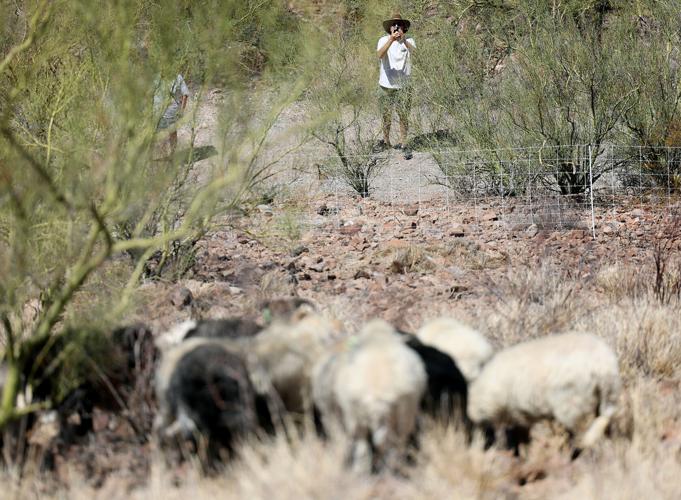
A hiker takes a photo of sheep brought to Sentinel Peak Park to help rid the area of buffelgrass.
The city has agreed to come in after the grazing is done to spray a pre-emergent herbicide on the areas where the sheep have been to prevent the plants from growing back.
“The goal is to identify if this is an effective method to ultimately eradicate buffelgrass and allow native plants to return to the park,” Hamwey said. “We won’t know unless we try, and it doesn’t hurt that the sheep are cute to watch munching on buffelgrass.”
Desert menace
The hardy, fast-growing grass native to Africa and Asia was planted widely in Arizona starting in the 1930s, mostly to provide forage for livestock and curb erosion. It has since spread throughout the desert, crowding out native grasses and fueling once-rare wildfires that ravage saguaros, palo verdes and other local flora not adapted to such things.
Experts warn that if left unchecked the plant threatens to convert large swaths of the Sonoran landscape into a non-native grassland.
Something new and creative needed to be tried, especially on the mountain overlooking downtown Tucson, Norman said. “We’re been spraying for over a decade. We’ve been hand-pulling for something like 20 years. It’s still getting ahead of us,” she said. “The grass was brought to the U.S. for grazing. What the heck, let’s get some animals out there to eat it.”
It has taken about three years to pull the pilot project together. First, organizers had to find someone in southern Arizona with animals capable of doing the work.
They initially considered using goats, but they were worried about them eating all the branches off the trees and “hoofing up on the saguaros,” Norman said. “Goats can be pretty destructive. They’re notorious for eating anything and everything,” she said. “We’re doing this to save the saguaros and the palo verdes. Sheep are far more gentle.”

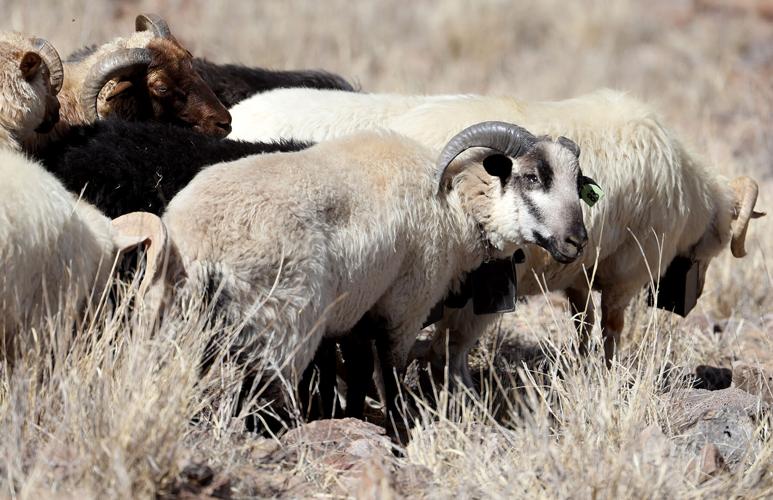
Fifteen sheep have been grazing in Sentinel Peak Park since March in the latest battle against buffelgrass.
Norman’s collaborators on the project are Grant Tims, livestock contractor with Grazing Specialist LLC, and Flavie Audoin, an assistant rangeland management specialist with U of A Cooperative Extension.
The animals were brought in from the Tombstone-Bisbee area, but they are Navajo-Churro sheep, a Northern Arizona breed that seems to fare well in desert environments. Their first stop was a farm in Avra Valley, where they spent several months being trained to live around electric fences and wear virtual-fencing collars that can be programmed to keep the sheep in specific areas.
The herd finally went to work eating buffelgrass on “A” Mountain in mid-March, starting just behind the condo development on the south side of Sentinel Peak Road, in an area tucked away from public view and only accessible by a private drive.
Project team members were “purposely trying to keep the lid on (the project) for the first month,” while they worked out the kinks, Norman said. “We figured the longer we could keep it quiet, the better.”
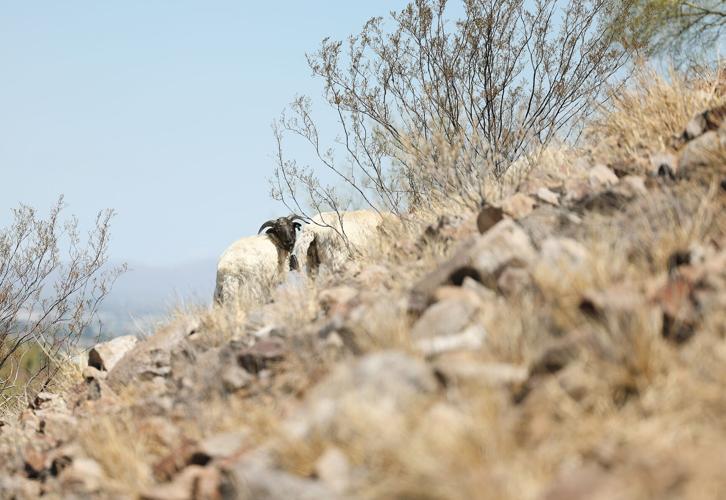
Now the animals are grazing in plain sight on a steep, rocky hillside directly above the hiking trail that leads north from “A” Mountain’s lower parking lot. Visitors, some of them with dogs, walk past the enclosed area throughout the day, stopping occasionally to snap pictures with their cell phones.
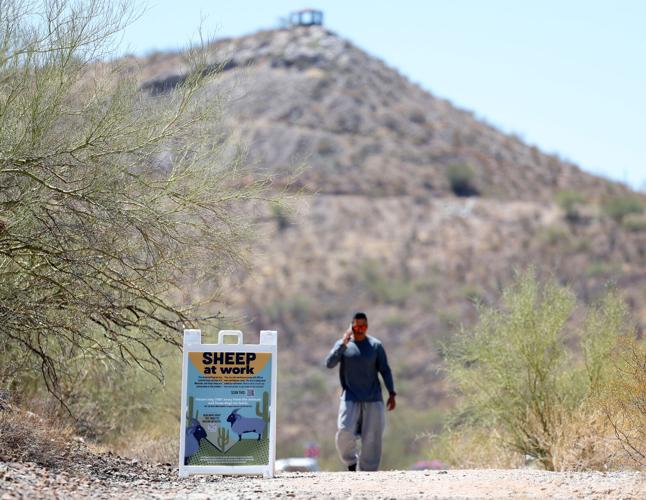
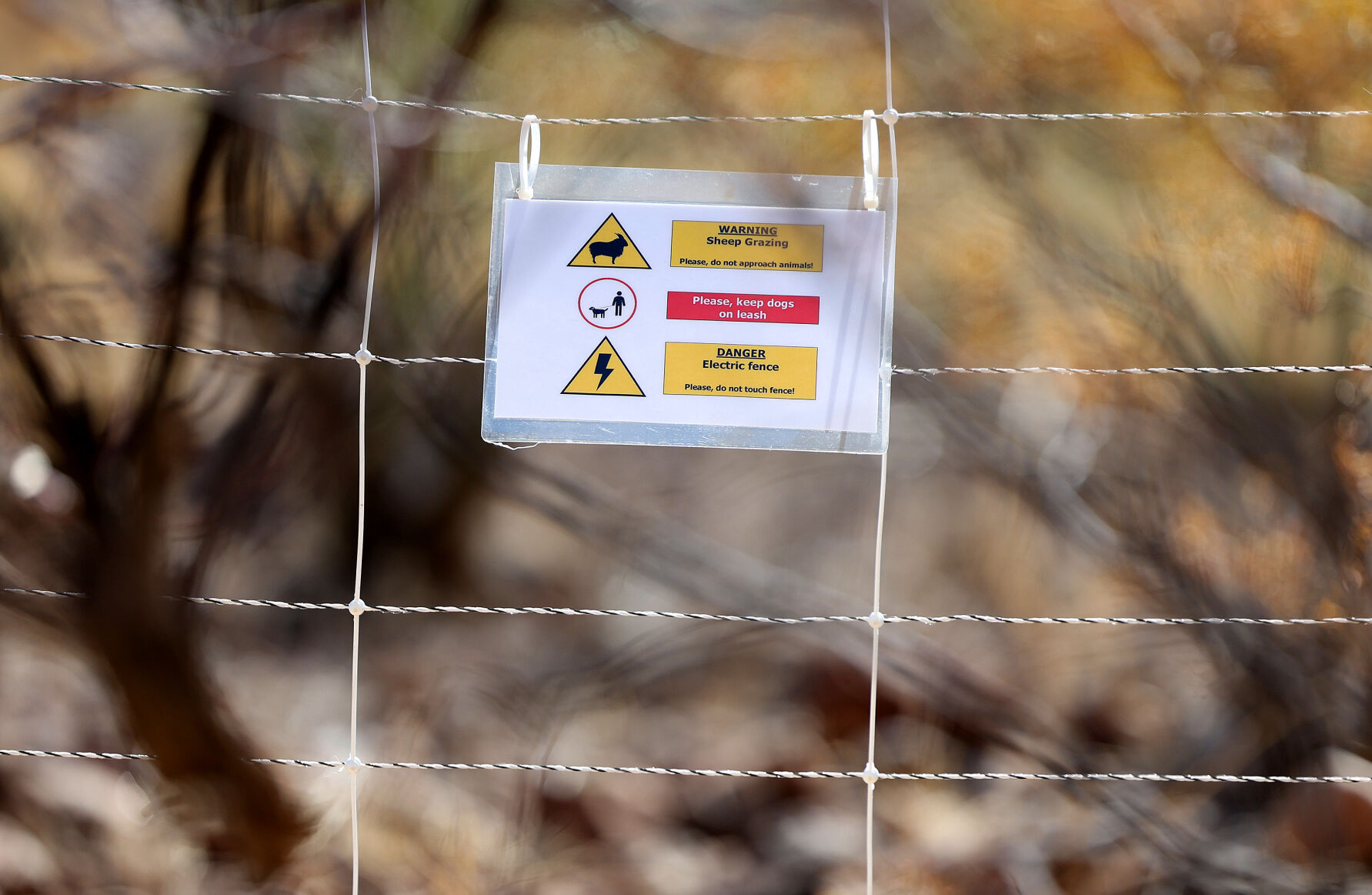
Multiple warning signs have been posted telling people not to approach the sheep, let their dogs off the leash or touch the electric fence.
Herd mentality
The sheep stay on the mountain overnight, so the fence serves to protect them from any predators or mischievous members of the public.
Early on in the pilot project, a coyote found its way inside the wire, though it probably wishes it hadn’t.
Norman said a resident along Sentinel Peak Road witnessed the whole thing: First, the sheep squeezed together in a tight group with their horns facing outward. Then one of them stepped forward to confront the coyote, which eventually turned tail and ran smack into the electric fence several times before finally escaping back into the desert.

A sign informs hikers about a sheep-grazing effort within Sentinel Peak Park.
The project is expected to last into June, depending on how well the sheep handle the growing heat. “We’re watching them very closely,” Norman said.
The livestock contractor and others check on the condition of the herd “a couple times a day” and make sure the animals have sufficient water in their troughs, she said.
The sheep are also being fed alfalfa pellets and vitamin supplements, because record dry conditions since August have left forage on the mountain so sparse and lacking in nutrition.
The programmable collar each animal wears makes a sound as the sheep approaches the edge of the zone it is assigned to. If the sheep tries to cross the invisible boundary, the collar gives a mild shock.
That may sound cruel, but Norman said Tims and Audoin have assured her that the sheep aren’t harmed and quickly learn to avoid triggering their collars. “They’re so adaptable and smart,” she said.
The hope is that the herd will eat the buffelgrass down to the ground, leaving only tiny sprouts that can be easily killed with only a small amount of herbicide.
Less spraying means less chemicals released into the landscape. It also means less work for the poor souls who have to do the spraying, which involves lugging a heavy backpack tank filled with herbicide across the desert and up the sides of mountains in July and August, when monsoon rain causes the buffelgrass to green up.
“It’s a really rough time to be out there spraying,” Norman said.
As it turns out, conducting a targeted grazing project in rugged terrain so close to the city can be pretty challenging, too.
“It’s steep. There’s no water. There are people that go out there to party at 3 a.m. There are mountain bikers who want to use the same paths where our fences are,” Norman said. “If we can make it work here, we can make it work anywhere. We can make it work on Mars.”

