



The U.S. Forest Service is now accepting public input on its environmental review of a multibillion-dollar critical minerals mine in the Patagonia Mountains, about 75 miles southeast of Tucson.
But anyone planning to weigh in during the 45-day comment period had better start reading.
The draft environmental impact statement on the Hermosa mining project is 1,185 pages long. The table of contents alone takes up six pages, not including the lists of figures, tables and appendices. The glossary of acronyms and abbreviations covered in the document runs on for five pages.
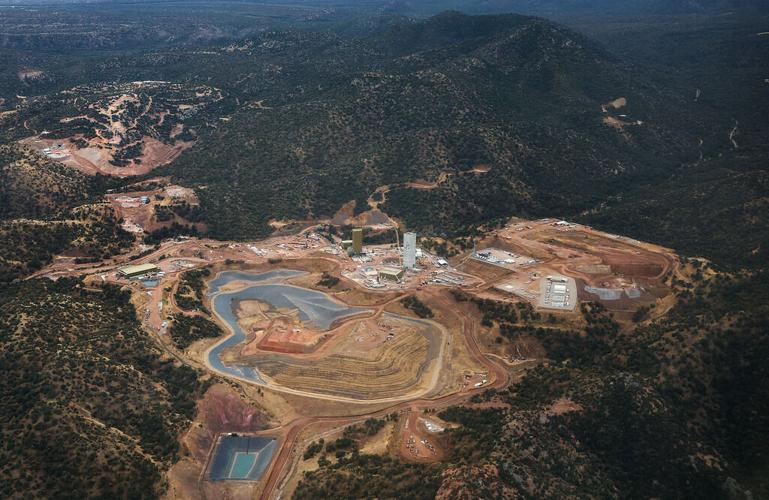
Construction is already well underway on the underground zinc and manganese mine, which Australia-based mining giant South32 hopes to open in 2027 on about 750 acres of private land in the mountains less than 10 miles from the town of Patagonia and the U.S.-Mexico border.

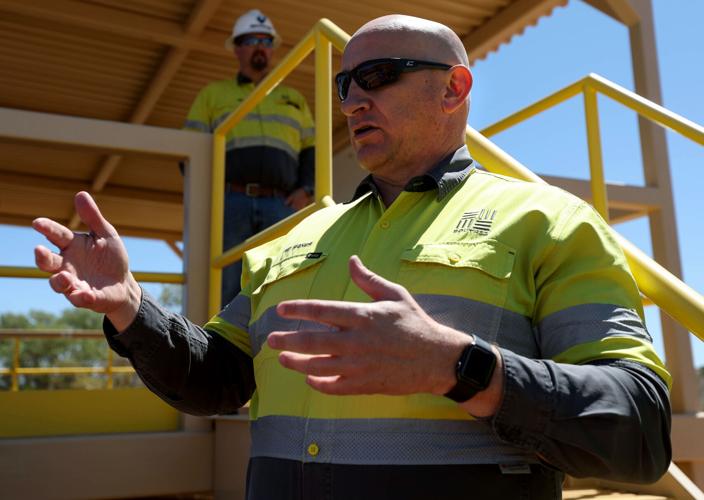
South32 Hermosa president Pat Risner talks about the mining project during a 2024 media tour.
The draft review examines the project’s impacts to the surrounding Coronado National Forest, including South32’s plans for a new transmission line to power the mine and an 8-mile access road connecting the site to Arizona Route 82 near the turn-off for Patagonia Lake.
The document also covers the mine’s plans to build a second tailings pile on adjacent forest land and release treated water from the mining operation back into the local watershed.
The environmental review will not result in an up-or-down decision on the mine itself, according to Hermosa project president Pat Risner.
“The scope of this is just the ancillary infrastructure around the private lands,” he said. “So when you read the draft environmental impact statement, it talks about the no-action alternative, and that no-action alternative is a mine on private lands.”
In February 2024, South32’s board approved $2.16 billion to build the mine. Risner said that construction program is nearly 40% complete, with a pair of vertical access shafts now extending more than 600 feet into the ground.
Those shafts will eventually reach a depth of about 2,900 feet, allowing a network of mine tunnels and block chambers to be excavated outward from there.

South32’s Hermosa mine site in the Patagonia Mountains, as seen from the air during a 2025 EcoFlight.
The mine has drawn opposition from nearby residents and conservationists, some of whom have already sued to block the project. Their wide-ranging concerns include air and water pollution, the depletion of local aquifers, heavy truck traffic, noise, damage to the regional eco-tourism economy and the destruction of prized sky-island habitat used by several endangered species of plants and animals.
Carolyn Shafer is mission coordinator for the Patagonia Area Resource Alliance. She said her small-town nonprofit is working with about two dozen local and national experts on a detailed response that outlines all the ways the draft environmental impact statement fails to address the damage the mine will cause.
The group has also issued a “call to action” to its members, encouraging them to submit their own comments.
“The 21st century extraction industry’s promises of sustainability are wholly inadequate in this region,” Shafer said.
The Forest Service’s lengthy review, mandated by the National Environmental Policy Act, was released on May 9. Comments will be accepted through June 23.
Input can be submitted online, by mail or during public meetings on May 27 at Patagonia Union High School in Patagonia and May 28 at Nogales High School in Nogales. Both open-house-style meetings are scheduled to start at 4:30 p.m. and last two hours.
Though Risner insists the mine will be developed regardless, he said “a lot of the preferred alternatives that are in this document actually do result in reduced environmental impact.”
Constructing a new primary access road, for example, would divert mine-related traffic away from the community of Patagonia and off of the mine’s current access route on a county road that is popular among outdoor enthusiasts, he said.
And the proposed 138-kilovolt transmission line would allow the mine to be powered with renewable energy, reducing emissions that would otherwise be produced by the compressed-natural-gas generators at the site and the trucks needed to haul fuel for them, Risner said.
As federal environmental review starts, South32 is building on private lland
Shafer and others argue that any new power line built for the mine should be buried in the ground to reduce the risk of wildfires in the mountains above Patagonia.
Mining at the site could go on for 70 years or more, according to the draft environmental review.
Both manganese and zinc are designated as critical minerals by the U.S. Geological Survey, with little to no current production in North America of the minerals used respectively to make electric-vehicle batteries and galvanized steel for infrastructure projects.
South32 officials have said its mine in the Patagonia Mountains sits atop one of the world’s largest untapped zinc deposits and potentially enough battery-grade manganese to meet most of U.S. demand for the mineral. That could help explain why the project has continued to receive federal backing, regardless of who occupies the White House.
“I think the risk of foreign supply chains … and the ability to onshore them and address that risk is a pretty bipartisan issue,” Risner said. “It’s very strongly supported by both parties, so that’s been good.”
Now South32 officials are watching to see what happens with President Trump’s shifting trade policy.
“We’re kind of in wait-and-see (mode) on where the tariffs land. We haven’t had any issues with receipt of materials or equipment that we need, so that’s going well,” Risner said. “Obviously, we’re sourcing as much as we can domestically. There’s some equipment that you can’t source domestically.”

