




A few months from now, the monsoon-soaked sky islands of Southern Arizona will erupt into a spongy, white-capped wonderland.
And the mushroom man will be there.
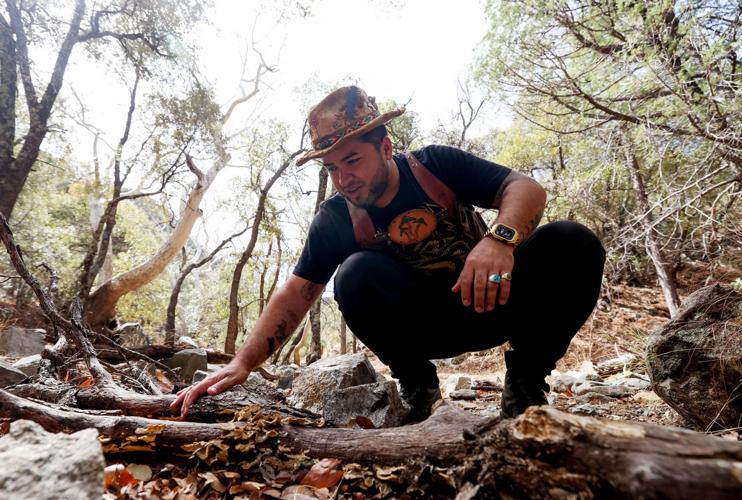
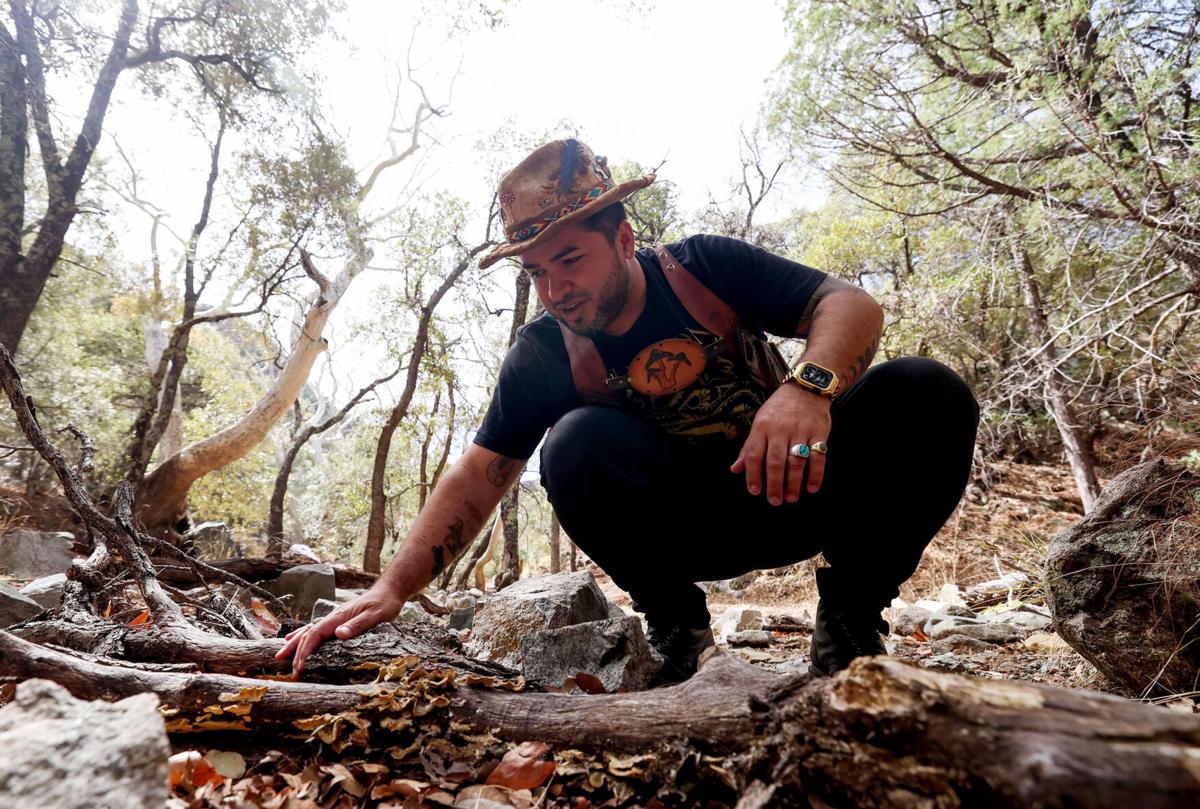
Tucson resident Hernán Castro said he typically spends four or five days a week tromping around the mountains during the peak of fungus season in late summer, when local forests spring to life with a surprising array of spore-filled fruit.
“I should just stay out there,” he said.
For most of the past decade, the self-trained mycology expert has been collecting edible and medicinal mushrooms across Arizona. For the past seven years or so, he has been leading foraging trips to Mount Lemmon and elsewhere to teach others how to identify and ethically harvest different species of fungi.
“Once you start finding them, it’s sort of like an Easter egg hunt,” the 37-year-old said. “It’s very exciting, because there are different shapes and colors and smells and tastes. You get a little high from the excitement of finding something different. It’s really, really fun.”
Castro knows just where to go to collect a local cousin of the portobello that pushes its way up through desert clay and “tastes a million times better” than store-bought varieties, he said. If you go out with him on a moonless night, he can guide you to a type of mushroom that glows in the dark. He has even cataloged something called the destroying angel, a particularly poisonous species that is thankfully rare in the West but apparently does show up on Mount Lemmon from time to time.
And just days ago, at an undisclosed sky-island location, Castro tracked down what he called the rarest mushroom he has ever found: a medicinal species known as agarikon (Laricifomes officinalis, if you want to get scientific about it) that has never been definitively identified in Arizona before.
At the moment, though, the mushroom man is busy gathering something else: petition signatures for a campaign he launched late last year to designate another, far more common local species as Arizona’s official state mushroom.
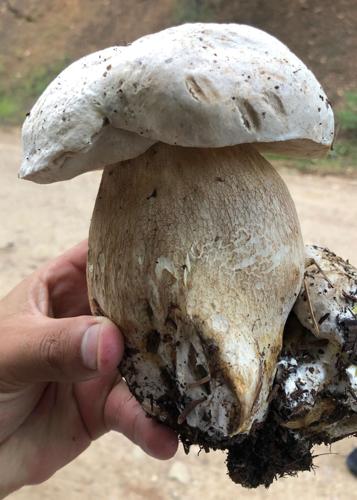
He thinks that as-yet-unclaimed title should go to the white king bolete, an edible species similar to an Italian porcini that grows abundantly across the state.
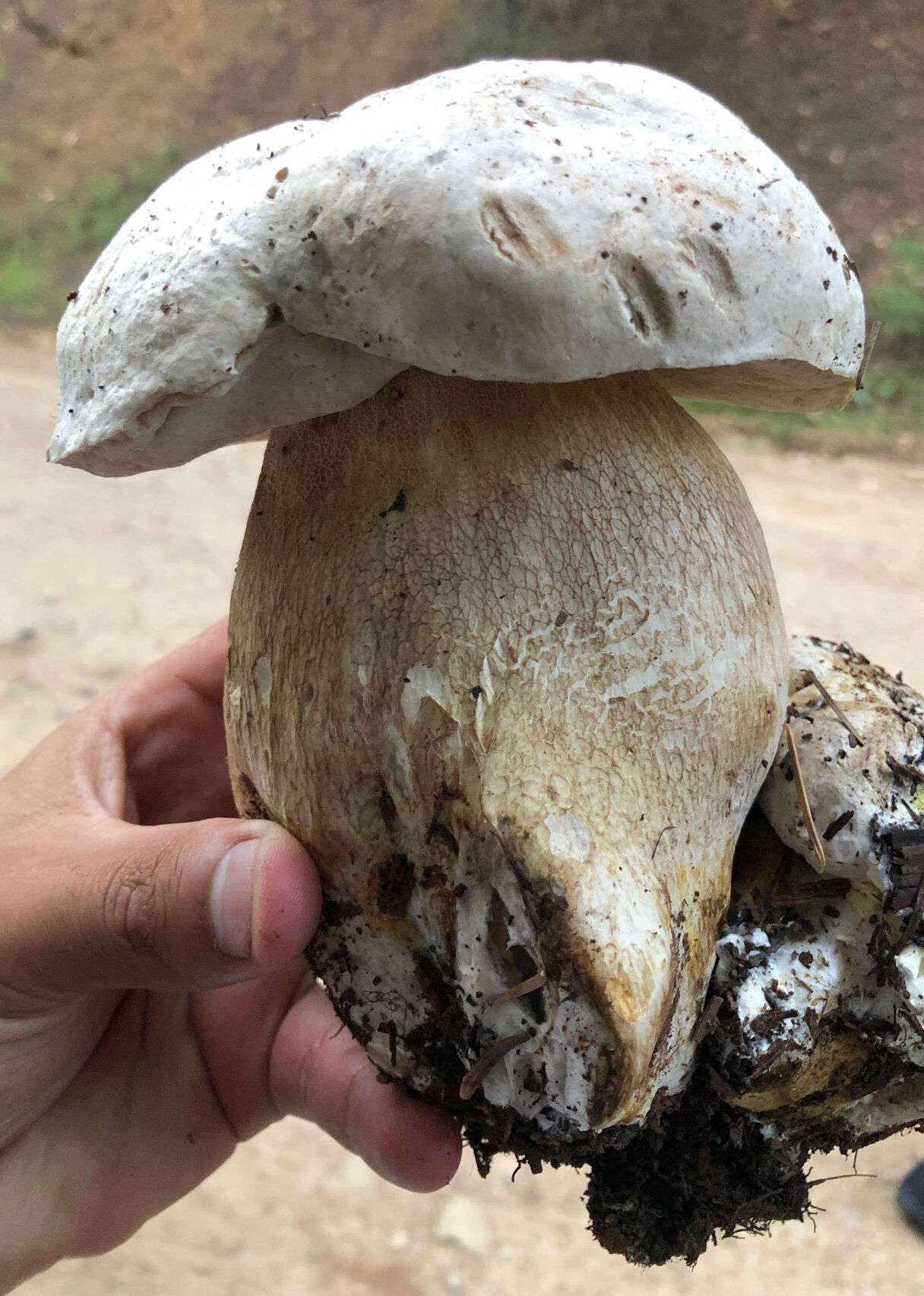
Hernán Castro holds a white king bolete after it was picked on Mount Lemmon in 2019. He wants this edible species to be designated as Arizona’s official state mushroom.
“It’s found everywhere,” Castro said. “It’s on Mount Lemmon, it’s over by Pinetop and Flagstaff, it’s on Mount Graham — basically all over Arizona.”
The white king seems especially at home among the ponderosa pines high in the Catalinas, where it grows impressively large and in much greater numbers than other types of bolete.
“I’ve had some with a cap the size of a platter, and a stem that could be about a foot and a half tall,” Castro said.
Fungus among us
The state mushroom idea has already won the support of Arizona’s largest group of fungi enthusiasts, though they have yet to endorse a specific candidate for the honorary title.
“As an organization, the Arizona Mushroom Society is committed to getting a consensus on what the state mushroom should be,” said Mike Dechter, who serves as the nonprofit group’s executive director and a member of its science committee.
In February, the society put the question to its roughly 2,000 members and the 6,000 people on its mailing list. The voting is still open, Dechter said, but the white king bolete seems to be the leading contender so far.
The choice makes sense for several reasons.
Scientists first described the species in 1976 using samples collected in northern Arizona by amateur mycologist Charles Barrows, whose reward was to have the new mushroom named after him: Boletus barrowsii.
Dechter said this particular “choice edible” is also closely associated with the ponderosa pine — often sprouting from the roots of the tree where the ground is the wettest, usually along the drip line at the edges of the canopy — and Arizona happens to be home to the world’s largest contiguous ponderosa forest.
Individual white king boletes can swell to “as big as your head” in as little as two to three days and end up weighing as much as 3 pounds, he said. “It’s quite a sight to come across in the forest.”
Dechter’s interest in fungi foraging began in 2008, when he was working as a wildland firefighter in New Mexico and saw a guy driving along a backcountry road with the bed of his pickup filled with wild mushrooms.
Today Dechter works out of Flagstaff as a project planner for the U.S. Forest Service and leads mushroom hunting forays in his spare time. There’s a whole strange world of colors and flavors out there waiting to be discovered, he said, but it has to be done carefully.

Turkey tail mushrooms grow on a log in Madera Canyon.
“A really good rule of thumb is don’t eat anything unless you can get it positively identified,” Dechter said.
That doesn’t mean looking it up on some random search engine or app, either. You need to show your wild mushrooms to an expert, either in person or through a carefully curated, science-based social network like iNaturalist or the society’s own Arizona Mushroom Forum on Facebook.
Dechter said the forum is actively moderated by him and others from the society, so people can expect quick responses and “IDs that are never dangerous.”
Thanks to Arizona’s varied topography across a range of climate zones, the state is home to an impressive variety of mushrooms, including lethally toxic species that can resemble ones that aren’t. (That’s why all Arizona Mushroom Society forays, potlucks and other activities come with a liability waiver.)
But a wild mushroom doesn’t have to be poisonous to hurt you. “Just as with plants, you could be allergic to mushrooms that are perfectly edible,” Dechter said. “Everything has to be well cooked,” and when you try a new type for the first time, it’s wise to start with a small piece of it to see if it agrees with you.
There are also government restrictions to follow.
For example, the National Park Service doesn’t allow foraging at all, while the Forest Service generally considers mushrooms to be a “special forest product” that can be collected in limited amounts for personal use without a permit.
In the Coronado National Forest, which includes the Catalinas, the Rincons and the Santa Ritas near Tucson, foragers are allowed to fill a 1-gallon container during a single outing but can’t take more than 5 gallons worth of mushrooms over the course of a year.
Shroom to grow
Castro said his fungi fascination began in 2011, when his brother taught him how to grow his own gourmet varieties.
He began exploring the potential medical benefits of mushrooms in 2015, after his father was left partially paralyzed by a series of strokes. Castro said his research on stroke recovery treatments led him to several promising studies from Japan involving lion’s mane mushrooms.
He decided to grow his own lion’s mane and make an extract for his father to take. Within a year and a half, he said, his dad had regained the ability to speak and nearly all of his lost mobility — something Castro credits to the extract, though he can’t prove it scientifically.
At his family’s urging, he soon went into the mushroom business.
“A lot of people started asking me for extracts. One mushroom led me to another mushroom and then another, and it snowballed from there, basically,” Castro said. “That’s how I got into the foraging aspect.”
He didn’t realize that was even an option at first. He said he first learned about Arizona’s incredible mushroom diversity when he attended a national mycology conference in the White Mountains, where he met a number of scientists in the field and attended presentations on basic species identification. That’s when he discovered that seemingly exotic varieties he thought he had to culitvate himself or order from East Asia could actually be found growing wild in the mountains near his home.
From then on, he said, “I kind of fell in love with mushrooms, and before I knew it, I was all the way in.”

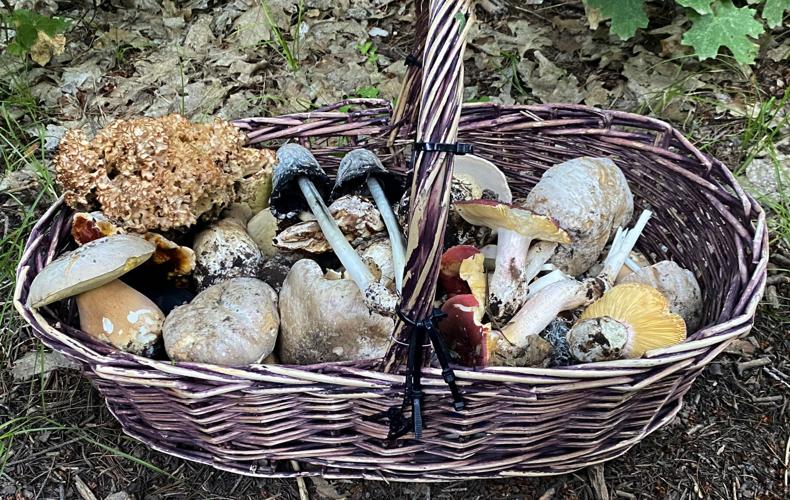
A basket of wild mushrooms harvested in 2021 demonstrates the surprising variety that can be found during the peak of fungi season in Arizona, after monsoon storms in late summer.
Today, Castro makes his living leading seasonal foraging trips and selling fungi-infused products under the name Desert Alchemist.
He said he doesn’t mess around with so-called “magic mushrooms” — the psychedelic ones that are illegal to grow, sell or possess in Arizona — though a lot of people he meets assume that he does.
Instead, his website offers several varieties of mushroom coffee and extracts with names like “Brain Boost,” “Sleep Spell” and “Pain Maim,” which he makes using the fungi he grows or collects.
Though various types of mushrooms do have clinical applications, health experts warn that many bold claims about the healing properties of fungal supplements have not been verified with large-scale, well-designed human trials.
As of April 18, nearly 600 people had signed Castro’s online petition to designate an official state mushroom. He doesn’t really know how many signatures he needs to collect. “Whatever it takes to get the governor’s attention, I guess,” he said.
Castro has also reached out to his state representatives in hopes of getting one of them to introduce a bill on behalf of the white king bolete. He said all he has gotten are automated responses so far.
He knows his campaign is not the most important thing that elected leaders have to deal with at the moment, but he thinks now is a good time to do it. After all, fungus is pretty popular these days. It might even out-poll some politicians.
“There’s a lot of mushroom stuff out there that people are really into,” Castro said. “And there’s no partisan affiliation. It’s kind of like a neutral thing that everybody can get behind on both sides.”

