

PHOENIX — State lawmakers want to allow, for the first time, religious chaplains to counsel students on public school campuses.
Phoenix Republican Rep. Matt Gress said the legislation, which gained preliminary House approval Thursday, would make such counseling strictly voluntary. He said it would be up to districts to decide whether to participate.
He also said parents would have to grant permission and could choose among any chaplains who have offered to make themselves available.
But that isn’t exactly true as the proposal is written.
To get on an approved list, a person would have to be a chaplain from a “local religious group,’’ meaning one that meets at least once a month at a location in which the school district is located. So any religion that doesn’t have a church, synagogue, mosque or meeting hall within that district — there are more than 200 districts throughout the state — could not offer up someone to counsel students.
Senate Bill 1269 further defines who is a religious group whose chaplains would be considered eligible. The definition specifically includes only those religions that have a hierarchy of teachers, clergy, sages or priests, regularly engage in a ceremony, ritual or protocol, and “acknowledges the existence of and worships one or more supernatural entities that possess power over the natural world.’’
Phoenix Democratic Rep. Stephanie Simacek pointed out that locks out someone who is an atheist from providing in-school counseling, even if that is the preference of the parents.
And others questioned whether it is proper — or even legal — to have chaplains of any faith counseling students.
Proponents made no secret they want religion in public schools.
Gress, in pushing the measure, told colleagues, “It’s almost as if ‘God’ is being treated like a four-letter word. We are a religious people and we presuppose a supernatural being.’’
Rep. Justin Olson, discussing the measure in the House Education Committee, had his own take.
“We have become a secular society and that is damaging to our society,’’ said the Mesa Republican. “We need to have opportunities for people to look to a higher power.’’
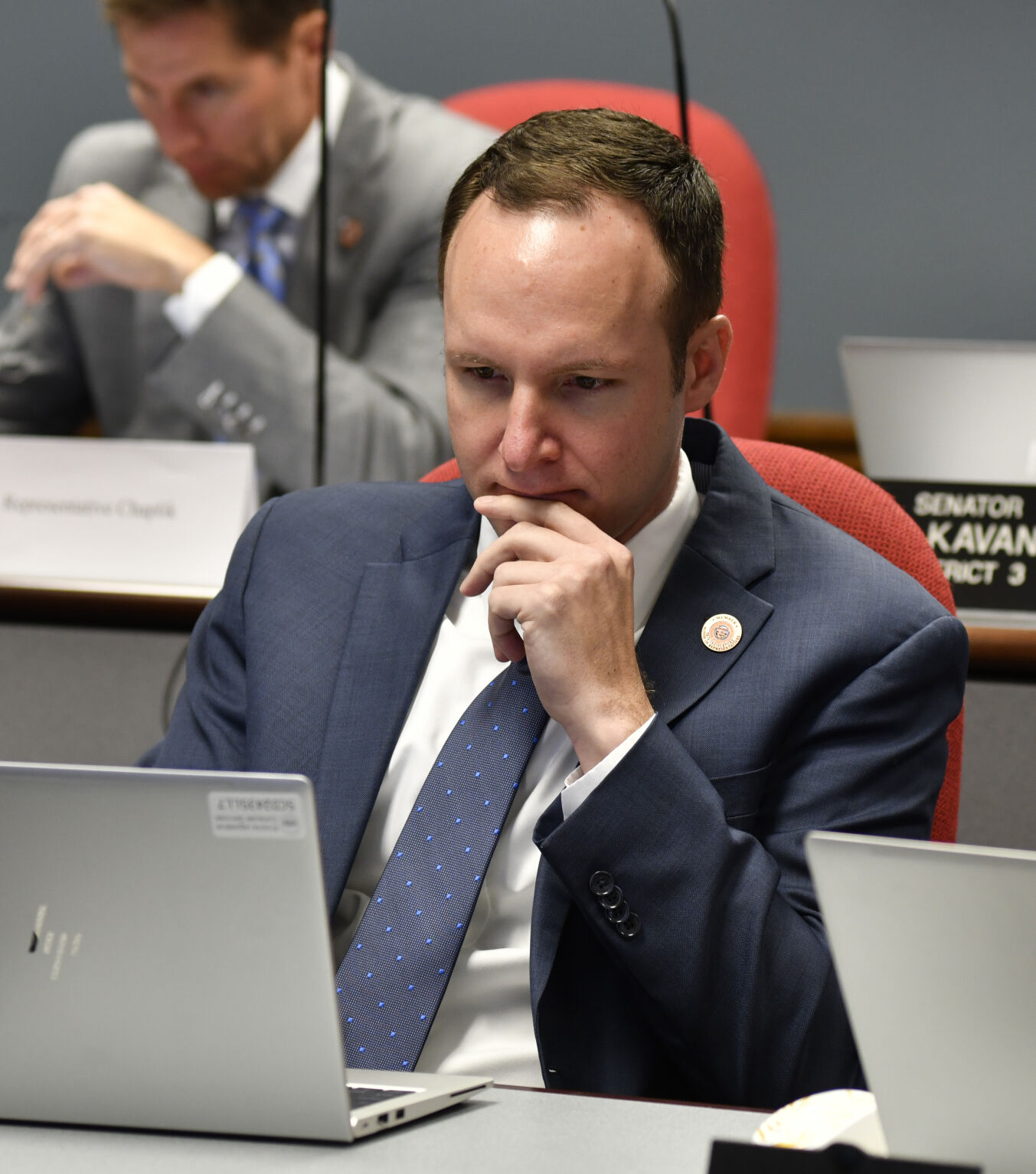
Rep. Matt Gress, R-Phoenix, said in pushing for the legislation, "We are a religious people and we presuppose a supernatural being.''
Rep. David Marshall, a Snowflake Republican, said he was not convinced by foes’ arguments that it takes education and training for someone to become a social worker or counselor and qualify them to provide guidance and advice.
“Are there some good psychologists?’’ he asked. “I’m sure there are. But I think Jesus is a lot better than any psychologist.’’

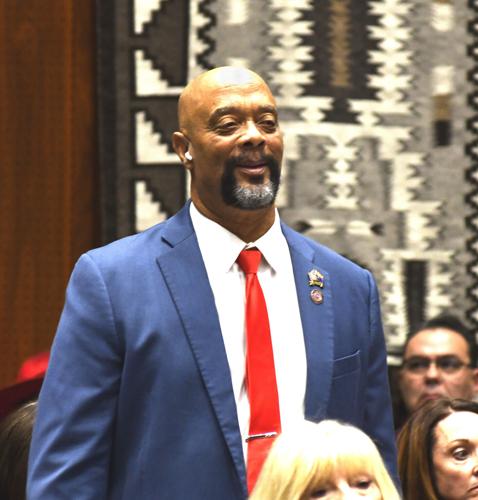
Rep. David Marshall, a Snowflake Republican, said in supporting the proposal to allow chaplains to counsel students in public schools: "I think Jesus is a lot better than any psychologist.''
The measure still needs a roll-call vote in the Republican-controlled House. It then has to go back to the Senate, which approved the original proposal by Sen. Wendy Rogers, R-Flagstaff, and has some differences in wording.
If it becomes law, look for legal challenges to school districts that agree to participate.
Gaelle Esposito, representing the American Civil Liberties Union of Arizona, said the measure runs afoul of First Amendment prohibitions against schools sponsoring religious activities.
“It explicitly authorizes chaplains to be able to ‘conduct religious exercise,’” Esposito said.
She does not think this can be excused simply because a parent gives consent, any more than a parent agreeing to allow a child to be taught creationism in a public school would make that activity legal.
Dianne Post, legal director of the Secular Coalition for Arizona, said the fact that there are some 2,700 different religions in the United States means there is no way adherents to each of them can get their choice of a counselor.
But not everyone thinks there is a legal issue.
Rep. Lisa Fink said the concept of a separation between church and state is nowhere in the Constitution.
Instead, the Glendale Republican said, it was in a letter Thomas Jefferson wrote to the Danbury Baptists where he used the phrase “a wall of separation between church and state.’’ And what he was targeting, she said, was the concept that those who did not belong to a specific — and state-sanctioned — church could not be barred from participating in public discussions.
Fink supported the measure, saying it has “plenty of guardrails,’’ including the fact that participation would be voluntary.
But Rep. Nancy Gutierrez, a Tucson Democrat, called the plan “outrageous.’’
“Public schools are not places for religious teaching,’’ she said. “They are places for math and science and reading. We have no need for chaplains in our public schools.’’

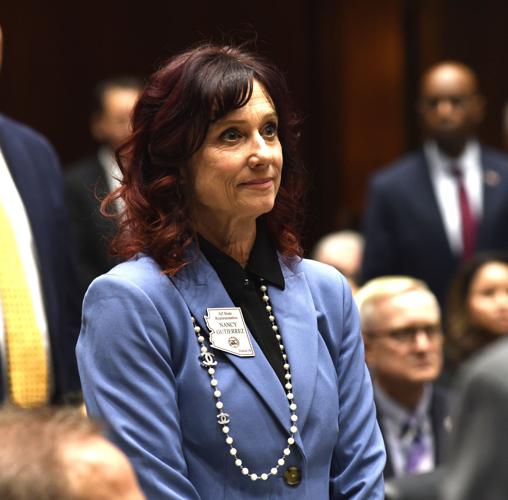
Rep. Nancy Gutierrez, a Tucson Democrat, opposed the proposal, saying, "Public schools are not places for religious teaching. They are places for math and science and reading."
Gutierrez, who is a teacher, also noted this comes amid perennial claims by some lawmakers that educators are “indoctrinating’’ students.
“If we want to talk about indoctrination going on in our public schools, this would be it,’’ she said of the legislation.
Rep. Lupe Diaz, a Benson Republican who is a pastor, said having chaplains available would help youngsters deal with issues.
“Most people in your community, even with students, they will approach a religious leader or a chaplain, a pastor, rabbi and whoever it is before they consider going to a counselor or a psychologist,’’ he said.
Diaz said he doesn’t see a danger, even if chaplains lack professional training in counseling.
“A well-trained chaplain will know that they can take a person only so far, and then they will refer them,’’ he said. “And I think that that’s really, really critical to be able to have someone they can go to, that they feel safe, before they are referred somewhere else or recommended to be referred somewhere else.’’
Gress insisted there would be no proselytizing for any specific religion. But he acknowledged that what’s in the legislation goes beyond mere advice or counseling on a specific course of action.
“I think that perhaps there is a spiritual deficit that needs to be addressed,’’ Gress said.

