


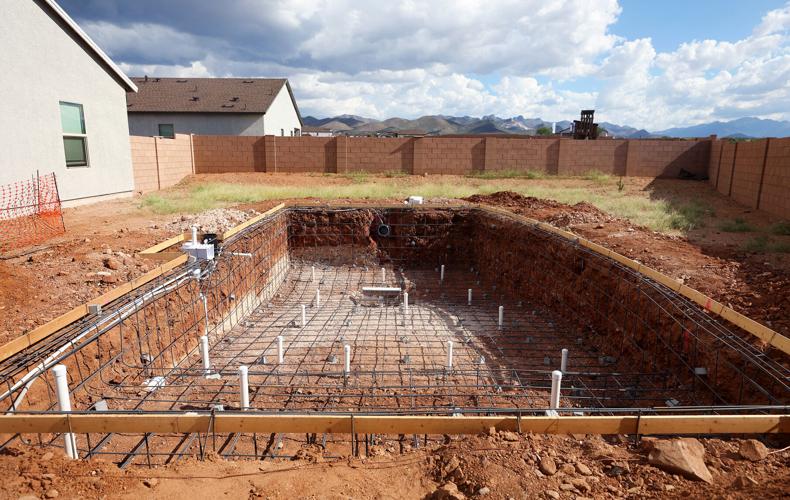



Joel and Rebecca Bertrand are installing a swimming pool in their Corona de Tucson backyard to give them a break from extreme summer heat.
Tyrell Hullum is installing a pool in the backyard of his Catalina Foothills house as an investment, knowing the house will be worth more with a pool when he puts it on the market.
Dolores Munoz is having a pool built at her home southwest of Tucson because she and her three kids, all younger than 10, don’t get out much and “she is wanting to have her own little resort out there,” said Marisol Arana, the contractor who is installing the pool.
These new pool owners fit a continuing pattern of explosive growth in private swimming pools in the Tucson area since 2000. The growth far exceeds the area’s population increase or the number of new homes and townhouses built. The number of residential pools in Tucson has spiked 88% in that time to almost 60,000, Pima County Assessor’s Office records show.
The pools provide pleasure and satisfaction for people who can afford to have them installed. And they’re not cheap, starting at around $50,000 and escalating to $200,000 for the fanciest, most elegant designs. Their popularity has created a major business sector with well over a dozen pool dealers and contractors who install pools in the Tucson area.
While the number of new pools installed is typically much lower annually than during the boom real estate years before the 2008-09 crash, all but one of five Tucson-based pool dealers and contractors the Star contacted said they’re doing well. One, Justin Halbert of Southern Arizona Pools, said his business is “off the charts.”
But their high water use concerns many environmentalists who want public officials to focus on building more public pools and want less emphasis on private pools for individuals, although they stress they’re not looking for pool ownership or size to be regulated.
One reason for the growth in pools is obvious. With the Tucson area continuing to get hotter, more people want pools to give them a break from it, said Halbert, a sales manager for the seven-year-old Southern Arizona Pools. While most climate scientists say the hotter weather is due to human-caused climate change, and President Donald Trump denounces climate science as a “hoax,” Halbert said he isn’t interested in the politics — he just notices it’s getting hotter.
The growth in swimming pools “has a lot to do with people moving in from out of town. This is what we hear every day. People move here from somewhere cold and one spouse says to the other, ‘Fine, I’ll go with you to Arizona but we have to get a pool,’” Halbert said.
“Another thing we hear a lot, when people retire out here, they want the grandkids to visit. They know the best way to get them out here is to get them a pool,” Halbert said. “You know how kids are. They get bored real quick. You’ve got a pool, you’ve put them in water.”
But at the same time, those pools use lots of water at a time when concerns about water supply are increasing due to a continuing drought and a major risk of future cutbacks to Central Arizona Project supplies from the Colorado River — the city of Tucson’s primary drinking water source.
Pools installed before 2020 use up to 28,000 to 30,000 gallons a year, while newer pools have gotten smaller and more likely use 17,000 to 21,000 gallons yearly, said Gary Woodard, a longtime Tucson water researcher and consultant. Either way, a pool is the largest single water user in the homes of most people who have a pool, said Woodard — even more than a similar-sized lawn.
Typically, a pool that doesn’t have a cover to limit evaporation — which most pools don’t — evaporates five feet of water a year, he said. To compensate for some of that, a pool usually gets a foot per year of rainfall, making the net loss about four feet a year, he said.
As salts from the salty Colorado River water gradually build up in pools in Tucson and other cities using CAP water, you also have to replace all the water about every five years, he added.
But household lawns have become increasingly uncommon in Tucson, having in many cases been ripped out by their owners and replaced by less thirsty desert landscaping, or increasingly, by artificial turf.
The rise in the number of swimming pools, however, far exceeds the 27% increase in total county population from 2000 to 2024 and its 57% increase in single-family residences in the same period, assessor’s office records show.
If you assume that all 27,000-plus of the post-2000 pools use 30,000 gallons a year, that totals more than 2,500 acre-feet of water yearly. An acre-foot can serve four Tucson households for a year.
That would be about 25% more drinkable water than the 1,910 acre-feet of reclaimed wastewater that would have been used annually by the two proposed Project Blue data-center complexes the Tucson City Council unanimously voted to kill last month. If you assume all pools use 21,000 gallons a year, that totals nearly 1,800 acre-feet annually, a little less than Project Blue’s projected consumption.
‘It’s one way to cool down’
Of her household’s decision to install a pool, Rebecca Bertrand said, “I just always wanted a pool in our backyard. We have the space for it now so we’re doing it.”

The Bertrand family is having a new pool installed at their home in Vail. The number of pools in peoples’ yards in single-family homes and townhouses in Pima County has nearly doubled to almost 60,000 since 2000.
Her husband Joel added the decision to pay $50,000 to $60,000 to have a pool put in came “just because of the Arizona summers. The heat. It’s one way to cool down when it’s 100 to 110 degrees.
“We’ve always tried to buy property in Flagstaff. But there’s just outrageous prices up there for property,” said Joel Bertrand, an instructional specialist and technical trainer for Raytheon Missile Systems in Tucson. “A pool is definitely economical compared to buying property in Flagstaff and Show Low.”
Besides the heat, another reason pools are popular is they’re very visually appealing and add to the backyard’s value, said Greg Miller, a pool contractor whose company Smart Pool Builders is installing the Bertrands’ pool.
“For a lot of people in higher-end houses, over $1 million, pretty much any architect will tell you you have to put in a pool in a house like that, for resale value,” Miller said. “A pool is a perceived luxury item. You can imagine holding a Fourth of July party, with 30 guests and no pool. Everyone will feel cramped in your living room.”
The Bertrands’ house is a $450,000 home, “a notch above a starter home,” Miller said. “It’s a tract home.”
‘We’ll get our investment back’
Resale value for his Catalina Foothills house is what Tyler Hullum had in mind in deciding to put in a backyard pool costing “right around the low ‘50s.”
The house, built in 1966, lies near Ina Road and First Avenue, and the pool is smaller than many, capable of holding 3,000 to 3,500 gallons of water. It’s also a fiberglass pool, which Hullum said is a lot more inexpensive than a concrete pool.
Overall, the Catalina Foothills has about 10,000 personal pools, by far the largest amount of pools in any individual area of unincorporated Pima County, assessor’s records show.
A general contractor, Hullum said he just started installing pools for a living. He ultimately wants to sell the foothills house by year’s end after first renting it out to someone. The pool is part of a larger renovation project he’s working on to upgrade the kitchen and bathrooms.
“Most houses in that neighborhood already have pools. We know we’ll be able to get our investment back if we install it. We bought that house for investment purposes,” Hullum said, speaking of himself and his wife.
“People will want a pool in Tucson. It’s hot. For the kind of house we’re trying to sell, an upgraded house, people will not want to spend that kind of money on a house without a pool.”
Hotel resort looks in the backyard
Dolores Munoz, her husband and their kids live in the Three Points area, west of the Sierrita Mountains and off Ajo Way, west of Arizona 286, her pool contractor Arana said. Arana’s company will finish installing the “very large” pool in the next two weeks, she said.
Arana said Munoz is a realtor who works from home a lot, and her husband is a truck driver who is often away from home.
“They are home all day every day. She doesn’t have time to take her kids out for physical activity. She decided to do a hotel resort look in her backyard,” Arana said. “They’re going to do an outdoor kitchen. They are doing a play area where they will have swings. They are going to have an outdoor screen so they can watch movies from the pool.
“They have 5 acres — they’ve really got a large pool, 16 feet by 37 feet. She said, ‘We’re 40 minutes from everything. It’s hard to even go out for groceries or quick runs from the store,’” Arana said of her client.
Encouraging more public pools instead
Environmentalists Ed Hendel and Lisa Shipek sit on the city of Tucson’s Citizens Water Advisory Committee. They have major concerns about Tucson’s water supply, particularly in light of the continued declines in Colorado River flows.

With the Tucson area continuing to get hotter, more people want pools to give them a break from it, said Justin Halbert, a sales manager for Southern Arizona Pools, which installed the pool shown here.
Shipek directs the Watershed Management Group, which advocates that Tucson Water residential customers reduce their average daily water use from about 80 to 40 gallons per person. That will enable the city to rely on its limited, nonrenewable groundwater supply and not on CAP water, the group says
Shipek and Hendel say they believe local governments need to stir the region away from having so many private pools and invest more in public pools, which will save water by having lots of people use the same pool.
“The 88% increase in private pools demonstrates how much residents value them as a quality-of-life improvement, especially as temperatures rise,” Hendel said. “However, given the uncertainty surrounding the Colorado River and the high water usage of individual pools, this trend is not sustainable in the long term.”
Similarly, “We should carefully consider how pools fit into sustainable desert living here in Tucson. Whenever possible, community or public pools are a great way to meet the need for cooling off in hot temperatures and recreation,” Shipek said.
Hendel added, however, that he doesn’t believe in “shaming individuals or demanding they lower their quality of life. This is a policy and infrastructure issue.
“It is the responsibility of local government to provide alternatives and structure incentives that naturally reduce the demand for private pools. If we had more community pools that were easily accessible and had extended hours, I believe demand for private pools would drop.”
He and Shipek agreed a rebate system to encourage pool owners to remove them would be a good idea. But Shipek added that pool owners usually have more financial resources, and may not warrant a conservation rebate. One idea could be to provide a water conservation rebate when pool owners replace their pool with a water harvesting landscape, she said. The city could double the water harvesting rebate if a pool is removed, she said.
Just this past Monday, the governing board of the suburban Metro Water District voted to establish a rebate program that will pay pool owners $2 per square feet, up to $200, to remove their pools.
The rebate is “less about the volume of water and more about what the customer will have to pay for their water in the next 10 years,” as water costs rise, said Wally Wilson, a top Metro Water official.
“CAP water costs us $300 an acre-foot right now. If that acre-foot in the future has to be for desalinated water or advanced water purification,” in which wastewater is treated to drinking quality, “it could be $3,000,” said Wilson, the district’s water resources manager. “Every acre-foot now is not expensive to the customer but every acre-foot in the next 10 years could be hugely expensive.”
Although the subject of pool removal rebates has come up among Tucson officials, including water advisory committee members in the past, Tucson Water currently doesn’t plan to propose a rebate, said Natalie DeRoock, a utility spokeswoman.
Instead, Tucson Water has partnered with Metro Water, Oro Valley and Marana to create poolremovalhelp.org, a resource to guide residents through the process, costs and benefits of pool removal, she said. The utilities have sponsored four public workshops to educate pool owners about how to remove their pool if they choose to do so.
“We are monitoring customer interest and will continue evaluating potential opportunities,” she said.
Rory Juneman, the advisory committee’s chairman, said committee members are open to reviewing any kind of conservation program, but “we would want to analyze the cost and benefits of (a pool) rebate compared to our other conservation efforts to make sure it is reasonable. We typically want to support conservation efforts that are most effective with the limited dollars available.”
Committee member Andrea Gerlak said a $200 rebate is too small to encourage a lot of pool owners to remove pools. But at the same time, unlike with rebates the city currently gives for rainwater harvesting, low-flow toilets and other home plumbing equipment, the cost of removing a pool is so high, running well into the thousands of dollars, “we could never give enough money to offset what it is going to cost,” she said.

Justin Halbert of Southern Arizona Pools, which installed this pool, said his business is “off the charts.”
Gerlak, director of the University of Arizona’s Udall Center for Studies in Public Policy, has a pool that her family has used regularly for years. She doesn’t know a single person with a pool who has removed it but she does know a lot of people who have headaches with their pools and wish they didn’t have one, she said.
Convincing people to remove their pools is more of a psychological challenge, a challenge to peoples’ imagination, she said.
“We need to figure out what it means not to have a pool. It’s been such a mainstay in our community, there’s a long held public acceptance of them. Now, when we see lawns, we question how many chemicals they use and why do you have lawns? We’re nowhere near that understanding with pools.”
Water use debates
Defending the water use of pools, Southern Arizona Pools’ Halbert said, “Pools hold a lot of water, but the amount they evaporate is a rounding error” compared to how much golf courses use, he said. “I can’t cite statistics but I know that golf course water goes out onto the course and never goes back. The amount of water evaporating in a pool is not insignificant but is nothing compared to what goes on a golf course.”
Pool dealer Miller said he’s been told, “if you put a lawn in your yard, it will use more water than a pool. I’m not a scientist but I think it’s a pretty common fact that watering grass uses more than a pool.”
Woodard emphatically disagreed, saying, “One square foot of pool uses more than twice as much water as one square foot of irrigated turf.”
Pool owner Joel Bertrand said Arizona could do a lot to fix its water problems by building a pipeline to bring water here from the Mississippi River — “they could use that during storm surges.”
“It’s not like an oil pipeline, where if you have a leak you can create a catastrophe. You’d be taking water from areas that don’t need that water, especially during hurricane season, and you’re pumping it to the Colorado River,” Bertrand said.
A state agency, the Water Infrastructure Financing Authority of Arizona, is considering proposals to import water from out of state, mainly from desalinated seawater from the Gulf of California in Mexico. But such projects will be very expensive and likely controversial to build.
A Catalina Foothills resident, who spoke on condition his name not be used, told the Star, “I don’t care” about the water use of a 35-foot-long by 19-foot-wide pool he had installed last year at a cost of under $100,000.
“Until they start restricting it I don’t care what it costs,” said the pool owner, who runs a small business and said he doesn’t want to be identified out of concern he’ll get blowback from environmentalists for his comments.
“I work hard. I don’t feel guilty spending my money for enjoyment,” he said, adding, “Aside from the water that has left the planet or is deemed unusable from mining and stuff, we have the same amount of water that we had from the start.”
‘It’s a pain to maintain’
Pool removals are always far less common than installations — in 2024, there were 133 pools removed and 615 installed here, assessor’s office records show.
But there is clearly growing interest among some owners in getting rid of their pools. When four local water utilities announced they would sponsor two public workshops over the summer to educate interested pool owners in how to remove their pools, attendance was so high they had to schedule two more workshops, the last for Oct. 4. The three workshops so far have drawn a little more than 120 people.
An attendee at the last workshop, in early September, foothills resident Ina Shivack, said her family’s pool was in good shape when they bought their house in 1996, but “we just don’t use it. When I first moved into my house, we used it occasionally, but we never use it a lot.”
The same goes for attendee Buddy Martin, whose family got their pool when buying their house in Tucson’s West University neighborhood 29 years ago. While the pool is in good shape, he said he never uses it. His wife takes a dip in it virtually every day, but they’ve both decided they’d rather have a guest house in that spot than a pool, he said.
“It’s a pain to maintain. I hate paying water bills and electricity bills for it. It feels like it’s an extra $100 a month for six months or so, maybe seven months when I have the pool open,” said Martin, who covers the pool during the cooler months.
It can cost $5,000 to $7,000 to pay a contractor to remove a pool, consultant Woodard told the gathering. But you can usually get those costs paid back in two and one-half years, he said.
“You may be looking at three, four or five years, but the rule of thumb is anything less than seven years is a no-brainer,” Woodard said.

