


For years, Tucson has had semi-sanctioned camping for unhoused people.
The city uses a “homeless encampment protocol and reporting tool” to decide whether a camp must be removed or can be left alone. Leaving a camp as is, in a way, sanctions it.
In earlier years, street cops used to direct unhoused people into certain places, notably the 100 Acre Wood bicycle park, as a sort of semi-official camp of last resort. It wasn’t official, but it worked for a while, before becoming more sinister in recent years and gradually getting dispersed now.

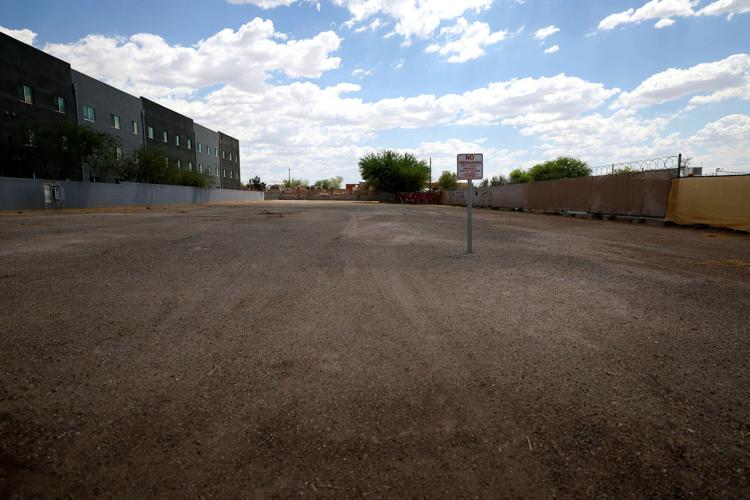
The City of Tucson will provide a safe sleeping site for those experiencing unsheltered homelessness at 244 East Grant Road.
The 100 Acres is where former City Council member Steve Kozachik wanted to set up a sanctioned camp site, but he found little support for his idea.
“Tucsonans do not want sanctioned encampments, and neither do I,” Mayor Regina Romero said on X, the former Twitter, on March 2022. “They’re expensive to create, maintain and secure.”
Things suddenly changed this summer, though. An unsolicited proposal brought to the Tucson City Council June 3 by a local mutual-aid activist, Victoria Devasto, is scheduled to become reality Oct. 1.
“STAR Village,” just east of North Stone Avenue on East Grant Road, will house up to 25 women and LGBTQ people. It will have bathroom access, water stations, trash facilities, safe-sleeping areas and shade. Social-service agencies will offer services.
I stopped by Tuesday morning, and contractors were digging the trench for the water line that will serve the site.
What explains the idea taking hold so quickly now when it’s been batted around for years, including in my columns? The detail of Devasto’s proposal, the willingness of Kozachik’s successor, Karin Uhlich, to push it, and the increasing urgency of the situation.
“We had never tried it before,” Romero said in an interview Tuesday. “Right now, I think, is a really important time that we try something different.”
Romero’s perception of Kozachik’s idea was that it was not as detailed or orderly as Devasto’s proposal. It may also have helped that Uhlich and Vice Mayor Lane Santa Cruz, who supported this idea, are close political allies of Romero, while Kozachik was not so close an ally.
Devasto's plan "is well thought out, is very organized," Romero said. "It's a more well thought out strategy."
Rather than “sanctioned camping” she calls this “safe outdoor space.” It’s modeled in part on a similar project in Phoenix, which city staff visited after Devasto made her proposal, and on a longstanding one in Las Cruces, N.M.
Each client will be provided a bed in one of the site’s tents, with a table, a battery-operated fan, a trash can and a locking storage box. Residents will have to agree to the rules of the site — which may include bans on violence, theft and on-site drug use — and must enroll with an agency for services within a week.
Devasto, who founded the Community on Wheels mutual-aid group in 2020, also sees this moment in Tucson as demanding more solutions.
“Things have gotten so bad,” she said Tuesday. “The numbers, the fatalities, the extreme heat, the ordinances, the park closures.”

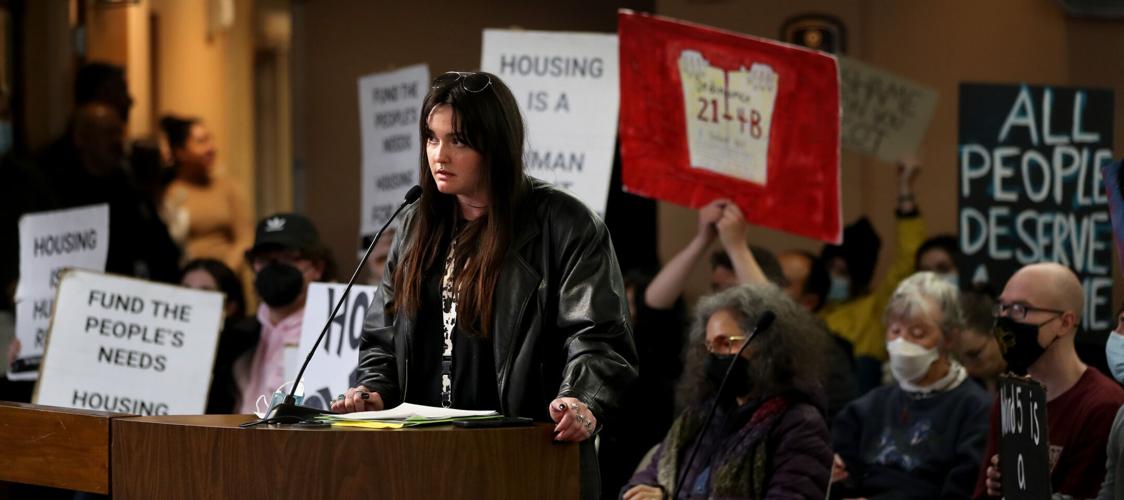
Victoria Devasto, founder of the Community on Wheels mutual aid group seen here at a 2024 council meeting, handed out a pamphlet in June a for a city-sanctioned homeless camp that quickly is becoming reality.
The idea, as stated in her proposal, was to create “a supportive environment where individuals can stabilize, heal and move forward.”
The focus on women is due to their vulnerability on the streets.
“Sleeping as a woman outside is incredibly difficult in the city of Tucson,” Devasto said. “A lot of people are staying up all night to get any form of safety whatsoever.”
This is something I’ve heard from unhoused people before. It’s hard for any of them to get a good night’s sleep due to the need for constant vigilance, but it’s especially hard for women who are more vulnerable, including to sexual assault.
I wandered the area near the STAR Village site Tuesday and ended up speaking with a woman named Vanessa Sanchez, under a shade structure at Doris Thompson Park.
She said at night she spends “most of the time trying to stay up to keep ahold of my belongings.”
“You can’t even turn your back,” she said.
Sanchez said she has been on the streets for about eight months due to drug use. If she’s with someone else overnight, she said, they’ll sometimes alternate sleeping periods. At most, Sanchez said, she gets 5-6 hours of sleep per night.
“I was so used to a bed,” she said. “Coming out here, it’s so hard to sleep.”
She said she would be interested in getting into the new camp when it opens.
The STAR Village joins a series of other pilot programs that the city has undertaken to try to get a handle on the problems of addiction, housing affordability, mental illness and unhoused people in the streets. Usually those pilot projects become permanent.
The Community Safety Health and Wellness Program, for example, and the Violence Intervention and Vitalization Action program both went from pilot programs to permanent.
The likelihood is, if STAR Village can work at protecting people while they sleep at night, and getting them into services and housing, it will become permanent. It could also grow.
“It’s not more beds per encampment,” Devasto said. “It’s replication in other wards.”
The size would almost certainly remain at about 25-30 people, she said. That is the number other cities have found works best.
The idea with this one is to find people sleeping outside in the adjacent neighborhoods and bring them into STAR Village. If it works, and if they find funding, more sites could be established in other parts of the city.
All it took was a detailed plan and a sudden political convergence for the idea to take hold.

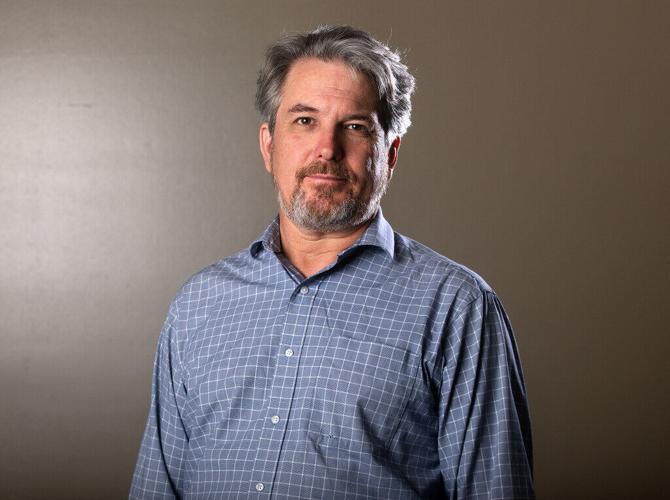
Arizona Daily Star columnist Tim Steller

