




Water levels in wells and flows on the San Pedro River have fallen below minimums set by a judge, giving momentum to an environmental activist’s push for limits on Sierra Vista/Fort Huachuca development.
Superior Court Judge Mark Brain of Maricopa County set the minimums to ensure the San Pedro, its riparian landscape and a tributary are protected. His rulings in August 2023 and December 2024 were also aimed at safeguarding federally reserved water rights on the river.
But levels in five monitoring wells and annual flows as measured by three stream gauges on, underneath and near the San Pedro and a tributary are all below minimums set by Brain.
The low levels have prompted a leader of the Tucson-based Center for Biological Diversity to push several state and federal agencies to stop allowing or encouraging new home development in the neighboring Sierra Vista/Fort Huachuca area.
The agencies haven’t acceded to the demands made by longtime San Pedro crusader Robin Silver.
But the Arizona Department of Water Resources is reviewing a request by Silver to revoke its previous determination that a 100-year adequate water supply exists for a nearly 7,000-home development in Sierra Vista, approved long ago and still unbuilt.

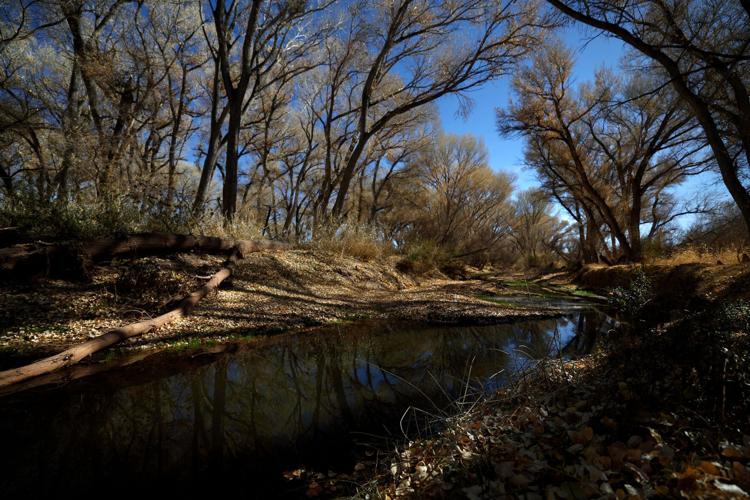
On the San Pedro River, shown here near Sierra Vista, water levels in five monitoring wells and flows measured by three stream gauges are all below minimums set by a judge.
And the U.S. Department of Housing and Urban Development is reviewing Silver’s separate request to stop underwriting home loans in the Sierra Vista area, a HUD source told Silver in an email, he said.
The river’s water rights date back to 1988, when Congress created a major national conservation area along the river as a way to ensure it survives, unlike many other desert rivers, such as the Santa Cruz in Tucson, that dried up from excessive groundwater pumping.
Brain’s rulings formally quantified those rights by setting minimum levels in monitoring wells and stream gauge flows. His rulings aren’t final, in part because they’re part of a much broader court case covering formal adjudication of water rights for the entire Gila River Basin that includes the San Pedro.
The San Pedro Riparian National Conservation area covers about 57,000 acres, and runs north for about 40 miles from the Mexican border to St. David, just south of Benson.
The river in that area is known as one of the world’s premier hot spots for migratory birds and as an excellent haven for large and small mammals. It plays host to numerous federally protected species, including the endangered Southwestern willow flycatcher, the threatened Western yellow-billed cuckoo, the threatened northern Mexican garter snake and the endangered Huachuca water umbel.

The San Pedro riparian area is known as one of the world’s premier hot spots for migratory birds. But minimum water levels in the river and a tributary are below minimums a judge said are needed to protect habitat and federally reserved water rights.
But the river’s future has long been considered imperiled because of continued groundwater pumping to serve homes and businesses in the Sierra Vista area, and to a much lesser extent by the region’s farms, which have long been declining in number and scope.
The San Pedro has long run a chronic deficit between demand by people for the groundwater underlying it and the groundwater supply. The deficit between pumping and recharge has declined from about 33,000 acre-feet in 1990 to about 20,000 acre-feet in 2023, due mainly to decreased agricultural pumping, a December 2024 report from the Arizona Department of Water Resources shows. But many scientists have long said the river could still dry up in the future unless the deficit is drastically reduced or eliminated.
‘Irreplaceable treasure’
Here are specifics of how river flows and well levels have fallen below their court-established minimums:
— Of nine monitoring wells along the river that Brain established for measuring water levels, five have levels ranging from less than one foot to more than four feet below the minimums the judge set.
— Of four stream gauges along the San Pedro and the Babocamari River, a tributary, three have total flows substantially below minimums set by Brain.
— The river’s gauge near the city of Tombstone carried 42% less total water in 2023 than the 5,948 annual, acre-foot minimum set by the judge. The river’s Charleston gauge in 2023 carried about 33% less water than the 6,826 acre-feet required by the judge.
Silver’s efforts to prod state and federal agencies to stop authorizing new homes, or in some cases reverse past such authorizations, stem directly from his view that groundwater pumping in the Sierra Vista area is now violating the river’s federally reserved water rights and needs to be cut back.
“The San Pedro River is the last free-flowing, undammed river in the desert Southwest,” said Silver. “We can do better than allow it to die,” he said, calling it an “irreplaceable treasure.”
“After decades and decades pf debate, the groundwater levels and streamflow amounts to protect this river have been established and must be respected,” said Silver, vowing to do “everything we can (including litigation if necessary) to insure this treasure survives.”
Longtime Sierra Vista City Manager Chuck Potucek declined to say whether he agrees that federal water rights are being violated, in part because the judge’s decree still isn’t final.
“I know there are some questions. My understanding is that it is close to becoming a decree and that will open up an appeals window,” said Potucek, whose city government has often battled with environmentalists over the area’s groundwater pumping issues. “It’s probably imminent. We’ll see who appeals on what grounds.”
Silver, however, noted that ADWR cited Brain’s findings in a groundwater model report on the river the department prepared almost a year ago for the entire Upper San Pedro Basin.
The department prepared that report for the broader court case covering the entire Gila River Basin’s water rights issues, which are being handled in the Gila River Adjudication, which has now stretched about 50 years.
“Whatever secretarial things the court has to do, they are not going to change the court’s findings of fact, arrived at this time after years of litigation,” Silver said.
ADWR officials declined to say if they agree the river’s federal water rights have been violated. Spokesman Doug MacEachern didn’t say why the agency wouldn’t comment on that. But in the past it has routinely declined to comment on pending litigation or the possibility of such litigation filed by the Center for Biological Diversity.
Review of development plan
On Oct. 31 of last year, the state agency signed an agreement with the center, Silver and Sierra Vista environmentalist Tricia Gerrodette to review and possibly revoke its 2013 determination that an adequate water supply for 100 years exists for the planned 7,000-home Pueblo del Sol development.
The agreement followed a lawsuit filed by the center alleging the department failed to meet its legal duty to review and possibly revoke its adequacy determination in light of the Superior Court ruling establishing the river’s water rights.
In Cochise County, home of Sierra Vista, the finding of an adequate water supply for a new development is needed before the project can be built. The new agreement has no timeline for when the state review must be finished.
ADWR had previously declined to consider the San Pedro’s status in determining water adequacy for the development because at the time, the river lacked any “quantified” federal water rights. The Arizona Supreme Court upheld that position in a 2018 ruling. But ADWR agreed in court testimony back then that its position could change if those rights ever were quantified, the Supreme Court’s ruling noted.
The center has also filed additional complaints, calling on Gov. Katie Hobbs and ADWR to review and revoke water adequacy determinations previously issued for another 47 subdivisions in the Sierra Vista area. So far, the center’s complaints have not been answered, the group said.
Potucek, the Sierra Vista city manager, said there are many alternatives to limiting development, including storm-water management, effluent recharge, vegetation management and conservation that he said can facilitate responsible development.
“I don’t think you can take any one particular answer as being a silver bullet,” he said.
Water for new homes challenged
The center wrote to HUD in September, pointing out Judge Brain’s ruling and saying, “Water for new homes and developments in the Fort Huachuca/Sierra Vista area is no longer legally available.
“The declining water levels show that historic cumulative groundwater pumping of approximately 2 million acre-feet is overtaking efforts to mitigate the excessive local groundwater extraction,” Silver wrote to Tanya Birks, HUD’s Phoenix field office director.
He asked Birks to confirm if she is the person responsible for oversight of loans underwritten by HUD and the Federal Housing Administration in the Fort Huachuca/Sierra Vista area. If she is, “please let us know of your intentions” regarding future loans for new homes in that area, Silver wrote.
He’s received no official response from HUD, although a HUD official told him in a November email that the issue will need “internal review” before he can discuss it, Silver said.
In separate correspondence to HUD, Silver noted that the agency’s handbook requires that a lender operating with a HUD-backed mortgage “must ensure that its operations are compliant with all applicable federal, state, and local laws.”
The Star emailed Birks early Friday, seeking her comment on Silver’s letter, but her office sent out an automated response saying she won’t return until Jan. 21. Two HUD spokespeople also didn’t immediately respond Friday to requests from the Star to comment on Silver’s email.
Arizona departments’ responses
Silver also has tried unsuccessfully to persuade the Arizona Department of Real Estate to not issue public reports authorizing the sale of homes in new subdivisions.
He’s repeatedly sent the department letters saying it is issuing inaccurate reports authorizing the sale of homes in new developments because the reports don’t mention the San Pedro water supply issue.
Each time, the department has rebuffed him, saying the subdivisions in question have completed reports showing adequate water supplies, or that they aren’t selling homes or home lots now.
On Dec. 4, for instance, Ted Amdert, a senior investigator for the department, wrote Silver that it had closed an investigation into a complaint he’d filed about the accuracy of five Sierra Vista subdivisions’ public reports regarding water availability. He wrote that he concluded the complaints were “outside the department’s jurisdiction.”
Amdert noted that the investigation found the public reports for each subdivision included an ADWR-issued public report showing that an adequate water supply existed for the subdivision. The water provider also had provided accurate information about the development’s water provider, Amdert said.
“No information that was included in the complaint demonstrated that the original developers to whom their respective public reports were issued are actively offering those lots for sale,” he wrote.
In responding on Dec. 12, Silver sent the department photos of homes being offered by the same developers of various Sierra Vista subdivisions to show that they’re up for sale.
He noted many new houses in a development “are often built and sold by developers or builders who are not the original developers named in the public reports.”
“Whether or not the new developer or builder is not the one named does not change the fact that an accurate public report is critical in providing information to the buyer of the newly constructed home being marketed and sold for the first time,” Silver wrote to the department.
But on Jan. 10, Deputy Real Estate Commissioner Jim Knupp wrote to Silver that of the five subdivisions he had complained about, only one was currently offering lots for sale by its developer. That one, known as Canada Vista, had not changed its report on water availability in recent times.
The real estate agency lacks the legal authority or expertise to make its own findings related to water, and it relies on information provided by ADWR, Knupp wrote. The real estate agency asked ADWR about this, and the (Water) Department confirmed there have been no changes or updates to the water report in question,” Knupp said.
“If you believe the water report is inaccurate, you would need to work through the Arizona Department of Water Resources to address such a claim,” Knupp wrote to Silver.
Silver, in reply, said there are updates needed to the development’s water reports because of the recent monitoring well levels and stream gauge readings that were below the minimums set by the judge.
“There is no 100-year water supply in the Sierra Vista-Fort Huachuca area that is legally available,” Silver said.

