


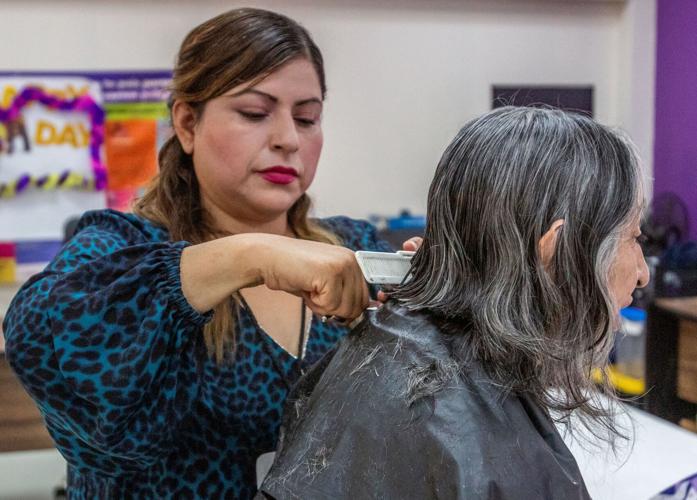



NOGALES, Sonora — Teresa Alvarez smiled after getting about eight inches of her salt-and-pepper locks trimmed into a chin-length bob, in what she said was the first real haircut she’d had in years.
“I feel like a new person,” said Alvarez, 64, a Mexican national who said she was deported to Nogales in April, after 48 years living and working in the U.S.
Alvarez, who is staying at migrant-aid group Kino Border Initiative, said the trim — courtesy of a volunteer Nogales stylist — also helped her feel ready to look for a job in Nogales, hopefully building on her experience as a certified nursing assistant in the U.S., she said.
“I’m hoping to find the same job here,” she said in early June.
It was the monthly “haircut day” at Kino Border Initiative’s migrant shelter and resource center, just south of the Mariposa port of entry in Nogales. The binational migrant-aid nonprofit offers temporary shelter, legal assistance, job-search support and psychological counseling for those traumatized by harrowing journeys north, or the dangers they fled at home.
Personal care, like a simple haircut, can help restore a sense of dignity for displaced people struggling with what to do next, KBI media specialist Yohana Oviedo said.

Migrant-aid nonprofit Kino Border Initiative offers a "haircut day" to its guests every month, thanks to a partnership with volunteer Nogales stylists. In early June, stylist Perla Alejandre, left, gave a trim to 64-year-old Teresa Alvarez, a Mexican national who said she was deported to Nogales in April, after 48 years in the U.S.
“We’re talking about families, human beings who have gone through so much pain,” she said. “They need to be heard, and we need to create a community that welcomes migrant people as human beings and defends their rights.”
Amid a massive increase in global displacement since the COVID-19 pandemic, KBI had been a critical resource for those seeking safety and a better life in the United States.
But as the U.S. has increasingly shut down access to asylum — starting in June 2024 under then-President Joe Biden, and continuing under President Donald Trump — KBI’s role has shifted from assisting a global population of asylum seekers bound for the U.S., to helping those now “stuck” in Mexico to plan for a potential long-term future there.
More migrating people and recent deportees from the U.S. are considering staying in Mexico, said KBI executive director Joanna Williams.
“We’ve moved from a mentality of short- to medium-term displacement, to a reality of long-term integration,” she said.
Previously, many at KBI were waiting on appointments to enter the U.S. through the Biden-era CBP One phone application. The CBP One app was swiftly canceled when Trump took office in January, stranding thousands who had been waiting sometimes up to a year for permission to enter the U.S. at a port of entry.
The Trump administration has accelerated the U.S.’s turn away from asylum, in what human rights advocates call a betrayal of U.S. international treaty obligations and a violation of domestic law that currently allows anyone to request asylum once on U.S. soil, no matter how they arrived there.

During Kino Border Initiative’s monthly haircut day in early June, volunteer Nogales stylist Perla Alejandre gave a free trim to Teresa Alvarez, who said it was the first real haircut she’d had in years. “I feel like a new person,” said Alvarez, 64, a Mexican national who said she was deported to Nogales in April, after 48 years living and working in the U.S. without legal status. Like many who have been deported from the U.S., or blocked from accessing asylum there, Alvarez said she’s planning to stay in Mexico, where she hasn’t lived since she was a teenager growing up in Michoacan.
In Mexico, where asylum requests are now surging, the asylum system is “deeply under-invested” and struggling to manage heightened demand, Williams said.
Advocates say Mexico can be unsafe for non-Mexican asylum seekers, and for Mexicans fleeing organized crime groups in their home country. Many were already “internally displaced” within Mexico, having sought refuge in other cities, before seeking asylum in the U.S.
The Trump administration designated six groups in Mexico as “foreign terrorist organizations” in February, including the Sinaloa Cartel. Experts say the terrorist designation in effect strengthens the U.S. asylum cases of Mexicans fleeing violence in their home country.
Non-Mexican migrants also face grave risks from organized crime groups, which have developed a lucrative kidnapping-for-ransom enterprise targeting migrants who were on their way to the U.S., advocates say.
For many displaced people, returning home isn’t a possibility, said Mexico City-based human rights advocate Ari Sawyer.
“Just because the U.S. shuts down the border doesn’t mean people aren’t still fleeing their countries and don’t have a need to come,” Sawyer said.
‘I’m going back’
Even as some deportees make plans to settle in Mexico, others with established lives in the U.S. are determined to return to their families there, Williams said.
Williams said she spoke last month with a father recently deported from Arizona and separated from two sons, ages 11 and 12, back in Phoenix.
“He said, ‘If I’m gonna be real, I’m going back to my kids, Joanna. I don’t know when, but I’m going back,’” Williams said. She hasn’t seen him at KBI since that conversation.
The lack of legal options to enter the U.S. drives the market for human smugglers, advocates say.
Without a legal path to enter the U.S., and as border agents are now denying migrants they encounter the right to request asylum, more will make dangerous journeys through remote areas of the borderlands, risking their lives in the process, Williams said.
The remains of nearly 4,400 migrants have been found in the Southern Arizona desert since 2000, according to Humane Borders, and many more are still missing.
Criminal groups in Mexico are adapting, as they always do, to U.S. border restrictions and finding new ways to profit, advocates say.

Yohana Oviedo, Kino Border Initiative media coordinator.
Yohana Oviedo, Kino Border Initiative media coordinator.
KBI’s Oviedo spent a week in southern Mexico last month, on a fact-finding trip with the nonprofit’s Mexico-based partner, Jesuit Refugee Services. There, she learned that organized crime groups are now charging Latin American migrants to leave Mexico through its southern border, as some try to return to their home countries.
Mexico City-based Sawyer said that’s realistic, as organized crime groups basically control the Mexico-Guatemala border, although Sawyer hadn’t yet heard of the fee to cross into Guatemala.
The U.S. Department of Homeland Security implemented a policy this year to deport more immigrants to central or southern Mexico, instead of just over the U.S.-Mexico border, in an effort to “break that smuggling cycle,” John Mennell, a spokesman for U.S. Customs and Border Protection, told the Arizona Daily Star in May.
“Now we’re sending them further afield, so they can’t go right back into the hands of the smugglers and be pushed right back across the border,” he said.
But kidnappings have exploded in the southern part of the country, where Mexican immigration authorities are trying to contain migrants, said Sawyer, co-founder of human-rights advocacy group Frontera Federation.
“Once Mexico and the U.S. began working together to keep people in the south of Mexico, the response (from criminal groups) was pretty immediate,” Sawyer said. “Anytime we see a new deterrence policy or crackdown on asylum, anything that cuts down access to safe and legal pathways to the U.S., there’s a direct and immediate response by organized criminal organizations” to profit from it.
‘Mexico Te Abraza’
More U.S. deportations to southern Mexico could be one reason why new shelters in northern Mexico, established in anticipation of mass deportations, have plenty of space in them.
Earlier this year, Mexican President Claudia Sheinbaum announced the program, “Mexico Te Abraza,” or Mexico Embraces You, establishing 10 shelters along the border, including in Nogales, Sonora, and a program to help integrate migrants and deportees.
Those deported to Nogales, Sonora, who are mostly Mexican nationals, are connected to the government shelter, where they get assistance getting identification documents and are given 2,000 pesos — about $100 — to help those who want to return to their home state, said Marcos Moreno Báez, Mexican consul based in Nogales, Arizona.
The number of deportees arriving in Nogales, Sonora, has ranged from about 60 to 100 daily, Moreno Báez said. The labor department is helping connect many to thousands of private-sector jobs available for deportees from the U.S., he said.
Mexico has a very low unemployment rate, and the national economy has benefited from the arrival of more workers, Moreno Báez said.
“Honestly, that has helped to continue to have a positive economic growth in Mexico, at least in the start of the first quarter of 2025, despite the (economic) forecast” from international financial institutions, he said.
Many deported Mexicans are long-time U.S. residents who speak fluent English and have found work at a Nogales call center, which has a partnership with KBI, Oviedo said.

Kino Border Initiative, a binational migrant-aid nonprofit with a shelter in Nogales, Sonora, has been receiving just two to five new arrivals each day, mostly Mexican people deported from the U.S., staff say. As the U.S. has increasingly shut down access to asylum, KBI’s role has shifted from assisting a global population of asylum seekers bound for the U.S., to helping those now “stuck” in Mexico to plan for a potential long-term future there. “We’ve moved from a mentality of short- to medium-term displacement, to a reality of long-term integration,” said KBI executive director Joanna Williams.
But recent deportees, and stranded migrants, are often obvious targets for smugglers, KBI staff say. Outside KBI, staff often see people — known as halcones, or hawks — acting as look-outs for smuggling groups, seeking potential customers, Oviedo said.
DHS is trying to break that cycle with deportations further south. But smuggling groups target migrants there, too, she said.
“Mexico is full of migrants,” she said, but most are now stuck in the south.
At Kino Border Initiative these days, just two to five people are arriving each day. About 71% of new arrivals at KBI are now deportees from the U.S. That’s compared to spring 2024, when just 22% of new arrivals had been deported, and the majority of new arrivals were migrants from across the globe, bound for the U.S., Williams said.
Far fewer migrants now are arriving from the south, and KBI’s non-Mexican migrants, from places like Venezuela, Colombia and Haiti, all arrived well before Trump’s Jan. 20 inauguration, Oviedo said.
Asylum system overwhelmed
Asylum requests in Mexico surged from 2021 to 2023, coinciding with heightened levels of migration in the region, said Stephanie Brewer, Mexico program director for the Washington Office on Latin America, a D.C.-based research and advocacy group that promotes human rights and social justice.
Asylum requests in Mexico in 2023 topped 140,000, compared to 2,100 in 2014, Mexican data show.
In 2024, asylum requests declined by about 40% in Mexico, likely due to the availability of CBP One for asylum seekers hoping to make it to the U.S., as well as Mexico’s aggressive efforts to deter migration through the country, Brewer said.
Now that hundreds of thousands have been cut off from access to asylum in the U.S., Mexico is experiencing another surge in asylum requests, though government hasn’t released 2025 figures, she said.
Mexico’s immigration enforcement agency, the Instituto Nacional de Migración, or INM, cracked down on migration toward the U.S.-Mexico border beginning in early 2024 and continuing under the Trump administration.
INM’s budget is 35 times greater than that of the Mexican Commission for Refugee Assistance, known by its Spanish acronym COMAR, which has struggled to speed up its processes to meet the demand for asylum, Williams said.
“Mexico’s asylum system was not designed and resourced to process those exponentially increased numbers of asylum requests,” Brewer said. That leaves asylum seekers in “extremely precarious conditions” as they wait for their application to be processed.
In Tapachula, Chiapas, a Mexican town on the border with Guatemala, KBI’s Oviedo said she met a Haitian family who has been waiting 2.5 years for a response to their refugee application.
The pressure on COMAR may get worse soon: The United Nations’ refugee agency, the UN High Commissioner for Refugees, which has traditionally supported Mexico’s asylum program, is facing a 60% budget cut and has laid off 190 workers and closed four offices in Mexico, according to a report from El Economista.
A spokeswoman for COMAR said she forwarded the Star’s questions about asylum requests to Mexico’s agency for human rights, population and migration, which did not respond before the Star’s deadline.
Without legal status, non-Mexicans can only work informal jobs, and are more vulnerable to exploitation and being detained by Mexican immigration authorities. They can also face discrimination and xenophobia, advocates say.
A Venezuelan mother at Kino Border Initiative — who said she was too afraid for even her first name to be published — said false rhetoric from U.S. politicians, painting Venezuelans as dangerous gang members, has worsened the discrimination they face in Mexico.
“It’s done a lot of damage to us,” she said in June, referring to comments by Secretary of State Marco Rubio.
The woman said she fled violence and political persecution in Venezuela with her husband and son. The family waited more than a year in Nogales for an appointment with CBP One, which would allow them to legally enter the U.S. to request asylum, only to see the program abruptly canceled when Trump took office in January.
“They deceived us,” she said, speaking in Spanish. Her family doesn’t want to stay longer in Nogales, fearing the criminal groups operating in the border region, but traveling through Mexico without documentation is dangerous, too.
Her family lives with “the fear of not knowing whether we’ll make it out of this alive,” she said.
Human rights advocate Sawyer said the Mexican government needs to make some practical changes to live up to its promise of welcoming migrants.
For example, those who have already spent months in Mexico — waiting in vain for the CBP One appointments offered under Biden and canceled by Trump — have missed the 30-day window to apply for asylum there, “through no fault of their own,” Sawyer said.
“That’s a policy that, oh my God, needs to change,” Sawyer said. “If Mexico is going to do the bidding of the U.S. and keep people from the border, sending them back to Villahermosa and Tapachula (in the south), where they’re vulnerable to kidnapping and extortion and other human rights abuses, at the very least the country should change its policies so people do have access to the asylum system.”
As U.S. law enforcement targets transnational organized crime, its restrictive immigration policies are fueling business for those same criminal groups, Sawyer said.
“The only way to combat organized crime, to put a dent in their profits, is by making migration legal,” Sawyer said. “Migration is a fundamental fact of our existence. It’s never going to stop. But we can choose how we’re going to deal with it, in a way that’s humane and prevents loss of life.”

