




Evidence of the Trump administration’s militarization at Arizona’s southern border has been mounting in recent weeks, even as migrant arrivals there have dwindled to historic lows.
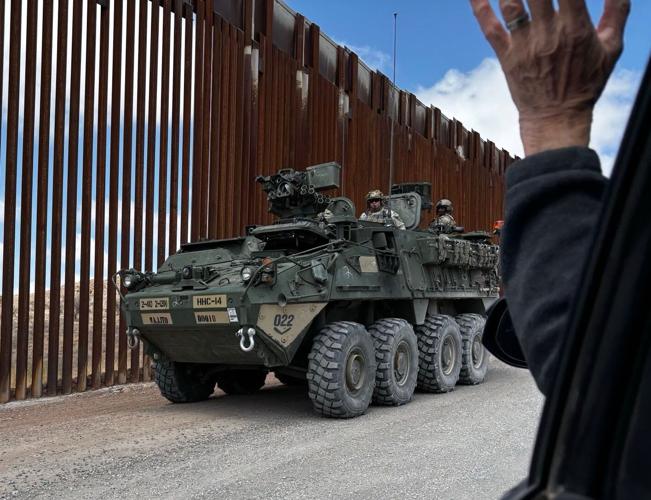
Humanitarian volunteers have spotted eight-wheeled “Stryker” armored vehicles rolling along the steep border wall road east of Sásabe, and in the town of Why, about 27 miles north of Lukeville. Soldiers have at times used the rugged California Gulch area, south of Arivaca, as a gathering place, threatening a rare desert fish species there, a Southern Arizona conservationist said.
Humvee vehicles have been seen amid the grasslands of the San Rafael Valley, where a new stretch of border wall is planned, and Santa Cruz County residents have reported seeing a Stryker vehicle in Kino Springs and more military personnel at the Nogales border crossing.
More than 1,800 soldiers have been deployed in Arizona, as well as armored vehicles and military aircraft, although public lands along the border in Arizona haven’t yet been transferred to the Department of Defense, as has happened in New Mexico and Texas.

A military Stryker vehicle — one of more than 100 of the eight-wheeled armored vehicles currently deployed to support the southern border mission — was spotted by humanitarian volunteers this month on a remote stretch of border road, east of Sásabe, Arizona. As on the rest of the U.S.-Mexico border, migrant arrivals here have been very few lately, aid workers say.
But even as the Trump administration surges military resources to the U.S.-Mexico border — where there are now more than 10,000 soldiers and 100 Strykers border-wide — U.S. Immigration and Customs Enforcement is planning to ask some Border Patrol agents to transfer away from the border to support the mass deportation campaign in the U.S. interior, CNN reported.
An ICE spokeswoman told the Arizona Daily Star the agency would respond to the Star’s inquiry about the plan in the coming days. Local Customs and Border Protection officials were unaware of the plans, as of Friday.
The move seems to be an acknowledgement of the excess capacity at the border lately, despite the Trump administration’s insistence that a national emergency and an “invasion” exist there, immigration experts say.
Migrant encounters between ports of entry are still at historic lows, despite a small increase for the month of April, according to the latest data from U.S. Customs and Border Protection.
“There’s a big mismatch between the rhetoric (about an invasion) and the reality,” said Colleen Putzel Kavanaugh, associate policy analyst for the nonpartisan Migration Policy Institute.
‘Imperative we stay vigilant’
Border Patrol’s Tucson Sector Chief Sean McGoffin told the Star in a May 14 interview that despite the quiet border, the military support has been “a huge help,” including providing enhanced surveillance along the border.
“They are doing a lot of different jobs that help us to be able to have more eyes on the border, to be able to do our jobs and even have greater awareness of what’s transpiring, because of them being on the border with us. So they’re definitely helping us,” he said.
McGoffin emphasized that border security isn’t only about immigration.
“We still have to be vigilant about people trying to smuggle narcotics into the U.S. We have to be careful and not let our guard down. Even though immigration has taken up so much of our time, it’s not the only thing we have to worry about along the border. It’s imperative we stay vigilant,” he said.
On the low migrant arrests figures, McGoffin said that’s a product of stricter policies at the border, starting last year under President Joe Biden, and word spreading widely about the consequences of illegal entry.
“It’s a continuous effort to applying consequences, and reminding people that coming across that border illegally is going to result in prosecution and you will be returned,” he said.
Human-rights advocates maintain that those stricter policies, largely banning access to asylum, violate U.S. law and international treaties that guarantee the right to seek asylum once on U.S. soil, regardless of how one entered the country.
On May 9, a federal court ruling backed up many of advocates’ critiques, raising questions about what the future of asylum access will look like at the border: A U.S. District Court in D.C. ruled most of Biden’s asylum restrictions imposed in June 2024 violated the Immigration and Nationality Act and would harm people seeking asylum.
“Today’s federal court ruling reaffirms what we’ve said time and again — that the bipartisan war on asylum has obstructed equitable access to fundamental human and legal rights in ways both arbitrary and capricious,” said Javier Hidalgo, legal director at Texas-based nonprofit RAICES, in a statement.
Biden’s earlier “Circumvention of Lawful Pathways” rule — which only allowed migrants access to U.S. ports of entry, where they could request asylum, if they first secured an appointment using the CBP One phone app — expired earlier this month. The rule had also imposed a higher threshold for a successful asylum petition for those who didn’t enter the U.S. through a port of entry.
The ACLU has also challenged President Donald Trump’s “invasion” declaration, used to justify the near-complete ban on asylum access.
“A lot depends on appeals, but if court finds the invasion declaration unlawful, the U.S.-Mexico border would be back to ‘normal’ rules,’” said Kathleen Bush-Joseph, policy analyst with the Migration Policy Institute’s U.S. immigration policy program.
“I think it’s remarkable that we might be at a point of having all of this military build-up at the border, but none of the rules that were put in place to try to slow arrivals in effect.”
A few months into Trump’s first term, migrant arrivals began rising again, following a transitional “wait-and-see” period, Putzel Kavanagh said, but it remains to be seen if that will happen again in the coming months.
Military zone

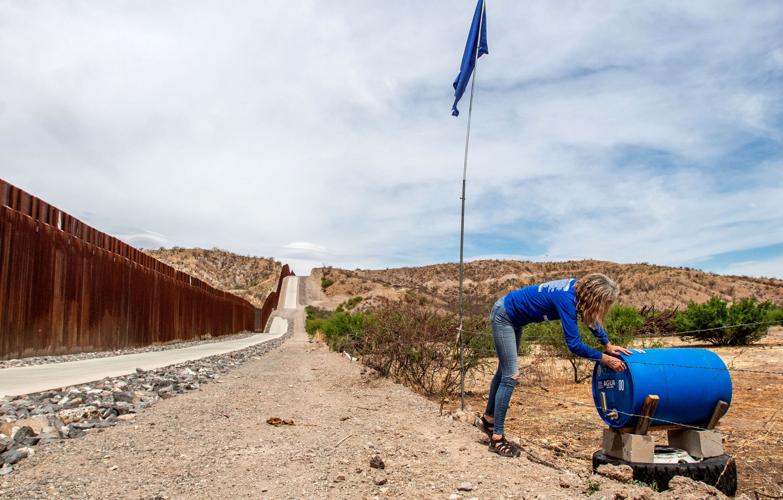
No migrants were in sight on a recent visit to the border wall east of Sásabe, Arizona, where humanitarian volunteer Christy Coverdale Stewart checked on the water level in one of Humane Borders’ water stations.
Last month, the Trump administration began transferring land along the border to the Department of Defense, making those lands a temporary military installation off-limits to civilians.
Federal officials say that allows soldiers to temporarily detain migrants, who can be transferred to CBP custody and charged with trespassing on a military base, without running afoul of the Posse Comitatus Act. That’s the law that normally prohibits the military from engaging in civilian law enforcement, but it contains a loophole for actions that further a “military purpose.”
Critics say it’s an alarming overreach of executive power and an abuse of that loophole, which could make it easier to justify use of the military in the U.S. interior one day.
The official land transfer hasn’t yet happened in Arizona, and Border Patrol’s McGoffin said he doesn’t yet have an indication of when it will happen.
Hundreds of migrants have already been charged with trespassing in the military zone established in New Mexico and part of Texas. The arrests so far have been made by border agents, not soldiers, said CBP spokesman John Mennell. Military personnel have provided information leading to those arrests, an Army spokesman said.
But prosecuting those trespassing charges just got tougher for the Department of Justice: Federal magistrate judges in New Mexico have dismissed the trespassing charges against more than 100 of those charged, ruling the government failed to show migrants knew they’d entered a restricted area, the Associated Press reported Friday. The migrants still face charges of illegal entry and potential deportation.
In New Mexico, that militarized zone stretches 3.5 miles into the state in some areas, far deeper than initially anticipated, the Star reported in April. The Roosevelt Reservation, the strip of federal land that tracks the southern border in California, Arizona and New Mexico, extends just 60 feet into the U.S. from the border.
If the militarized zone in Arizona also stretches miles from the border, that will mean significant disruption to fragile habitats in Southern Arizona, including a stream through California Gulch that’s home to the rare Sonora chub, a protected desert fish, said Chris Bugbee, southwest conservation advocate for the Center for Biological Diversity.
In late April, Bugbee said he came upon five unmarked vehicles, and more than a dozen soldiers in fatigues, in California Gulch. He said he asked one soldier, “What are you guys doing out here?”
“His answer: ‘We’re just driving around,’” Bugbee said. “That is word-for-word. I think they’re twiddling their thumbs out there.”
Bugbee said he’s concerned about civilians unknowingly entering the military zone once it’s established in Southern Arizona, where the expansive, rugged terrain would make it hard to delineate where a military zone begins, unless the Army installs a new fence system.
“I’m waiting to see what’s gonna happen to American citizens who enter these spaces. Are we gonna get trespassing charges as well?” he said. “Somebody like me who regularly goes down there not only to recreate, but for work as well — I like to get down there in the monsoon season and look for endangered fish — what would happen to me?”
There’s also the question of how cattle grazing would be managed once the Army takes over public lands from agencies like the Bureau of Land Management and U.S. Forest Service, he said.
“This is happening too fast. It’s really kind of a scramble,” Bugbee said. “A lot of it hasn’t been thought through, in my opinion.”
Santa Cruz County Sheriff David Hathaway, who spotted a column of Humvee vehicles in the San Rafael Valley on a recent visit, said he worries about the economic and social implications of the militarization effort, which could deter shoppers from Mexico who support the Nogales economy, and vice versa.
“Any enhanced visible military presence, the feeling is that will discourage people from coming to the border, where people will think it’s unsafe and out of control and a war zone, like East Germany during the Soviet era ... which couldn’t be further from the truth,” Hathaway said.
He’s also concerned about the consequences for people who are accustomed to enjoying recreational activities, like hiking, hunting and bird-watching, in the borderlands.
“I’d be worried about clashes between military personnel and regular Americans out there for a Sunday hike, not thinking they’re going onto a military base,” he said.
Meanwhile, ICE’s plan to transfer border agents to the U.S. interior — despite the surge of military to the border — also reflects the challenges facing ICE agents to meet the Trump administration’s aggressive mass-deportation goals.

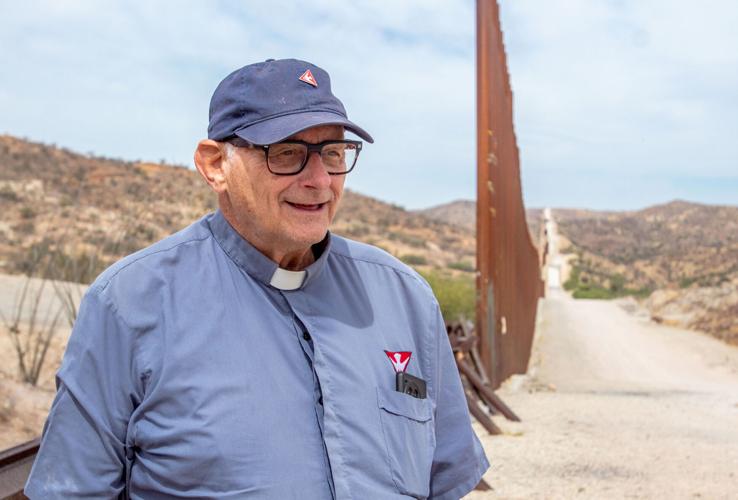
Father Ray Riding, a Catholic priest and volunteer with the Tucson Samaritans, said he’s visited the border region east of Sásabe once or twice a week for months, and he hasn’t seen a single migrant on his recent visits. It’s a departure from last fall, when aid workers routinely encountered dozens of migrants each day, said Riding, pictured here about 22 hilly miles east of the Sásabe port of entry on May 12.
The Justice Department is also shifting 2,000 law enforcement officers from other federal agencies — including the Drug Enforcement Agency and the Bureau of Alcohol, Tobacco, Firearms and Explosives — to assist with immigration enforcement for the rest of the year, the New York Times reported.
That’s in line with DOJ priorities outlined in a January memo, directing federal law enforcement and prosecutors to prioritize immigration-related offenses, including misdemeanor illegal-entry cases.
The Star reported in February about concerns that laser focus on immigration will divert limited resources from critical enforcement areas, such as drug trafficking, violent crime, child exploitation and white-collar crime.
Recent border numbers
Migrant arrests have been dropping since early 2024, when Mexican immigration enforcement strengthened efforts to slow the progress of migrants trying to reach the U.S. border amid a global increase in forced displacement. Apprehensions between ports of entry then dropped dramatically after Biden’s June 2024 restrictions on asylum access, under his “Securing the Border” rule.
Since Trump took office, the numbers have dropped further, though CBP’s April statistics show a modest increase from 6,800 migrant arrests in March, to about 8,000 in April. That’s compared to more than 128,000 migrant arrests in April 2024.
In the Tucson sector, border agents arrested 1,327 migrants outside ports of entry in April, compared to 1,068 in March.
The demographics have changed, too: Most migrant arrivals now are single adults from Mexico, as opposed to the families from across the world who were many of the border-crossers throughout Biden’s term, and at the end of Trump’s first term, Putzel Kavanaugh said.
That’s a return to the demographic norms of the 1990s and early 2000s, she said.
On a recent visit to the Arizona border east of Sásabe, a Star reporter saw only a couple trucks driven by soldiers along the border wall road, and there were no migrants in sight.
Father Ray Riding, a Catholic priest and volunteer with the Tucson Samaritans, said he’s visited the area once or twice a week for months, and he hasn’t seen a single migrant on his recent visits. It’s a departure from last fall, when aid workers routinely encountered dozens of migrants each day, he said.
“What’s happening now is the people crossing now are risking their lives walking (through the desert). They’re not asking for asylum,” he said.
Advocates have long warned that the more restrictive border policies are, the more likely it is that migrants will be pushed further into dangerously remote areas of the borderlands, risking their lives.
In late 2023, hundreds of migrants arrived in the remote area east of Sásabe daily and waited hours or days in harsh conditions to turn themselves in, leaving aid workers at times pleading for a greater Border Patrol presence there.
Now that migrant encounters have dwindled, the surge in resources makes no sense, Riding said.
Humanitarian workers worry about when they’ll no longer have access to this remote area of the border, raising concerns about the lack of outside oversight of military operations there.
“They just do not want accountability,” Riding said. “That has been one of the bulwarks of our nation, like having a free press, free speech. ... They are doing everything to take our eyes off that.”
Joanna Williams, executive director for the binational migrant-aid nonprofit Kino Border Initiative, in Nogales, said border militarization has been ongoing for years, even since 2001, but especially since 2018 when Trump deployed the military to assist with border-wall construction.

In late April, a volunteer with Humane Borders spotted at least four Stryker armored vehicles at the Border Patrol station in the town of Why, Arizona, about 27 miles north of the U.S.-Mexico border.
That’s “normalized” an atmosphere of surveillance and military oversight that shouldn’t be considered normal, she said.
“He (Trump) moved what is normal, and we haven’t been able to go back to a world in which the military is not here,” she said. “The presence of the military now is just consolidating that reality and changing the reality of our beautiful border, which is actually a place of interconnection, of back and forth, and community. It’s nothing close to a war zone.”
The militarization effort can negatively affect the well-being of soldiers diverted from the work for which they’re trained, Williams said.
“There’s very little thought given to, is this a good use of resources? Is this reasonable for the people doing this work?” she said. “This is not what they signed up for. They’re isolated, far from family and community networks. They signed up for that in a way — but they signed up to do that in a place where they’re actually needed.”

