


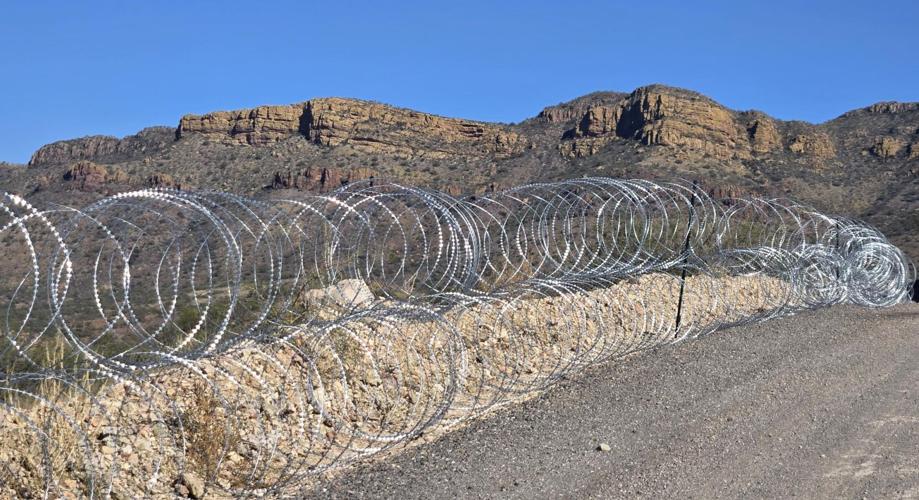


Environmentalists are raising the alarm about border agents' increased use of concertina "razor" wire along the Arizona border, not only atop the wall, but also on the desert floor, where advocates say it poses grave risks of entanglement and death to wildlife, including jaguars and ocelots, while doing little to stop migrants' crossings.
The use of concertina wire is spreading "like a cancer" throughout the border region, including in Arizona's Pajarita Wilderness, west of Nogales, and the Coronado National Memorial, east of the San Rafael Valley, said Erick Meza, border program coordinator for the Sierra Club's Grand Canyon chapter.
Border agents have previously installed concertina wire along the top of the border wall in urban areas, including around Nogales. But the use of concertina wire on the ground in remote, sensitive natural areas is a new development, posing harm to wildlife already threatened by increased militarization and rising barriers in the borderlands, Meza said.

Border agents have previously installed concertina "razor" wire along the top of the border wall in urban areas, including in this area east of the port of entry in Sásabe, Arizona. But the use of concertina wire on the ground in remote, sensitive natural areas is a new development, posing life-threatening risks to wildlife already threatened by increased militarization and barriers in the borderlands, says Erick Meza of the Sierra Club's Grand Canyon chapter.
Environmentalists point out that — much like the border wall itself — humans are able to overcome concertina wire, including by cutting through it or using a blanket to cover it, Meza said. Animals are the ones that will suffer from its use in the desert, he said.
"It's something that definitely is not going to stop humans from crossing, but it is going to potentially have major consequences for animals," Meza said.
Environmentalists say they've seen military personnel — deployed to the border earlier this year as part of the newly established "National Defense Area" in Arizona — as well as U.S. Border Patrol agents installing the concertina wire in border regions of Arizona and California. Border agents have recently unfurled the wire in the remote area south of Arivaca, Arizona, east of the Sásabe port of entry.
A spokesman for the Department of Defense's "Joint Task Force-Southern Border," headquartered at Fort Huachuca, said the placement of concertina wire was "deliberately designed" in coordination with Border Patrol guidance "to maximize defensive efficiency, ensure safety, and deter illegal crossings."
"The ongoing installation of the concertina wire is part of a necessary, strategic effort to bolster this security by discouraging and preventing illicit movement across this border," according to an emailed statement from Maj. Paul O'Daniel, director of public affairs for the joint task force. "The concertina wire is localized to specific areas, indicated as most necessary for this security measure by our Border Patrol partners. Because of the unique, coiled nature of concertina wire, it can allow for the passage of small, ground-dwelling species while still maintaining a secure perimeter."
O'Daniel clarified that concertina wire is distinct from "razor wire," which is a single strand with sharp blades.
"Concertina wire uses similar blades but is shaped into large, spring-like coils that create a thick '3D wall,'" he wrote. "Because it is bigger and bulkier, it is easier for both humans and animals to see," helping prevent entanglements.
The wire on the desert floor likely poses more of a risk to wildlife than to humans, humanitarian volunteers said. But if someone tried to cut through the wire to free a trapped animal, for example, or stumbled and fell into the wire, that could pose a real danger, said Pastor Randy Mayer, of the Green Valley-Sahuarita Samaritans.
"What I understand is, if it breaks apart, it's like a spring. You risk that wire snapping around and cutting people," Mayer said. "I don't think it's going to stop humans. ... You just have to walk a little bit around it."
The Department of Homeland Security and Border Patrol are sharing promotional videos online showing border agents installing the concertina wire, including a Dec. 18 Instagram video of Nogales Station agents rolling out the wire across unidentified grasslands, to a soundtrack of Alice in Chains.
Another promo video, posted to the Border Patrol Tucson Sector's Instagram account Dec. 3, shows rolls of concertina wire being delivered by military helicopter to agents on the ground.
On Dec. 12, Sky Island Alliance, along with 23 other environmental and humanitarian groups, wrote a letter of complaint to the Border Patrol's Tucson Sector Acting Chief Henry Laxdal about the ground-level concertina wire installed in areas including the Huachuca Mountains, Guadalupe Canyon and Buenos Aires National Wildlife Refuge.
"This wire presents an immediate threat to wildlife," the letter said. "We request that this wire is quickly removed to prevent injury to wildlife, including two endangered species known to occupy the area," jaguar and ocelot.
At night, concertina wire would be hard for animals to see, particularly if they're moving fast, advocates say. Larger animals, including mule deer and cattle, could easily get caught, Meza said.
"It's a death trap," he said. "This is something unprecedented. ... There are absolutely no studies or any type of concern around what are the consequences to wildlife."
U.S. Customs and Border Protection — the parent agency over Border Patrol — did not respond to the Star's inquiry about the use of concertina wire.

On Dec. 12, Sky Island Alliance, along with 23 other environmental and humanitarian groups, wrote a letter of complaint to the U.S. Border Patrol's Tucson Sector acting chief about the "ground-level" concertina wire deployed in remote areas including the Huachuca Mountains, Guadalupe Canyon and Buenos Aires National Wildlife Refuge.
With migrant arrivals at record lows, U.S. soldiers deployed to the southern border under the Trump administration have little to do, environmentalists and humanitarian aid workers say.
"We have these 10,000 troops that have been deployed to the border, in (a time of) the lowest record of crossings of undocumented migrants. They're just sitting out there doing nothing, so someone came up with the idea of, 'Let's put them to work installing concertina wire,'" Meza said.
In late November, U.S. soldiers deployed to the border in Arizona began blocking humanitarian aid workers from reaching a remote area of the southern border, east of Sásabe, where large numbers of migrants were arriving in 2023 and 2024, volunteers report.
Today, the area is quiet, with hardly any migrant arrivals, but volunteers with the Tucson and Green Valley Samaritans still try to patrol the area for people in need.
"My sense is, the soldiers are just carrying out some decisions that the Border Patrol has put in place, but it's just very quiet out there. There’s nobody crossing," said Mayer of the Green Valley-Sahuarita Samaritans.
"I’ve been doing this work for 25 years. We’ve seen the ups and downs of administrations, and polices, and what we’ve learned is that the bad policies of one administration continue and get worse under the next," Mayer said. "Here we are, this beautiful public land, the Pajarita Wilderness area, and yet now we have military there."
The Defense Department's O'Daniel said he didn't have knowledge of the roadblock east of Sásabe that's preventing humanitarian workers from passing.
"We do take these concerns seriously and will look into the matter," he wrote.
'Death zone'
The expanded use of concertina wire comes as contracts for additional border barriers have proliferated under the Trump administration. A controversial new border wall project is underway in the grasslands of the San Rafael Valley, about 30 miles south of Sonoita.
Construction crews have installed about 1.5 miles — out of a planned 27 miles — of 30-foot steel-bollard wall in the grasslands of the valley, said Eamon Harrity, wildlife program manager for Sky Island Alliance. The valley marks a crucial wildlife corridor that connects the jaguars of Southern Arizona to the breeding population in northern Mexico, conservationists say.
In November, CBP announced plans for an additional 19 miles of border wall in Pima, Santa Cruz, and Cochise Counties, and at least 42 miles of secondary border wall in the Tucson Sector.
That project will close a gap of several miles in the Patagonia Mountains, and will seal off the remaining open corridor in the Pajarita Wilderness west of Nogales, Harrity said.
The project will also close a gap in the wall at the rugged Fresnal Peak, near the Buenos Aires National Wildlife Refuge east of Sásabe, and will seal off Guadalupe Canyon in eastern Arizona, near the New Mexico state line, he said.
Harrity said the extent of the new border wall under construction — at massive financial and environmental cost to the nation, with little benefit in terms of operational security — is "outrageous."
"These projects announced in Arizona will effectively close the entire Arizona-Sonora border, outside Tohono O'odham (reservation land), which is 62 or 63 miles of currently unwalled stretch of border," he said. "Outside of that, the entire border from Yuma to Texas really is going to be one continuous border wall and in many places, two parallel lines of 30-foot border wall."
The ribbon of inaccessible land between the two walls will become "death zone" ecologically, and could become a trap for wildlife that made it through the first wall, using small wildlife passages for which conservationists had advocated, Meza said.
The double-wall system will result in a clear-cut area stretching 200 feet north from the border, Harrity said.
"It's an incredible loss of land that we’re forfeiting for this effort," Harrity said. "It's also just an unparalleled destruction of some really unique and beautiful areas."
Earlier this month, DHS announced it had awarded Fisher Sand & Gravel a $1.49 billion contract for a large part of the new wall projects in Arizona. The North Dakota-based company has a record of thousands of environmental violations and legal problems, and has ties to some allies of President Donald Trump.
That includes a 2019 lawsuit, filed by the U.S. Department of Justice, alleging poor workmanship on a 3.5-mile border-wall segment in Texas, privately funded by Trump supporters.
ProPublica previously reported that a 2022 settlement agreement requires Fisher to maintain a $3 million bond for 15 years for future repairs of the "severely" eroded wall.
Extensive stadium lighting is also planned for the border region, which will cause a "massive impact" ecologically, Harrity said.
"Anything that moves, communicates or navigates at night will be affected by the use of security lighting along the border," he said.
The Sierra Club is urging the public to contact congressional representatives and to sign its petition in opposition to the use of ground-level concertina wire in the border region.
"This is not only an Arizona issue; it's a U.S.-Mexico border issue. It's happening everywhere," including in the Jacumba Mountains of California, Meza said.
The Trump administration has made unprecedented use of the waiver authority under the Illegal Immigration Reform and Immigrant Responsibility Act and the Real ID Act of 2005, allowing the administration to bypass dozens of environmental laws to install its border fortifications.
CBP did issue a call for public comments on the latest Arizona border wall project — the deadline was Dec. 22 — but advocates say the agency isn't engaged in good-faith environmental assessments.
At the border, "a lot of decisions are being made without honest and sincere input from affected communities," Harrity said.

