



A unilateral U.S. strike against criminal groups on Mexican soil appears more possible than ever, security experts say, following the U.S.'s deadly military raid in Venezuela and President Donald Trump's renewed threats to take on Mexican "cartels," with or without Mexico's consent.
But the more likely scenario is that Mexico's leaders will do whatever they can to avoid that outcome, said Tony Payan, executive director of the Claudio X. González Center for the U.S. and Mexico at Rice University’s Baker Institute for Public Policy, in Houston.
"If I were (Mexican President) Claudia Sheinbaum, I certainly would be concerned," he said. Mexican leaders now have more incentive to "cave" to Trump's demands to allow U.S. troops into the country, framing it as a voluntary partnership, Payan said.
"They want to avoid the worst scenario, which is unilateral U.S. action," he said. "They’d rather cave in and sell it domestically as a collaborative effort. ... To save face, the only thing Sheinbaum can do is say, 'Okay, let’s work together.' There’s no other choice."
Last week, Trump said he's offered repeatedly to send U.S. troops into Mexico to confront drug traffickers, but Mexican President Sheinbaum, who took office in October 2024, has declined.
"Mexico has to get their act together. ... We're going to have to do something," Trump told reporters on Air Force One, the day after the Jan. 3 Venezuela operation in which U.S. forces captured Venezuelan President Nicolás Maduro and his wife Cilia Flores.
Trump said of Sheinbaum, "Every single time I talk to her, I offer to send troops. ... She's a little afraid. The cartels are running Mexico."
On Thursday, Trump escalated his threats, saying in a Fox News appearance, "We are gonna start now hitting land, with regard to the cartels" in Mexico.
A land incursion of U.S. troops into Mexico would be a "much larger provocation" than something like a drone strike on a fentanyl lab, which — although still a violation of international law — could be more easily overlooked, said Tricia Bacon, an American University professor who worked in counterterrorism at the U.S. State Department from 2003-13.
Sheinbaum has strongly condemned the U.S. attack on Venezuela and reaffirmed Mexico's sovereignty.
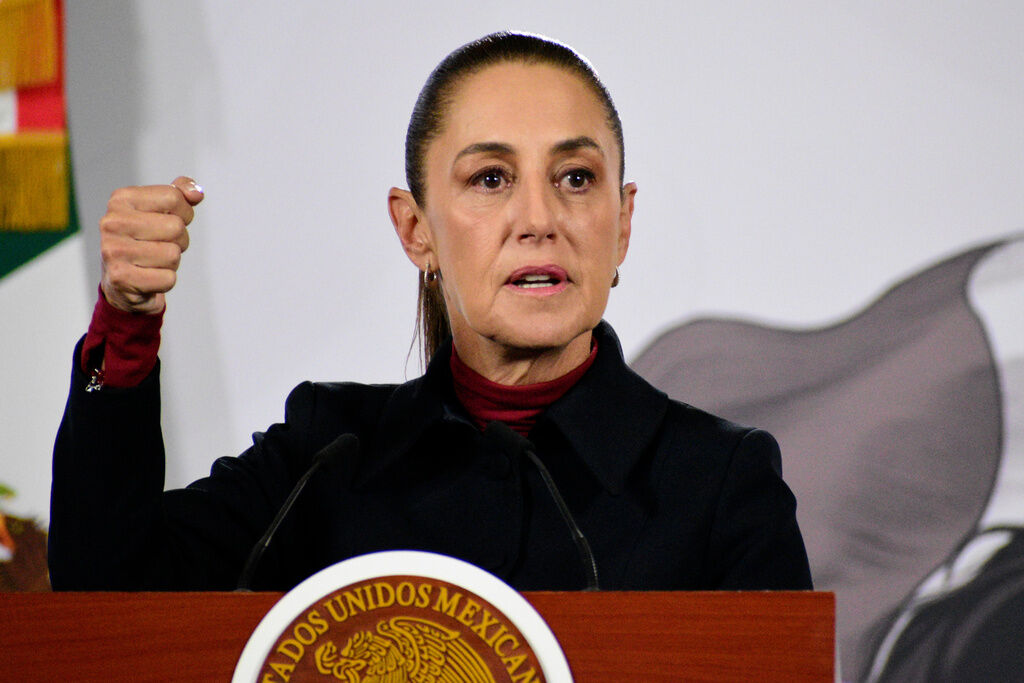
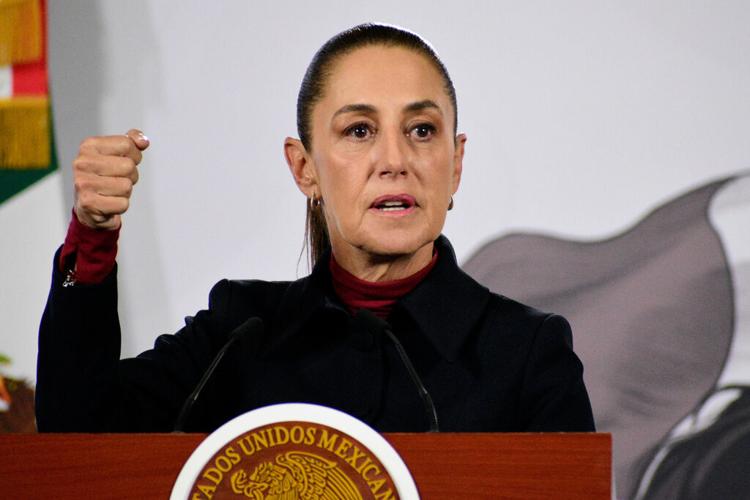
Mexican President Claudia Sheinbaum speaking in Mexico City after the U.S. struck Venezuela. In the face of U.S. President Donald Trump's escalating threats to take action in Mexico, Sheinbaum said: "We categorically reject intervention in the internal affairs of other countries. ... We state with complete clarity that for Mexico, and for all Mexicans, the sovereignty and self-determination of peoples are not optional, nor negotiable."
"We categorically reject intervention in the internal affairs of other countries," Sheinbaum said in her daily news conference on Jan. 5. "The history of Latin America is clear and compelling: Intervention has never brought democracy, has never generated well-being or lasting stability. ... We state with complete clarity that for Mexico, and for all Mexicans, the sovereignty and self-determination of peoples are not optional, nor negotiable."
Responding to Trump's land-strike threat, Sheinbaum called Friday for more communication and information-sharing with the U.S., noting that Secretary of State Marco Rubio has praised Mexico's coordination with U.S. agencies through a new U.S.-Mexico working group, focused on security.
Although it's now clear Trump is willing to follow through on his threats, that doesn't mean a unilateral strike in Mexico would make sense for the U.S. strategically, experts say.
Without the permission of the Mexican government, a U.S. strike would be an act of war against a critical ally, said retired Air Force Lt. Col. Rachel VanLandingham, a national security law expert and law professor at Southwestern Law School. It would also be less effective tactically than continuing bilateral work with Mexico to tackle organized crime and drug trafficking, she said.
But that doesn't mean it's out of the question, she said. The U.S. raid in Venezuela underlines that Trump doesn't feel bound by international or domestic law, and isn't concerned with long-term outcomes, she said.
"Nothing would surprise me," she said. "They will do it if they think the pros will outweigh the cons."

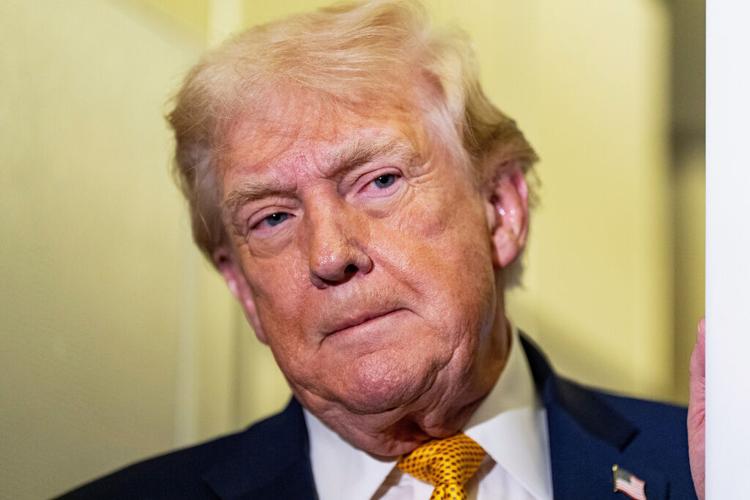
President Donald Trump on Air Force One on Sunday, Jan. 4, 2026, when he said, "Mexico has to get their act together. ... We're going to have to do something." On Thursday, Trump escalated his threats, saying in a Fox News appearance, "We are gonna start now hitting land, with regard to the cartels" in Mexico.
Strike would 'detonate' progress
Stephanie Brewer, Mexico program director for the Washington Office on Latin America, or WOLA, said any unilateral strike on Mexico would undermine recent progress. WOLA is a D.C.-based research and advocacy group that promotes human rights.
"The single glaring action the Mexican government has said it will not accept is U.S. military action" in Mexico, Brewer said. "To detonate the cooperation and dialogue that exists, and throw that large and important of a bilateral relationship into chaos, would be unthinkably irrational."
But to a president focused on polls and headlines, the aggressive optics of a drone strike in Mexico may be Trump's priority, she said.
"It would create a headline in which the U.S. administration could portray itself as being tough," she said. "But it's not actually tough on the problems that are supposedly being addressed," such as fentanyl overdoses in the U.S.
If Trump truly wanted to tackle the U.S. drug problem, she said, he wouldn't be cutting resources for addiction prevention and treatment that could slow U.S. consumers' demand for fentanyl.
Sheinbaum has so far avoided Trump's wrath by "folding" to U.S. demands on immigration and security, said Mexico City-based David Mora, Mexico senior analyst for the International Crisis Group.
Even before Trump took office, Mexico deployed thousands of National Guard soldiers to the U.S.-Mexico border, and has worked aggressively — to the concern of human rights advocates — to slow migration northward toward the U.S. border. Migrant arrivals at the U.S. southern border are now at record lows, federal data show.
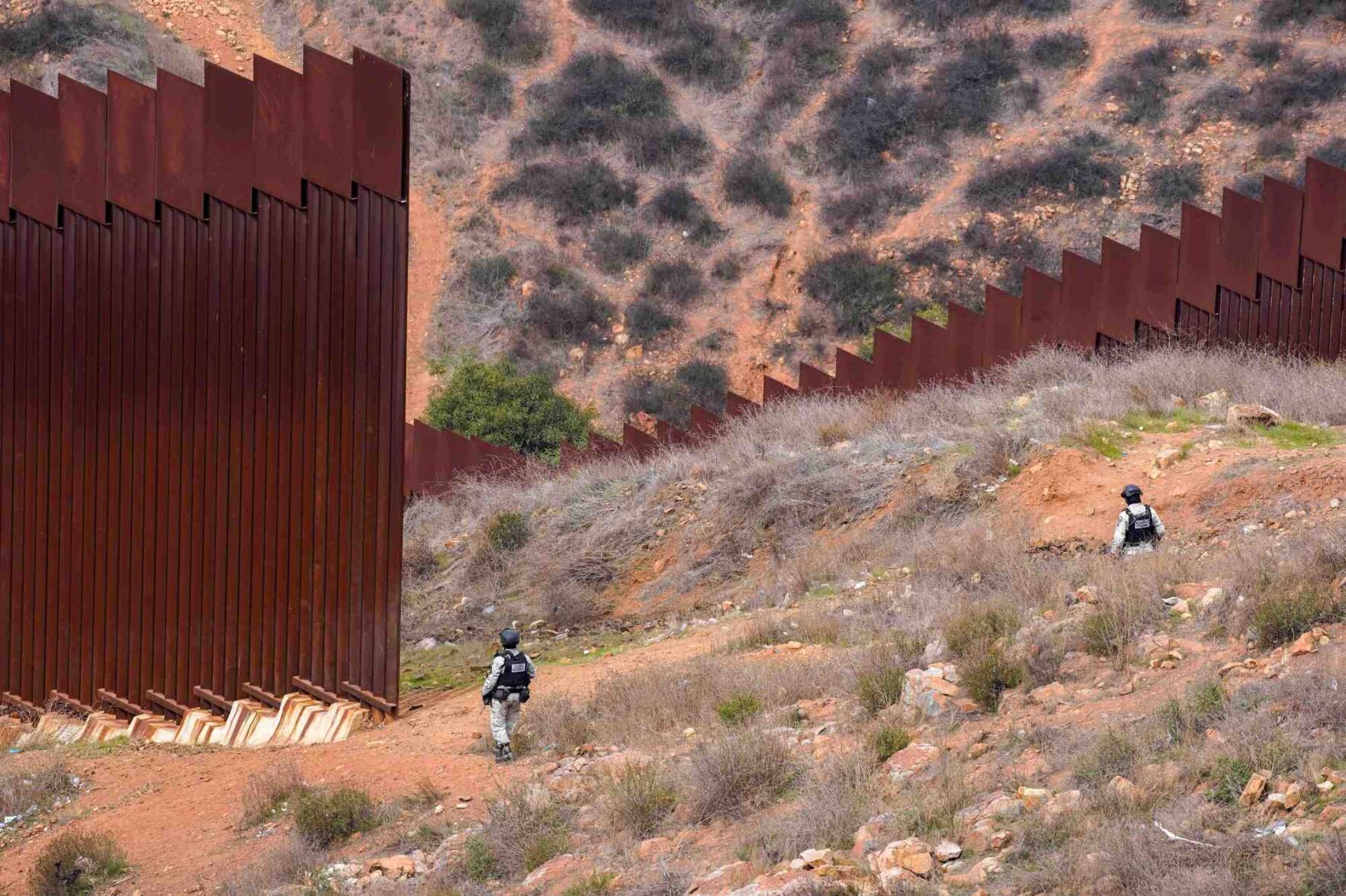
National Guard troops at the US-Mexico border fence in Tijuana, Baja California, in March 2025. Mexico deployed thousands of National Guard soldiers to the border and has worked to slow migration, experts say. "The U.S.-Mexico relationship, as contentious as it has been, that's a very close relationship," said Stephanie Brewer, Mexico program director for the Washington Office on Latin America. "Over the past year there's been a deepening of cooperation. The Mexican government is showing it is willing to make concessions, to fulfill U.S. requests, especially in the security sphere." Still, Trump seems willing to damage that relationship, Brewer said.
Since Trump took office, Sheinbaum has extradited dozens of alleged cartel members wanted in the U.S., Mora said. On Dec. 31, Mexican forces arrested alleged Sinaloa Cartel leader Pedro Inzunza Noriega, who is facing narco-terrorism charges in the U.S., Mora said.
The Venezuela operation "brings this sense of urgency to the Mexican government, in the sense of, 'We need to do more. If we want to avoid unilateral military action on Mexican soil, we need to step up the game,'" he said.
The U.S.'s deep cultural and economic ties to its southern neighbor represent a far different relationship than that of the U.S. and Venezuela, Brewer said.
"The U.S.-Mexico relationship, as contentious as it's been, that's a very close relationship," she said. "Over the past year there's been a deepening of cooperation. The Mexican government is showing it is willing to make concessions, to fulfill U.S. requests, especially in the security sphere."
Still, Trump seems willing to damage that relationship, Brewer said.
"These events (in Venezuela) demonstrate unequivocally that the threats we’ve been hearing of some type of military action or strikes in Mexico do need to be taken seriously," Brewer said. "They cannot be dismissed simply as a bluff or a negotiating tactic. These messages are coming from an administration that has shown with absolute clarity that it is willing to violate international law."
'Foreign terrorist' label
In February, the Trump administration added six Mexican cartels to its list of "foreign terrorist organizations," but some experts dispute the legitimacy of the label.
Before now, only groups using violence with political motives have been designated terrorists by the State Department, but that isn’t a legal requirement, Bacon said. Groups that operate with a profit motive, which appears to be the case for Mexican cartels, have conventionally been considered transnational criminal organizations.
Bacon said she'd argue dropping the political-agenda criteria for the terrorist designation is "unwise from a policy perspective," but it's legal.
It's possible U.S. intelligence agencies have classified evidence that cartels are using profits for political ends, but that's not clear, VanLandingham said.
"I suspect in some of these designations, there’s abuse of the criteria but I can’t rule out a factual predicate for some of this," she said.
A common misconception is that the foreign terrorist designation authorizes use of military force, but that's false, VanLandingham said. While the designation can be useful politically and rhetorically in justifying use of force to the public, it does not authorize lethal strikes, she said.
"It's a completely separate component of a civil and criminal legal structure to go after these groups punitively, in a civil and criminal way — not a lethal way," she said.
But that may be irrelevant, experts said. In separate interviews with the Star, Payan, Bacon and VanLandingham all described the Trump administration's guiding philosophy as "might makes right," making its actions hard to predict.
"We’re not in normal times, and the Trump administration is the not going to stop to think about the niceties of legality," Payan said.
Venezuela strike
On Thursday, five Republican U.S. senators joined Democrats in advancing a war powers resolution requiring congressional approval for any further attack on Venezuela, the Associated Press reported.
About 100 people were killed in the Jan. 3 military operation in Venezuela, the country's interior minister said Wednesday, mostly security forces at Maduro's compound in Caracas, but also civilians caught in the crossfire. No U.S. troops died, but several were injured.
The U.S. Department of Justice has accused Maduro of conspiracy to import cocaine and "narco-terrorism," calling Maduro's government "corrupt" and "illegitimate" in an unsealed indictment.
The operation, which left in place the rest of Maduro's authoritarian regime, violated international and domestic law, as did the deadly U.S. strikes on alleged drug-smuggling boats in the Caribbean, VanLandingham said.
To justify the boat strikes, Trump declared in October that the U.S. is in a "non-international armed conflict" with "drug cartels," but that's false, VanLandingham said. (The "non-international" qualifier refers to a conflict with non-state actors, she said.)
"He could say the moon is made of purple cheese; it doesn’t make it so," VanLandingham said. "He’s claiming something that isn’t true, but he was doing so to harness and trigger the power under the law to kill people as first resort," under the rules of war.
Neither can Trump accurately claim the U.S. is in an armed conflict with Mexican crime groups due to the flow of fentanyl to the U.S., she said, noting that the vast majority of fentanyl entering the U.S. comes through official ports of entry, in vehicles driven by U.S. citizens.
But the success of the Venezuela operation makes a unilateral strike in Mexico more likely, Bacon said.
"It's both that he followed through on the threat (in Venezuela) and secondarily, that it went so well," she said. "Our military is so good at these kinds of operations. This is what we’ve been doing for decades. ... So when you do an operation like this and it's so seamless — no Americans were killed, relatively few civilians were, they snatched the guy — from their perspective, it's a very positive picture. I think it becomes a lever that you want to pull again, because it works."
Payan pointed out that recent polling data showed a spike in approval for Trump after the Venezuela strike.
"In the U.S., there’s a very strong 'rally-around-the-flag' effect after an action like this," he said. With the 2026 mid-term elections coming up, "This is a dangerous year, between now and November, because it may provoke Trump — in order to raise his own polls, and the chances of the Republicans in November — to take more aggressive action abroad."
Trump's statements have made clear the goal of the Venezuela operation was to secure access to Venezuela's crude-oil reserves, Payan said, describing the Trump administration's approach as "neo-imperialism."
"Our foreign policy, at least in name, prior to Trump was about democracy, human rights, openness, liberty, accountability," Payan said. "It seems the Trump administration is completely void of any considerations of those values. It's simply: 'We want the oil in the market so the oil price will go down.'"

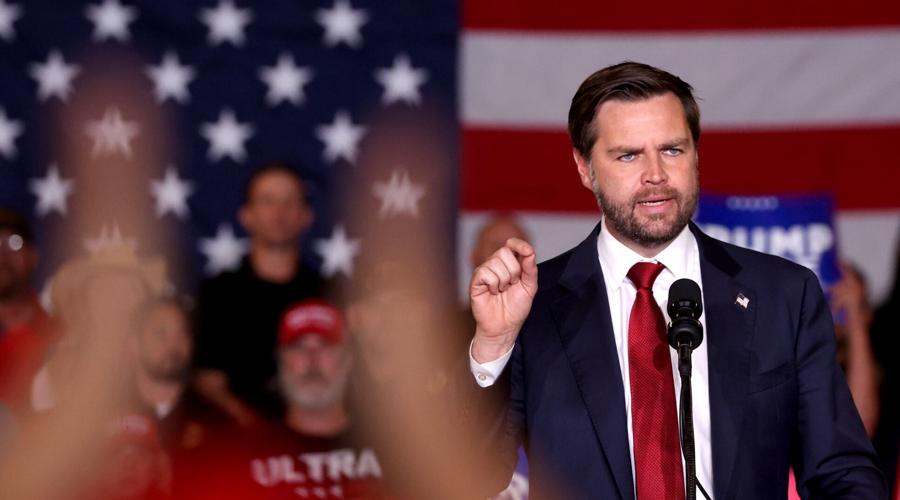
The Trump administration's threats to use the U.S. military against cartels in Mexico are not new, though President Donald Trump has been renewing and intensifying them over the past week. In an October 2024 campaign rally shown here, Trump's then vice-presidential running mate JD Vance told a Tucson audience: “You need to have a president who sends in the U.S. military to battle with the Mexican drug cartels."
The self-interest at play suggests Trump and his cabinet won't be concerned with the long-term consequences of unilateral strikes in other Latin American countries he's threatened, including Mexico, he said.
Corruption 'entrenched' in Mexico
Security consultant Gary J. Hale, a former drug-policy fellow at Rice University’s Baker Institute, said corruption in Mexico is deeply "entrenched."
"There’s no level of society in Mexico that is not touched by corruption," said Hale, who worked in intelligence and operations roles for the Drug Enforcement Agency for 32 years.
Historically, Mexico's cooperation with the U.S. in tackling corruption has only gone so far; fundamental reform is still out of reach, Hale said.
"They do this all the time. They round up a notorious kingpin of whatever cartel is not in their corrupt sphere, and hand them over," he said. "'Wow, Mexico is cooperating'. ... But they’re really not. They’re throwing out sacrificial lambs to keep the U.S. at bay. That’s what’s going to happen," as pressure from the Trump administration grows.
Hale said he believes Trump will follow through on his threats to strike unilaterally in Mexico, but those operations will be limited in scope.

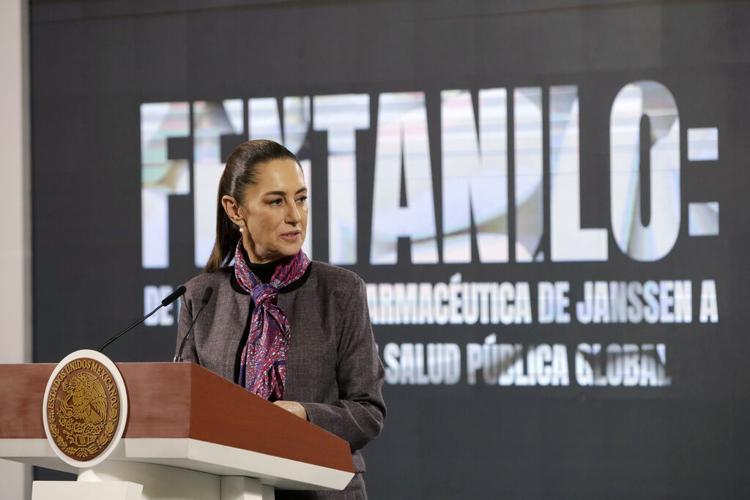
Mexican President Claudia Sheinbaum during a January 2025 news conference where her campaign "Stay away from drugs, fentanyl kills you!" was announced. Since U.S. President Donald Trump took office a year ago, Sheinbaum has extradited dozens of alleged cartel members wanted in the U.S., says David Mora, Mexico senior analyst for the International Crisis Group. But historically, Mexico's cooperation with the U.S. in tackling corruption has only gone so far; fundamental reform is still far out of reach, says Gary J. Hale, a drug-policy fellow at Rice University’s Baker Institute until last year.
"Mexico is the largest trading partner of the U.S.," he said. "We can’t ruin that. Our economies would both tank."
Anti-corruption advocates in Mexico wouldn't dispute Trump's assessment that organized crime is deeply engrained in Mexico's political and economic spheres, and many in Mexico would welcome a real effort to curtail criminal groups' power, experts said.
Sheinbaum has been more willing to take on criminal groups than her predecessor, President Andrés Manuel López Obrador. But critics say she's failed to stand up to her party's complicity with organized crime and the violence unleashed on Mexican civilians.
Mexican cartels are para-military operations, armed with high-powered weapons that largely come from the U.S., "with a large capacity for inflicting violence," said Mora of the International Crisis Group.
Fighting them requires military strength, but force alone isn't enough, he said.
"They have their foot in myriad industries, both legal and illegal, to fund other operations. They’re also intertwined with governments at the local level, at the federal level," Mora said. "Those are things you don’t stop just by sending a drone and bombing somewhere in Sinaloa. To tackle that problem, you need to pursue bigger and deeper strategies: following the money, and dismantling the corruption networks that have allowed these groups to flourish."
Mexican President Claudia Sheinbaum during a January 2025 news conference where her campaign "Stay away from drugs, fentanyl kills you!" was announced. Since U.S. President Donald Trump took office a year ago, Sheinbaum has extradited dozens of alleged cartel members wanted in the U.S., says David Mora, Mexico senior analyst for the International Crisis Group. But historically, Mexico's cooperation with the U.S. in tackling corruption has only gone so far; fundamental reform is still far out of reach, says Gary J. Hale, a drug-policy fellow at Rice University’s Baker Institute until last year.
Strengthening Mexico's criminal-justice system means tackling widespread impunity, Brewer agreed.
"The key is to root out the different forms of collusion and tolerance between state actors and criminal groups, and improve investigations and prosecutions," as well as addressing the flow of firearms from the U.S. to Mexico, she said.
"There are very logical and urgently necessary areas where both governments should be taking action," she said.
Fifty years of the "War on Drugs" proves it's a failure, including the "Kingpin Strategy" of taking down cartel leaders, resulting in fragmentation of criminal groups and increased violence as others scramble to fill the power vacuum, Brewer said.
Mexico-based security expert Eduardo Guerrero argued in a December article in El Financiero that U.S. pressure to confront corruption in Mexico could be a "historic opportunity" to transform the country and free its citizens from the grip of organized crime.
That would first require Mexico to "admit defeat," acknowledging criminal groups control large swaths of the country, he wrote.
"In states as diverse as Guerrero, Tamaulipas and Jalisco, federal forces act as temporary visitors, unable to even minimally affect the criminal structures that govern daily life," wrote Guerrero, director of Lantia Intelligence, a consulting firm that tracks criminal groups.
The ruling Morena party has enough consolidated power to make reform a reality, Guerrero wrote. Pressure from the U.S. could be "our leverage to finally rebuild our weak security and justice institutions — a reconstruction that Mexico has postponed for decades."
"What is at stake is not merely the bilateral relationship," Guerrero said. "It is the kind of country we will be in the next half-century: one that manages daily tragedies while overseeing its own decline, or one that takes the initiative and dares to rebuild its security and justice institutions with the support of its partners."

