



SÁSABE, Ariz. — At a volunteer-run migrant-aid camp, about 22 miles east of the Sásabe port of entry, the only action on this quiet Wednesday afternoon was the rustle of flags marking the humanitarian site and the sound of birds flitting among the trees.
A few dozen yards away, in Mexico, two reddish-brown cows were visible through the steel bollards of the U.S.-Mexico border wall as they grazed in the brush, strewn with discarded clothes, water bottles and baby diapers, left by migrants led to this remote area by human smugglers.
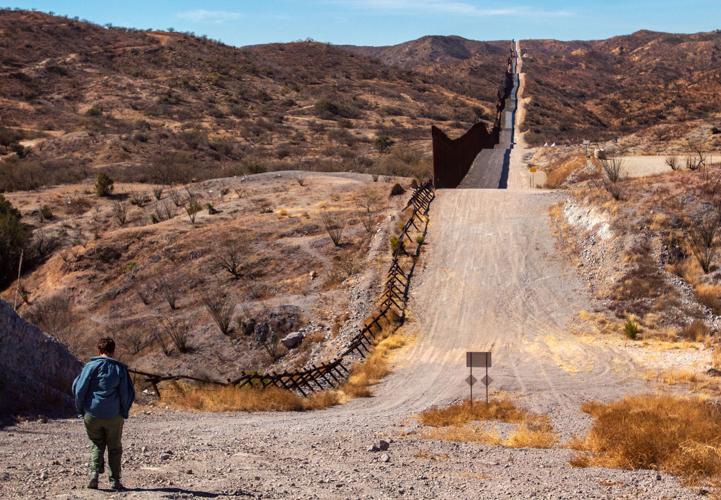
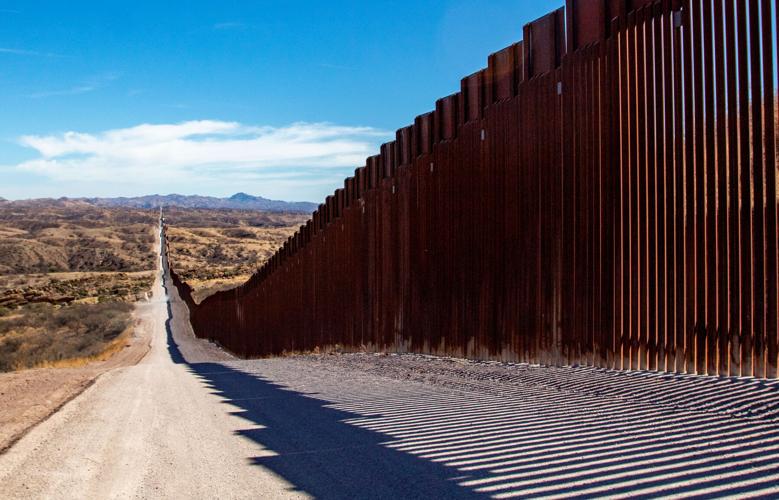
At this far-flung spot, more than 20 miles from the nearest Border Patrol station, the 30-foot-tall border wall abruptly changes to a low-lying vehicle barrier, before ending at a steep hill. The easy access to U.S. soil has made the spot a popular drop-off point for human smugglers transporting migrants, who in recent years have mostly sought to surrender to border agents, rather than trying to evade arrest.
Hundreds of asylum seekers arrived daily in the border area east of Sásabe in late 2023, leading volunteers with groups such as the Tucson Samaritans to establish a series of humanitarian-aid stations, offering life-saving water, food and shelter to exhausted migrants as they waited for hours or days — often in extreme heat or cold — for border agents to arrive.
But migrant arrivals across the entire southern border have plummeted since then, and on Wednesday afternoon, there was no sign of human activity on either side of the wall, aside from the handful of U.S. humanitarian volunteers checking on supplies.
“It’s been quiet,” said Gail Kocourek, a long-time volunteer with the Tucson Samaritans. “There’s nothing going on. The numbers had already dropped a lot under Biden.”

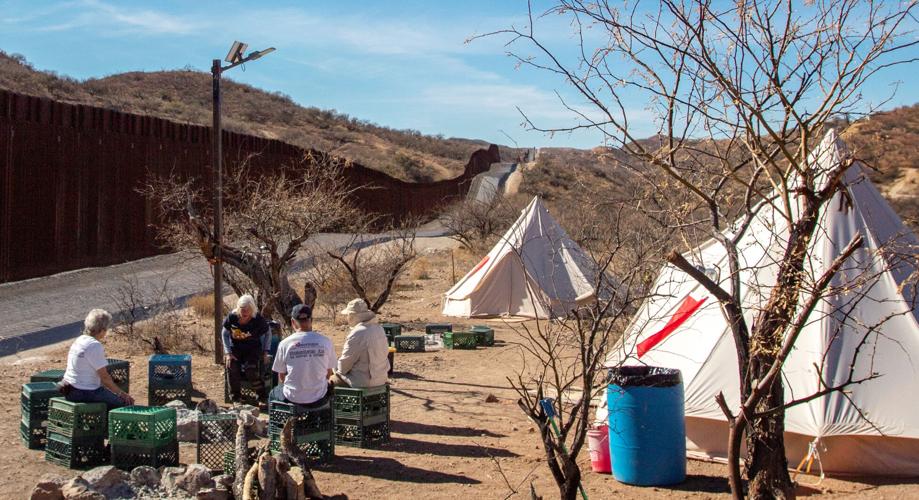
Four volunteers with the Tucson Samaritans sit around a stone-lined fire pit at the volunteer-run humanitarian-aid camp on Wednesday, more than 20 miles east of the nearest Border Patrol station. Volunteers established the camp to provide water, food, shelter and first-aid to migrants arriving in this remote area. Hundreds of asylum seekers were crossing the border in this region every day in 2023, sometimes waiting hours or days in harsh conditions for border agents to arrive. But migrant arrivals here have plummeted since then, even before President Donald Trump took office in January, volunteers say.
The reality here is tough to square with the Trump administration’s Jan. 20 declaration of a “national emergency” at the border, which Trump said, in an executive order, warrants a surge of U.S. Department of Defense resources.
“America’s sovereignty is under attack,” reads President Donald Trump’s national emergency declaration. “Our southern border is overrun by cartels, criminal gangs, known terrorists, human traffickers, smugglers, unvetted military-age males from foreign adversaries, and illicit narcotics that harm Americans, including America.”
Another executive order declared an “invasion” at the border, an unprecedented move that shut down access to asylum protections in the U.S. A third order closes off legal pathways to humanitarian protection in the U.S., established under President Joe Biden to discourage people from entering the U.S. outside official ports of entry.
Fort Huachuca is now hosting 500 active-duty soldiers deployed from New York’s Fort Drum “to support the effort to take operational control of the southern border,” a Fort Drum press release said.
Mexican President Claudia Sheinbaum also agreed to send 10,000 more Mexican National Guard members to her country’s northern border, as part of an agreement to delay Trump’s threat of 25% tariffs on imports to the U.S. That includes 400 new Guard members now stationed in Nogales, Sonora, the city’s mayor said.
The surge of resources, considering current conditions at the border, is a “mismatch,” Colleen Putzel-Kavanaugh, associate policy analyst for the nonpartisan Migration Policy Institute, said on Thursday.
“It’s odd to hear the words of ‘national emergency’ or ‘invasion’ applied to the current reality,” she said. “We are seeing some of the lowest border encounters in decades, so the need to surge all of these resources and personnel to the border doesn’t entirely add up. What the military or National Guard can currently do in helping Border Patrol or Office of Field Operations (at ports of entry) is very unclear.”

Tucson Samaritans volunteer Marla Freedman Rice, left, walks west along the U.S.-Mexico border toward a humanitarian-aid camp, located on U.S. Forest Service land on the north side of the border-wall road. In this remote area more than 20 miles from Sásabe, the 30-foot-tall border wall abruptly changes to a low-lying vehicle barrier, before ending at a steep hill. The easy access to U.S. soil has made the spot a popular drop-off point for human smugglers transporting migrants and asylum seekers.
Republicans in Congress are also pushing for $175 billion in additional U.S. Department of Homeland Security funding for border enforcement, and for interior enforcement led by U.S. Immigration and Customs Enforcement, which is running short on detention space needed to meet the Trump administration’s demand for deportations.
DHS’s current budget is just over $100 billion already, said Adam Isacson, director for defense oversight for the Washington Office on Latin America, or WOLA.
“The upshot of it is, probably sometime in the next month, there’s going to be an historically enormous amount of money for DHS, and some of that is going to be for the border, but the bulk of it will be mass deportation,” he said.
Outside U.S. ports of entry, the southern border is now fortified by 16,500 Border Patrol agents, an expected 3,600 active-duty military soldiers, 4,500 Texas National Guard and 2,200 National Guard already deployed under Biden, Isacson said. With just 29,000 migrant arrests recorded in January, that equates to about one migrant per law enforcement agent or soldier per month, he said.
Using the even lower daily migrant-arrival rate for the week of Feb. 13, that equates to about one migrant for every 100 soldiers or agents per day.
“What are they all doing?” Isacson said.
“Invasion” declaration unwarranted, advocates say
Advocates allege that the “invasion” declaration, invoked under Section 212(f) of the Immigration and Nationality Act, is illegal and also threatens the lives and safety of thousands of would-be asylum seekers.
Even asylum seekers who legally entered the U.S. after presenting themselves at a port of entry are now subject to deportation without having their asylum claim heard.
The American Civil Liberties Union sued the Trump administration Feb. 3 on behalf of legal-services organizations that provide counsel to asylum seekers, including Arizona’s Florence Refugee Rights and Resettlement Project. The ACLU says the asylum shut-down endangers “countess lives.”
“No president has the authority to unilaterally override the protections Congress has afforded those fleeing danger,” said Lee Gelernt, deputy director of the ACLU’s Immigrants’ Rights Project.
Isacson said legal challenges will likely result in the “invasion” declaration being overturned, as there’s no justification for it.
“I don’t think unorganized, leaderless kids and families and job-seekers with humanitarian needs are an invasion,” he said. “I don’t think most judges would agree with that. ... Once a judge does strike that down, I think even the Supreme Court won’t think there’s an invasion.”

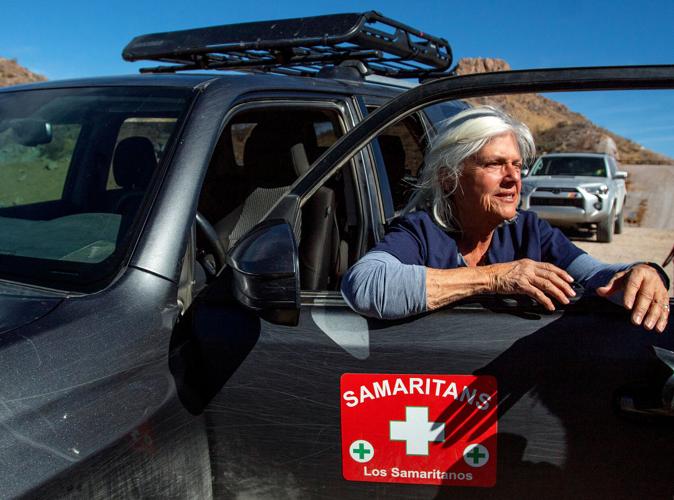
On Wednesday, long-time Tucson Samaritans volunteer Gail Kocourek visited a humanitarian-aid camp established by volunteers more than 20 miles east of Sásabe, Sonora, along the border-wall road. Although other volunteers reported a handful of asylum seekers had been picked up by border agents early that morning, there was no one at the camp on Wednesday afternoon. Migrant arrivals across the entire southern border have plummeted since 2023. "There's nothing going on. The numbers had already dropped a lot under Biden," Kocourek said.
Since Trump took office, lawyers with the Florence Project haven’t met anyone detained at ICE’s Eloy or Florence facilities who were being processed for asylum claims, or more limited relief options, such as protection under the Conventions Against Torture — for those who prove they’d likely be tortured if returned home — or withholding of removal, said Rocío Castañeda Acosta, advocacy attorney with the nonprofit.
Even with the invasion declaration, those two options should still be available for those who meet the high threshold required, Putzel-Kavanaugh said, but it’s still not clear how Border Patrol is handling those cases.
More than 150 would-be asylum seekers attended a recent information session at Kino Border Initiative in Nogales, Sonora, where Castañeda spoke. The atmosphere was “heartbreaking,” she said. Some attendees had been kidnapped and extorted in Mexico while waiting for an appointment through the Biden-era CBP One phone app, which allowed them to enter a U.S. port of entry to request asylum. The day he took office, Trump swiftly canceled all CBP One appointments, for which many had waited as long as a year.
“There was sadness, fear, hopelessness and a lot of worry about what do we do next. How do we even journey back?” Castañeda said.
Already low migrant arrests drop further
On Wednesday morning at the Sásabe migrant-aid camp, volunteers reported that a handful of asylum seekers had been picked up by Border Patrol agents around 8 a.m. — and likely faced a quick return to Mexico — but since then, it appeared no one else had arrived all day. The camp’s stone-lined fire pits were cold, and two white tents offering shade and a place for rest were empty.
Even before Trump took office, in December Tucson Sector migrant arrests already had declined by 80% from December 2023, when record-high arrest figures ballooned amid a global increase in migration. Throughout 2024, the steep decline was due to both aggressive enforcement in Mexico, preventing migrants from reaching the border, and the Biden administration’s limits to asylum access, implemented in June 2024.
In the Tucson Sector in January, border agents arrested 4,727 migrants between official ports of entry, about a 35% decrease compared to December 2024, according to the latest figures from U.S. Customs and Border Protection, or CBP, which oversees Border Patrol.
Border-wide, agents arrested 29,000 migrants between ports of entry last month, compared to 47,300 in December, CBP data show.
The week of Feb. 13, Border Patrol arrests dropped to about 285 daily arrests border-wide, compared to 1,500 daily arrests in December, Border Patrol Chief Michael Banks told CBS News.
Border Patrol’s Tucson Sector Chief Sean McGoffin told the Star in a Feb. 12 interview that in the previous week, agents had arrested just 460 people, or about 66 each day, and the numbers were continuing to decline.
The certainty of a quick removal, along with prosecutions to impose criminal consequences, are contributing to lower arrivals, said McGoffin, who moved from his role as Yuma Sector chief to replace outgoing Tucson Chief John Modlin in November.
Fewer encounters with large groups of asylum seekers — which required agents to devote substantial resources to transporting and processing people — means agents can focus on their primary mission of apprehending those trying to evade detection, he said.
“The morale has gone up as a result of that, because they’re doing the job they signed up to do,” he said.
McGoffin would not directly respond to the Star’s questions about whether he’d characterize the current situation at the border as an emergency or invasion.
“I’ll just tell you this: Any time you have a situation where you have a border, someone’s going to be engaged in smuggling,” he said. “We have to have an absolute degree of certainty where nothing’s crossing the border. Until you have that you’re going to have a situation where we need to have a significant presence down there making sure that doesn’t happen.”
The appearance of calm at the border isn’t what matters, he said.
“There are cartels on the other side of the border that are engaged in nefarious activity, whether it’s narcotics, whether it’s people, those things are still going on,” he said. “... We have to make sure that we’re stopping it at all costs.”

On Wednesday, the border wall east of Sásabe, Arizona was quiet. In recent weeks, since President Donald Trump took office, Border Patrol arrests between ports of entry have dropped to about 350 daily arrests border-wide, compared to 1,500 daily arrests in December. Border Patrol Tucson Sector Chief Sean McGoffin told the Star in a Feb. 12 interview that in the previous week, agents had arrested just 460 people, or about 66 each day. “It’s continuing to go down as we speak,” McGoffin said.
Isacson said it remains to be seen whether current low arrest figures will hold, or if migrants and human smugglers are taking a “wait-and-see” approach, as is common during times of leadership or policy changes.
“We’ve got monthly data of Border Patrol apprehensions by month, going back to fiscal year 2000,” Isacson said. “And the lowest months of the century were not during COVID; they were actually during the first few months of Trump’s first term.”
After Trump took office in 2017, border agents arrested just 11,000 migrants that April before the numbers began to climb again, reaching 130,000 monthly arrests by the spring of 2019, Isacson said. Migrant arrivals slowed when the pandemic started, then rose again during the post-COVID economic recovery, Isacson said.
The U.S. economy and availability of jobs is still the biggest “pull” factor for migrants, he said.
McGoffin didn’t have a clear answer on whether any asylum cases were still being processed for those who told border agents they feared return to their home country. A border agent present during the Star’s interview said Conventions Against Torture claims are being processed, but CBP has not yet responded to the Star’s efforts to confirm that.
McGoffin also suggested that asylum seekers should simply go to a port of entry, as has Trump’s “border czar” Tom Homan, without acknowledging that Trump’s executive orders, and the cancelation of the CBP One application, have eliminated the avenues to do so.
Access to official ports was already tightly controlled before Trump took office last month, with asylum seekers routinely prevented from approaching the ports, either by U.S. or Mexican officials, advocates say. The Star has interviewed families sleeping with their young children outside Nogales’ DeConcini port of entry in hopes of eventually being allowed to enter the port to request asylum.
CBP has not yet responded to the Star’s request to clarify with port officials the current protocol at the DeConcini port.
Impact of surges to border
So far, the most visible impact of Mexico’s National Guard surge to its northern border has been the extended wait times for tourists returning to Arizona from the Sonora beach town of Puerto Peñasco, known in Arizona as Rocky Point.
Mexican National Guard are searching each vehicle in the border town of Sonoyta, as they approach the port of entry at Lukeville, Arizona, Sonora officials and tourists say.
Puerto Peñasco tourism director Lizette Ybarra told the Star that local officials had recently met with state tourism officials in hopes of finding ways to speed up the searches, but she acknowledged that travelers should plan for delays as they return to Arizona.
In a Facebook post, Puerto Peñasco Mayor Óscar Castro said Lukeville port director Peter Bachelier has agreed to extend the port’s closing time from 8 p.m. to 10 p.m. on Fridays from March to October, and to keep the port open after 8 p.m. on other days when vehicles are still in line.
Nogales, Sonora Mayor Juan Francisco Gim told local media that 400 National Guard members had arrived in the city in the first week of February, where, in addition to fortifying the border, they would focus on national and local security.
In the small border town of Sásabe, Sonora, two Mexican National Guard members stood near the quiet port of entry last Wednesday. They told the Star they’d been transferred from Mexico City in December, but didn’t know whether additional Guard members had arrived as part of Sheinbaum’s accord with Trump.
The young Guard members said their role was focused on searching vehicles entering Mexico for weapons and drugs, as well as peace-keeping alongside the larger Mexican Army presence in the small town.

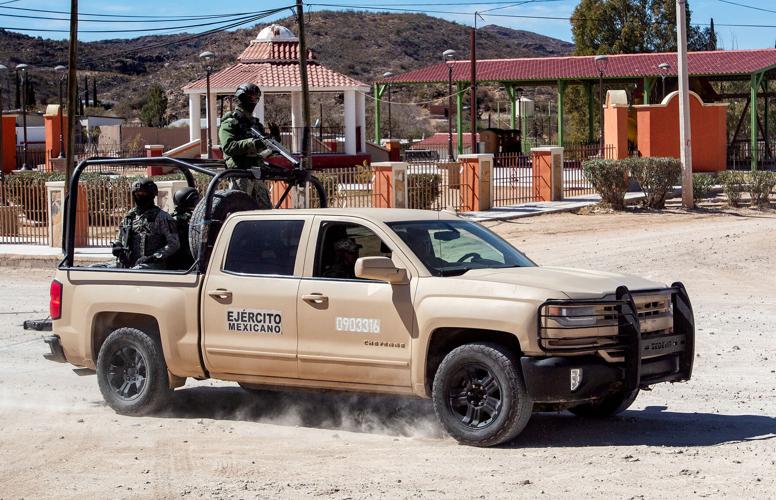
One of four trucks carrying Mexican Army soldiers drove through the small border town of Sásabe, Sonora on Wednesday. Most of the 2,000 residents of Sásabe, Sonora fled in late 2023 amid a violent conflict between two criminal factions, fighting for control of the lucrative human-smuggling routes in the area. Two National Guard members near the Sásabe port of entry told the Arizona Daily Star that the violence has subsided and traveling through the town is safe now. The Guard members said their role in Sásabe is focused on searching vehicles entering Mexico for weapons and drugs, as well as peace-keeping alongside the larger Mexican Army presence in town.
Most of the 2,000 residents of Sásabe, Sonora fled in late 2023 amid a violent conflict between two criminal factions, fighting for control of the lucrative human-smuggling routes in the area.
The violence has subsided, and traveling through the town is safe now, the National Guard members said.
Need for humanitarian aid remains, volunteers say
While the numbers are low, smugglers are still dropping off some people most days at the end of the border wall, east of Sásabe, volunteers say.
Since Feb. 1, about 74 asylum seekers have arrived here and surrendered to border agents, said Charles Cameron of the Green Valley-Sahuarita Samaritans. Volunteers with the Tucson and Green Valley Samaritans, Humane Borders and No More Deaths coordinate to ensure a daily presence in this area.
In recent weeks, “the Border Patrol presence has diminished. We expected the opposite,” Cameron said. “We haven’t seen any sign of the military, and the Border Patrol seems to be rededicating their resources inland, rather than to the wall.”
In December, aid workers got a warning from a U.S. Forest Service liaison that their humanitarian camp, located on Coronado National Forest land, would be shut down after Trump took office, but so far, the agency hasn’t made a move to do so.
Forest Service spokeswoman Starr Farrell said the agency would not respond to the Star’s questions about what prompted the warning about the impending camp closure, nor whether the closure might still happen.
“The USDA Forest Service has taken no action related to humanitarian organizations along the border wall east of Sasabe, Arizona,” she said in a Feb. 13 emailed statement. She directed the Star to CBP for more information.
Tucson Sector Chief McGoffin told the Star he had no information about plans to shut down the camp. He said while he respects the work of humanitarian volunteers and their life-saving mission, he hopes to “put them out of business” due to lack of migrant arrivals.
Aid groups say the vast majority of border agents they encounter are appreciative of volunteers’ presence here. Prior to the establishment of the camp, and their addition of donation-funded portable bathrooms, volunteers were trucking donated supplies to the remote area from hours away, and digging latrines for human waste.
“It was horrible. That’s why Doctors Without Borders came” in May 2024, declaring a “humanitarian medical crisis“ at the site, Kocourek said. “We were really afraid of a cholera outbreak.”
The volunteers routinely notify Border Patrol about medical emergencies, or the presence of asylum seekers seeking to turn themselves in to agents, who previously rarely patrolled this area. Aid workers also prepare migrants for what to expect when agents arrive.
“There have been a number of Border Patrol agents — the actual people with boots on the ground here — saying, ‘We don’t know what we would do if you weren’t here. People would just be scattered to the wind,’” Cameron said.
Humanitarian volunteers report rendering first aid to pregnant and elderly travelers; sick infants; and people with broken limbs, hypothermia, heat-related illness and physical or developmental disabilities.
Earlier this month, volunteers aided a Guatemalan man in a wheelchair and his 8-year-old daughter, who was “trembling” with fear, Cameron said.
“What would this guy have done if we weren’t out there? He was totally immobile. His daughter was scared to death,” he said. “We tried to comfort her, but we couldn’t.”
Local ranchers have also expressed gratitude for the volunteers’ construction of protected fire pits, which are much less of a fire hazard than the scattered fires migrants sometimes build themselves, Kocourek said.
Despite the threats of the camp being forcibly shut down, “We’re operating under the assumption that we’ll keep a minimal camp footprint going, as long as people keep showing up,” Cameron said.
Even saving one life, or comforting one scared child, is worth the effort, Kocourek said on Wednesday after replacing the bags in the camp’s trash bins.
“It’s not the amount of people; it’s the fact that we’re here,” she said.

