


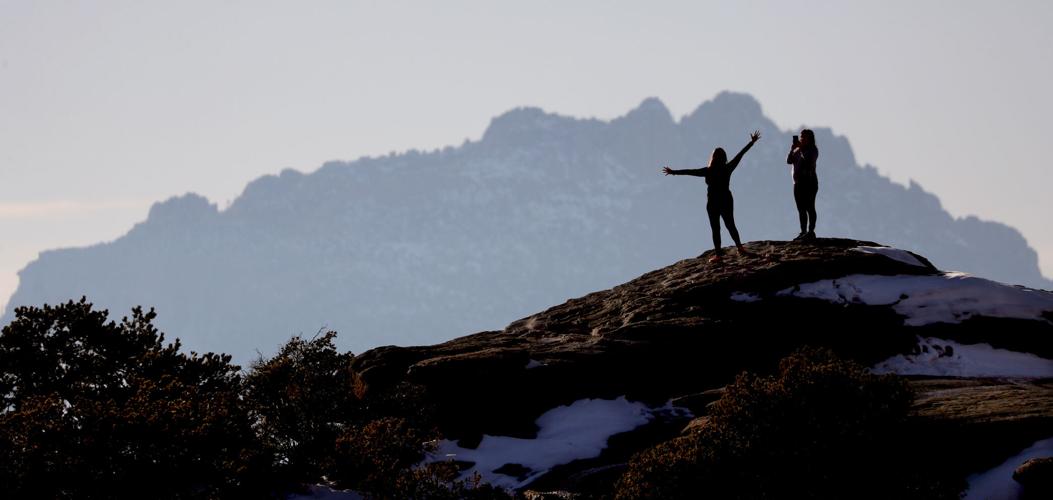

Large sections of Sabino Canyon Recreation Area, Mount Lemmon and Madera Canyon, and parts of Mount Graham, would be eligible for selling off as part of proposed Senate legislation that would authorize disposal of millions of acres across the West.
The bill, introduced last week, would require both the U.S. Interior secretary and the U.S. Agriculture secretary, who oversees the U.S. Forest Service, to sell between .5% and .75% of their total land holdings.
The bill’s stated purpose is to open up some federal lands for housing to ease the nation’s chronic housing shortage. It would set criteria for offering land for sale based on its suitability for housing, its proximity to existing housing and whether it’s part of an isolated tract that would be inefficient to manage.
"There is a nationwide shortage of approximately 4 million homes and a shortage of 7 million affordable homes. This extreme lack of supply and affordability, coupled with excessive federal land ownership in the West constrains economic growth and the opportunity for western communities to thrive. Unlocking federal land for housing will develop millions of single-family homes, resulting in greater housing supply and making housing more affordable," a Senate Energy and Natural Resources Committee fact sheet about the bill said.
Environmentalists locally and regionally are denouncing the legislation as a potential giveaway to billionaires to add on to their existing large tracts to build “megamansions,” not affordable homes. They note that language in the bill says the land sold could be used for housing or other “associated community needs.”
Tuesday morning, Arizona Sen. Mark Kelly, a Democrat, joined the chorus of opponents, saying, "I oppose any effort to force the sale of Forest Service land in Arizona. These public lands are part of who we are as they support our economy, protect our environment, and offer Arizonans a place to hike, hunt, and explore.
"Selling them off to fund Trump’s tax giveaways to billionaires is reckless and wrong. Once they’re gone, they’re gone for good—lost forever to public use and conservation," Kelly said in a statement.
In total, 2.2 million to 3.3 million acres of public lands in 11 Western states including Arizona would have to be sold if the legislation passed, various press accounts have reported. The only Western state where no land sales would occur would be Montana, whose Rep. Ryan Zinke — a former Interior secretary — has strongly opposed such legislation in the House.
The reason that prime recreation areas such as Sabino and Madera canyons in the Tucson area, and the Mount Graham area in eastern Arizona, are on the list is that they don’t fall within a number of classes of federal lands that would be exempt from being offered for disposal. National parkland, national monuments and wilderness areas could not be offered for sale, for instance.
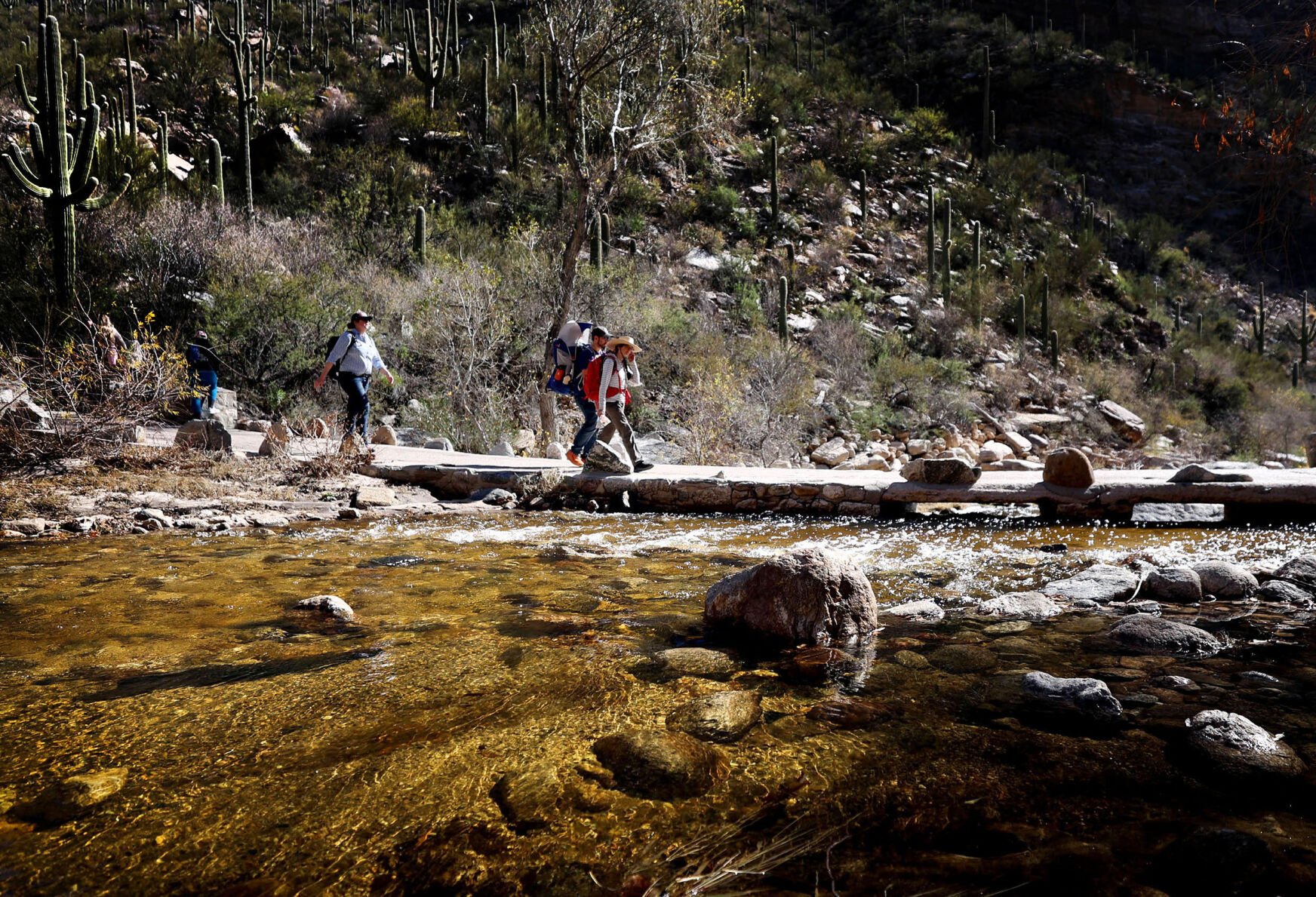
Large sections of Sabino Canyon Recreation Area, shown here, and of Mount Lemmon and Madera Canyon in the Tucson area would be eligible for selling off as part of proposed Senate legislation that would authorize disposal of millions of acres across the West.
The Sabino Canyon Recreation Area at the base of the Catalina Mountains and the Madera Canyon area at the base of the Santa Rita Mountains aren’t set aside as wilderness even though large areas of both ranges are in wilderness.
“It’s a disgraceful giveaway of public lands. Our favorite areas of our public lands to hunt and camp in would be sold to billionaires to build more megamansions,” said Laiken Jordahl, a conservation advocate for the Tucson-based Center for Biological Diversity.
“I go to Mount Graham regularly. We camp on Mount Lemmon all the time,” Jordahl said. “They are not abstract or far way places. They are our cherished public lands.”
Utah Republican Sen. Mike Lee, who chairs the Senate Committee that drafted this legislation, and other backers say the bill would open up lands for future housing development to ease the country’s chronic shortage of affordable housing.
“We’re opening underused federal land to get Washington, D.C. out of the way of communities that are trying to grow,” said Lee last week in a video announcing introduction of the legislation.
“This does not touch national parks, monuments or wilderness. Were talking about isolated parcels that would be better to manage privately and better suited for housing and infrastructure,” he said.
“Washington has proven again and again it can’t manage its lands. We’re opening up lands for energy and resource development. We’re turning federal liabilities into taxpayers’ values, reducing the deficit and unleashing American energy.”

Parts of Mount Lemmon would be eligible for selling off as part of proposed Senate legislation that would authorize disposal of millions of acres across the West.
Kate Groetzinger, of the environmentalist Center for Western Priorities, called the bill a blatant and clumsy attempt to liquidate millions of acres of national public land “that currently belong to all Americans.”
She said the bill would not only offer for sale lands “completely inappropriate for affordable housing, but it contains no specifications requiring housing built on these lands to be affordable.” Instead, it would “allow billionaires to buy scenic National Forest land to build trophy homes on the tops of mountains or increase the size of their private ranches,” she said.
Lee, however, said in the video, “You will not lose access to the lands you love. We’re reopening unused federal land, to expand housing, support local land development and get Washington, D.C. out of the way.”
The legislation was introduced as part of the budget reconciliation measure that has been pushed by President Donald Trump as his “big, beautiful bill.”
It’s one of many proposed provisions that backers of the legislation say could raise revenue to offset what’s lost by the tax cuts the bill proposes.
If enacted, the legislation would lead to lands being put up for sale fairly fast.
The Wilderness Society this week released an analysis of the land sale legislation that concluded more than 250 million acres of federal lands would be eligible for being offered for sale. The group had previously estimated that about 120 million acres would be eligible for possible sale, but increased that figure after the Senate Energy and Natural Resources Committee put together an updated version of the bill last Saturday (June 14).
Not later than 30 days after the legislation becomes law, the Interior and Agriculture secretaries would be required to publish notices soliciting nominations of BLM and Forest Service parcels for potential disposal. Nominations could be made by the general public or by state and local agencies. More than 14 million acres of Forest Service and BLM lands in Arizona would be eligible for sale, the society's analysis concluded.
Not later than 60 days after the bill was enacted into law, and every 60 days afterward, both the Interior secretary and Agriculture secretary would have to identify tracts of federal land suitable for disposal.
Before lands could be formally offered for sale, the federal agencies would first have to consult with the governor of the state in which the parcel is located, “applicable” local government agencies and “applicable” tribes, the bill says.
The “land sale hotspots” such as Sabino Canyon and Mount Graham are shown in an interactive map produced by the environmentalist Wilderness Society to show what areas would be eligible for sale under the legislation.
“We applied the criteria in the Senate bill to the public lands estate in the West, and then we highlighted what is left that would be available for sale. And that’s where you see places like Sabino Canyon, the backside of Mount Lemmon being eligible,” said Mike Quigley, the society’s Arizona State Director.
For many Tucsonans like Quigley, it’s hard to think of another place in Tucson that has the same name recognition and outdoor access as Sabino Canyon.
“Sabino Canyon in particular means a great deal to the people of Tucson,” Quigley said. “It’s where families go during the holidays, when they have out-of-town visitors. It’s where the people of Tucson go every day to get in exercise in a nice outdoor environment. And it’s really a beautiful canyon. It’s a crown jewel of the Coronado National Forest in Tucson and Southern Arizona.”
A scaled-down version of the bill, allowing land sales in only Utah and Wyoming, was offered in the House when it debated the tax cut legislation. But it was pulled before the lower chamber could vote on the bill at the insistence of Zinke.
Arizona Sen. Ruben Gallego, a Democrat, tweeted that earlier this year, he had reached out to the White House and to Republicans in Congress that he is “ready and willing” to work toward a bipartisan solution “to use federal land for affordable housing. I heard nothing.
“Now, they are burying language to sell off public lands in their reckless budget bill — arbitrarily mandating how much land should be sold and leaving out any protections to insure the housing that is built on that land would be affordable. This isn’t the solution,” he tweeted on Monday.
Jim Darling, president of Friends of Sabino Canyon, said, “We’re looking into it and finding out what the reality of that is. I can’t imagine that it would be really seriously considered for disposal.”
He noted that people are working on a new visitors center in Sabino and that the canyon visitorship has a large economic impact locally.
With Mt. Lemmon once again painted white from recent snow showers, here is a look at Tucson's popular winter destination in past decades.

