


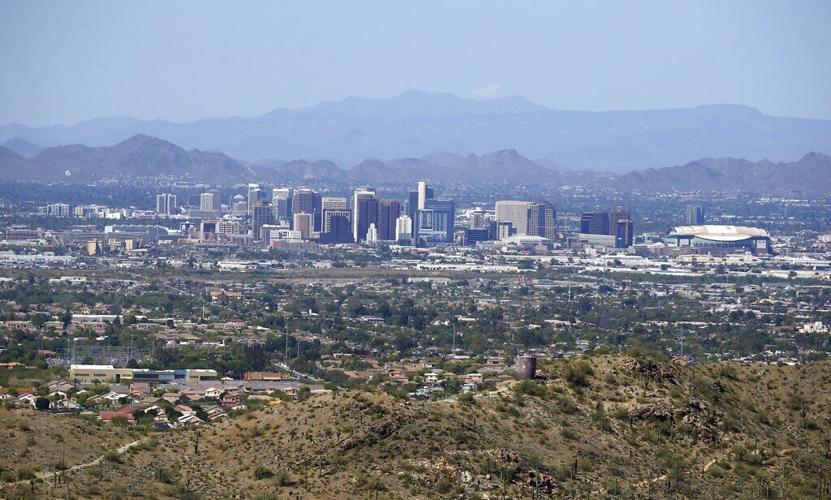


Three major water bills that cleared the Legislature on its final day are being touted by supporters as gains for affordable housing, water-rate savings for some fast-growing Phoenix suburbs, and flexibility for private water companies needing new supplies.
But the bills, now awaiting a signature or veto by Democratic Gov. Katie Hobbs, are being blasted by opponents as little more than vehicles for continued sprawl — and ways to get around state restrictions on the use of groundwater for new subdivisions in the Phoenix area and in Pinal County.
While supporters see the bills as a “win-win” for housing and water supplies, opponents view them as part of a larger “disaster” fouling state water policy.
The three bills would speed conversion of farmland to subdivisions, allow private water companies to transport groundwater from a major rural basin to urban areas, and waive for a decade certain requirements for replenishment of groundwater pumped for new development in some cases.
The backdrop was the June 2023 Arizona Department of Water Resources decision halting all approvals of new subdivisions in the Phoenix area that would be served by groundwater.
It followed a similar ADWR decision in 2019 limiting homebuilding in much of Pinal County lying between Tucson and Phoenix. Both decisions were based on ADWR’s computerized groundwater models that projected groundwater demand will exceed supply in those areas over the next 100 years.
These bills wouldn’t overturn those decisions, but would make it easier for building to resume in some areas affected by them.
In addition, one of the bills would speed conversion of farms to subdivisions in the Tucson area and others unaffected by those decisions.
‘End-around’
Former state water chief Kathleen Ferris and longtime Sierra Club lobbyist Sandy Bahr said the last-minute passage of these bills represents excessive developer control over water matters in the state.
“Rather than ensuring actual enforcement of the Groundwater Management Act, they provide an end-around to the Arizona Department of Water Resources groundwater modeling” that led to state decisions to put brakes on home building in Maricopa and Pinal counties, said Bahr in a letter Tuesday to Hobbs urging vetoes of these and five other water bills.
The bills represent an end-around to “the assured water supply program, and any limits on unsustainable sprawl development. Rather than tightening up the Groundwater Management Act, which is sorely needed, they poke more holes in it,” wrote Bahr, who is director of the Sierra Club Grand Canyon Chapter.
Added Ferris, “It was not a good session for water management. I don’t think anything really important or an improvement for groundwater protection was passed. That happened because the Republicans in the Legislature want to help the developers, pure and simple.”
But Spencer Kamps, a longtime Phoenix-area lobbyist for home builders, calls the bills “good for the aquifer and good for housing. They will allow more supply to come to the market.”
He laughed at opponents’ accusations of excessive developer control, noting that he pushed a bunch of other water bills that never made it through the Legislature.
“I think there’s clearly a desire by policymakers, Democrats and Republicans, to do what they can for water. They understand the water efficiencies for housing (compared to that of farms), and the need for housing,” Kamps said.
“What we do doesn’t hurt the aquifer,” he said, because the groundwater pumped for new homes must be replenished, usually elsewhere, by the recharge of renewable supplies.
Critics, however, say the future replenishment supplies will be threatened by impending cuts in renewable supplies to Arizona from the Colorado River.
Hobbs’ office hasn’t taken a public position on these bills, the governor’s typical stance on pending legislation.
‘A win for homeowners’
The farm to urban bill gives an incentive for farms that typically use the most water to transfer that water supply to housing that has legal replenishment obligations, said Rep. Tim Dunn, a Yuma Republican who was deeply involved in negotiations over that measure.
“It’s a win for the aquifer and a win for homeowners. Home prices are skyrocketing and more supplies will bring down price of homes,” Dunn said.
That bill, the most sweeping of the three to pass, was negotiated back and forth for months before reaching final passage last week. It was voted down in the House on Friday only to be reconsidered and approved on Saturday, the final day of the legislative session, in both GOP-controlled chambers.
The bill would allow developers to buy farmland in areas of Maricopa and Pinal counties where development is now halted and transfer a portion of their water rights to the building of new subdivisions. Those subdivisions could gain certifications of having an assured water supply for 100 years, a state requirement for new subdivisions in urban areas.
And while no such limits exist on new subdivisions in the Tucson, Prescott and Santa Cruz county state-run water management areas, homebuilders who buy farmland there could still use some of the farms’ historic water rights for their assured water supply applications.
Will it save water?

Three major water bills that cleared the Legislature on its final day are being touted by supporters as gains for affordable housing and water-rate savings for some fast-growing Phoenix suburbs. But they're being blasted by opponents as vehicles for continued sprawl and ways to get around state restrictions on groundwater pumping.
A core issue over this bill is whether it really would save water. Opponents questioned that because for the first 10 years after passage, it would allow homebuilders to transfer 2 acre-feet per acre of farm water rights to new homes.
That’s close to twice the 1.3 acre-feet the average Phoenix-area subdivision uses on an acre, ADWR has said.
The bill has been modified to say the subdivision could claim 2 acre-feet per acre or one-half of what a farm in question was using per acre — “whichever is less,” Dunn said.
But the state’s estimate doesn’t take into account water used by amenities in many subdivisions, said Kamps. They include common areas and parks containing grass. stormwater retention basins and community pools, he said. Adding those uses brings total water use per acre much higher, he said.
Before the state decision slamming the brakes on new housing last year, “we included all that land in our subdivisions. It was good water policy, because all of that water use got replenished,” said Kamps, vice president of the Home Builders Association of Central Arizona.
Replying to Kamps, bill opponent Sen. Priya Sundareshan, a Tucson Democrat, said, “These amenities are often a design choice by the developer to include, and this also undercuts the idea that these houses are needed for affordable housing to be built.”

The three bills awaiting Gov. Katie Hobbs' actions would speed conversion of farmland to subdivisions, allow private water companies to transport groundwater from a major rural basin to urban areas, and waive for a decade certain requirements for replenishment of groundwater pumped for new development in some cases.
Previously, the same developers had argued that ADWR’s groundwater model overestimated how much water their subdivisions would use because they only needed 1 acre-foot per acre, she said.
“They are trying to use low numbers to justify why the legislation is necessary and then high numbers to justify why the acre-foot per acre granted them should be high,” Sundareshan said.
Kamps replied that many of these amenities are required by cities, including turf, landscaping, ground coverage and tree sizes. Responding to Sundareshan’s comments, he added that before the state clamped down on subdivision approvals, state-assured-supply certificates were generally for 2 acre-feet per acre, “give or take some,” he said.
The state water agency in late May told a closed gathering of supporters and opponents that its analysis concluded the bill would not save water use at all in Pinal County and would save water use in the Phoenix area only if certain changes were made. The department has been asked by bill supporters to amplify its research by also considering benefits to the aquifer from effluent use and the replenishment of groundwater by these subdivisions.
ADWR officials haven’t responded to questions from the Arizona Daily Star about this bill. But sources on both sides of this issue have confirmed ADWR’s comments in the private meeting.
The bill’s architects changed some but not all provisions in reply to ADWR’s concerns. They tightened up requirements limiting how far water used on farms could be transferred to a new subdivision. Another change gave ADWR the right to decide how many years a piece of cropland had to be farmed out of the last five years for its water rights to be eligible for transfer.
“DWR is doing great work. We want to give them time, as we tried to change these things statutorily, we still believe it will save water for Maricopa and Pinal counties,” Dunn said. “I don’t disagree with how they’re doing modeling and if we can’t show we’re helping the aquifer, it will be hard for (Hobbs) to sign the bill.”
Also awaiting Hobbs’ action
The other bills before the governor include:
— One would let cities in the Phoenix areas that get future, state-approved designations of assured water supply use groundwater on new subdivisions for the next 10 years without having to pay for replenishing the aquifer to compensate for their pumping. It is seen as primarily benefiting Buckeye and Queen Creek, municipalities where growth has been most slowed by the June 2023 ADWR order.
This bill would will avoid short-term “rate shock” for water customers from having to quickly pay for replenishment, supporters say.
But Ferris said it would act as a strong disincentive to the cities for bringing in renewable water supplies to replace the use of pumped groundwater. A pending ADWR rule is aimed at prodding those cities into using renewable supplies and would require them to reduce pumping by 25% if they become designated. But under this bill they could use lots of groundwater in the meantime without replenishment.
“They say we need a bridge to renewable supplies. That’s what they said in 1993” when the state replenishment requirement was passed for new urban area subdivisions, Ferris said. “How many bridges are we going to give these people?”
Ferris’ arguments aren’t wrong, but they ignore political realities and other financial incentives, said Rep. Alexander Kolodin, a Scottsdale Republican who supported that bill.
“If they had to do replenishment from Day 1, they’d never enter a path to designation. No politician would ever impose that rate increase on ratepayers. They’d get voted out of office,” Kolodin said.
The third bill would allow private water companies to transport groundwater pumped from the Harquahala Valley west of Phoenix into urban areas needing additional supplies. That right is now exclusively held by municipal water providers in cities such as Phoenix and Tucson. A small portion of that water can also be transported from the valley into neighboring La Paz County lying west of Maricopa County.
The valley contains one of three groundwater basins in Arizona that are exempt from a state water law passed in the early 1990s forbidding the transfer of groundwater rights from one basin to another. The other basins where transfers are allowed are the Butler and McMullen valleys, also both west of Phoenix.
Dunn said this bill is needed so communities served by private water companies have water available. Not all cities serve all residents water through their own utilities, he said, citing Buckeye and Queen Creek, again, as examples. Casa Grande also doesn’t deliver water to its residents but needs water from other sources to grow, he said.
“That’s just the way we deliver water now,” he said.
But the bill sanctions the use of the Harquahala Valley as a “groundwater pumping sacrifice zone” and rewards speculators and hedge funds who buy and sell groundwater rights from such areas, Sierra Club’s Bahr wrote to Hobbs.
“We also object to giving private water interests more control of water, something that is essential for life, as this bill allows,” she wrote. “We are concerned that this bill will open the door for more entities to try and get at that water. Will we see a bill next year that allows private hedge funds to import water?”
Tony Davis graduated from Northwestern University and started at the Arizona Daily Star in 1997. He has mostly covered environmental stories since 2005, focusing on water supplies, climate change, the Rosemont Mine and the endangered jaguar. Tony and David talk about the award winning journalism Tony has worked on, his journey into journalism, Arizona environmental issues and how covering the beat comes with both rewards and struggles. Video by Pascal Albright/Arizona Daily Star
Tony Davis graduated from Northwestern University and started at the Arizona Daily Star in 1997. He has mostly covered environmental stories since 2005, focusing on water supplies, climate change, the Rosemont Mine and the endangered jaguar. Tony and David talk about the award winning journalism Tony has worked on, his journey into journalism, Arizona environmental issues and how covering the beat comes with both rewards and struggles. Video by Pascal Albright/Arizona Daily Star
Tony Davis graduated from Northwestern University and started at the Arizona Daily Star in 1997. He has mostly covered environmental stories since 2005, focusing on water supplies, climate change, the Rosemont Mine and the endangered jaguar. Tony and David talk about the award winning journalism Tony has worked on, his journey into journalism, Arizona environmental issues and how covering the beat comes with both rewards and struggles. Video by Pascal Albright/Arizona Daily Star

