



Tucson’s water conservation odyssey started with homeowners ripping out lawns and thirsty mulberry and elm trees in the 1970s in favor of prickly pear and mesquite.
Many or most front lawns had vanished here by the 1980s. In the 1990s and beyond, aging toilets and washing machines were phased out in favor of fixtures and appliances that slurp half as much water or less than their predecessors.
Now, the region’s latest water conservation tool appears to be the smart water meter.
Its advocates say it can detect leaks and educate homeowners and businesses about their best paths to saving water during a time of growing scarcity. But some conservationists say it’s not the ideal water-saving device because many of its benefits aren’t guaranteed — unlike those of low-flow toilets and shower heads. Other conservationists do strongly support these meters.
Smart meters were the conservation tool of choice for water utilities, private water companies and other entities in Pima County as they recently reaped $28.2 million out of $200 million in new state conservation grants.
About 55% of this region’s total grants, or $15.76 million, including $6 million that was awarded to the city of Tucson, will purchase smart meters to be installed in homes, businesses and other water users. Sixteen of the 28 projects funded countywide, or 57 of the total, are at least in part for smart meter installation.
Statewide, smart meters also came out on top in the water conservation funding competition, the Arizona Agenda reported.. A total of 72, or 38.1% of 189 projects awarded grants, went for smart meters and related upgrades, the Agenda found. Turf removal projects won 22.1% of the grants, agricultural water system upgrades won 13.2% and water-efficient plumbing fixtures won 11.6%.
The state’s Water Infrastructure Financing Authority’s governing board awarded the last set of grants on Wednesday, after issuing several rounds over the past year. The $200 million is by far the largest single investment ever in Arizona by a government agency on water conservation.
The board awarded 187 grants, including nearly 30 to public and private water utilities and other entities in Pima County. Besides Tucson, grantees include Marana and Oro Valley, Metro Water, numerous private water companies, Pima County government, the nonprofit Watershed Management Group and the Tohono O’odham Water Utility Authority.
The smart meters can electronically transmit signals conveying water use, leaks and other water data to utilities from their customers
But some conservation advocates, agreeing the meters can be a valuable tool, say they will work well only if homeowners and businesses voluntarily take the information they provide and translate it into ways to use less water.
Brian Richter of the national conservation group Water Sustainability says some older methods, such as replacing still-thirsty fixtures in homes, offer more certainty. At a time when every drop counts, it’s important to be as certain as possible of saving as much as possible, Richter says.

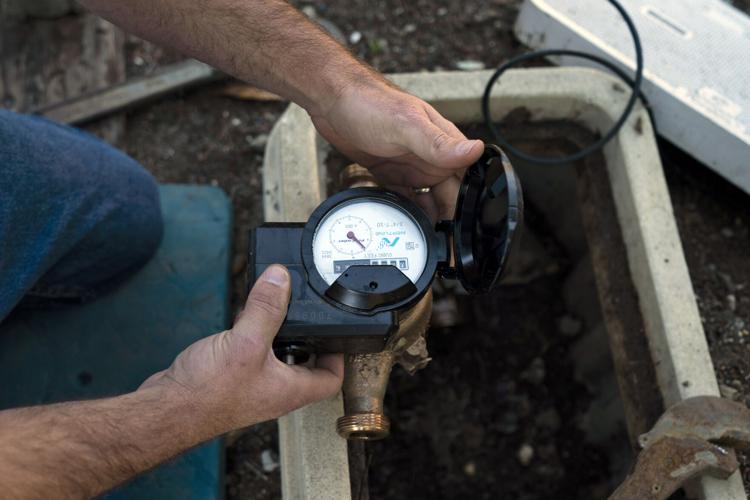
A worker installs an advanced water metering system. Tucson Water is getting $6 million for smart meter installation from state grants. They will serve all its commercial, industrial and reclaimed water customers, and about 10% of its residential customers, said utility spokesman Natalie DeRoock.
Others advocate additional harvesting of rainfall to replace use of groundwater or Colorado River water for outdoor landscaping and for growing fruits and vegetables at home. That practice is already subsidized by rebates from the city of Tucson and suburban Metro Water.
Such measures were barely in the running in the recent competition for the state money. Only a little more than $3 million, or about 10% of the $28 million awarded to Pima County users, will go for replacing aging fixtures, state records show.
Only one project receiving state funds in Pima County was for water harvesting — for about $250,000. It went to a joint project sponsored by the nonprofit Native Seeds Search and the Pima County Department of Natural Resources, Parks and Recreation to install “an interconnected series of earthworks, collection gutters and cisterns.”
Residents to get meters
Tucson Water is getting $6 million for smart meter installation, out of about $11 million in total grants. They will serve all its commercial, industrial and reclaimed water customers, and about 10% of its residential customers, said utility spokesman Natalie DeRoock.
Tim Thomure, a former Tucson Water director who becomes Tucson’s city manager on July 1, said he generally agrees with Richter’s observation that voluntary, behavioral conservation actions are not as certain as structural conservation actions such as turf removal and fixture replacement.
A fact sheet provided by the state water financing authority essentially agrees. Studies suggest such meters can promote water conservation, “but it depends on individual and household characteristics and how communications are designed and targeted,” the fact sheet said.
But smart meters “are still meaningful and substantial,” Thomure said. “For example, an undetected exterior plumbing leak can waste as much, or more, water than a leaky or inefficient fixture.”
With smart meters, “such leaks will be detected much sooner, giving the opportunity to take fast action and save water. Further, (they) can detect water loss from leaky fixtures that might otherwise go undetected — and be the catalyst for a structural conservation fix,” he said. “As such, (deploying smart meters) is a strong water conservation strategy and is complementary to other water conservation actions.”
Thomure sits on the water infrastructure authority’s governing board. But he said he recused himself from voting on any grant involving the city of Tucson. That was to avoid an appearance of a conflict of interest, he said. He said he was speaking to the Arizona Daily Star about this issue solely as an authority board member.

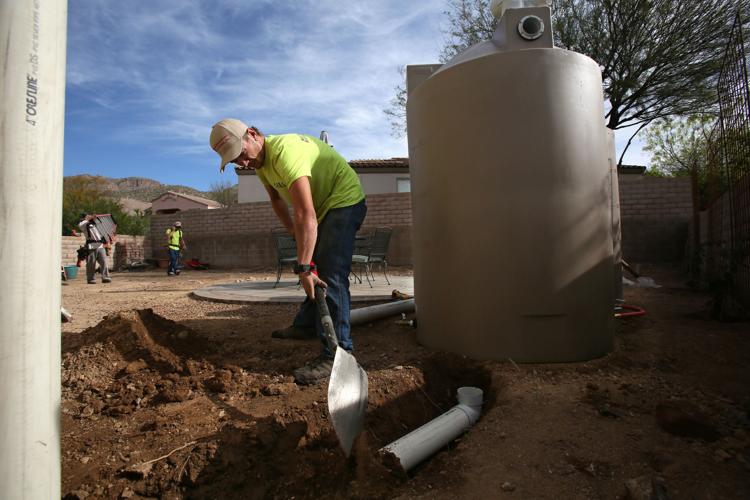
A worker buries PVC pipe that feeds rainwater from gutters to two 500-gallon tanks in Tucson, so the water can be used on outdoor landscaping. Advocates call for additional harvesting of rainfall to replace use of groundwater or Colorado River water for outdoor landscaping. But such measures were barely in the running in the recent competition for state grants for water conservation.
Currently, Tucson Water service technicians respond to over 3,000 leaks yearly, DeRoock said. Use of the meters means the utility and its customers can “proactively address and repair leaks. Additionally, it will help identify and reduce water losses due to theft or leaks via continuous monitoring and data analysis.”
The smart meters will also help the utility reduce fuel use and CO2 emissions by eliminating the need to drive tens of thousands of miles yearly to collect meter reads, Tucson Water says.
The northwest side’s Metro Water’s $3 million state grant will pay to install 12,000 meters, primarily for residential uses, said its general manager, Joe Olsen. The meters will provide “real-time updates” on household water usage and potential leaks, compared to what’s now found in a single monthly meter read, he said.
With a $2 million federal grant and a million in local matching funds added, the utility will have $6.5 million for new meter installation, he said.
Also, customers will be able to log into portals on these meters, to see historical and current water usage, Olsen said.
Pima County fared well
The $200 million statewide water conservation pool is the product of a hard-fought compromise.
In 2022, Republican Gov. Doug Ducey and Republicans who control the Legislature wanted to authorize spending $1 billion to build a desalination plant or another big project to import water from out of state.
The Republicans agreed to the conservation money to gain Democrats’ support. Some Republican legislators also held off supporting the $1 billion augmentation measure unless there was conservation money, based on the argument action is needed now while it will take a decade or longer to get a big water importation project approved and built.
In the doling out of state money, Pima County actually fared proportionately better than did Maricopa County, which often outmuscles Pima for state dollars.
Pima County reaped about the same percentage of the state money — 14.1% — as its percentage of Arizona’s 7.5 million population.
Maricopa County, with about 4.5 million residents, got far more water conservation money — about $69 million, or about 35% of the $200 million. That’s proportionately a smaller slice than its 61% of Arizona’s population.
Maricopa County cities’ and other utilities’ planned uses of their money will be radically different than what’s planned by Pima County cities, private water companies and the Tohono tribe.
Only about 10% of the $69 million headed to Maricopa County is planned for smart meter installation and replacement. About 15% of its money is targeted at replacing thirsty plumbing fixtures.
The biggest share of its state money — 41% — will be devoted to pulling up grass from parks, school grounds and commercial and residential properties, to be replaced by desert trees, cacti and shrubs, since grass is far more common there than here.
In Tucson, the City Council has already approved restrictions on installation of strictly decorative grass in new commercial and apartment developments. Council members have said they wish to ultimately follow this up by eventually removing existing turf. But only 1.5 million of the city’s $11 million in state grants is for turf removal.
One reason Tucson-area utilities now favor smart meters is that they save money for paying meter-readers to drive trucks around neighborhoods and business districts, said a longtime water expert here. He asked that his name not be used because he said he doesn’t want to lose his access to local water officials for speaking out publicly.
The state grants only provide funds to utilities that were planning to install smart meters anyway, he said.
While smart meters can lead to conservation, to go beyond using them to detect leaks will require them to gain more data, the expert said. Utilities will need to do more analysis to pinpoint households whose peak-hour water usage is attributed to irrigation and that are using “way more than their landscaping will need,” he said.
Smart meters can be a reasonable conservation tool for homes or businesses with old infrastructure and a lot of leaky pipes — if they make good use of the meters’ data, the expert said, adding, “My guess is for most water service utilities, conservation is not the number 1 reason for using the meters.”
But smart meters offer value to the city beyond water conservation — “they’re the wave of the future,” said Val Little, a longtime conservation advocate and a member of Tucson’s Citizens Water Advisory Committee.
If it was just water conservation at issue, “they might have come up with different ways to use that money,” Little said.
The state grant offers the utility cost savings for the expensive smart meter installations, with conservation benefits being a byproduct, she said.
With conservation, “we already have the low-hanging fruit taken care of,” she said.
Water savings foreseen
Installing a smart water meter can reduce water deliveries by 2-10% by reducing unmetered deliveries, detecting leaks, and driving conservation behavior, said a fact sheet provided to the Star by the state water infrastructure authority.
Metro Water’s Olsen gave a slightly higher savings estimate, saying that “according to multiple industry studies, to result in between 9% and 12% reduction in water usage.”
But new, “water smart” plumbing fixtures appear to save more water — being 20% more efficient than older, standard fixtures, said a second fact sheet from the state water authority. High efficiency toilets and shower heads can save up to 60% in water use compared to less efficient fixtures, that fact sheet said.
At the same time, statistics Tucson Water gave the state water authority show the city’s smart meter installations will save significantly more water over the meters’ life than would be saved by other city proposals — which were also funded — to replace outdated plumbing fixtures.
But installing rainwater harvesting basins in homes or neighborhoods can also save substantial water and provide numerous other community benefits, said Brad Lancaster, author of two books on the subject.
Building an average-sized basin along streets costs $1,300 to $1,700, and the basins last at least 30 to 60 years, and can harvest 67,000 gallons of water in 15 years, he said.
The Dunbar Spring neighborhood north of downtown Tucson where Lancaster lives has been installing such basins for 28 years and they still “work great,’ he said. While city of Tucson water harvesting rebates cover half the cost of installing such basins, another funding source could pay for more, he said.
“The smart meter gets you a smart meter, water conservation (of imported water), and data,” Lancaster said.
But a street-side basin also brings “a native food forest, water conservation and water gain, flood control, water conservation, direct and indirect recharge of our aquifer, heat-island abatement with its native shade trees and understory plantings, wildlife habitat, beauty, community involvement and community building,” Lancaster said.
While smart meters are a good thing, he said, Tucson should invest more in “living passive water-harvesting, native-food forestry efforts that have a much longer life than smart meters, conserve and capture far more water, and which provide a far greater array of community and environmental benefits.”
Longtime Arizona Daily Star reporter Tony Davis talks about the viability of seawater desalination and wastewater treatment as alternatives to reliance on the Colorado River.

