

PHOENIX — Republican lawmakers are moving to help insurance companies ensure they get a jury more to their liking when their clients are sued for everything from traffic accidents and contract disputes to malpractice and polluting the environment.
But the question of whether they have the constitutional power to do so remains in doubt.
On a party-line vote, the Republican-dominated House Appropriations Committee approved a proposal Monday by state Sen. Mark Finchem to reinstate, at least in part, a practice that used to allow attorneys for each side to use peremptory challenges. These challenges allow them to eliminate jurors not for any specific reason like bias but, in essence, because they believe those individuals are less likely to see things the way their clients want.
“Maybe they don’t have probably the intellectual capacity to do a very complex case, so you strike that juror,’’ said Marc Osborn, a lobbyist who represents some of the largest insurers, who is pushing for the change.
Osborn also cited a case involving procurement contracts that went to trial about a month ago.
“We had four ‘furries’ on the jury that we could not strike,’’ he told lawmakers. “These are individuals who dress up like animals and do things. They’re not the kind of people we wanted on the jury because it reflects in decision-making. And we could not throw them off the jury.’’ As it turned out, the case settled before it went to the jury.

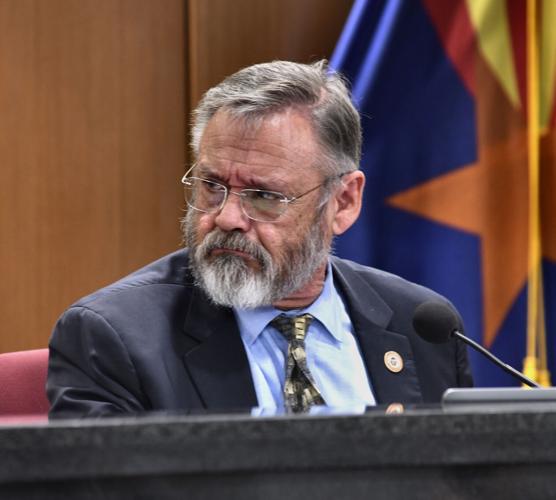
Sen. Mark Finchem
But Barry Aarons, who lobbies for the Arizona Trial Lawyers Association — attorneys who represent plaintiffs who file suits seeking to recover damages — said the insurers raised no concerns when the Arizona Supreme Court eliminated peremptory challenges in 2021.
So what changed?
“All of a sudden, over the last couple of years, they suddenly realized they were losing a lot of cases because there were real people getting on juries,’’ Aarons said.
Under the rules adopted four years ago by the state’s high court, the only way an attorney can eliminate a juror is “for cause,’’ such as showing that person is likely to be biased.
Finchem’s Senate Bill 1509 would overrule the Supreme Court rule by spelling out in law that each side in a civil case is entitled to four peremptory challenges. That would be on top of however many prospective jurors attorneys can have struck “for cause,’’ such as bias or inability to serve.
The Prescott Republican also took a swat at the Supreme Court for eliminating the peremptory challenges in 2021.
“The court took it upon itself to essentially write law,’’ he told colleagues, saying he found that “particularly offensive.’’ That decision, said Finchem, belongs to the “policymakers,’’ meaning state legislators.
That, however, may not be true.
“Under our separation of powers, the (Supreme) Court has responsibility for trial court procedures,’’ Chief Justice Ann Scott Timmer told Capitol Media Services. That includes “how jury trials are conducted,” she said.

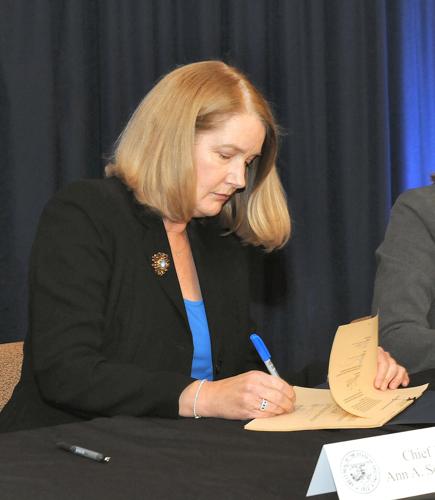
Chief Justice Ann Scott Timmer
That brought a sharp retort from Finchem.
“Perhaps she should reread the Arizona Constitution,’’ he said in response. “The Legislature handles ‘what’ the law is, the court handles ‘how’ the ‘what’ is implemented. If the chief justice wants to craft policy, perhaps she should run for a legislative office.’’
If Finchem’s bill becomes law, it is bound to lead to a challenge the first time an attorney in a civil case seeks to eliminate a juror without being able to cite a reason. And any litigation ultimately will wind up back at the Supreme Court.
All this is the result of the decision by the justices in 2021 to accept the recommendations of two judges from the State Court of Appeals. Peter Swann and Paul McMurdie argued that the move would go a long way to eliminating a situation where juries often do not reflect the racial and ethnic backgrounds of their communities.
“The primary tool by which this discrimination is practiced is the peremptory strike,’’ they wrote.
All that was addressed by the U.S. Supreme Court in 1986 in the case of Batson v. Kentucky.
In that case, James Batson, a Black man, was on trial charged with burglary and receipt of stolen goods. The prosecutor used his peremptory challenges to eliminate all four Black prospective jurors. Batson was then convicted.
In a 7-2 ruling, the nation’s high court said the prosecutor’s actions unconstitutionally denied the defendant his right to a fair trial and his right to equal treatment under the law.
Since that time, any time there is a peremptory challenge to a minority juror, attorneys are supposed to articulate a non-racial reason for their decisions, both in criminal and civil cases. But Swann and McMurdie, in their 2021 report to the Arizona Supreme Court, said the data convinced them that still meant fewer minorities on juries, even with lawyers citing what they claim is a legitimate reason.
They had evidence to back that up. Data compiled by the Administrative Office of the Courts in 2021 showed that in criminal cases, the proportion of white jurors seated varied only 3% from their representation in the population.
By contrast, Black jurors were underrepresented by 16%. And Hispanics were underrepresented 21% of the time, while there was a 51% gap for Native Americans.
That report said the disparities were even more pronounced in civil cases — the part of the 2021 rule that Finchem and the insurers want changed.
There is some evidence the change has helped make civil juries more reflective of the population.
A study in the Arizona State Law Journal published this past winter shows a lesser disparity between the number of whites who were called for jury duty but ultimately not chosen and a similar statistic for minorities.
Timmer, in her comments to Capitol Media Services, said the decision to eliminate peremptory challenges was not made lightly. She said the justices looked at various proposals, took comments from the public and attorneys, and relied on the court’s own study of the issue.
“Primarily, we concluded that everyone has the right and privilege to serve on a jury and should not be stricken for any reason other than an inability to be fair in a particular case,’’ Timmer said. “As it has turned out, the rule change has allowed more people to serve on juries, has shortened the selection process — thereby speeding up trials — and has saved valuable resources.’’
Finchem’s legislation now needs approval of the full GOP-controlled House and would then go to the Republican-led Senate. It also ultimately would need the approval of Democratic Gov. Katie Hobbs.

