Leaders of the Tohono O'odham Nation are looking at legal options to fight U.S. Customs and Border Protection's plans for not just one, but two 30-foot steel-bollard barriers along the Nation's southern boundary with Mexico, despite the tribe's decades of work with CBP on alternatives to a wall.
Tohono O’odham Tribal Chairman Verlon Jose said CBP's plans fly in the face of the Nation's vehement opposition to a border wall dividing its ancestral lands, and undermine the tribe's history of collaboration with the U.S. government on border security.
"The wall does not work. There are so many other things we can work on together to address the issue," Jose said in an interview with the Arizona Daily Star. "What happened to the government that’s supposed to be for the people, by the people, when the people have no voice?"
CBP's online interactive "Smart Wall Map" shows double walls planned along the Tohono O'odham Nation's 62-mile boundary with Sonora, Mexico, where the Nation's ancestral lands stretch south to Hermosillo and west to the Sea of Cortez.
Fueled by a $46.6 billion funding allocation in 2025's "One Big Beautiful Bill," CBP's double border-wall plan would ultimately install two parallel border walls along nearly all of Arizona’s 373-mile boundary with Mexico, cutting through three national wildlife refuges and two National Park Service sites, and running along almost the entire border in California and New Mexico.
A CBP spokesperson confirmed to the Star the primary and secondary walls will be 30 feet tall, with a 150-foot "enforcement zone" in between, though that width could vary depending on the location.
"CBP is committed to ongoing coordination with stakeholders, including tribal nations, throughout planning and construction activities," the written statement said. "CBP values its relationship with the Tohono O’odham Nation and remains focused on open communication and minimizing impacts."
That's not reassuring to critics and advocates for tribal sovereignty, who say the Trump administration has ignored its obligation to consult with the Tohono O'odham Nation and now appears willing to sacrifice the working relationship established in past years.
"It's going to take a generation to heal a lot of the damage being done," said Aaron Cooper, executive director for the Ajo-based International Sonoran Desert Alliance. The nonprofit is an alliance of people from the Tohono O'odham Nation, the U.S. and Mexico who work to preserve the Sonoran Desert's environment, culture and economy. "Trust is a very difficult thing to win back."
'Orders from the top'
The Tohono O'odham Nation was divided in two by the Gadsden Purchase, the 1854 land-acquisition treaty between the U.S. and Mexico, Jose said. Today, about 3,000 of the Nation’s 37,000 enrolled members live in Mexico.

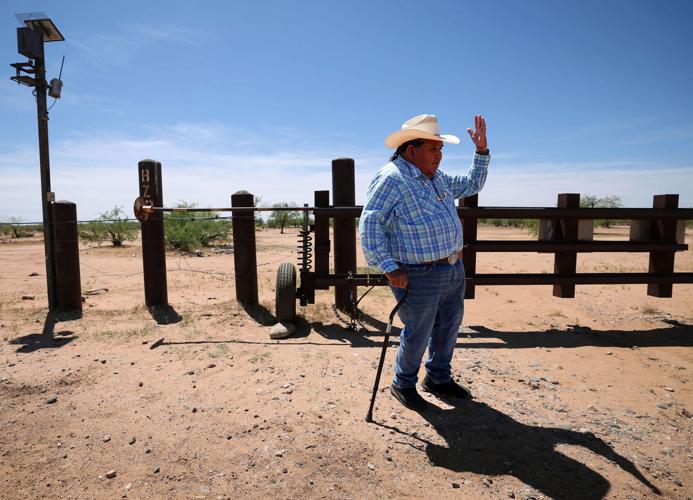
Tohono O'odham Nation Chairman Verlon Jose said the tribe is looking at legal options to challenge the Trump administration's plans to build two 30-foot walls on the southern boundary of the Nation. About 3,000 of the Nation’s 37,000 enrolled members live in Sonora, Mexico. "This wall is going to be further division," Jose said. If it happens, "an elder said to me, 'I don't know if I can go on living. It would break my heart.'"
"This wall is going to be further division," Jose said. If it happens, "an elder said to me, 'I don't know if I can go on living. It would break my heart.'"
Federal officials are treating the wall on the Nation's southern border as an inevitability, Jose said.
In a January meeting with tribal elders, the Border Patrol’s new chief of the Tucson sector, John R. Morris, was straightforward about CBP’s plans. When asked if a wall would be built on the Tohono O'odham Nation, Jose recalled Morris saying, "Yes. When and how, I don't know, but those are the orders from the top."
A CBP spokeswoman declined the Star's request to interview Morris, saying CBP is "not conducting interviews at this time."
Federal surveying appears to be already underway for the wall project, according to tribal member, human-rights advocate and author Mike Wilson, who recently visited the reservation's border with Mexico and saw what he believed to be new markers staking out the location of a new border wall.
When the Star asked if surveying was underway on the Nation's southern boundary, a CBP spokesperson did not directly answer but acknowledged the agency is "conducting surveys for new border infrastructure."
Critics say the plan for a secondary border wall, right next to a primary wall, is further evidence that walls don't work.
But CBP claims that "enforcement zone" between the walls "provides agents with a secure space to respond to illegal activity and deploy advanced technology to contain the illegal activity between the two barriers, making the surrounding communities safer.
"Border walls and supporting infrastructure help agents funnel illegal traffic through ports of entry for detection and law enforcement resolution, and remain a critical investment in national security."
Past compromise
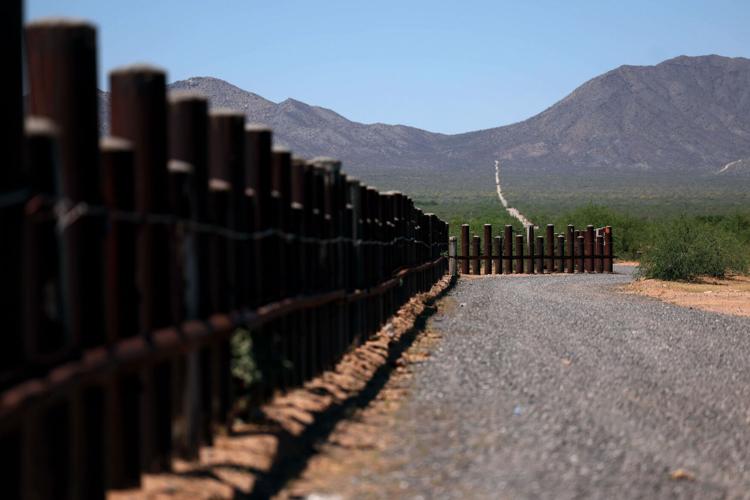
The Tohono O'odham Nation partners with CBP on border issues, working with the agency in 2006 to add vehicle barriers along its 62-mile border with Mexico, Jose said. Those low-lying barriers allow for wildlife crossings, and include three crossing points allowing tribal members to reach ancestral lands in Sonora, he said.
CBP did not directly respond to the Star's query about whether the new border wall, or walls, would account for those crossings.
The Nation spends $3 million in tribal dollars annually on border security, Jose said. Tribal leaders have allowed CBP and U.S. Immigration and Customs Enforcement to install surveillance towers, border access roads and operating bases on the Nation’s land, and are considering CBP's request to add motion-activated linear ground detection systems, Jose said. Through the "Shadow Wolves" tactical unit, Native American agents based in Sells work with ICE's Homeland Security Investigations to track and disrupt drug- and human-smuggling operations.
But past compromises to avoid a 30-foot wall seem moot today, Jose said.
Tribal elders traveled to Washington, D.C., in February to press the Department of Homeland Security, CBP's parent agency, to respect the tribe’s opposition to a wall, and focus on alternative technology that's more effective than a physical barrier.
"In the meetings (with tribal members), they just go through the motions. But they already have their plans," Jose said.
Jose said he's learned from unofficial sources that DHS is already working on contracting out the projects on the Tohono O'odham Nation, despite telling tribal leaders they want their input.
"That's a betrayal," he said. "That's telling you to straight to your face, 'Yes, I lied to you. My word doesn’t mean anything.'"
Jose said a legal challenge is likely on the horizon, and confrontations with construction crews at the border may be unavoidable.
"We hope that we never have to get to that point where we physically have to mobilize to do that," he said. "As tribal leader, you never want to put people in harm's way. So we continue to advocate why a border wall will not work."

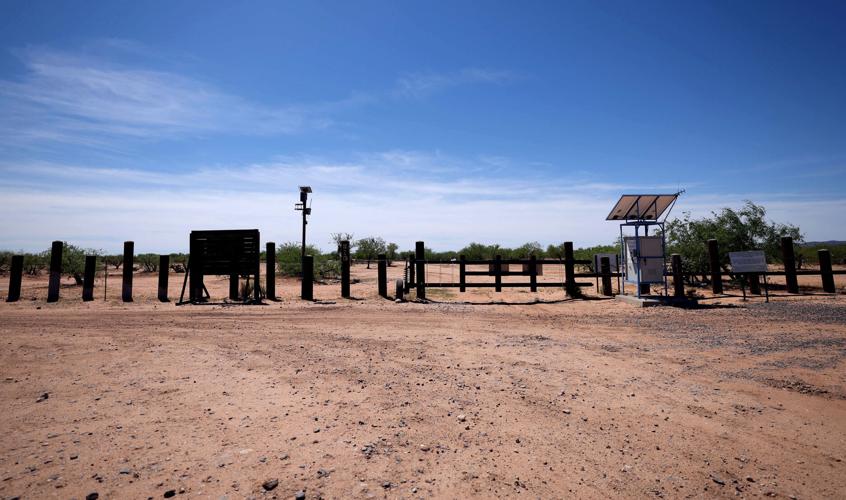
Tohono O'odham Nation Chairman Verlon Jose said the tribe consulted on the placement and design of the vehicle barrier at the Nation's southern boundary. It's made from rust-colored, concrete-filled steel pipes spaced about 3 feet apart and between 4 to 6 feet tall. The San Miguel gate, shown here, is one of three openings along the Nation’s 62-mile stretch of border where enrolled tribal members can drive across outside of the official ports of entry.
Legal justification
Established through a series of executive orders starting in 1917, the Tohono O'odham Nation spans 2.8 million acres, roughly the size of the state of Connecticut.
Experts say there are several legal rationales DHS could pursue to justify its wall projects without the Nation's support. One would be limiting construction to the Roosevelt Reservation, a 60-foot strip of federal land running along the southern border from New Mexico to California.
But two walls likely couldn't fit in this space, and the project would be complicated by CBP's need to use the Nation's land for road construction and storing materials, said David Beeksma, director of the University of Arizona's Native Nations Institute.
Still, it would likely be the most "legally defensible" strategy for CBP, said Beeksma, who previously worked for the Bureau of Indian Affairs as superintendent of the Tohono O'odham Nation.
"There are political considerations and there’s sovereignty issues. But from a strictly legal perspective, if it’s within that strip, the U.S. government has a fairly good case," he said.
CBP did not directly respond to the Star's query about its legal basis for construction of the wall without the Nation's consent, only stating that CBP can operate within the Roosevelt Reservation. "If operations require access outside this area, CBP coordinates with relevant stakeholders," the statement said.
Alternatively, DHS could ask Congress to use its "plenary power" — an "unreviewable" authority to make decisions in key areas, including border security, immigration policy and federal Indian policy — to pass a law permitting the construction on tribal land, Beeksma said.
Or the DHS secretary could use its waiver authority — which it's done for dozens of border-wall projects — to waive legal requirements to engage in tribal consultation or environmental reviews that would interfere with the projects.
Courts have tended to side with DHS on challenges to the waiver use when it comes to border security, but this kind of case could be different, as tribal sovereignty is "settled law in the U.S.," Beeksma said.
By waiving tribal-consultation requirements for such a huge project, "you've really eroded the concept of sovereignty," he said. "It doesn't eliminate sovereignty, but it degrades it sufficiently that a court might look at that and say, 'I lean in favor of sovereignty being the greater need than border security.'"
Some question whether the Nation's establishment through presidential executive orders leaves it vulnerable to unilateral action by a president.
Law professor Rebecca Tsosie, who is a faculty member for the UA's Indigenous Peoples’ Law and Policy Program and of Yaqui descent, said it's unlikely a president could act alone, without Congress, to meaningfully change or rescind such orders.
"Trust reservations today carry the same status and rights regardless of whether they were established by Treaty or Executive Order," she wrote in an email. "Congress has ratified the reservation boundaries and trust status of these lands, so I do not think there is anything that could be done without Congressional action."
'Dancing with the devil'
Not everyone approves of the Tohono O'odham Nation's long-running collaboration with CBP, the parent agency over Border Patrol.
Enrolled tribal member Mike Wilson has long criticized the Nation for the partnership, arguing that allowing Border Patrol and ICE on tribal land has subjected tribal members to harassment, surveillance and violence, and created a slippery slope to greater federal intervention on tribal lands.
"You are dancing with the devil," he said. "How long do you think he's going to tolerate you?"
But he acknowledged the Nation has to grapple with an implicit threat from the U.S. government to either cooperate on border security, or risk the federal appropriation that supports the Nation's infrastructure.
"You're appeasing the federal government, and you're hoping that the federal government will not declare war on you," he said. "And now, this threat of double border wall on tribal lands is a declaration of war. For me as a tribal member, it's the ultimate ultimatum."
In the face of past threats to build a wall at the Nation's southern border, tribal leaders have been able to successfully mount a public relations campaign, centered on tribal sovereignty, forcing the U.S. government to "back off," Wilson said.
That strategy likely won't work under the second Trump administration, he said.
"Now with this administration, there are no moral limitations, nor accountability," he said.
Cultural sites damaged, at risk
Secondary barriers have been a limited part of CBP's border plans since the first Trump administration, with some double wall already in use near the Naco port of entry, the Andrade port of entry west of Yuma and between San Diego and Tijuana.
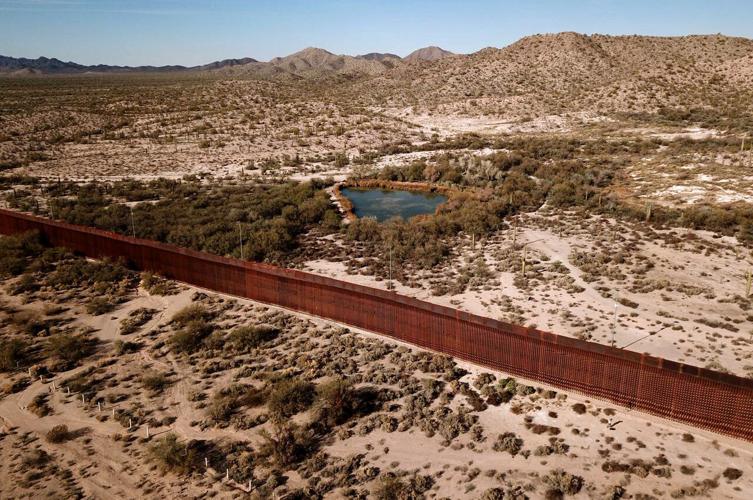
Nearly 45 miles of secondary wall are planned at Organ Pipe Cactus National Monument, where fragile ecosystems, particularly Quitobaquito Springs, have already been significantly impacted by the first border wall.
When the primary wall at Organ Pipe was built, CBP gave the park’s personnel three months to do a land survey in search of indigenous artifacts. Staff were out in the summer months doing that survey in brutal heat, said Erick Meza, borderlands coordinator for the Sierra Club.
"They still were able to rescue over 5,000 artifacts," he said. "This place just has an amazing amount of history. But for the tribes, it is really sacred and valuable place, a part of their history. It will be devastating for them again," if the secondary wall is also built there, he said.
A second wall north of the first would almost certainly reach the waters of Quitobaquito. Wall construction there risks draining the water source, which would likely result in the extinction of several species that live only at the springs, Meza said.
"Border wall construction requires 100,000 gallons of water a day," he said. "We’re in a period of drought already. It is very fragile ecosystem — it’s a spring of fresh water in the middle of the desert."
CBP said in a statement that it's working with U.S. Fish and Wildlife Service and the National Park Service "to avoid Quitobaquito Springs and minimize impacts to sensitive resources."
But promises, without enforcement to back them up, don't mean much, critics say. DHS has exercised its authority to waive dozens of environmental and cultural-preservation laws, which would have mandated consultation with stakeholders, environmental reviews and damage mitigation.
CBP also said, as it did before construction of the primary wall at Quitobaquito, that no groundwater will be used within 5 miles of the springs. Environmentalists believe wall construction did reduce water levels at Quitobaquito, despite that pledge.
Quitobaquito at risk
Quitobaquito Springs, about 120 miles southwest of Tucson, sits outside the Tohono O'odham Nation's boundaries but is sacred to tribal members, particularly those who descend from the Hia-Ced O'odham, the "Sand People," who lived there.

The border wall runs next to Quitobaquito Springs at Organ Pipe Cactus National Monument in an aerial photo taken from Mexico. The Trump administration is planning to build a second wall parallel to the first one, raising concerns about what the project could do to the historic oasis and other sensitive sites.
In 2020, when the first border wall was underway just south of the pond, two O'odham members were arrested for their spontaneous act of resistance that succeeded in temporarily halting construction.
One of those protesters, Amber Ortega, told the Star that construction of the first wall at Quitobaquito was a "traumatic event." When she and friend Nellie Jo David encountered a bulldozer there one day in 2020, they took action to stop the work, and to inform the workers — and the National Parks staff who ultimately arrested them — about whose land they were on, she said.
"Never in history had our land ever been dug into in that way," she said. "So we planted ourselves, and we sang and we educated them."
Ortega was eventually found not guilty of the two misdemeanor charges against her, when a judge agreed the government had imposed a "substantial burden" on her religious freedom, setting a precedent that could support future resistance activities, she said.
Ortega said she doesn't know what kind of protest will occur if construction proceeds on a second border wall there, but she feels certain there will be "collaborative resistance."
"I really do believe that we will have a collective effort to show the United States of America that we are not an extinct people," she said. "Our voices are our resilience, our presence is our resistance, and our fight is eternal."
The gate
On a recent Tuesday, tribal Chairman Jose took a Star reporter and a photographer to see the border as it looks now across much of the Tohono O’odham Nation.
The drive from the capital of Sells takes about 30 minutes on San Miguel Road, also known as Indian Route 19, a two-lane highway that passes Baboquivari High School and a few small villages on its way south.
The road turns to dirt for the last few hundred yards to the border, where a vehicle barrier marks the line drawn across the Tohono O'odham's ancestral land by the Treaty of Guadalupe Hidalgo and the Gadsden Purchase.
As Jose pulled up to the boundary, a coyote sniffed the ground on the U.S. side, then slipped back into Mexico, where it flattened its ears and stared at the approaching vehicle before sauntering off to the south.
Jose said the tribe consulted on the placement and design of the structure, which is made from rust-colored, concrete-filled steel pipes spaced about 3 feet apart and alternating in height from 4 to 6 feet tall. He pointed out places where the barrier jogs around important spots the tribe wanted protected, from saguaros and other important plants to cultural sites, including graves.
At this spot, though, there is an opening — one of three along the Nation’s 62-mile stretch of border where enrolled tribal members can drive across outside of the official ports of entry.
The Border Patrol refers to it as the San Miguel gate, Jose said, but his people just call it "the gate." An agent will come and unlock it for anyone who pushes a nearby button, shows the proper ID and passes inspection.
Jose said members of the tribe cross the border regularly for everything from funerals to everyday errands like medical appointments or shopping. For a time, he said, people on the Mexican side would set up an occasional market catering to villagers from the U.S. side.
Jose and his guests from the Star weren’t alone during their April 7 visit to the border. Almost immediately, several white and green trucks rolled up behind them, and a Border Patrol agent walked over to ask the tribal chairman if he needed the gate to be opened.

The Tohono O'odham Nation has long partnered with Customs and Border Protection on border security, working with the agency in 2006 to add vehicle barriers along its 62-mile border with Mexico, said Tribal Chairman Verlon Jose. Those low-lying barriers allow for wildlife crossings, and include three crossing points allowing tribal members to reach ancestral lands in Sonora, he said. The Nation spends $3 million in tribal dollars annually on border security, Jose said. "I believe the Nation has bent over backwards, and then some, to secure this country," he said. "We demand a seat at the table."
No one would be crossing today, he told the woman.
So how might all this work in the future, with two 30-foot-tall barriers blocking the border instead, the reporter asked him.
One way or another, Jose said, the Tohono O’odham Nation will not allow those walls to be built.
Native American DHS secretary
Former Republican Sen. Markwayne Mullin, a citizen of the Cherokee Nation, was confirmed by the Senate as DHS secretary in March. It remains to be seen if Mullin, the agency's first Native American leader, will take action on behalf of tribes' sovereignty.
U.S. Sen. Ruben Gallego, an Arizona Democrat, pressed Mullin about DHS's failure to consult with tribes under the Trump administration, during Mullin's Senate confirmation hearing last month.
"When it comes to building some of these installations on the border, there has been very, very little to no tribal consultation, especially with some of our border tribes, (like) the Tohono O'odham Nation," Gallego said. "You know, it’s important that DHS actually speak to these communities."
Mullin committed to working with tribes in response.
"I respect tribal sovereignty," Mullin said. "There's a lot of technology now. We do have a job to secure the border, but we will work with tribal nations because there's other ways to have a physical barrier, where you can have technology there, too, and I don't think anybody would complain about that. ... I have a lot of good friends in Arizona with tribes that we've had good relationships with."
A DHS spokesperson did not directly respond to the Star's questions about Mullin's stance on DHS's current border-wall plans for the Nation, and the Nation's opposition to them.
"DHS is committed to ongoing coordination with stakeholders, including tribal nations, throughout planning and construction activities," DHS said in a statement. "DHS values its relationship with the Tohono O’odham Nation and remains focused on open communication and minimizing impacts."
U.S. Rep. Adelita Grijalva, a Tucson Democrat, said in Trump's second term, DHS's lack of consideration for even the pretense of tribal consultation has been strikingly "callous."
"That this administration is not even considering tribal sovereignty is new in my lifetime," she said.
Grijalva said the billions DHS is pouring into endless border-wall construction and maintenance would be better spent on U.S. ports of entry, where 90% of CBP's fentanyl seizures take place.
"They have so much money, it seems like they don't know what to do with it, so now they're going to create a second wall," Grijalva said. "We can’t afford child care, according to Trump, we can't afford Medicaid or Medicare. But somehow we have $46 billion to build a wall that nobody asked for. ... When they talk about waste, fraud and abuse, this is a great example of that."