


PHOENIX — A last-minute provision dropped into the House version of the state budget seeks to trim Attorney General Kris Mayes’ authority to bring legal charges against anyone related to election issues.
It would require prosecutors to get permission from both the House and Senate judiciary committees before filing any election-related lawsuit if a judge in any other case had said there was at least “prima facie’’ evidence they had violated the state’s anti-SLAPP law, short for Strategic Lawsuit Against Public Participation statutes. That law is designed to prevent public officials from using the courts to punish and prevent speech on political issues.
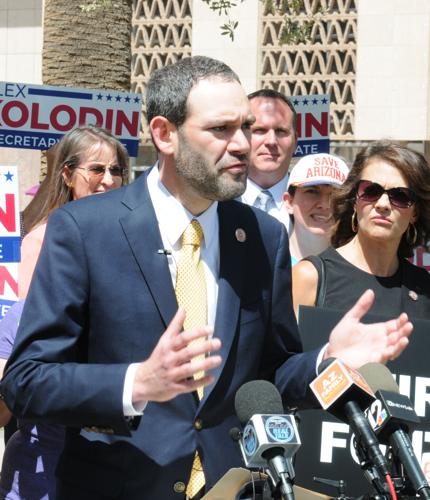
The new provision in the House budget was written by Scottsdale Republican Rep. Alexander Kolodin.
It comes after a Maricopa County Superior Court judge ruled in February that the remaining 16 defendants in the “fake electors’’ case being prosecuted by Mayes, a Democrat, have provided such prima facie evidence, demonstrating to him that the indictments against them appear to attack what is “at least in part some arguably lawful speech.’’
Mayes has appealed the ruling by Judge Sam Myers in the case, which involves Republicans who falsely claimed Donald Trump had won Arizona in 2020 and that, instead of winner Joe Biden’s electors, they were Arizona’s lawful electors to the Electoral College.

Rep. Alexander Kolodin
It is unclear whether the provision Kolodin got inserted into the budget, if it becomes law, would affect the ongoing electors case and force Mayes to get legislative approval to pursue the charges of fraud and conspiracy against the defendants.
But it definitely would hobble Mayes — and any county prosecutor, as the measure also would apply to them — in filing future cases.
Pima County Attorney Laura Conover said it would chill the ability of prosecutors to bring charges that could have political overtones.
A single finding that a prosecutor may just have violated the SLAPP provisions — not even a final ruling — would trim that prosecuting agency’s ability to pursue future election-related cases. That’s because it would give either the House or Senate judiciary committees, both now controlled by Republicans, veto power over new legal actions.
Beyond that, Conover, a Democrat, said there’s a constitutional issue.
“Directing prosecutors to ask the Legislature for permission to prosecute sounds like quite the separation of powers problem,’’ she said.

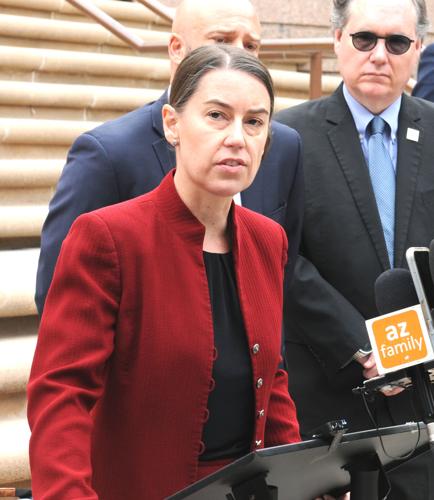
Pima County Attorney Laura Conover
Richie Taylor, press aide to Mayes, agreed.
“This is creating an extra-judicial tribunal to run specific criminal prosecutions through,’’ he said.
Maricopa County Attorney Rachel Mitchell, a Republican, declined to comment.
Kolodin rejected the claim the legislation is unconstitutional.
“We extensively researched this and found no separation of powers issues exists,’’ he said. Instead, Kolodin said, it complies with how one branch — in this case, the one with the money that funds prosecutors — can act to exercise legitimate oversight over another.
“Indeed, this is the way that the power of the purse is meant to reinforce checks and balances,’’ he said.
Kolodin acknowledged he worked to get the provision into the budget on behalf of the Arizona Freedom Caucus, of which he is a member.
The caucus members are considered the most conservative of Republican lawmakers at the state Capitol, including one who is a defendant in the “fake electors’ case.
Kolidin said the legislation, which still needs approval by the Senate and the signature of Democratic Gov. Katie Hobbs, is justified.
“Ending the tyrannical weaponization of government that manifests its ugliness in the form of political prosecutions is a matter of critical importance to the foundation and future of our republic,’’ he told Capitol Media Services.
Kolodin, who is running for secretary of state in next year’s election, said the mechanics of his proposal are simple: If the majority Republicans who control the judiciary committees in either the House or Senate believe the attorney general or county attorney is “trampling’’ the lawful exercise of constitutional rights, “then additional legislative oversight is necessary to prevent further abuses of power.’’
He made it clear who he thinks has been doing that.
“Kris Mayes is a perfect example of why this provision is necessary since she has repeatedly engaged in hyper-partisan prosecution based on novel legal theories conjured up by leftist activist organizations,’’ he said.

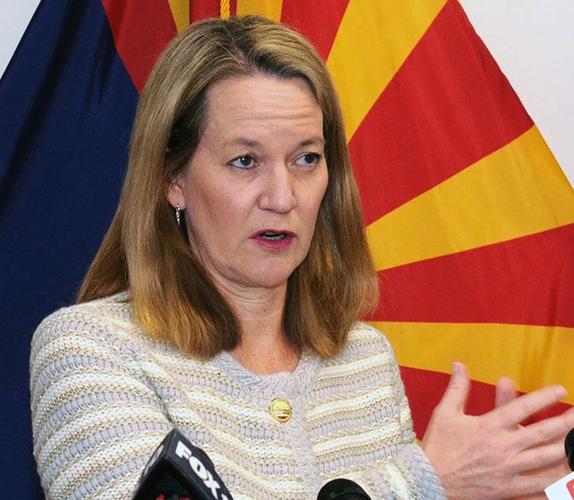
Mayes
One of those involves the charges related to the 2020 presidential election.
Mayes got a state grand jury in 2023 to indict 11 Republicans who prepared a report and sent it to Washington saying Trump had won the popular vote and they were entitled to cast the state’s electoral votes for him. But Biden had won the popular vote in Arizona, by 10,457 votes.
One of those “electors’’ is Sen. Jake Hoffman, R-Queen Creek, who chairs the Freedom Caucus.
Also indicted were others Mayes said were involved in crafting the scheme, including a top aide to Trump and some of his lawyers; the president himself was named an unindicted co-conspirator.
Taylor, Mayes’ press aide, said what Kolodin is trying to put into state law needs to be seen through that lens.
“He’s using a political vendetta to harm the ability of elected prosecutors to do their jobs,’’ Taylor said.
Still, there is at least some basis for Kolodin’s claim of outside influence on Mayes.
Documents obtained last year by Capitol Media Services showed that, ahead of Mayes obtaining the indictment in the electors case, States United Democracy Center provided her office detailed guidance on how to prosecute the individuals. That group says it’s non-partisan, though its past work aligns with Democratic caucuses.
Taylor said at the time the office did its own investigation but that States United provided “a memo that outlines potential charges to be brought.’’
The documents showed that States United specifically spelled out exactly which Arizona laws could be used to prosecute those involved and made recommendations. It also detailed why it would still be legally OK to indict people years later for events that had occurred in 2020.
In issuing his preliminary ruling, Judge Myers said there was evidence of a violation of SLAPP by Mayes in bringing the charges. He specifically mentioned the attorney general’s comments when announcing the indictment that “this should never happen again.’’
That did not result in dismissal of the case. Instead it turned the legal tables on the attorney general, saying it is now up to her to explain why the charges in the indictment are justified or risk having the case thrown out.
That has been put on hold, however, after Myers sent the whole case back to the grand jury over a different incident. He ruled that prosecutors had failed to provide the jurors with details of an 1887 federal law about how Congress must handle the possibility of competing presidential electors. Mayes is appealing that ruling, too.
Mayes separately obtained an indictment against two Republican Cochise County supervisors on felony charges after they balked at completing the legally required canvass — the formal counting — of the votes in the 2020 election. Supervisors Peggy Judd and Tom Crosby said they had questions about whether the machines used to tabulate the ballots were properly certified.
Judd pleaded guilty to a single count of failing to perform a duty and placed on unsupervised probation; Crosby continues to fight the charges.

