




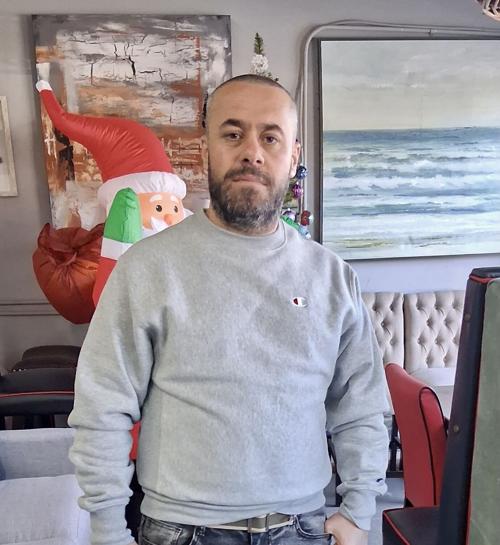
Syrian asylum seeker Kamel Maklad has been released from Eloy Detention Center, after more than two years in immigration detention and one year after an immigration judge agreed he'd face threats to his life in his home country.
Maklad said he heard from an ICE official Monday morning that his release was imminent, following Maklad's successful habeas corpus petition challenging his incarceration on constitutional grounds. Speaking to the Arizona Daily Star on a video call from Eloy, one day before his release early Tuesday morning, Maklad recalled bursting into tears at the news.
"Today, I feel like a new person," he said with a broad smile, speaking in Spanish. "I need some time to get my life back."
Maklad flew to Atlanta on Wednesday, where he joined a cousin with whom he crossed the U.S.-Mexico border in September 2023, near Lukeville, Arizona. Another cousin, who is a U.S. citizen, will be Maklad's sponsor, he said.
The Department of Homeland Security held Maklad, 38, at Eloy for more than a year after an immigration judge granted him withholding of removal to his home country in November 2024, agreeing Maklad would likely face threats to his life or freedom in Syria.
As a member of the pacifistic Druze religion, Maklad said he fled Syria's civil war after he was targeted for conscription into the Syrian Army. If he'd resisted due to his religious beliefs, he would have been sent to the front lines or imprisoned, he said.
But even after he was granted withholding of removal, DHS refused to release Maklad and continued searching for a third country to deport him to.
Though he's no longer detained, Maklad is still vulnerable to deportation to a third country, if DHS can find one that agrees to accept him.
Under previous administrations, third country removals were rare, and immigrants granted withholding of removal were usually released from detention and could secure temporary work permits, with conditions such as routine ICE check-ins and wearing an ankle monitor.
But the Trump administration has been aggressively pressuring more countries to accept deportees from the U.S. who aren't their citizens, keeping immigrants detained in the meantime.
DHS has not responded to the Star's request Thursday for comment on Maklad's release.
When the Star reported on Maklad's ongoing detention in October, DHS Assistant Secretary Tricia McLaughlin issued a statement claiming, without evidence, that Maklad is a "suspected terrorist."
"One thing is for certain this suspected terrorist will not be allowed to remain in the U.S.," McLaughlin wrote in the Oct. 21 email. "We will find a third country to accept him."
The allegation shocked Maklad, and three of his current and former attorneys, who said DHS lawyers never once raised that allegation during Maklad's immigration proceedings.
DHS has yet to provide any evidence of the claim.
Suspected terrorist activity would have been a legal bar to Maklad receiving relief through withholding of removal, but DHS didn't appeal the judge's decision to grant it last year.
Habeas petition prevailed
Maklad, whose lawyers say has no criminal record in the U.S. or Syria, said he was losing hope when he filed a habeas corpus petition last month, arguing his continued detention was illegal.
Habeas petitions allow detainees to ask a judge — in federal court, independent of the U.S. Department of Justice's civil immigration court system — to review the constitutionality of their continued detention.
Responding to Maklad's petition, DHS admitted on Dec. 5 it was unlikely Maklad could be deported to a third country "in the reasonably foreseeable future. ... Respondents do not oppose Petitioner’s request for release at this time."
That same day, U.S. District Judge John Tuchi ordered Maklad's release.
"Habeas corpus is a lifesaver to use against ICE. They are abusing us," Maklad said, speaking from Atlanta by phone on Thursday. "We aren't criminals; we're immigrants."
Formerly a last resort, habeas corpus petitions have become a critical tool for immigrants facing indefinite detention under the Trump administration, advocates say.
Trump's DHS is detaining immigrants who, under prior administrations, they agency would not have targeted for detention, said Luis Campos, Maklad's immigration attorney. (Another attorney represented Maklad in his habeas case.)
"To incarcerate someone, particularly an individual who has no criminal history and to incarcerate them indefinitely, has traditionally not been a thing in the United States," Campos said. "What we’re seeing now is something I haven’t seen in the course of my career, which is: Let's just keep someone in detention indefinitely and hope no one sounds the alarm. And that's what we did in this case — tried to sound the alarm."
Indefinite detention violates the due-process clause of the 5th Amendment, according to a U.S. Supreme Court decision cited in Maklad's habeas petition.
The 2001 Supreme Court ruling, in the case of Zadvydas v. Davis, held that an immigrant with a deportation order may only be detained for "a period reasonably necessary" to bring about the immigrant's removal from the U.S.
Detentions longer than six months are presumed unlawful, unless there exists a "significant likelihood of removal in the reasonably foreseeable future," the ruling said.
'They saved my life'
On Thursday, Maklad said he's received "a thousand" congratulatory calls from family and friends back in Syria, and supporters in Arizona, since he was released Tuesday. His family in Syria have been receiving friends and family at their home every day, in celebration, he said.
And after two days of freedom — albeit with a large monitoring device attached to his ankle — Maklad said he was looking at the world through new eyes.
"I've been out for two days, and I feel completely different," he told the Star by phone, while on his way to buy clothes with his cousin. "I feel completely new, I feel completely strange, because wow! I'm really seeing life."
But Maklad is also deeply upset by the years he's lost, by the mistreatment he says he experienced at Eloy and by the "abuses" of DHS.
"I don't understand the evil they did to me. I ask even today, 'What did I do? Why did they steal two years and three months of my life?'" he said. "Thank God for the blessing, the miracle that got me out of there."
Support from the public, especially volunteers who visited with him regularly at Eloy and his attorneys, helped him hold onto hope in his darkest moments, he said.
"They saved my life," he said. "I won't forget that. That is a great blessing I received."
Cecilia Valenzuela, a volunteer with a Tucson-based group that organizes regular visits with Eloy detainees, began visiting Maklad in December 2024. In recent months, she'd grown concerned about his deteriorating mental state as he languished in Eloy, with no idea when he'd be freed.
"These types of situations require all of your psychological and spiritual strength," she said. "It's a tremendous challenge and he lived up to it, even though sometimes he felt very, very at the end of his strength. In that moment, the community helped him keep going."
The visitation program aims to counteract the dehumanization that immigrants experience in detention, she said. The program — a "ministry of presence," Valenzuela said — also brings rewards for the volunteers.
"I don't want it to be looked at as if they are charity cases for us. We are in mutual solidarity," she said. Of Maklad, she said, "When he talks, he strengthens me, and I strengthen him. ... That's very moving for all of us, to truly accompany someone in the worst of moments, when you think that there is no light at the end of the tunnel."
Effects of Biden rule
Campos said DHS could continue searching for a third country to accept Maklad as a deportee. He cited the case of Kilmar Abrego Garcia, whom DHS wrongly returned to his home country of El Salvador, despite a judge having granted him withholding of removal there. Since the man's return to the U.S., DHS has tried to find a third country to accept Abrego Garcia.
Abrego Garcia was released Thursday, following a federal judge's order.
"If the U.S. finds a third country to accept (Maklad), he could potentially be subject to re-apprehension. I remain nervous about that," Campos said. "Given Abrego Garcia’s case, for example, the government is hyper-focused on removing individuals, particularly individuals who come into the public eye."
Maklad was ineligible for asylum due to the Biden-era "Circumvention of Lawful Pathways" rule, which largely denied the protection to asylum seekers who didn’t use the CBP One scheduling app to enter the U.S. at a port of entry.
The May 2023 rule put asylum protection out of reach for thousands of asylum seekers who may have otherwise had valid claims, leaving them eligible only for a more limited form of relief known as withholding of removal.
Withholding only prevents immigrants' deportation to their home country, but leaves them vulnerable to removal to a third country.
In October the Star reported that DHS attempted to deport Maklad to Venezuela on Sept. 19. Maklad said he spent about a half-hour in a Venezuelan airport, after the U.S. sent him there on a deportation flight full of people from Venezuela.
Although he previously lived there, Maklad has no legal status in Venezuela and was quickly flown back to the U.S. At the airport, Venezuelan officials told Maklad they’d never agreed to receive him, Maklad said.
DHS has not responded to the Star's Oct. 15 questions about the failed deportation, apparently without securing prior approval from Venezuela first.
Maklad said he has an ICE check-in scheduled for February, and Campos is helping him apply for a work permit. He's determined to do everything by the book, he said.
"I don't want to risk doing anything that could get me into trouble," he said.

