

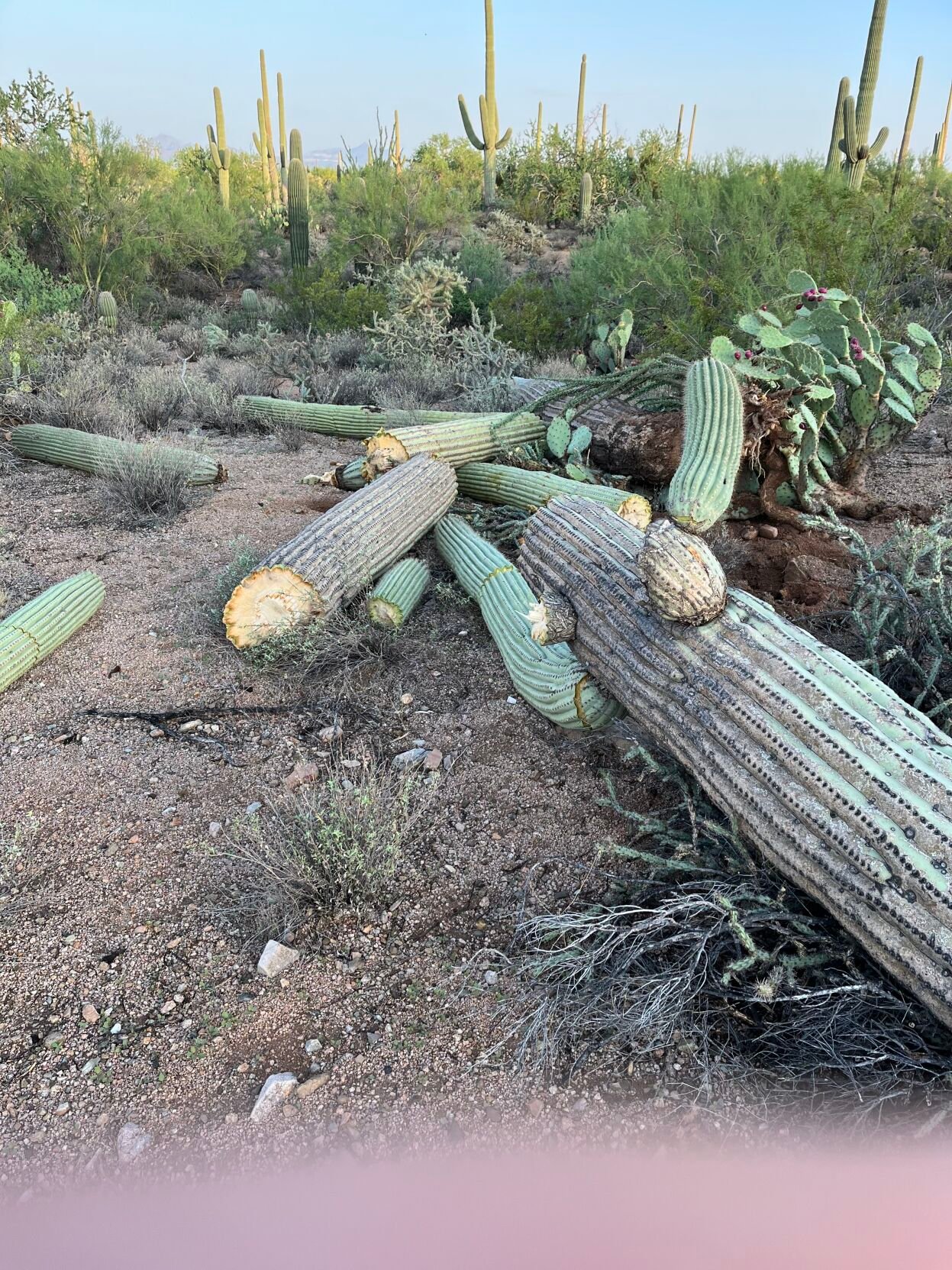

The confirmed number of downed and damaged saguaros in Saguaro National Park-West from last month’s “blowdown” in a windstorm has topped 400, up to four times higher than an earlier estimate.
“We have so far mapped more than 400 saguaros that either fell down or are missing their tops or arms,” Don Swann, a National Park Service biologist who has led the ongoing count, said Tuesday.
Most of the damaged or downed saguaros are taller than 12 feet high, and “quite a few are more than 25 to 30 feet high, Swann said.
The tallest ones are “obviously pretty old, more than 75 to 100 years old,” he said.
The saguaros blew down in the late afternoon on Aug. 22 in high winds. The National Weather Service has said that 62 mile per hour winds occurred at around 3:40 p.m. that day at Tucson International Airport, where the city’s official weather readings are taken.
Originally, the park service estimated that more than 100 saguaros were knocked down by winds. That estimate has jumped after a crew of seven to 10 park service officials, volunteers and interns, along with private saguaro researcher Bill Peachey, drove and walked through the affected area twice more since officials first reported on the incident on Aug. 25.
The officials have covered about a square mile of park land so far, centered at or near the intersection of Kinney and Sandario roads at the park’s northwest edge. On Friday, they hope to complete their survey of the damage on national park land north and northeast of Kinney Road, Swann said.
That effort will cover land along Hohokam Road, a dirt road leading to some of the park’s prime hiking and picnicking areas.
“We still have everything north of Kinney Road, from half of a mile west of the visitors’ center to Sandario. Nobody’s mapped anything in there. That’s quite a distance,” Peachey said.
Before the count is over, Peachey expects authorities to find “certainly more than 500” downed and otherwise damaged saguaros, and possibly 1,000, he said Tuesday.
“I don’t want to say at this point,” said Swann, if the total of damaged saguaros inside the national park could have reached 1,000.
There “doesn’t seem to be any rhyme or reason” in the patterns at which saguaros have fallen, Peachey said.
“There seemed to be spates of them. You’ll see a whole bunch together — you see them lining side by side,” Peachey said. “I mapped four saguaros, single stemmed, literally against one another. We found places where there were groups of five or six blown over, almost like in a row. It seemed like the wind was maybe dipping down or somewhere, and took those.”
“There was an older one right next to a younger one, literally growing side by side. One fell to the southeast, against the grain of the wind. The other one fell 180 degrees out from that,” he said.
When saguaros fall over, “they break every single root. Over they go,” Peachey said. “Then they’re falling on other vegetation, doing a lot of collateral damage.”
Peachey and Park Service officials have said this was the largest saguaro blowdown in the Tucson area since 2011. That’s when around 2,000 saguaros blew over in a nearly six-square-mile area centered on Ironwood National Monument, lying north of Saguaro National Park-West and northwest of the Tucson metro area.
Researchers use drone images to create 3-D virtual cactus forests

