

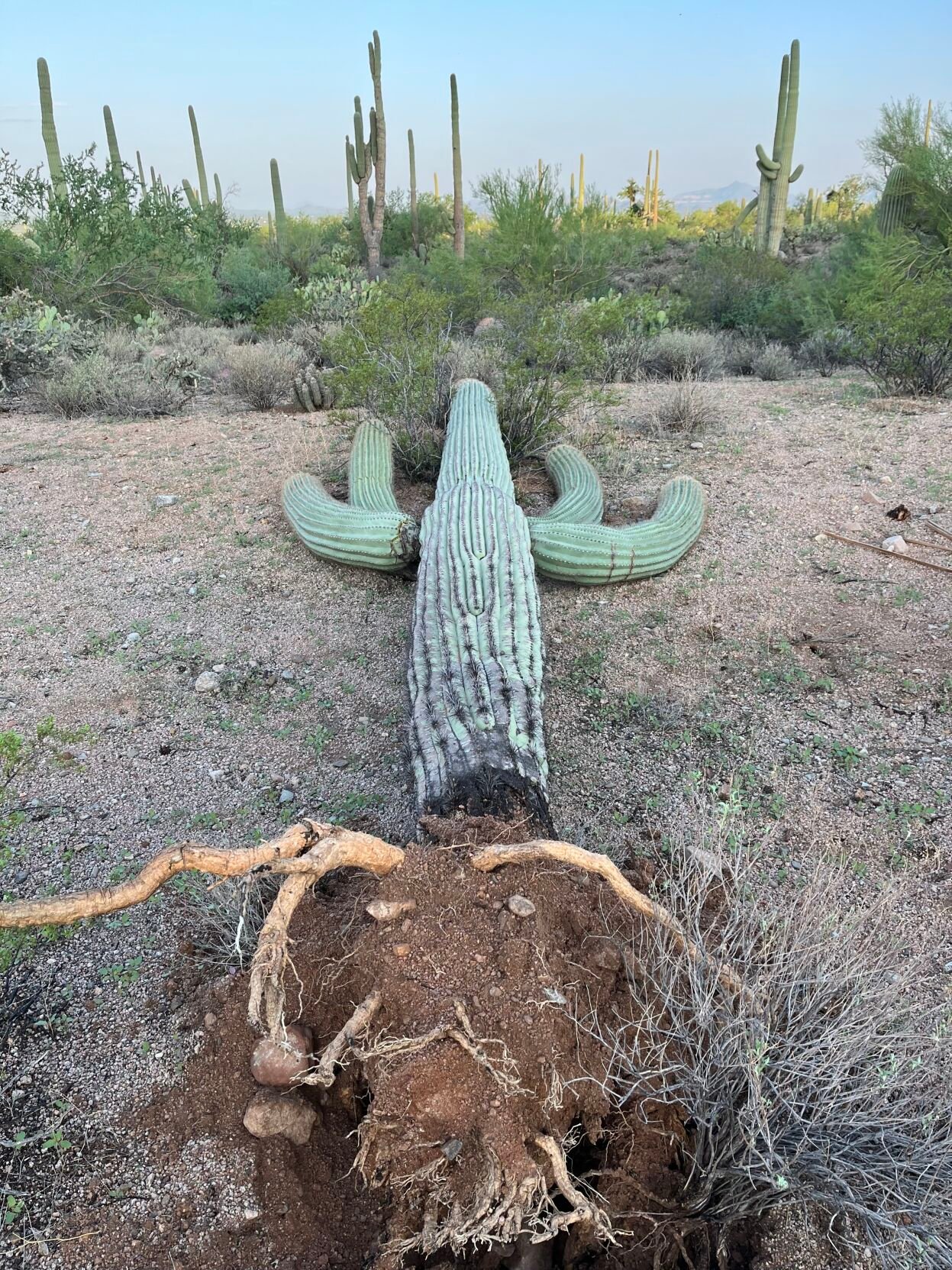

At least 100 saguaros blew down in Saguaro National Park-West during a major windstorm earlier this week, a National Park Service official said Friday.
While park service officials say the full extent of storm damage to the saguaros won’t be known for weeks, they and a private saguaro researcher agree there hasn’t been a wind-driven saguaro blowdown of this size or larger for more than a decade.
Late Tuesday afternoon, Saguaro Park-West “experienced a large blowdown that damaged many large saguaros,” said Perri Spreiser, the park’s acting chief of interpretation. “Our current estimates are that at least 100 were knocked over. Others lost arms and had their tops sheared off.
“Other plants — palo verdes, ironwood, ocotilllo and prickly pear — were also damaged,” Spreiser said, adding there are still “many, many hundreds of standing healthy saguaros” in the area.
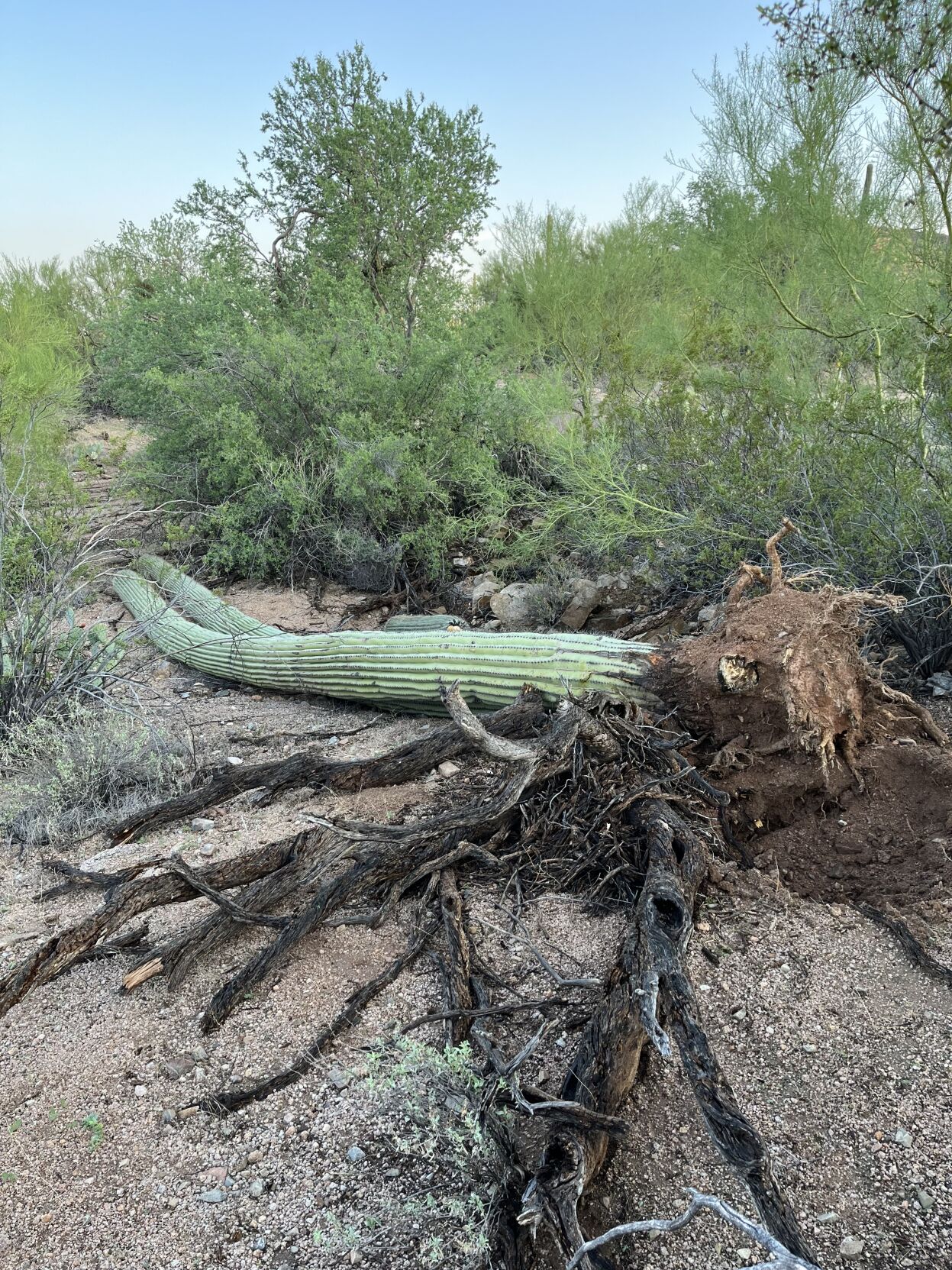
A National Park Service official and a private saguaro researcher agree there hasn't been a wind-driven saguaro blowdown of this size or larger for more than a decade in the Tucson area.
Bill Peachey, a geologist who has monitored saguaros in the Tucson area for decades, visited an area northwest of the Saguaro Park-West visitors center early Wednesday and estimated the number of downed saguaros to be in the “hundreds.”
The damaged saguaros occupied “a long swath” of desert, at least almost a half-mile wide and running at least a mile down into a neighboring valley, said Peachey.
The wind “blew the tops off of some, in areas along arroyos where surrounding vegetation usually buffers the saguaros from wind damage,” he said. “Wind shear will take the top off and an arm off.”
The cacti likely fell victim to a “microburst — these microbursts can act like a karate chop,” Peachey said.
“The wind even pushed over some small ones. You hardly ever see that because they’re down low in the vegetation,” he said. “I saw a couple no more than 4 feet high” that were blown over.
A microburst is a localized column of sinking air within a thunderstorm and is usually less than or equal to 2.5 miles in diameter, the National Weather Service said.
Peachey said this was the largest saguaro blowdown in the Tucson area since 2011, when around 2,000 saguaros blew over in a nearly six square mile area centered on Ironwood National Monument. Spreiser said she, too, isn’t aware of any saguaro blowdown in this area of the size of this week’s event since the Ironwood Monument windstorm.
The National Weather Service reported on Friday that 62 mile per hour winds occurred at around 3:40 p.m. Tuesday at Tucson International Airport. While Park Service officials initially reported the saguaros were blown down at about 4:30 p.m., Spreiser said the 3:40 p.m. time reported by the weather service sounds “totally reasonable.”
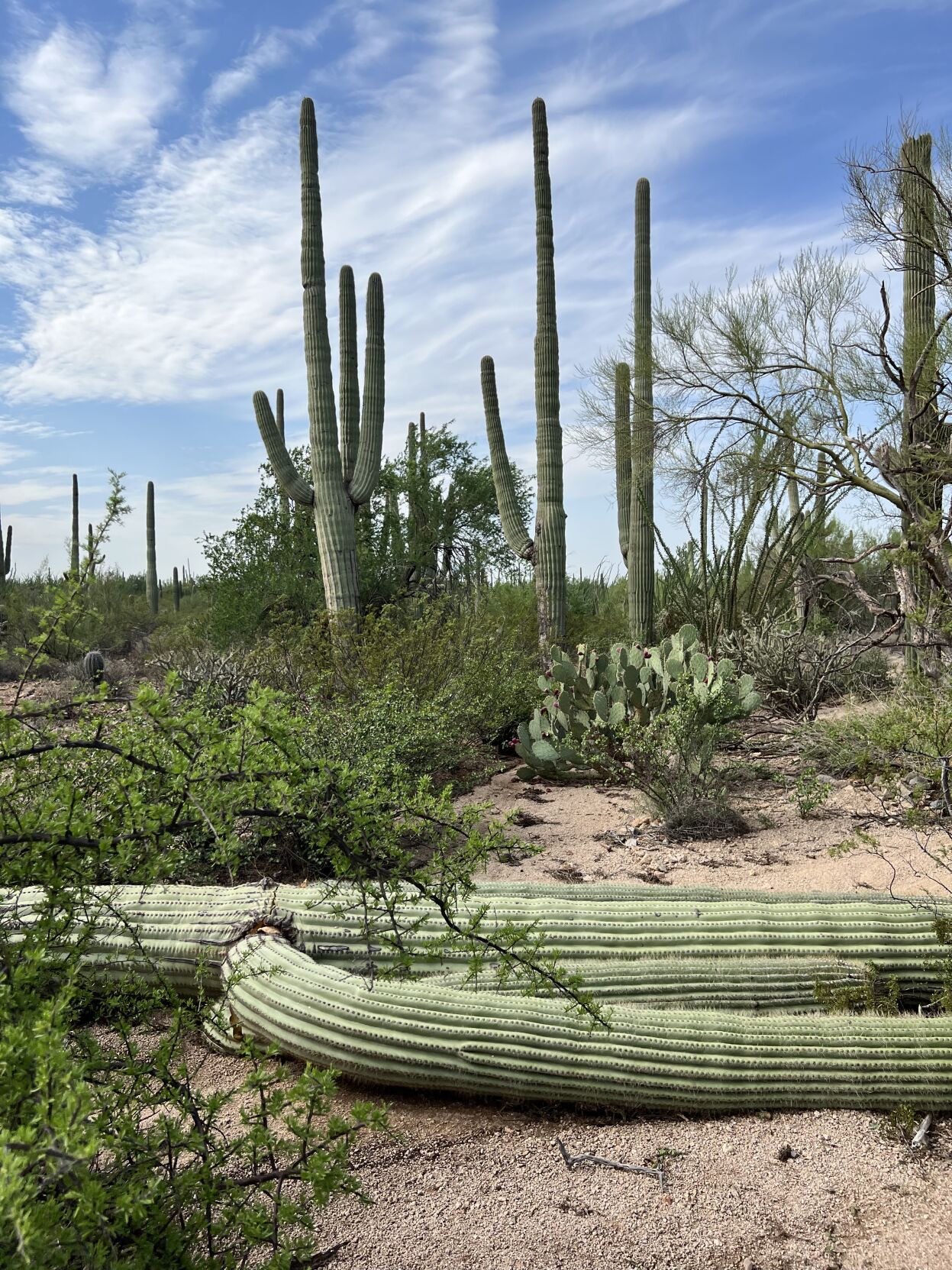
Bill Peachey, a private researcher who monitors saguaros in the Tucson area, visited the area northwest of the Saguaro Park-West visitors center Wednesday and estimated the number of downed saguaros to be in the "hundreds."
“We don’t know yet how strong the wind was” when the saguaros blew over in the park, she said. “That’s part of our ongoing investigation. We’re trying to figure out more about the actual event.”
The park service plans to send people to the area next week and in the coming weeks to conduct a more thorough assessment of the storm damage, Spreiser said. It hopes to put up a page on its website soon that will address this event and post updates as more information becomes available.
It’s probably going to take a few weeks to get a complete inventory of the damaged saguaros, she said. Right now, for instance, officials lack any measurement of how wide and long the damaged area extends, she said.
“The reason is that we are in major buffelgrass season and a lot of our crews (are) allocated with the pulling and spraying of buffelgrass, to preserve the larger saguaro area,” said Spreiser, explaining why totaling the damage will take so long.
She was referring to the invasive, nonnative grass that has taken over much of the Sonoran Desert and is considered a major fire risk.
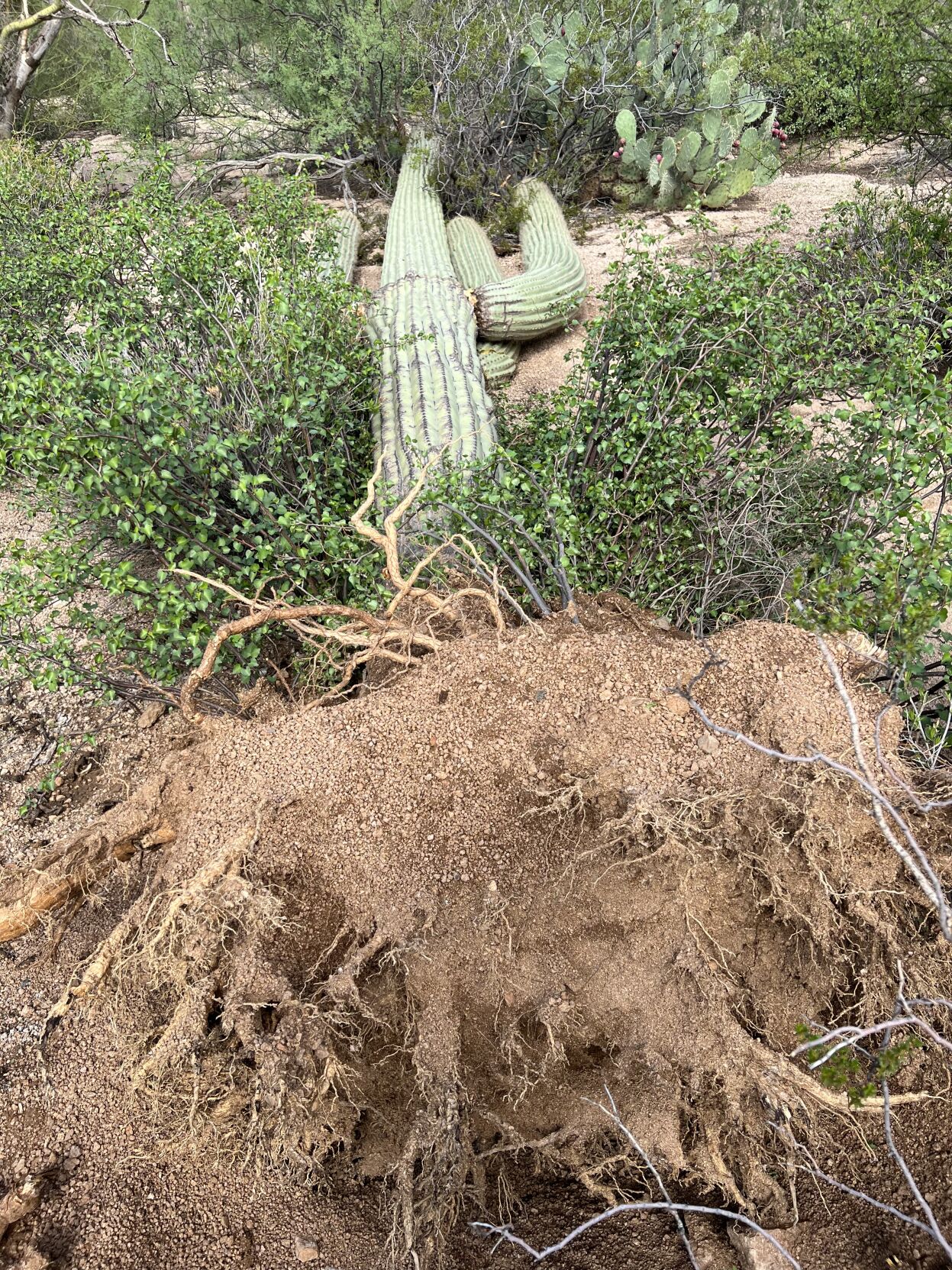
She said, however, that this wind damage doesn’t pose a long-term threat to the area’s saguaro population or to the many bird, insect and other species that depend on the saguaros for survival. The entire Saguaro National Park, both its east and west units, currently holds more than 2 million saguaros, she said.
Peachey agreed this event was hardly “the end of the world” for saguaros in the park. But he said it does represent the latest in a series of negative events affecting the saguaro that have him concerned. Since 1996, he has monitored a 2.5-acre plot of saguaros on the Tucson area’s far east side, near Colossal Cave.
The events include long-term declines in saguaro reproduction, some reports of heat-related saguaro deaths, and, on his particular saguaro plot near Colossal Cave, a pattern of lower-than normal saguaro blooms in the spring, he said.
Over a two-decade period, in eight of those years the blooming was less than normal and in two years only around 100 blooms formed on his plot’s 141 reproducing saguaros, compared to 6,500 blooms in a normal year, Peachey said.
While he can’t attribute these individual events directly to human-caused climate change, he said the events have the same symptoms as those that scientists have said are caused by climate change.
in the short run, Peachey said, the latest saguaro blowdown means local birds won’t have as many nest site possibilities and other animals, plants and insects won’t have the food, nectar and water they might have received from the downed saguaros.
“it’s another strike against them,” he said.
Husband-and-wife scientists hand off research after 43 years.

