





At age 15, Aleida Gehrels stood on the balcony of her family’s home in Holland and watched German paratroopers descend from the predawn sky.
It was May 10, 1940, and the Nazis had just launched the all-out invasion of Western Europe.

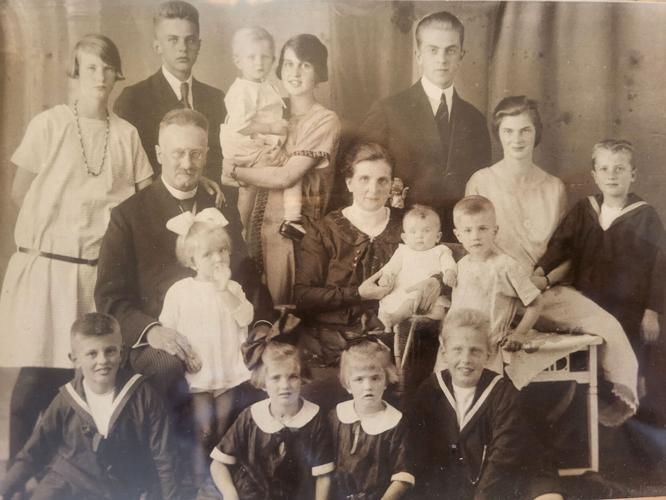
Aleida is the baby in this 1925 photo of the DeStoppelaar family in the Netherlands.
What followed for the Netherlands was five years of occupation, extermination and eventual famine that claimed the lives of more than 200,000 of its residents, roughly half of them Dutch Jews and Jewish refugees murdered in the Holocaust.
Aleida’s hometown was among the last European cities to be liberated, just a few days before Germany surrendered for good.
May 8 will mark the 80th anniversary of the Allied victory in Europe, but Aleida can’t believe that much time has passed. Even at age 100, she still remembers V-E Day like it was yesterday.
“It’s really hard to believe, because the war will always stay with you,” the Dutch immigrant and long-time Tucson resident said. “Whatever else happens in my life, World War II is always there.”
Invasion
Aleida was born on March 16, 1925, and grew up in Leiden, a university city near The Hague. As the youngest of the de Stoppelaar family’s 13 children, she had six brothers and six sisters, the eldest of whom was 20 years older than her.
Aleida was only 4 when her father died of a heart attack at age 52. When the war began 12 years later, she was still in school and living in the family’s cramped, three-story house with her mother, five of her youngest siblings and their housekeeper.

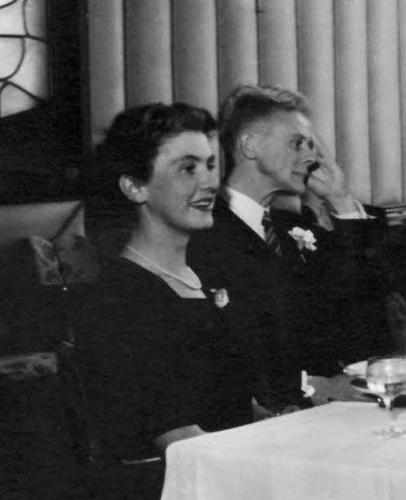
Aleida and Tom Gehrels on their wedding day in 1947.
“We knew it was going to happen,” she said of the invasion. “It was still a surprise.”
The family was awakened by the roar of propellers. “It sounded like 30, 45, 50 airplanes coming over, very noisy and pretty low,” Aleida said.
They sprang from their beds and crowded onto the second-floor balcony so they could see what was being dropped on them — soldiers, not bombs.
“It was very terrifying,” she said. “We saw paratroopers just coming down right in front of us, which was something that we would never have thought would happen.”
The Dutch fought back at first, but the government quickly surrendered after the Luftwaffe bombed the center of Rotterdam and threatened similar attacks on other large civilian targets. After that, Aleida said, “the Germans were free to invade with no more resistance. That was the first week of the war.”
Soon after, Hitler’s troops marched into Leiden and stationed themselves in the small 11th-century castle that overlooks the city from a man-made hill.
“They were in tanks and in jeeps and all that, and they actually marched right by our house,” Aleida said. “We didn’t pay attention to them. We didn’t go outside and look at them. We knew they were our enemies.”
No one had any illusions about what the invasion meant for the Netherlands’ sizable Jewish population. The Germans immediately began rounding people up, with a special focus on Amsterdam, the adopted home of Anne Frank.
“We had Jewish people hiding in our neighborhood,” Aleida said. “We also had young men hiding in our neighborhood” to avoid being sent to German labor camps.
One of them was a communist student from Amsterdam named Jan, who lived for a time in an upstairs room at the de Stoppelaar house and was not allowed to go outside. Aleida said their secret guest brought along a small radio the family would use to try to listen to the regular morning broadcasts by the Dutch government-in-exile in London. The Germans would jam the signal as soon as the introductory music began to play.

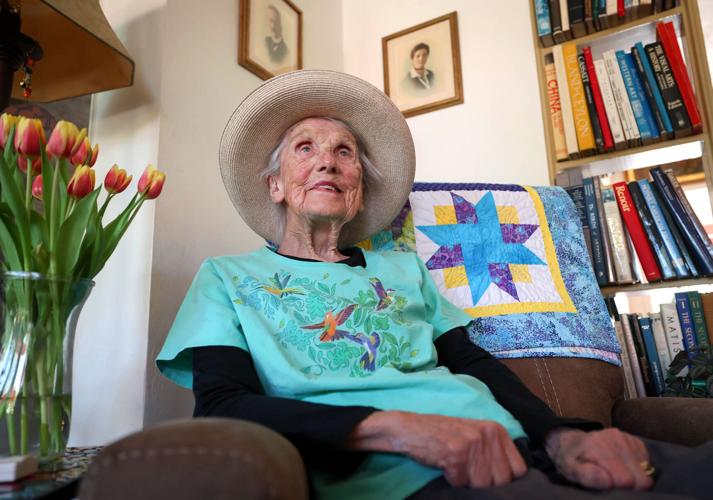
Aleida Gehrels, who celebrated her 100th birthday on March 16, poses for a portrait underneath photos of her parents at her Tucson home. She was a teenager during World War II, when her hometown in the Netherlands was under the control of the Nazis.
For news of the war, they relied on members of the underground in Holland, who risked their lives to publish and carefully distribute their own small newspaper. That’s how her family learned about the Allied landing at Normandy on June 6, 1944, Aleida said. “D-Day, I think, was the beginning of hope.”
By then, two of her brothers had escaped from Holland and traveled to England to join the military, Gerard as a paratrooper and Aard as a merchant marine.
They would survive the fighting in Europe but not the peace that followed. Aleida’s daughter, Jo-Ann Gehrels, said the men returned to the Netherlands as heroes, only to die by suicide a few years later — two more suspected casualties of what would come to be known as post-traumatic stress disorder.
World War II also took another de Stoppelaar brother, Cas, who was an administrator at a coffee plantation in Indonesia when Japan invaded what was then a Dutch colony. Aleida said Cas was rounded up with others from the Netherlands and executed in a Japanese prison camp.
Starvation
Life was hard in Holland during the first few years of Nazi occupation. It grew infinitely worse in the latter stages of the war.
When the Dutch government-in-exile ordered a railroad strike in late 1944 in hopes of speeding the collapse of the occupying forces, the Germans responded by cutting off all food and fuel shipments to the Netherlands’ densely populated western provinces.
It was the beginning of what came to be known as “the Hunger Winter,” Aleida said. The stores were empty, the schools were closed, and people struggled to find food and keep warm as bitter cold settled over the countryside.
“What you could find most often during the Hunger Winter was tulip bulbs. That became our main food, actually,” she said. “We wouldn’t eat them now. After the war was over, we never touched them.”
The desperate population also learned to survive on the edible parts of hyacinth plants. They tasted “just awful,” Aleida said, “but they were nutritious, and we had piles of them. As you may know, that area of Holland is what’s called the Keukenhof. It’s all tulips and hyacinths and all that.”
The de Stoppelaar sisters would go out during the day to scrounge for food or carry a pan to the city’s soup kitchen to collect the family’s ration for the day.
“We would have that one meal at lunchtime, and that would fill you for a while, but then there wouldn’t be anything else in the evening, so we really were hungry,” Aleida said.
They had no electricity, so their house was lit with candles. She remembers sitting around in the flickering light with her sisters, their stomachs growling as they reminisced about ham sandwiches and chicken eggs and all the other delicious foods they missed. Talking about it seemed to help somehow, Aleida said.
Occasionally, they also discussed all the different ways they would like to see Hitler tortured to death. That helped, too.
At night, they often drank tea for dinner and crawled into bed early under whatever blankets they had to escape the cold.
“We lost a lot of weight, but no one died. None of my sisters or my brothers died of starvation,” Aleida said. “But it was tough. It hurt.”
Liberation
Liberation Day finally arrived for Holland on May 5, 1945, when the German army agreed to lay down its guns and withdraw.
Word soon went out through Leiden that the Allies were planning an airdrop of food and other supplies in their area on May 7. Aleida called it “a day I’ll never forget.”

Aleida Gehrels in her golf cart with her dog, Bowie.
Everybody left their homes and walked to a park in the center of the city, where a flight of “really big warplanes” from the Royal Canadian Air Force soon appeared overhead, she recalled. “They dropped the food, but also they dropped little messages that came floating down. They said things like, ‘Be courageous,’ ‘We love you,’ ‘We’ll take care of you,’ and ‘The war is over.’”
It wasn’t just the townspeople who came to the park that day, either.
“The most interesting part was that the German soldiers who were still in our town, they came also,” Aleida said. “They didn’t have weapons anymore, so they just came and looked up at the airplanes. We had no contact with them, but they were there.”
Though she couldn’t muster any empathy for them at the time, looking back now she can’t help but feel sorry for those last German conscripts who were sent to guard her city at the end of their doomed campaign.
“I know they were not starving, but they were very, very young. They were just kids going back to a country in ruins. It must have been very hard,” Aleida said. “It’s just a matter of chance where you’re born, right? They were born in a Nazi country, and they grew up in a Nazi country. That’s not their fault. That’s not the way we thought right after the war. But now that we are wiser, we see it that way.”
The Nazis were mostly gone from Leiden when the Canadian ground troops arrived a few days later. Aleida said they rolled in on tanks and jeeps just as the Germans had five years earlier, only these men were waving and hanging from the sides of their vehicles with big grins on their faces.
“They were wonderful, and they had everything that you could wish for in their trucks,” she said. “They threw chocolate bars, cigarettes, coffee, everything that we had not seen (in years). That was liberation.”
Relocation
Aleida said much of Holland enjoyed “an amazingly quick recovery” after the war, and so did she.
In 1946, she was working as a travel agent at the port in Rotterdam when a man approached to ask about the badge she was wearing with her maiden name on it. He said he served with someone named de Stoppelaar in the war. It turned out to be her brother, Gerard.
And just like him, Tom Gehrels had also escaped from occupied Holland to train as a paratrooper in England. Then he joined Britain’s secret Special Operations Executive so he could parachute back into the Netherlands to assist the Dutch Resistance, with which he had served as a teenager.
Tom was also on a personal mission: to track down the whereabouts of his oldest brother, Cor, who had been sent to a concentration camp in Germany for helping Jews in Holland. Sadly, he never found Cor, who ended up dying in the camp a few weeks before the war ended.
Soon after their chance meeting in Rotterdam, Aleida and Tom started dating. By the following year they were married.
They emigrated to the U.S. in 1951 so Tom could complete his doctoral studies in astronomy at the University of Chicago. They moved to Tucson in 1961 so he could join fellow Dutch astronomer Gerard Kuiper at the University of Arizona as one of the first members of the newly formed Lunar and Planetary Laboratory.
Tom would spend the next 50 years at the U of A, developing instruments for NASA’s Pioneer space missions to the outer planets, setting up mountain-top telescopes to track near-Earth asteroids and studying the evolution of the universe.
When Tom died in 2011 at the age of 86, fighter jets from the Royal Netherlands Air Force flew over the U of A campus during his celebration of life to honor his wartime service.
His wife of 64 years still lives in the same house where they first settled in Tucson and raised their daughter and two sons.
Celebration
Aleida ended up with a lengthy career of her own after earning a Ph.D. in French literature from the U of A in 1969.
Nepotism rules at that time kept her from working at the same university as her husband, so she became a high school teacher instead, first at Palo Verde, then as the first instructor hired at what later became University High. “Madame,” as she was affectionately known, taught French and art history at UHS for 21 years.
Then in 1998, the year after she retired, Aleida went back to the U of A at age 73 to earn a four-year degree in biology, in part so she could keep pace with her astronomer husband and their three adult, science-trained children.
“I was the only one that knew nothing much about science except what the family would tell me. I thought that’s not so good, so I went back,” she said. “It didn’t help anybody except me, but I had a wonderful time with it.”
Until last year, when she was merely 99, Aleida could still regularly be seen pedaling her red tricycle around her Catalina Vista neighborhood with her dog, Bowie, in tow.

Left: Aleida Gehrels goes for a ride for her 99th birthday on March 16, 2024, back when she was still regularly pedaling her tricycle around her Catalina Vista Neighborhood in Tucson. Right: leida Gehrels in her golf cart with her dog, Bowie.
She has slowed down a little bit since then, but she still found the energy for not one but two parties for her 100th birthday on March 16.
The first was a private event in — where else? — the Century Room at Hotel Congress. “We had a jazz concert, just for our friends and family,” Aleida said. “It was wonderful.”
That was followed the next day by a block party in Catalina Vista that drew more than 100 people, including some of her former students. Jo-Ann Gehrels said it was amazing to watch her mother remember them by name and recall details about their high school days.
At last check, Aleida didn’t have anything specific planned for the 80th anniversary of V-E Day, but she said she might take a moment to mark the occasion during one of the regular, late-afternoon happy hours she and her daughter host in the neighborhood.
At least that’s what they’ve done in years past, Jo-Ann said. “I think when we remember, we do a toast.”
Perhaps this year, the glass they raise to liberation will have some nice champagne in it.
“Of course I’ll remember it,” Aleida said. How could she ever forget?

