


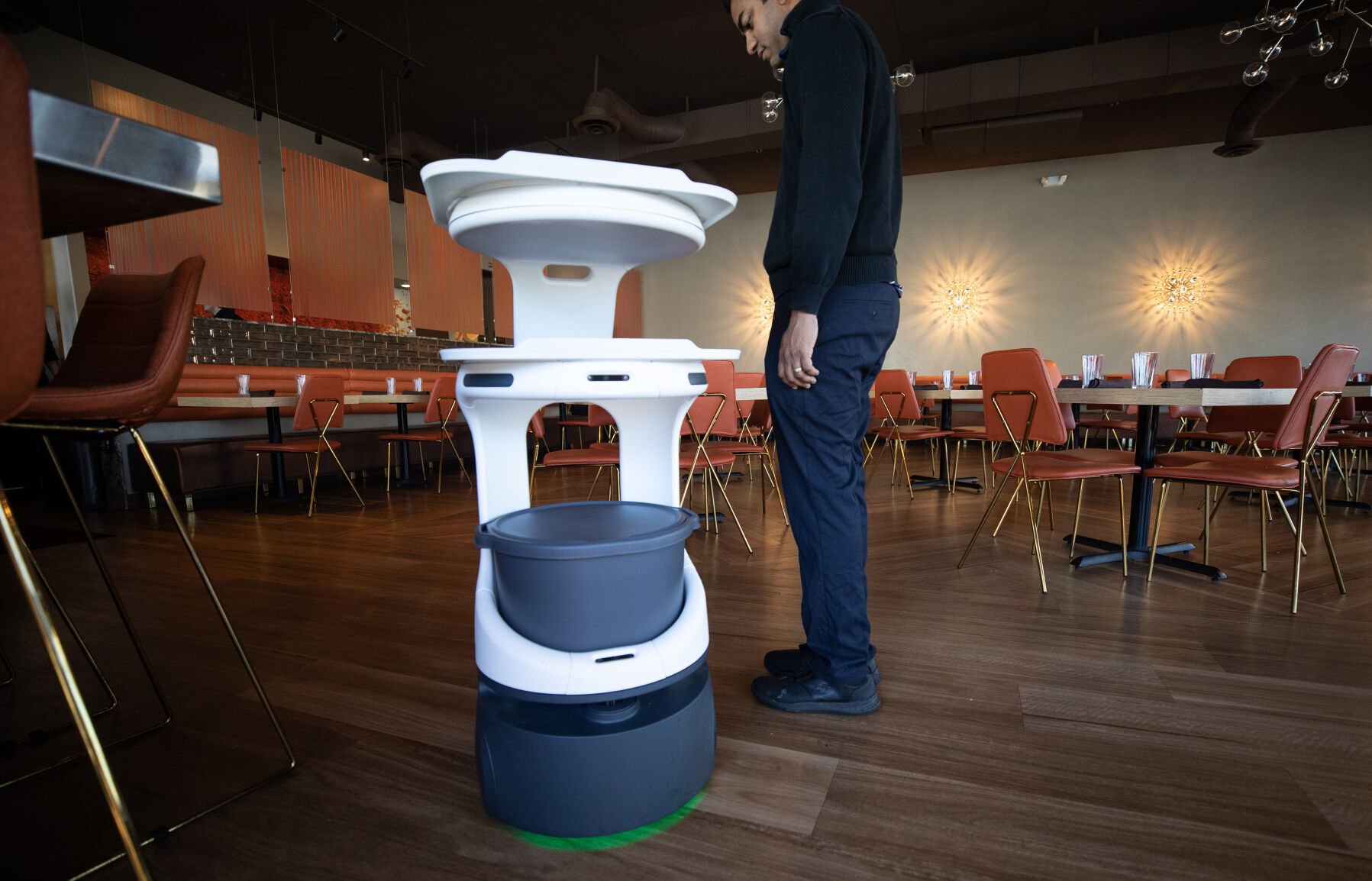

When given the assignment of carrying several tables worth of unwashed dishes to the kitchen for cleaning, a job that would put a frown on any restaurant worker’s face, Saffron Indian Bistro‘s newest employee just rolls with it.
More often than not, the act is met with smiles from restaurant patrons, who break out their phones to take video of the otherwise tedious task for TikTok, Facebook and other forms of social media.
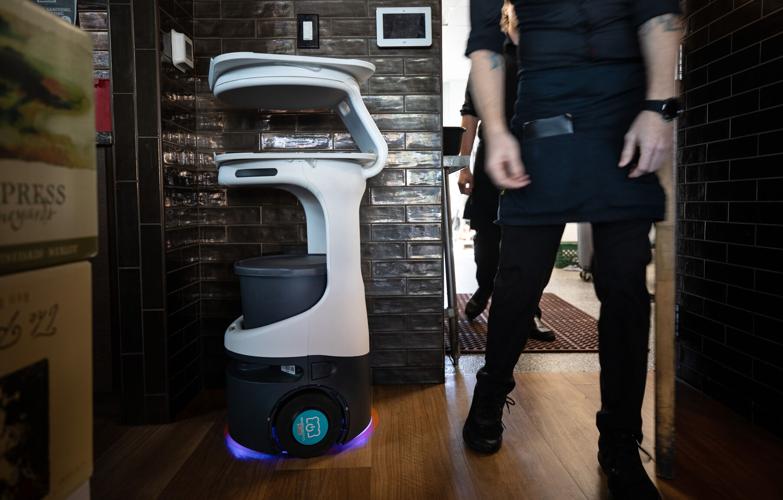
In those instances, all eyes are on “Spice,” a Servi hospitality robot, a little taller than R2-D2, that Saffron recently acquired to help its employees around the dining area.
When fully charged, “Spice,” with its several tiers to handle multiple jobs, can deliver food, drinks, take orders and assist in clearing tables for up to 12 hours at a time.
Saffron owner Mintu Sareen said they are only using their Servi for busing and bringing take-out from the back kitchen to the host’s stand.
“I don’t want to replace people with technology,” said Sareen. Saffron Indian Bistro has 53 employees. “We will always have that human touch. We got this to help our staff, so they don’t have to carry loads of dishes after meals.”
Sareen is renting the hospitality robot from Bear Robotics, a company in Redwood City, California, that specializes in self-driving technology geared to assist in restaurants, hotels, casinos, arenas and senior living facilities.
Saffron, which is located at 7607 N. Oracle Road in Oro Valley, is the first business in the Tucson area to have a Servi and one of only 20 businesses in the state. The rest are concentrated in the Phoenix area, including at a Hyatt Regency hotel and a Denny’s in Mesa, according to Juan Higueros, co-founder and chief operating officer at Bear Robotics.
Higueros said Bear Robotics launched in 2017 and has more than 6,000 Servi robots operating in businesses in 43 states, South Korea, Ireland and Japan.
Customers have the option to rent a Servi from the company, for between $699 and $899 a month depending on how long they want it. They can also buy a Servi outright for just shy of $15,000, with ongoing tech support from the company.
“Think of it as an additional set of hands,” Higueros said. “The employees are able to participate in more engaging activities instead of menial, repetitive tasks. Sometimes those trays can be pretty heavy. Carrying them for eight hours a day can be cumbersome.”
When a restaurant signs on with Bear Robotics, a field operator comes out to map a layout of the business, which is then programmed into the Servi, setting the parameters on where it can and cannot go within a designated area.
If Table 6 needs to be cleaned, a server will enter the number of the table into a tablet built into the robot. Once the Servi finds its way to the table, the server loads it with dishes. The robot then heads back to the kitchen while the server moves on to help the next customer.

“Spice” sits in the corner waiting to be called as servers pass from the kitchen at Saffron.
Higueros said Bear Robotics is working on more advanced hospitality robots that will be able to take elevators and work on multiple floors of hotels and office buildings.
“They will be able to deliver Amazon packages dropped off at the front desk, groceries, Uber Eats deliveries, everything and anything,” he said. “It has taken us a few years to get here. Now, you are hopefully going to start seeing more of these in your everyday life.”
Bear Robotics can access all Servi robots through its online network, which means any updates to the software can be made off-site. On a recent Tuesday, Saffron’s Servi had to be rebooted several times, a bug that the company fixed remotely, Higueros said.
The system glitches shook Sareen’s confidence in his new employee’s abilities, but he is opting to stick with it, for now.
“It is a new technology,” Sareen said. “It is going to take time.”
Sareen said when the Servi is working, which has, so far, been the vast majority of the time, it is both helpful to his human employees and entertaining for the guests.
“People love it,” Sareen said. “It has a cool factor. I want kids to say to their parents, ‘I want to go to that robot restaurant.’”
It's no secret that the way technology is affecting our everyday life has been accelerated by the COVID-19 pandemic. With many companies struggling to find workers and pay higher wages, some retailers and restaurants are investing in robots and other technology. Source by: Stringr
12+ Tucson restaurants we said goodbye to in 2022
Bentley's coffeehouse
Updated
Jo Schneider laughs for a photo with longtime friend Willow Bentley inside LaCo's courtyard, 201 N. Court Ave., on Jan. 12, 2022. Schneider and Bentley opened Bentley's House of Coffee and Tea 38 years ago. The cafe permanently closed its doors in December.
Tucson entered the new year without the longtime Bentley's coffeehouse, which closed in late December 2021 after nearly four decades in business.
With Bentley’s closed, the Schneider family and their community can still be found at the downtown restaurants LaCo and TallBoys.

Jo Schneider founded Bentley's so she could have and raise her sons, Ben and Eli, in a safe space, filled with community. She made that space home for generations of Tucsonans. The Schneider family can still be found at its downtown restaurants LaCo and TallBoys.
Wings Over Broadway
Updated
Wings Over Broadway, 5004 E. Broadway - Courtesy of Google earth
Wings Over Broadway announced the official closure of its restaurant at 8838 E. Broadway Blvd. in early October.
First opened in 1999, the restaurant moved into that most recent space from its original location at 5004 E. Broadway Blvd. in 2017. In a Facebook post, challenges WOB faced due to the COVID-19 pandemic and lengthy roadwork on Broadway were credited for the decision to cease operations.
Sullivan's Eatery & Creamery
Updated
Autumn Hand laughs along with regular customers as she takes their orders at Sullivan’s Eatery & Creamery, 6444 N. Oracle Road.
After 45 years, Sullivan’s Eatery & Creamery at 6444 N. Oracle Road will close for good.
Alex Mustaffa, who has owned the restaurant since 2017, said he will close no later than June 15, two weeks before his lease expires. But the closing could come sooner, he said, if he runs out of supplies or doesn’t have enough employees to keep the doors open.

1702
Updated
Eric Lepie, owner of 1702 Pizza and Craft Beer, is closing after 15 years in business.
1702 pizzeria closed its doors in May after 15 years of service. Not only will owner Eric Lepie be closing the restaurant but he’s also closing the final chapter of a 45-year restaurant career in Tucson.
Primo Italian restaurant
Updated
Primo at the JW Marriott Starr Pass Resort & Spa will close on Sept. 30. A new Italian trattoria-style restaurant will take its place in October.
After 18 years, two-time James Beard Award-winning chef and restaurateur Melissa Kelly is closing her Primo Italian restaurant at the JW Marriott Starr Pass Resort & Spa.
But Italian food is not leaving the west-side Tucson resort entirely.
Sometime in mid-October, Starr Pass, at 3800 W. Starr Pass Blvd., will replace the upscale Primo with a more casual trattoria.
Pizza Luna
Updated
Pizza Luna's sausage rossa pizza, $12.75, features wild mushrooms and housemade Italian sausage.
Pizza Luna owners Marc and Tracy Frankel closed their doors after five years of bringing Neapolitan-style pizza to the east side.
Last year, when the Frankels launched Bubbe’s Bagels with Becca Groff and Kyle Leuer, they tapped into an even deeper need. Unlike delicious, Neapolitan-style pizza, which can be found in other neighborhoods — downtown’s Anello, food trucks like Family Joint Pizzeria — east-coast-quality bagels could not be found anywhere else.
Tino's Pizza
Updated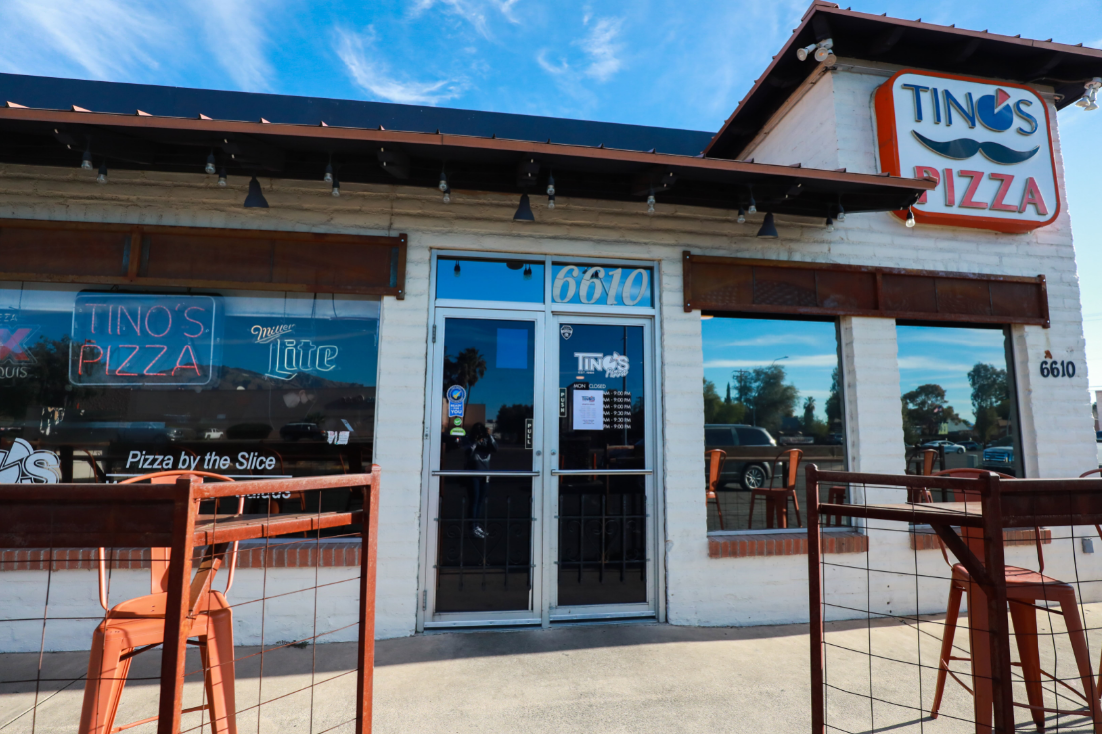
Tino's Pizza is closing in early February after nearly four decades in business.
In early January, the family made the painful decision to close Tino’s Pizza, after over 35 years, at 6610 E. Tanque Verde Road on Wednesday, Feb. 2.
“It’s hard to let go,” said Morgan Chonis, the family’s spokeswoman. “It’s been amazing, and the community and love and outpouring of support has been unreal. But ultimately it came down to the family’s decision to retire my father’s legacy.”
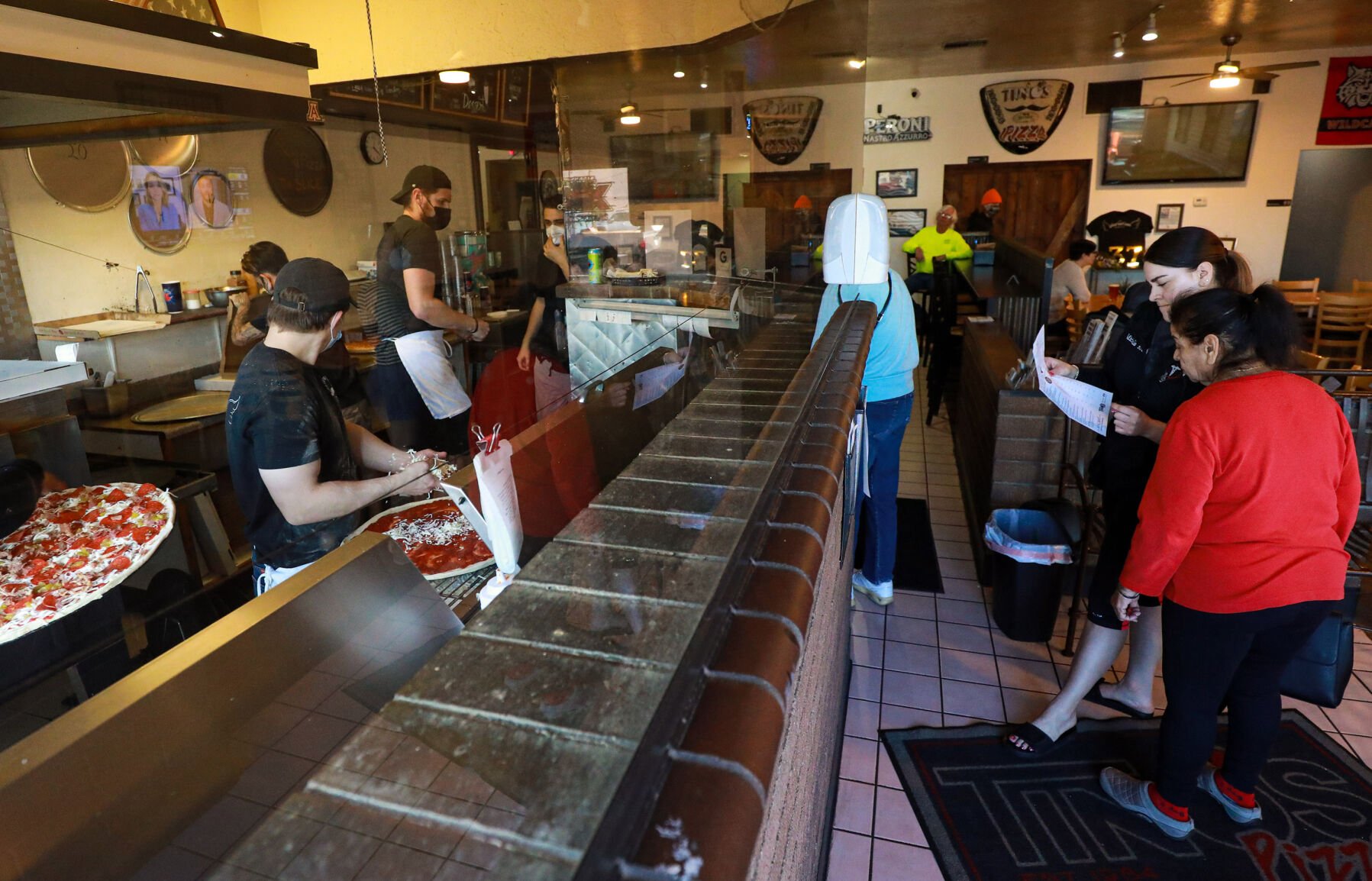
Morgan Chonis: “If you went to high school around here, it was the rite of passage to work here. We have kids working here now whose parents worked here.”
Fat Noodle
Updated
Lead cook Albert Leyva tops the House Ramen bowl with sesame seeds at Fat Noodle ramen restaurant, 811 E. Wetmore Road, on October 11, 2018, in Tucson, AZ.
Fat Noodle closed its doors at 811 E. Wetmore Rd. on August 6. The ramen shop will now make its food truck their main focal point. Fat Noodle is entirely made from scratch, from the noodles to the stock.

The Fat Noodle bowl of House Ramen features sonoran wheat house noodles, chicken and pork shoyu broth, pork chashu, soft egg, enoki, green onions, Fat Noodle sauce, sesame seeds and crispy onions at Fat Noodle ramen restaurant, 811 E. Wetmore Road, on October 11, 2018, in Tucson.

For Fat Noodle, opening a brick-and-mortar has been nearly two years in the making.

The FN Burger at Fat Noodle ramen restaurant is a sesame ginger beef topped with lettuce, tomato, hoisin sauce and spicy mayo on a grilled ramen noodle bun at Fat Noodle ramen restaurant, 811 E. Wetmore Road, on October 11, 2018, in Tucson, AZ.
4 Seasons Restaurant
Updated4 Seasons Restaurant announced that the restaurant is permanently closing at 1423 W. Miracle Mile. "We have provided high quality Thai food for 9 years and been an enthusiastic part of the local community," they wrote.
Donut Wheel
Updated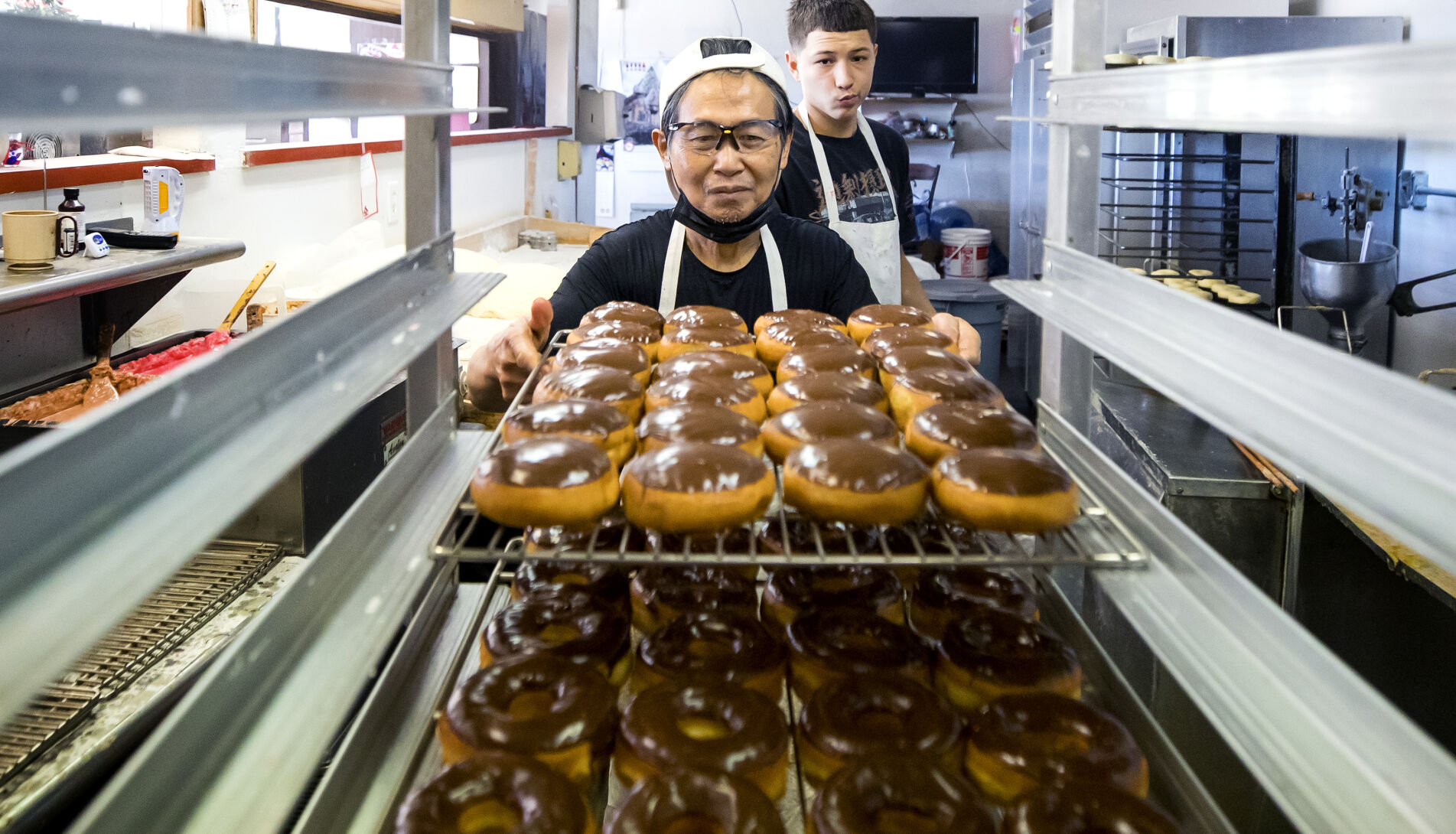
Sam Phetdara, owner, puts finished chocolate topped filling donuts on a rack at Donut Wheel, 4801 S Campbell Ave. in Tucson, Ariz. on Oct. 11, 2022. Donut Wheel is closing its doors after 34 years.
Donut Wheel at 4801 S. Campbell Ave. closed its doors Oct. 28.
“It’s time,” said Sam Phetdara, who has operated the doughnut shop at Campbell Avenue and Irvington Road for 34 years. “Our customers are sad and say they are going to miss us.”

Baker Josh Gonzalez puts sprinkles on chocolate and pink frosted donuts at Donut Wheel.

For Star subscribers: The two Donut Wheel locations are owned and operated separately. One will close at the end of the month and the other has already shut its doors.
Sonoran Brunch Company
Updated
This colorful mural where brunch foods rain down was created by Cactus Clouds Art. Find it at Sonoran Brunch Company in the drive-thru.
The Sonoran Brunch Company opened in 2019 near Kolb Road and 22nd Street. It featured colorful murals and breakfast foods.
Sonoran Brunch Company closed in May.
Eegees Grant & Alvernon
Updated
Any local is going to tell you to do this right away. Why? They're amazing and no one else has them. You can also take your eegee's drink to the next level with our simple tricks.
There are two near campus: Speedway Boulevard and Tucson Boulevard, 2510 E. Speedway Blvd. AND Grant and Campbell, 2470 N. Campbell Ave.
Eegee's at Grant and Alvernon closed its doors Nov. 29. The popular Tucson sandwich and shaved ice restaurant has nearby locations at Speedway and Tucson, Speedway and Craycroft or Campbell and Grant.
Mantis Gourmet Chinese Food
UpdatedMantis Gourmet Chinese Food will permanently close its doors at 8250 N. Cortaro Rd. on Dec. 31. The restaurant is one of several located in the Arizona Pavilions Marketplace.

