


Tucson-area migrant-aid groups are emphasizing their continued commitment to humanitarian work after receiving “intimidating” mailings, amid a rise in anti-immigrant activity since the November election.
At least three humanitarian nonprofits, the Green Valley-Sahuarita Samaritans, Salvavision and Humane Borders, received the unsigned postcards in late December, calling on people to “report illegal aliens” to U.S. Immigration and Customs Enforcement, or ICE.
The postcards, postmarked in Oakland, California, list places where undocumented people may be found — “at school, at work, at church, at restaurants, in your neighborhood” — with the warning, “There is nowhere to hide!”
The mailings seem aimed at instilling fear in immigrant communities by citing safe havens, like schools and churches, advocates said.
Salvavision founder Dora Rodriguez said on Friday she received the postcard at her home address, which is not listed on Salvavision’s website, she said.
“They did their homework,” she said. “This intimidation is not only for the migrant community, but also for the humanitarian organizations.”

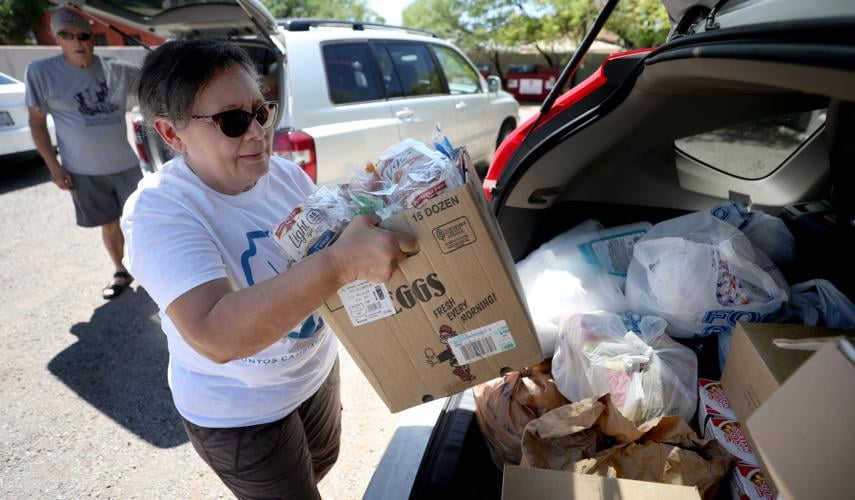
Dora Rodriguez loads supplies into her car to take to a migrant shelter in this 2021 file photo. The founder of the nonprofit group Salvavision said of postcards sent to migrant-aid workers, “This intimidation is not only for the migrant community, but also for the humanitarian organizations.”
Since President-elect Donald Trump won the November election, local migrant-aid groups have seen a rise in threats, harassment and vigilante activity, including vandalism of Humane Borders’ permitted water tanks, installed throughout the borderlands.
Regarding the postcards, “We are no stranger to harassment like this, unfortunately, so it’s nothing new,” said Laurie Cantillo, board chair for Humane Borders. The nonpartisan group stays in close contact with the Pima County Sheriff’s Department to report harassment and acts of vandalism, which tend to come in waves, she said.
The Tucson-area postcards came as similar mailings circulated in the sanctuary state of Oregon, where the attorney general and a local sheriff condemned “racist” mailings that told people to compile identifying information, such as license plate numbers, of those who might be undocumented, local station KPTV reported. Lincoln County Sheriff Curtis Landers reported the letter to the Federal Bureau of Investigations after receiving one, according to KPTV.
“We are encouraging our community members to do the right thing and use compassion as we encounter these types of messages,” the Lincoln County Sheriff’s Office said in a news release. “We strongly advise against engaging in activities such as those outlined in this letter, including collecting or sharing information about individuals based on their demographic or perceived immigration status.”

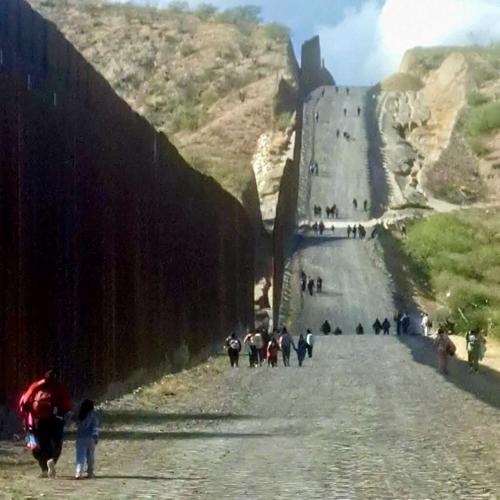
Asylum seekers, including mothers carrying children, walk toward Sásabe, Arizona, where a border station is located, in this 2023 file photo.
Along the border wall, armed vigilantes have put cameras in the faces of humanitarian volunteers, falsely accusing them of working with the “cartels” and of being human traffickers, Rodriguez said. Those vigilantes had been somewhat quieter last year, until Trump won the election, advocates said.
Rodriguez says humanitarian workers aren’t deterred by those efforts, increasingly carried out by opportunistic right-wing social media personalities.
“I am not afraid,” she said. “I am not planning to stop supporting families and children in our community. I’m practicing my right to morally be present for these people who need help. I am practicing my right to give humanitarian aid. That is never a crime.”
Funded by donations only, Salvavision is helping dozens of asylum-seeking families to settle in Tucson as they wait for their asylum cases to proceed. All are in the country legally. The nonprofit also provides humanitarian aid to migrants in remote areas along the U.S.-Mexico border, and also aids recently deported migrants in northern Mexico.

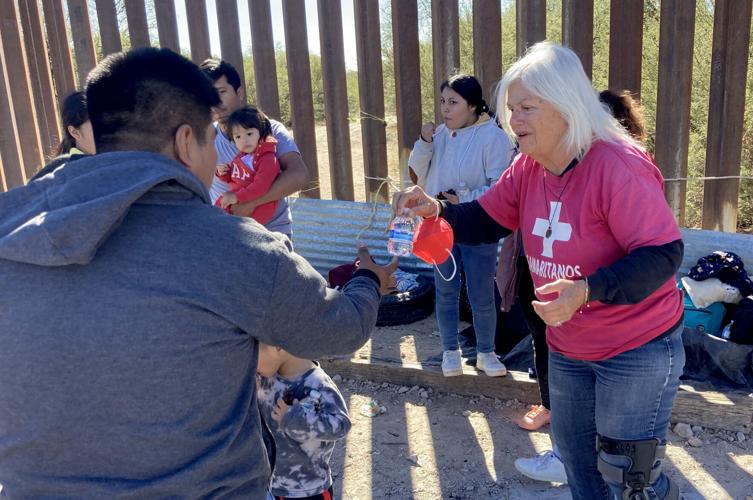
Gail Kocourek of the Tucson Samaritans distributes water to asylum seekers from Chiapas, Mexico, along the border east of Sásabe, Arizona, in this 2023 file photo.
Pima County Sheriff Chris Nanos told the Arizona Daily Star the anonymous postcards are “concerning.” The sheriff’s office had not received any reports about the mailings, which he said appear to be aimed at intimidation.
“As disturbing as it might be, I would tell our community to just ignore those things,” Nanos said.
Arizona’s immigrant community is preparing for the effects from Trump’s promised mass deportations, as well as the pending implementation of Proposition 314, a voter-approved ballot measure that empowers local law enforcement to arrest immigration-law violators. Prop. 314 will only go into effect if a similar law in Texas survives a court challenge.
Nanos, a Democrat, has told the Star that sheriff’s deputies here will not participate in immigration enforcement.
Pima County Attorney Laura Conover said the recent postcard mailing is an example of “fear mongering” that harms public safety, especially combined with the prospect of Prop. 314.
The ballot measure is likely to erode trust in local law enforcement, deterring undocumented people who witness crimes, or who are crime victims, from contacting authorities, Conover said.
“This is exactly what you don’t want. We need people to feel safe, and we need people to continue to report crime,” she said. “You don’t want half your community hesitating to report crime that they’ve observed, report crime that they have suffered from. That creates a very dangerous situation.”
Conover emphasized that Pima County’s bilingual tip line, 88-CRIME, is still a safe option to report crimes anonymously.
“Emboldened” vigilantes
Since Trump won the presidency after promising to “launch the largest deportation effort in American history,” anti-immigrant groups and vigilantes have been “emboldened,” said Randy Mayer, a pastor and co-founder of the Green Valley-Sahuarita Samaritans, which also received the postcard at the group’s listed address in Sahuarita.
The Samaritans are a daily presence at the border wall in Arizona, providing first aid, blankets, food and water to migrants who are often dropped off in remote areas by human smugglers.
Mayer said he is called by his Christian religion to help vulnerable people exposed to the elements near the border, where temperatures are now dipping into the 20s. Samaritans communicate with Border Patrol and local emergency responders to ensure they’re following the law while protecting human lives, Mayer said.
“I’ve been doing this since 2000. We’re not hiding anything,” he said. “I’m a Christian pastor. I follow Jesus’ ways of compassion and peace.”
In Tucson, a network of human-rights groups, led by Coalición de Derechos Humanos, have been hosting “know your rights“ clinics for undocumented immigrants, seeking to empower and prepare the community with good information, said Alba Jaramillo of Coalición de Derechos Humanos, and co-executive director of the Immigration Law and Justice Network.
In November, a group of “nationalists” showed up at a Tucson church with video cameras, the day before an event for undocumented people was scheduled there, Jaramillo said.
“We’re already seeing the harassment happening,” she said. “We were terrified that they were going to call ICE or that some of us would be followed.”
Tucson activists have received death threats, and some advocacy groups are deleting their addresses from webpages, for fear they could be targeted or infiltrated by bad actors, she said.
“Just as we’re getting organized to defend immigrant communities, the nationalists are getting organized as well, to create a culture of fear,” she said. “I think the election opened the door for a lot of this hateful rhetoric, and now we’re really going to have to look at our safety, and the safety of our immigrant community.”
Support for immigrants is more important than ever, Jaramillo said.
When it comes to hate speech, “We need to challenge it,” she said. “We need to dispel the myths, we need to tell immigrants we’re on your side, you’re not alone. I think it’s the moment for anyone that has sympathy for immigrant communities to speak up. We’re going to need their voice in order to challenge the anti-immigrant culture that we’re seeing.”
Trump’s plans to accelerate deportations will face hard limits due to logistical, financial, diplomatic and legal challenges. For example, mass deportation would require scaling up ICE staffing and detention capacity, and negotiating with countries who refuse to accept deportations from the U.S., experts say.
In the meantime, immigrant rights experts expect the Trump administration to weaponize fear, and use heightened publicity of routine ICE enforcement, in order to push people to “self-deport.”
The Biden administration is already carrying out high numbers of deportations, especially at the border since Biden signed a June executive order restricting asylum access.
A December report from ICE shows that in fiscal year 2024, which ended Sept. 30, the Biden administration surpassed Trump-era annual deportation levels, with 271,000 expulsions last year.
Under President Barack Obama, called the “deporter in chief” by critics, ICE deported a record 410,000 people in 2012 alone.
Conover said ICE enforcement in the interior of the U.S. should focus on detaining people convicted of, or accused of, violent crime, rather than people immersed in the community who don’t have a criminal record.
“The suggestion of mass deportation only serves to deplete and distract from what actually keeps us safe,” she said. “That needs to be targeted work against people who are causing harm. … Nobody wants distraction from that.”
Growing up undocumented, Jaramillo said she lived with fear until she finally got legal status in college. But fear can be countered by good information and solidarity in one’s community, she said.
“We gotta equip ourselves with tools to fight back, to defend ourselves, and all that comes with knowledge,” Jaramillo said. “Yes, the fear is real. But so is our resilience, so is our power, so is our spirit to keep our families together. That’s also real. We just have to keep sharing information and preparing for everything that’s coming.”

