





Joseph’s broken leg has healed, and the angel has his wings back at San Xavier del Bac.
Just in time for Christmas, worshipers at the 240-year-old church can say a prayer in front of the Nativity and rock the baby Jesus in his cradle, thanks to restoration work on the Tohono O’odham holiday display that has graced the mission for decades.
The refurbished Nativity scene went up in the east transept of the main chapel on Wednesday.

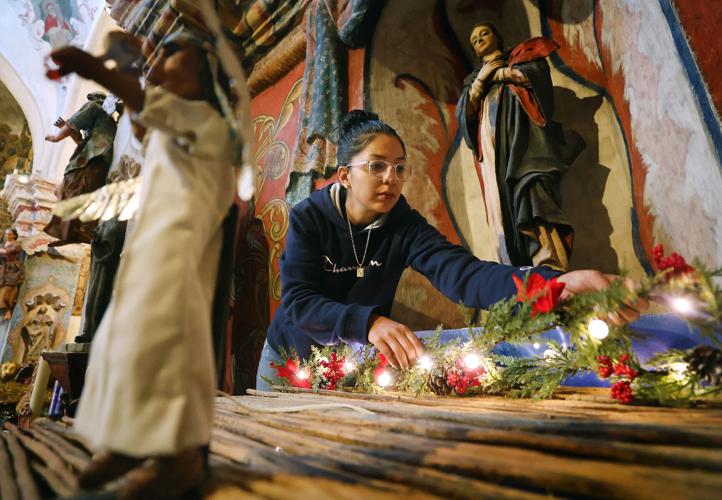
Susie Moreno, a conservation specialist, recently completed a restoration on the figurines and the backdrop for the nativity scene at San Xavier del Bac Mission. She places lights along the top of the Wa:To, ramada, made out of saguaro ribs. Moreno started as an apprentice and is now called on to repair and restore important features inside and out of the historic mission.
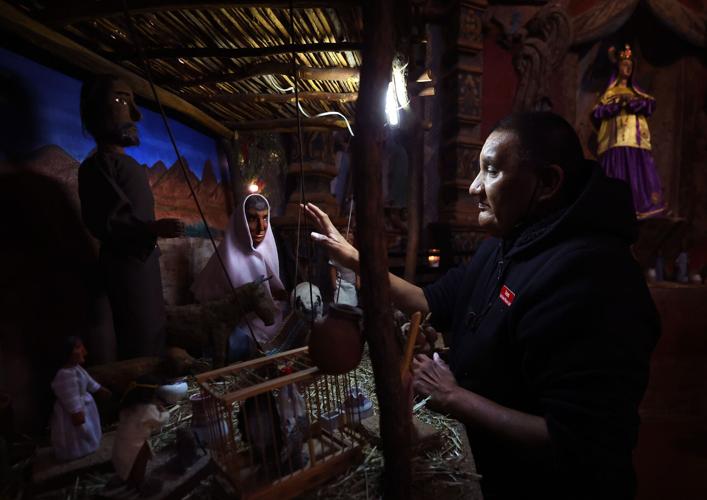
San Xavier custodian Ivan Burrell oversaw the setup as usual. The task means a lot to him, so he’s only missed doing it once in the past 23 years.
“It’s very special to me, and I’m very glad to have the honor to put this out for the people,” Burrell said.
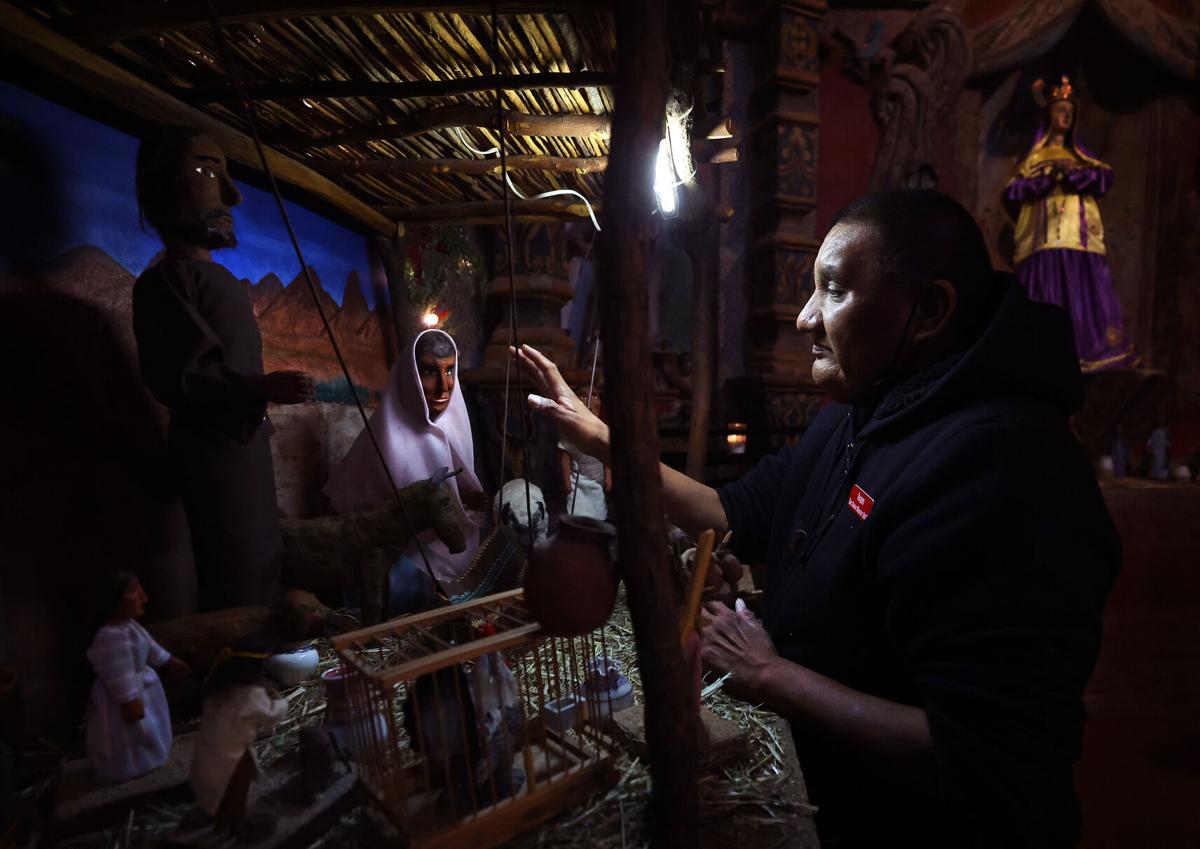
The Nativity includes the usual cast of characters, all of them with Native flourishes. It also features several O’odham villagers in traditional dress, including a woman with a burden basket on her head.
Watching the celestial scene from above is an angel with pressed tin wings, a headband and a brightly painted rattle in his hand.
There’s a specific order to how Burrell placed the figures, in keeping with the biblical story. “Joseph goes first,” he explained.
Burrell talked to the figures as he arranged them, thanking them for being there for another holiday season. Then he said a prayer in front of the finished scene.
The three wise men — with their little ceramic pots of gold, frankincense and myrrh — looked on from a nearby altar, where they will wait for their turn to travel to the manger. San Xavier Pastor Ponchie Vasquez said that won’t happen until the Epiphany, also known as Three Kings Day, on Jan. 6.
Artist Thomas Franco of San Xavier village created the Native Nativity out of mesquite and saguaro ribs. He donated it to the church in the early 1980s, and it has been on display there each Christmas ever since.
The late Tucson icon and folklorist “Big Jim” Griffith described Franco’s “lovely scene” for the Arizona Daily Star in 2013: “The dark-skinned holy family is under a ramada, with native pottery and baskets on the ground. The baby Jesus lies in a hanging cradle with a string leading to the edge of the altar. People may pause, say a prayer, pull the string and rock the baby.”
Burrell said Franco’s wife, Elsie, made the clothes for the figures. The black hair glued to their heads reportedly came from trimmings the couple collected after their children’s haircuts.
Franco came from a family of artists. His parents, Domingo and Chepa Franco, carved wooden figures and built dioramas in the 1950s and ‘60s depicting daily life for the O’odham.

San Xavier Mission
The Nativity was restored by Susie Moreno from Patronato San Xavier, the nonprofit that oversees preservation and fundraising for the historic building on Tohono O’odham land.
“It was a special project to me, because it kind of hit close to home,” said Moreno, a mission-based preventive conservation specialist. “I kind of had a personal connection to it.”
Feels like home
Moreno was born in the San Xavier District and baptized at the mission.
She studied at the mission school through eighth grade and regularly attended Mass at the iconic church next door.
At Christmastime, she remembers watching people line up to pray in front of the O’odham version of Bethlehem and pull the string. The uniquely interactive display was the only Nativity she ever knew as a child.
“Everyone knows to kind of rock him back and forth. Everyone is very gentle when they do it,” Moreno said. “It’s a tradition. It’s just normal to me.”
Repairing the Nativity was the first solo project for the 30-year-old, after about seven years of training under Tim Lewis and Matilde Rubio, the husband-and-wife conservators who have overseen the artwork at the mission for decades.
Moreno is Lewis’ niece. She said she didn’t have much interest in art or her uncle’s work growing up. She would spend time with him at the mission after school when she was little, but she didn’t really understand what he did until years later, when she started learning at his side.

Susie Moreno, a conservation specialist, unwraps the painting that will be placed behind the Nativity scene. “It was a special project to me, because it kind of hit close to home,” Moreno said of the Nativity scene restoration work. “I kind of had a personal connection to it.”
She thought a conservator was just a fancy name for an artist who restores old work by painting over it. She soon learned the science and the technical skill that goes along with the artistry.
“You’re not creating anything. You’re saving and preserving history,” she explained.
Moreno originally planned to become a nurse after she graduated from San Miguel High School, but she was working a retail job in August of 2016, when her uncle asked her if she wanted to come join him at the mission.
A month later, she started there as a part-time conservation apprentice.
Moreno has had a hand in every major restoration project since, including plaster repairs on the entire east tower and conservation work on the mission’s main altar and 17th-century bells.
Earlier this year, she was part of a crew that spent weeks on scaffolding more than 50 feet above the floor, cleaning and stabilizing centuries-old artwork on the inside of San Xavier’s dome. To reach their lofty work area, she said, they had to go up on the roof and climb into the church through one of the decorative windows near the ceiling.
Moreno still lives in her childhood home, about two miles from the mission. In addition to her now full-time job, she’s taking classes for the bachelor’s degree in heritage conservation she hopes to earn in a year or two from the University of Arizona’s College of Architecture.
Most days, her work involves regular maintenance of the historic decorations inside the mission, where dust is a constant challenge. “The doors are open seven days a week,” she said.
The rest of her time is spent on rapid repairs to damaged or deteriorating items or on special projects like the Nativity.
Manger makeover
Moreno said she started work on the display in June and finished it in November.
Everything was cleaned, dusted and repaired as needed.
She had to nail one of the angel’s wings back on and fix broken legs on Joseph, a wise man and one of the villagers. Several of the figures, carved from mesquite and saguaro ribs, had to be reattached to their bases.
The glued-on dirt covering the ramada’s plywood floor was refreshed with bits of straw from the nearby San Xavier Co-op Farm.
Moreno also replaced the Nativity’s brown leather hammock, which had been torn and patched with duct tape. The baby Jesus’ new cradle is a piece of saddle blanket printed with a Southwestern pattern.
To preserve Franco’s original Sonoran Desert backdrop, which used to be tacked to the back of the ramada, Moreno glued the painting to a thicker canvas and had it stretched over a sturdy frame. Then she touched up the work with special paints favored by conservators.
Finally, the old bulb that once lit the scene was replaced with an LED light that won’t damage the artwork.

Artist Thomas Franco of San Xavier village created the Native Nativity out of mesquite and saguaro ribs and donated it to the mission in the early 1980s. The pieces are carefully wrapped in plastic and stored away until December when they are placed on display leading up to Christmas.
Moreno documented her work throughout the process and came up with a new, more protective way to store the Nativity when it’s not in use. The figures used to be wrapped in newspaper and packed into cardboard boxes. Now they are kept in clear bags and carefully arranged like “a game of Tetris” inside hard-sided plastic containers, Moreno said.
“It was a lot of work but a very good experience,” she said of the project. “I really enjoyed it.”
The only thing missing on Wednesday was the star of the show. As tradition dictates, the baby Jesus won’t be placed in the manger until local parishioners gather for midnight Mass on Christmas Eve.
The display is scheduled to stay up until the Feast of Candelaria on Feb. 2. That’s when Burrell will carefully pack up the figures, thank them for watching over the people of San Xavier and say goodbye to them for another year.
He knows they’re just going back into storage, but he likes to imagine a different journey for the Natives of San Xavier’s Nativity.
“I always picture them walking off into the desert,” Burrell said.
In 1700, Father Eusebio Francisco Kino put down the foundations for a church at the village of Bac, on the Santa Cruz River near modern Tucson, to be named after his patron saint, St. Francis Xavier.

