



Richard Hockett spent more than two decades at Flandreau Indian School, teaching social sciences, coaching, helping direct a summer program and working as the students rights and responsibility officer.
But in 2022, he was moved to the boarding school’s dormitory, where he served briefly as home-living director.

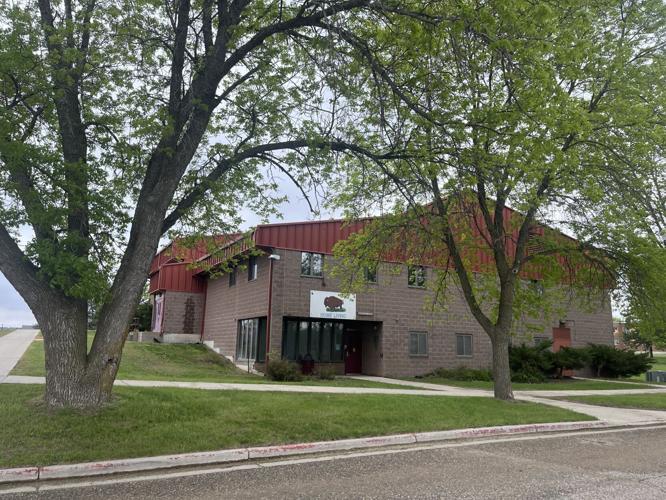
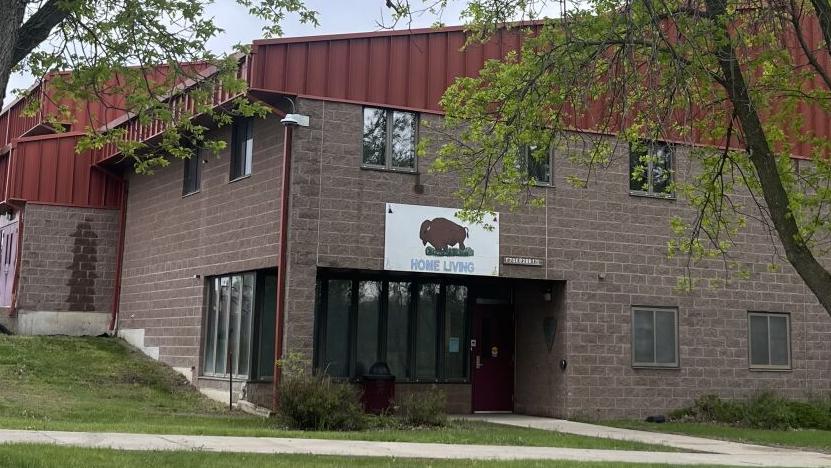
Flandreau Indian School's Home Living building is photographed on May 15, 2024.
It was there that he saw how, in the evenings, staff with “no medication training” would load up a cart with medications, “wheel them down the hallway and distribute them like that,” he said.
The lack of training and disorganized system contributed, Hockett said, to “med errors,” including “a number of” students being “given the wrong medication.”
Hockett was not the only Flandreau staff member who had concerns about how medications were administered at the school.
Two other former Flandreau staff members also said they never received such training.
A BIE spokesperson pushed back on these statements.
Pointing to federal regulations that require BIE staff to be trained on a variety of topics, including medication administration, the bureau spokesperson wrote that the BIE “provides this training to residential schools, including off-reservation boarding schools like Flandreau Indian School.”
The BIE spokesperson also wrote, “Over-the-counter and prescribed medications are secured in the dormitories under lock and key. The appropriate staff will oversee the review and organization of all medications for distribution by dormitory staff.”
Former staff and students, however, said they knew of students who were given the wrong medication, which staff attributed in part to a lack of training.
When untrained staff are administering medication, the danger is not only that patients will receive the wrong medication, according to Larry Wissow, a child psychiatrist at the University of Washington and Seattle Children's Hospital.

Larry Wissow, a child psychiatrist, said punishing minors who do not want to take medications is considered unethical.
“The thing that, from a therapeutic point of view, you worry about the most, especially in a group of kids who may either feel coerced into taking medicine or aren’t very happy about being where they are in the first place is they will only pretend to take it,” Wissow said. “And that they’ll either spit it out and throw it away or they’ll save it or give it to somebody else.
“And the problem is then that when they go back to get assessed for whether the medicine is working,” Wissow said, “they obviously won’t tell people that they really weren’t taking it and somebody — the doctor or whoever’s seeing them — is at a high risk of saying, ‘Well, the medicine’s not working. We better increase the dose,’ or will change the medicine or do something.”
Alerus Hanks, who attended Flandreau from 2020 to 2023, said she knew of students doing what Wissow described: pretending to take medication.
“Some girls would keep them for a while and take a bunch of them at a time,” she said. “I’m pretty sure some girls would even give their friends their medications.”

Alerus Hanks says psychotropic medications have been an important resource for her but that she was prescribed "a lot more" drugs at Flandreau Indian School, to negative effect. She is photograph May 19, 2024, on the Spirit Lake Reservation.
Hockett said he mentioned the lack of training to his wife, who has worked as a nurse for some 25 years and who alerted him to South Dakota’s rules for administering medications.
South Dakota administrative rules state, “All medications shall be administered to patients by personnel acting under delegation of a licensed nurse, or licensed to administer medications.”
“The supervising nurse shall provide an orientation to the unlicensed assistive personnel who will administer medications,” the rules state. “The orientation shall be specific to the facility and relevant to the patients receiving administered medications.”
The Indian Affairs Manual’s chapter on medication distribution at BIE schools lays out similar regulations.
“In the absence of trained medical staff, the school principal or a designee should be trained to administer medication to students,” reads the manual, which lays out the federal government’s “current operational policy” for Indian-related programs. “It is imperative that any person administering medication be educated about the method of administration and contraindications to giving the medication. The principal will set aside time for the school nurse, or if there isn’t one, a public health nurse, to train academic and/or dormitory staff on medication administration, which includes, amongst others, recognition of adverse side effects and allergic reactions."
Hockett said he tried to “rectify” problems with how medications were distributed at Flandreau.
“All I was trying to do is get one direct individual, which was the LPN nurse on campus, to be the one to distribute the narcotics, because that is a must, that the narcotics be distributed by either a person trained or a registered nurse, whether it's an LPN or RN,” Hockett said. “Well, that went over like a lead balloon.”
Instead of making these changes, Hockett said, school administrators and BIE officials retaliated by trying to make him move to Wyoming and take a position at St. Stephens Indian School. A 2022 investigation at St. Stephens had found that school officials engaged in a wide range of misconduct, including sexual misconduct “that may have harmed Indian children,” sexual harassment and bullying of parents and staff.
Hockett decided to retire instead. He filed a complaint with the Equal Employment Opportunity Commission, he said, but has not received a response.
Asked about Hockett’s allegations, a BIE spokesperson said the bureau “does not comment on specific or potential personnel actions.”
Contact us: Ted McDermott is a reporter for the Public Service Journalism Team at Lee Enterprises. He can be reached at ted.mcdermott@lee.net.
Up next: Concerns about Flandreau’s medication practices aren’t news to the Bureau of Indian Education. They were raised a year ago, in a parent’s complaint, but it’s not clear how these issues were investigated or what the school has done in response.


