


President Donald Trump frequently contradicts himself, sometimes in the same speech, social media post or even sentence. In the past 24 hours, he sent a torrent of mixed signals about the Iran war that raise more questions about the direction of the conflict and his administration's strategy.
On Friday alone, Trump said he was considering winding down the war, his administration confirmed it was sending more troops to the Middle East and the United States lifted sanctions on some Iranian oil for the first time in decades — relieving some of the pressure that Washington traditionally used as leverage.
He issued another contradictory statement Saturday evening, threatening to escalate the conflict by targeting Iran's power plants unless the country lets oil shipments pass through the Strait of Hormuz.
The confusing combination of actions deepens a sense among Trump's critics that there is no clear, long-term strategy for the war the U.S. and Israel launched against Iran.

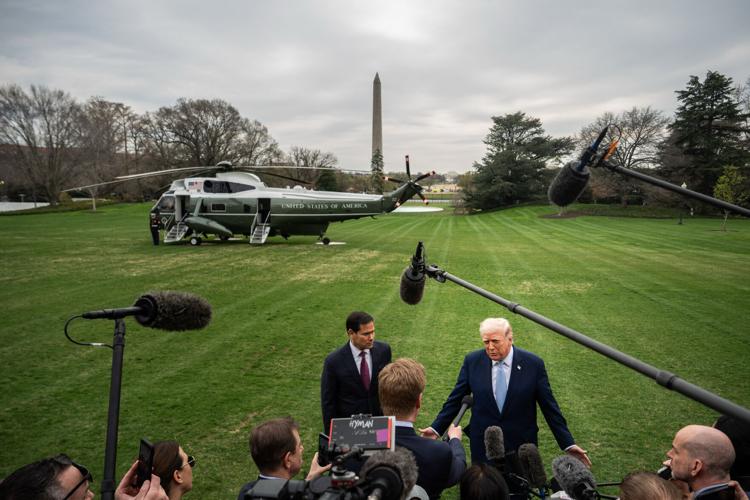
President Donald Trump, accompanied by Secretary of State Marco Rubio, speaks with reporters Friday while departing the White House in Washington.
'Winding down' the war
After another rough day in the financial markets, Trump said Friday afternoon on social media: "We are getting very close to meeting our objectives as we consider winding down our great Military efforts in the Middle East."
He contended the U.S. adequately degraded Iranian naval, missile and industrial capacity and prevented Tehran from acquiring a nuclear weapon.

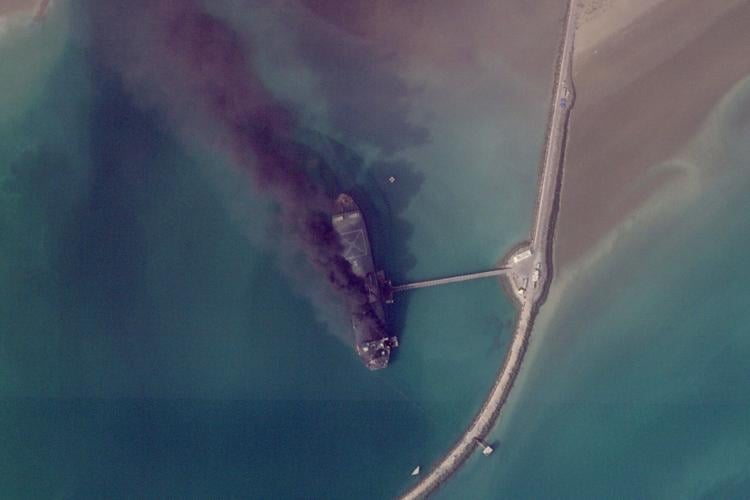
Fires burn on a ship March 2 after a U.S. military attack on a port in Bandar Abbas, Iran.
The Republican president then suggested the U.S. could pull out of the conflict without stabilizing the Strait of Hormuz, through which about one-fifth of the world's oil supply travels. The strait was ravaged by Iranian missile, drone and mine attacks during the war.
"The Hormuz Strait will have to be guarded and policed, as necessary, by other Nations who use it — The United States does not!" Trump wrote. But, in another contradiction, he said the U.S. would help if asked.
While oil that traverses the strait usually is bound for Asia and other places rather than North America, the chaos still affects the U.S. Oil is bought and sold globally, so a shortage in oil for Asian countries leads to bidding up prices on oil sold to companies in America, too.
That fact, coupled with an Israeli strike on Iran's gas fields and an Iranian retaliation that crippled a major terminal to ship liquefied natural gas from Qatar, helped tank U.S. equity markets Friday. There also was a sharp increase in U.S. fuel prices.

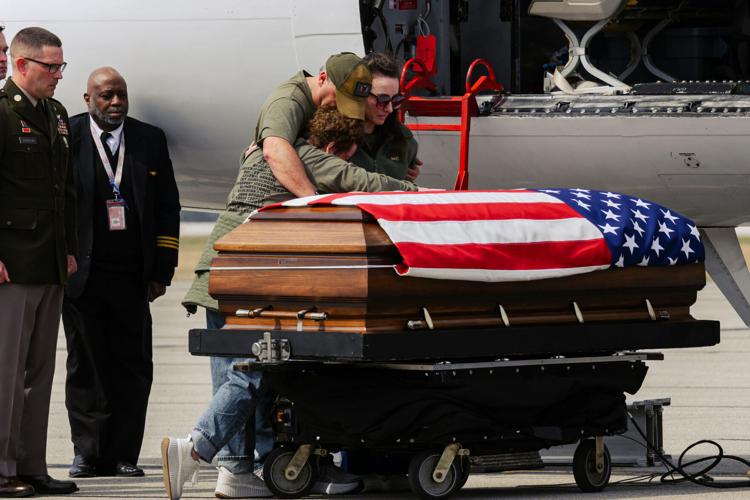
Family members stand with the casket carrying the remains of Army Sgt. Benjamin N. Pennington, 26, of Glendale, Ky., on Friday at Godman Army Airfield in Fort Knox, Ky. Pennington was the seventh U.S. service member to die in combat during the Iran war.
More US military might to the Middle East
Even as Trump said the U.S. was close to winding down the war, the administration announced it sent three more warships to the Middle East with about 2,500 additional Marines. It was the second time in the week that the administration said it was deploying more forces to the conflict. The military says about 50,000 support the war effort.
Trump ruled out sending in ground troops, though his administration hinted at a possible deployment of special forces or similar units.
The Marines being sent to the region are an expeditionary unit designed for quick amphibious landings, but their deployment does not mean a ground invasion is certain. Analysts have suggested it may require the presence of U.S. forces on the ground to ultimately secure the strait.
The surge in troops came just a day after news emerged that the Pentagon was seeking an additional $200 billion from Congress to fund the war. That extraordinarily high number does not suggest that the war was being wound down.

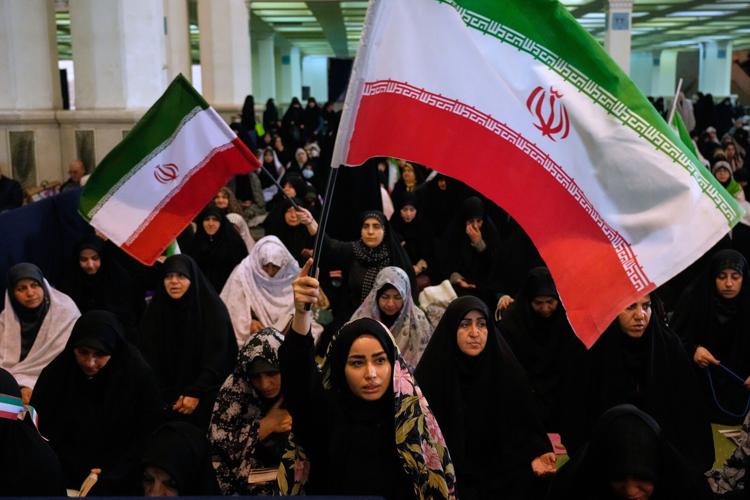
Worshippers wave Iranian flags Saturday during a ceremony marking the end of the holy fasting month of Ramadan at the Imam Khomeini Grand Mosque in Tehran.
Sanctions on Iranian oil sales
The administration said it would lift sanctions on the sale of Iranian oil, provided it was already at sea as of Friday to help lower skyrocketing energy prices by allowing freer sale of oil that Iran let pass through the strait. It also extends a financial lifeline to the Iranian government that Trump is targeting.
His administration tried other methods to lower oil prices. It tapped the U.S. strategic petroleum reserve and lifted sanctions on some Russian oil. Yet analysts say oil prices are likely to remain high for months regardless of the next steps in the war.

The Iranian oil eventually would have reached another country, but now the U.S. and its allies can bid on it as well, Treasury Secretary Scott Bessent wrote on social media.
"At present, sanctioned Iranian oil is being hoarded by China on the cheap," he wrote. "By temporarily unlocking this existing supply for the world, the United States will quickly bring approximately 140 million barrels of oil to global markets, expanding the amount of worldwide energy and helping to relieve the temporary pressures on supply caused by Iran."
While 140 million barrels may seem like a lot, that is only a couple of days' worth of oil on the global market.

Patrick De Haan, head of petroleum analysis at GasBuddy, a U.S. fuel-tracking service, said he does not expect the temporary suspension to have a major effect on gas prices. The de facto closure of the strait has a much greater effect, he said. "Prices will likely still continue to rise so long as the Strait remains silent," he noted.
The contradictions in the position were obvious in Bessent's post announcing the move, which labeled Iran "the head of the snake for global terrorism." He said the administration would take steps to prevent Tehran from cashing in on the sales, but it was unclear how that would be done.
Even among some Republicans, the contradictions triggered rare public skepticism.
"Bombing Iran with one hand and buying Iran oil with the other," Rep. Nancy Mace of South Carolina posted Saturday on social media.

Photos from the Mideast in the 4th week of the Iran war

A man takes cover as air raid sirens sound, warning of rockets launched from Lebanon toward Israel, in Kiryat Shmona, northern Israel, Monday, March 23, 2026. (AP Photo/Ariel Schalit)

Israeli security forces and rescue team respond at the site of an Iranian missile strike in Tel Aviv, Israel, Tuesday, March 24, 2026. (AP Photo/Ohad Zwigenberg)

Relatives grieve in Baghdad, Iraq, Tuesday, March 24, 2026, during a funeral of members of the Popular Mobilization Forces who were killed in a U.S. airstrike in Anbar, Iraq. (AP Photo/Hadi Mizban)

Israeli soldiers secure the site where an Iranian missile wreckage landed in the West Bank village of Kifl Haris Tuesday, March 24, 2026. (AP Photo/Majdi Mohammed)

An Israeli soldier jumps from a tank in northern Israel near the border with Lebanon, Saturday, March 21, 2026. (AP Photo/Ariel Schalit)

Israeli security forces and rescue teams work at the site struck by an Iranian missile in Arad, southern Israel, Sunday, March 22, 2026. (AP Photo/Ohad Zwigenberg)

Israeli security forces survey the site that was struck by an Iranian missile in Dimona, southern Israel, Sunday, March 22, 2026. (AP Photo/Ariel Schalit)

Smoke and flames rise from an Israeli airstrike that hit the Qasmiyeh Bridge near the coastal city of Tyre, Lebanon, Sunday, March 22, 2026. (AP Photo/Mohammad Zaatari)

Rescue workers and first responders work at a residential building hit in an earlier U.S.-Israeli strike in Tehran, Iran, Monday, March 23, 2026. (AP Photo/Vahid Salemi)

Children play beside a fragment of an Iranian ballistic missile that landed in a schoolyard in the Israeli settlement of Peduel in the West Bank Monday, March 23, 2026. (AP Photo/Ohad Zwigenberg)

People follow a truck carrying the flag draped coffins of Gen. Ali Mohammad Naeini, a spokesperson for Iran’s paramilitary Revolutionary Guard and one of his comrades Amir Hossein Bidi , during their funeral procession in Tehran, Iran, Saturday, March 21, 2026. (AP Photo/Vahid Salemi)

Iranian worshippers perform Eid al-Fitr prayers marking the end of the holy fasting month of Ramadan as one of them wears an Iranian flag at the Imam Khomeini Grand Mosque in Tehran, Iran, Saturday, March 21, 2026. (AP Photo/Vahid Salemi)

A displaced woman who fled Israeli airstrikes in southern Lebanon, carries her belonging as she moves to a better spot to shelter from the rain, past an Arabic anti-war poster that reads, "Sacrificing for whom? Lebanon does not need war," in Beirut, Saturday, March 21, 2026.(AP Photo/Hussein Malla)

Iranian Kurdish Mariam crosses the Haji Omeran border crossing on foot between Iran and the autonomous Kurdistan Region of Iraq (KRI), Iraq, Sunday, March 15, 2026, as the border remains open. (AP Photo/Leo Correa)

A man cleans debris from his apartment damaged when a nearby police station was hit Friday in a U.S.-Israeli strike in Tehran, Iran, Sunday, March 15, 2026. (AP Photo/Vahid Salemi)

The shattered structure of a police station is seen after it was hit Friday in a U.S.-Israeli strike in Tehran, Iran, Sunday, March 15, 2026. (AP Photo/Vahid Salemi)

A FlyDubai plane is parked at Dubai International Airport as smoke rises in the background after a drone struck a fuel tank early morning, forcing the temporary suspension of flights, in Dubai, United Arab Emirates, Monday, March 16, 2026. (AP Photo)

A member of the armed wing of the Kurdish-Iranian opposition group Organization of Iranian Kurdistan Struggle, known as Khabat, stands in front of a shrapnel pockmarked wall that allegedly was damaged in strike by Iranian-backed militias in Iraq last week at a military base on the outskirts of Irbil, Iraq, Monday, March 16, 2026. (AP Photo/Leo Correa)

Israeli security forces inspect a house in east Jerusalem where a fragment of an Iranian missile crashed onto the rooftop, Monday, March 16, 2026. (AP Photo/Mahmoud Illean)

Israeli soldiers operate next to their mobile artillery unit on the border with Lebanon in northern Israel, Monday, March 16, 2026. (AP Photo/Ariel Schalit)

Nofar Eliash holds her dog as she takes shelter with others while air raid sirens warn of incoming Iranian and Hezbollah missile strikes in Kiryat Shmona, northern Israel, Monday, March 16, 2026. (AP Photo/Ariel Schalit)

A man runs past a bulldozer clearing debris from a building damaged in an Israeli airstrike in Dahiyeh, Beirut's southern suburbs, Lebanon, Tuesday, March 17, 2026. (AP Photo/Hassan Ammar)

Residents inspect a house damaged yesterday by a projectiles launched from Lebanon in Nahariya, northern Israel, Tuesday, March 17, 2026. (AP Photo/Ariel Schalit)

Israeli air defense system fires to intercept missiles during an Iranian attack over Tel Aviv, Israel, early Sunday, March 15, 2026. (AP Photo/Ohad Zwigenberg)

Volunteers clean debris from a residential building damaged when a nearby police station was hit Friday in a U.S.-Israeli strike in Tehran, Iran, Sunday, March 15, 2026. (AP Photo/Vahid Salemi)

People walk past tents sheltering people displaced by Israeli airstrikes at a public space along the Beirut waterfront at sunset in Beirut, Lebanon, Sunday, March 15, 2026. (AP Photo/Hassan Ammar)

Fire and plumes of smoke rise after a drone struck a fuel tank forcing the temporary suspension of flights. near Dubai International Airport, in United Arab Emirates, early Monday, March 16, 2026. (AP Photo)

