


DUBAI, United Arab Emirates — U.S. President Donald Trump's surprising claim this week that talks with Iran were yielding great progress has only raised more confusion over a war whose goals were already unclear. The most basic question: What talks?
A 15-point plan from the Trump administration offering a potential pathway to an exit was offered late Tuesday to Iran through Pakistan, according to a person briefed on the contours of the plan but who was not authorized to speak publicly about it.

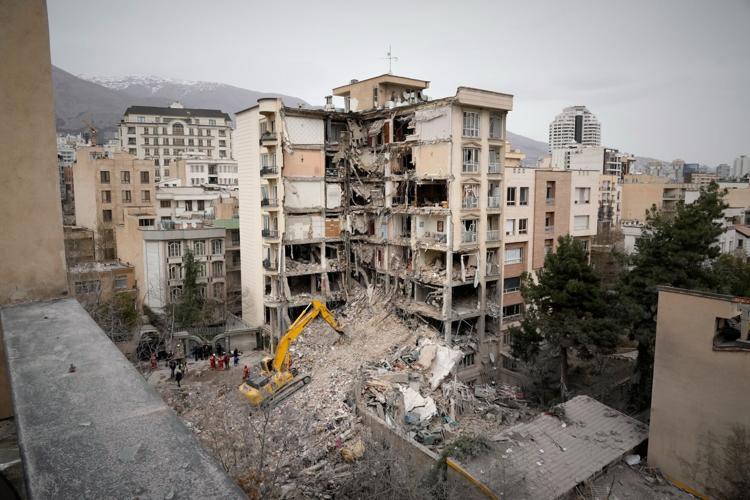
Iranian Red Crescent emergency workers use a bulldozer to clear rubble from a residential building that was hit in an earlier U.S.-Israeli strike in Tehran, Iran, March 23.
Iran has so far denied any negotiations were taking place, pledging to fight "until complete victory." Pakistan, Egypt and Gulf Arab nations are trying behind the scenes to piece together talks, but their efforts still seem preliminary. Israel is vowing to keep up its attacks.
If anything, the war appears only to be escalating. Barrages were fired into Iran, Israel and across the Mideast on Tuesday. Meanwhile, thousands more U.S. Marines were on their way to the Gulf, and the Army was preparing to deploy at least 1,000 troops from the 82nd Airborne Division to the Middle East in the coming days.

Here is a look at what's known and not known about possible talks to wind down the war.
Push for negotiations

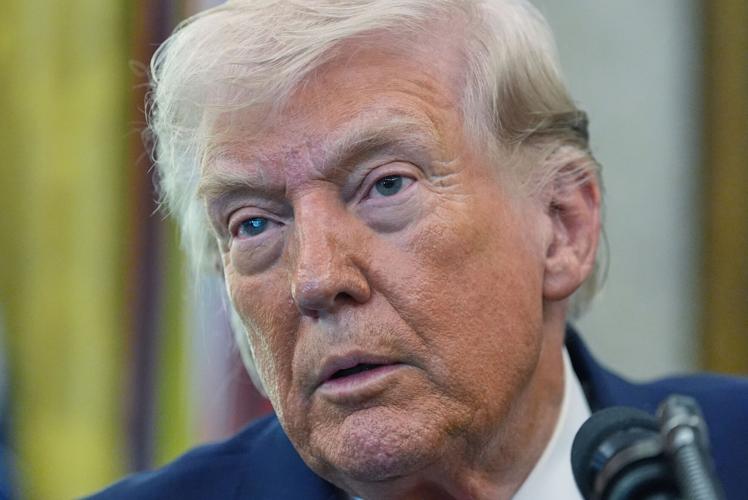
President Donald Trump listens to a reporter during the swearing in for Homeland Security Secretary Markwayne Mullin in the Oval Office of the White House, March 24, in Washington.
Since launching the war alongside Israel on Feb. 28, Trump has given shifting, and often vague objectives, and those mixed messages were on display in recent days. He has talked of degrading or destroying Iran's missile capabilities, and its ability to threaten neighbors — goals that he has some flexibility in declaring accomplished. A much tougher goal is ensuring Iran can never build a nuclear weapon, and Trump has insisted that will be part of any deal.
A reopening of the Strait of Hormuz — a vital waterway for oil shipments that Iran made virtually impassable when the war began — is now also a priority, for Trump and the global economy.
As Trump talks of engaging with leaders in Iran, he has backed off promoting the Islamic Republic's collapse. Israeli Prime Minister Benjamin Netanyahu, however, continues to say the war aims to help Iranians overthrow the theocracy.
Trump claimed that U.S. envoy Steve Witkoff and Trump's son-in-law Jared Kushner held talks Sunday with an Iranian leader. He did not say who that was.
President Donald Trump says Iran "means business" in talks to end the conflict even as Tehran denies any negotiations. Trump says there’s a “very good chance” of a deal this week, and credits his threat to strike Iranian power plants, a move he has delayed for five days.
Reports focused on Iranian Parliament Speaker Mohammad Bagher Qalibaf as a possible interlocutor. But Qalibaf quickly denied talks were taking place in a post on X.
The U.S. agreed "in principle" to join talks in Pakistan, according to three Pakistani officials, one Egyptian official and a Gulf diplomat, while mediators were still working to convince Iran. The officials all spoke on condition of anonymity because they were not authorized to provide the details to the media.
The Egyptian official said efforts are centered on "trust-building" between the U.S. and Iran, aiming to reach a pause in fighting and a "mechanism" to reopen the Strait of Hormuz.

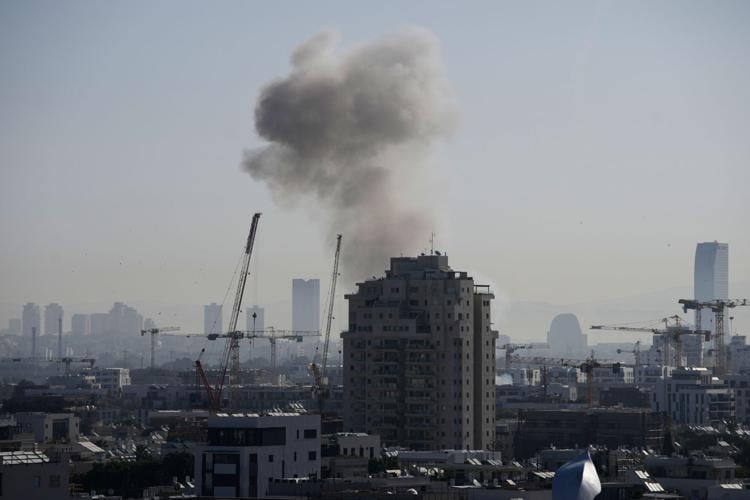
Smoke billows following an Iranian missile strike in Tel Aviv, March 24.
A 15-point peace plan delivered to Iran
A 15-point plan from the Trump administration has been delivered to Iran by intermediaries from Pakistan, who have offered to host renewed negotiations, according to a person briefed on the contours of the plan but who was not authorized to speak publicly about it.
Israeli officials, who have been advocating for Trump to continue prosecuting the war against Iran, were taken by surprise by the U.S. administration's submission of a ceasefire plan, the person said.
But with the U.S. taking steps to send additional soldiers and Marines to the Mideast, the move is being framed as Trump maneuvering to give himself "max flexibility" on what he'll do next, the person added.
The White House did not respond to requests for comment on the administration submitting the 15-point plan.

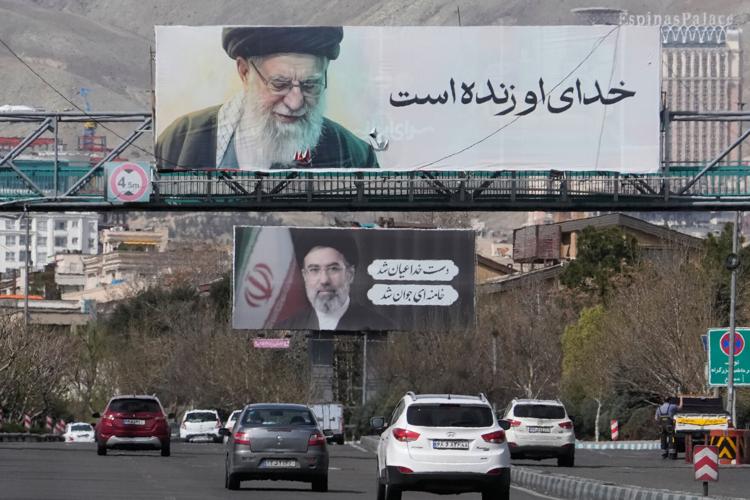
Vehicles drive under billboards showing portraits of the late Iranian Supreme Leader Ayatollah Ali Khamenei, foreground, and his son Ayatollah Mojtaba Khamenei, the successor to him, along a highway in Tehran, Iran, March 24.
Who speaks for Iran in any talks?
Iran's leadership appears to have remained relatively cohesive, despite weeks of heavy bombardment and the killing of its supreme leader and many top-ranking military figures.
But who actually is in charge is not known. The new supreme leader, Ayatollah Mojtaba Khamenei, hasn't been seen or directly heard from since he was named to replace his slain father, Ali Khamenei.
Within the Islamic Republic are other centers of power, including the military and the powerful paramilitary Revolutionary Guard, as well as political figures like Qalibaf, Foreign Minister Abbas Araghchi and President Masoud Pezeshkian.
It's not certain anyone entering talks with the U.S. would have backing from the military or Guard. In the ongoing war, Iran's military has conducted strikes based on orders of local commanders, rather than from any political leadership, Araghchi has said.
The spokesman of Iran's top military command, Maj. Gen. Ali Abdollahi Aliabadi, vowed on Tuesday that the fighting "will continue until complete victory." It was a message of defiance to Trump's claim that Iran was petitioning for peace, but possibly also a warning to anyone within the Iranian leadership not to back down in talks.

Was Trump just trying to buy time?
Trump's sudden declaration of progress in talks on Monday came just as the deadline was about to run out on an ultimatum he had made over the weekend threatening to "obliterate" Iran's power plants unless the country releases its stranglehold on the Strait of Hormuz. Iran threatened to retaliate against power, water and oil infrastructure across the Gulf.
Trump on Monday pushed the deadline back five days and said there's a "very good chance" a deal could be reached this week. That was a relief to global oil and stock markets.
Trump's move could signal he's wary of the war's possible long-term damage to the U.S. and global economy, though his administration has insisted that any pain from spiking oil prices will quickly be reversed once the war is over.
"Trump could be actively seeking an offramp," the Soufan Center, a New York-based think tank, wrote in an analysis.
On the other hand, the Soufan Center noted, Trump could be buying time for thousands of Marines heading to the region to arrive.
The Marine deployment could be a tactic to pressure Iran on negotiations. But it has also raised speculation that the U.S. may try to seize Kharg Island in the Persian Gulf, which is vital to Iran's oil network, or carry out an operation to remove enriched uranium from inside Iran. Either would mean a greater escalation and a longer war.
Trump has said he has no plans to send ground forces into Iran but has not ruled it out. Israel has suggested ground forces could participate in the war.

What is there to talk about?
Nuclear negotiations were already taking place when the U.S. and Israel launched their surprise attack on Feb. 28, killing the elder Khamenei in the opening salvos of the bombing campaign.
That only deepened Iranian mistrust of Americans in negotiations, especially after Trump's unilateral withdrawal in 2018 from a landmark nuclear agreement reached with the United States three years earlier. Iran and the U.S. held negotiations in early 2025, and when a two-month deadline set by Trump ran out, Israel hit Iran in a surprise attack that the U.S. joined in a 12-day war, striking Iranian nuclear facilities and military positions.
Trump said Monday that any deal to end the war will entail the U.S. removing Iran's enriched uranium, which is critical to its disputed nuclear program. Iran refused that demand in the past, insisting it has the right to enrich uranium for peaceful purposes.
A less ambitious goal for talks could be to reach a ceasefire and the reopening of the Strait of Hormuz.
But Araghchi seemed to reject any partial deal in an interview with Al Jazeera last Wednesday. "We don't believe in ceasefire. We believe in the end of war ... the end of war in all fronts," Araghchi said, emphasizing the need for solutions to conflicts throughout the region.
What about Israel?
Notably, Israel is not involved in the move for negotiations.
Israel has depicted itself as following Trump's lead, and it seems unlikely to continue with its strikes on Iran if the U.S. declared an end to the war. Still, it has pursued its own war aims beyond the Americans'. Its bombing last week of Iran's offshore South Pars natural gas field triggered intensified Iranian attacks on the Gulf Arab states, and Trump told Israel to halt such attacks.
In a statement late Monday, Netanyahu acknowledged Trump's diplomatic efforts but said Israel would continue to strike its enemies for the time being.
Also, an end to the war on Iran does not mean an end to Israel's bombing campaign in Lebanon. There, Israel has seized a new opportunity to try to crush Hezbollah after the militants fired rockets in support of Iran.
Photos from the Mideast in the 4th week of the Iran war

A man takes cover as air raid sirens sound, warning of rockets launched from Lebanon toward Israel, in Kiryat Shmona, northern Israel, Monday, March 23, 2026. (AP Photo/Ariel Schalit)

Israeli security forces and rescue team respond at the site of an Iranian missile strike in Tel Aviv, Israel, Tuesday, March 24, 2026. (AP Photo/Ohad Zwigenberg)

Relatives grieve in Baghdad, Iraq, Tuesday, March 24, 2026, during a funeral of members of the Popular Mobilization Forces who were killed in a U.S. airstrike in Anbar, Iraq. (AP Photo/Hadi Mizban)

Israeli soldiers secure the site where an Iranian missile wreckage landed in the West Bank village of Kifl Haris Tuesday, March 24, 2026. (AP Photo/Majdi Mohammed)

An Israeli soldier jumps from a tank in northern Israel near the border with Lebanon, Saturday, March 21, 2026. (AP Photo/Ariel Schalit)

Israeli security forces and rescue teams work at the site struck by an Iranian missile in Arad, southern Israel, Sunday, March 22, 2026. (AP Photo/Ohad Zwigenberg)

Israeli security forces survey the site that was struck by an Iranian missile in Dimona, southern Israel, Sunday, March 22, 2026. (AP Photo/Ariel Schalit)

Smoke and flames rise from an Israeli airstrike that hit the Qasmiyeh Bridge near the coastal city of Tyre, Lebanon, Sunday, March 22, 2026. (AP Photo/Mohammad Zaatari)

Rescue workers and first responders work at a residential building hit in an earlier U.S.-Israeli strike in Tehran, Iran, Monday, March 23, 2026. (AP Photo/Vahid Salemi)

Children play beside a fragment of an Iranian ballistic missile that landed in a schoolyard in the Israeli settlement of Peduel in the West Bank Monday, March 23, 2026. (AP Photo/Ohad Zwigenberg)

People follow a truck carrying the flag draped coffins of Gen. Ali Mohammad Naeini, a spokesperson for Iran’s paramilitary Revolutionary Guard and one of his comrades Amir Hossein Bidi , during their funeral procession in Tehran, Iran, Saturday, March 21, 2026. (AP Photo/Vahid Salemi)

Iranian worshippers perform Eid al-Fitr prayers marking the end of the holy fasting month of Ramadan as one of them wears an Iranian flag at the Imam Khomeini Grand Mosque in Tehran, Iran, Saturday, March 21, 2026. (AP Photo/Vahid Salemi)

A displaced woman who fled Israeli airstrikes in southern Lebanon, carries her belonging as she moves to a better spot to shelter from the rain, past an Arabic anti-war poster that reads, "Sacrificing for whom? Lebanon does not need war," in Beirut, Saturday, March 21, 2026.(AP Photo/Hussein Malla)

Iranian Kurdish Mariam crosses the Haji Omeran border crossing on foot between Iran and the autonomous Kurdistan Region of Iraq (KRI), Iraq, Sunday, March 15, 2026, as the border remains open. (AP Photo/Leo Correa)

A man cleans debris from his apartment damaged when a nearby police station was hit Friday in a U.S.-Israeli strike in Tehran, Iran, Sunday, March 15, 2026. (AP Photo/Vahid Salemi)

The shattered structure of a police station is seen after it was hit Friday in a U.S.-Israeli strike in Tehran, Iran, Sunday, March 15, 2026. (AP Photo/Vahid Salemi)

A FlyDubai plane is parked at Dubai International Airport as smoke rises in the background after a drone struck a fuel tank early morning, forcing the temporary suspension of flights, in Dubai, United Arab Emirates, Monday, March 16, 2026. (AP Photo)

A member of the armed wing of the Kurdish-Iranian opposition group Organization of Iranian Kurdistan Struggle, known as Khabat, stands in front of a shrapnel pockmarked wall that allegedly was damaged in strike by Iranian-backed militias in Iraq last week at a military base on the outskirts of Irbil, Iraq, Monday, March 16, 2026. (AP Photo/Leo Correa)

Israeli security forces inspect a house in east Jerusalem where a fragment of an Iranian missile crashed onto the rooftop, Monday, March 16, 2026. (AP Photo/Mahmoud Illean)

Israeli soldiers operate next to their mobile artillery unit on the border with Lebanon in northern Israel, Monday, March 16, 2026. (AP Photo/Ariel Schalit)

Nofar Eliash holds her dog as she takes shelter with others while air raid sirens warn of incoming Iranian and Hezbollah missile strikes in Kiryat Shmona, northern Israel, Monday, March 16, 2026. (AP Photo/Ariel Schalit)

A man runs past a bulldozer clearing debris from a building damaged in an Israeli airstrike in Dahiyeh, Beirut's southern suburbs, Lebanon, Tuesday, March 17, 2026. (AP Photo/Hassan Ammar)

Residents inspect a house damaged yesterday by a projectiles launched from Lebanon in Nahariya, northern Israel, Tuesday, March 17, 2026. (AP Photo/Ariel Schalit)

Israeli air defense system fires to intercept missiles during an Iranian attack over Tel Aviv, Israel, early Sunday, March 15, 2026. (AP Photo/Ohad Zwigenberg)

Volunteers clean debris from a residential building damaged when a nearby police station was hit Friday in a U.S.-Israeli strike in Tehran, Iran, Sunday, March 15, 2026. (AP Photo/Vahid Salemi)

People walk past tents sheltering people displaced by Israeli airstrikes at a public space along the Beirut waterfront at sunset in Beirut, Lebanon, Sunday, March 15, 2026. (AP Photo/Hassan Ammar)

Fire and plumes of smoke rise after a drone struck a fuel tank forcing the temporary suspension of flights. near Dubai International Airport, in United Arab Emirates, early Monday, March 16, 2026. (AP Photo)

