


World leaders have tried and failed to curb climate change by appealing to nations to act for the common good. Now, the Iran war and its costly energy crunch have some experts wondering if selfishness and nationalism may be a more likely way to save the planet, by boosting support for homegrown renewables over imported fossil fuels.
Bombed refineries, disrupted shipping channels for oil and liquefied natural gas and skyrocketing fuel prices should point even the most reluctant leaders to a cleaner fossil free future, some experts hope.
But others are dismissive, noting the same speculation emerged, and then quickly flopped, as recently as Russia's invasion of Ukraine. That prompted some European nations to replace gas with even dirtier coal.
“Just wishful thinking,” said Stanford University climate scientist Rob Jackson, who tracks global emissions of carbon dioxide.

The head of the United Nations argues otherwise.
“The turmoil we are witnessing today in the Middle East makes it evident that we are facing a global energy system largely tied to fossil fuels — where supply is concentrated in a few regions and every conflict risks sending shock waves through the global economy,” U.N. Secretary-General António Guterres said in an email to The Associated Press. “In past oil shocks, countries had little choice but to absorb the pain. Now they have an exit ramp.
“Homegrown renewable energy has never been cheaper, more accessible, or more scalable,” Guterres said. “The resources of the clean energy era cannot be blockaded or weaponized.”

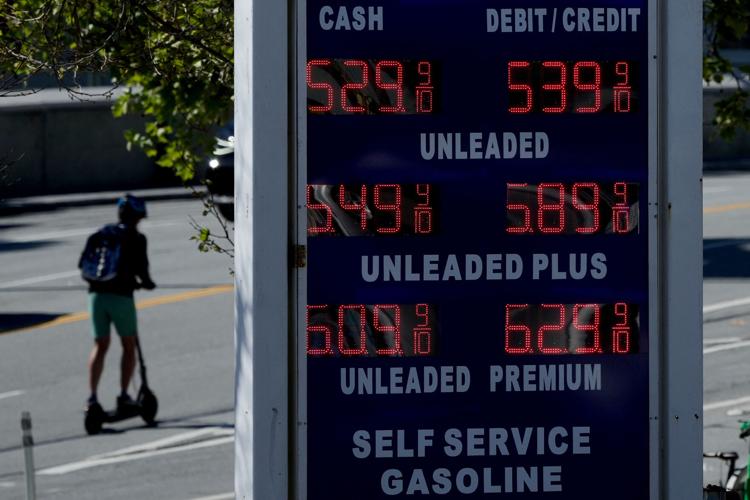
A person rides a scooter behind the gasoline price board of a gas station on Thursday, March 5, in San Francisco.
Going alone vs. together
Annual U.N. climate conferences aimed at global cooperation have accomplished little. The most recent meeting in Brazil, known as COP30, ended with a statement that didn’t even mention the words “fossil fuels,” much less include a timeline to reduce their use. Guterres said then that he “cannot pretend that COP30 has delivered everything that is needed.” Under President Donald Trump, whose attack on Iran has sparked new energy concerns, the U.S. didn't even participate in the Brazil meeting.
Even though renewable energy use and new installations are soaring globally, outpacing fossil fuel growth, the world continues to increase its fossil fuel use every year with emissions of heat-trapping carbon dioxide and methane rising to new highs year after. That's driving atmospheric warming that increases costly and deadly extreme weather, including dangerous heat, around the world.
“The bottom line is that for at least another five years and maybe longer, emissions reduction will in fact be dealt with largely unilaterally,” said Michael Oppenheimer, a Princeton climate and international affairs professor. “If countries see the Israel-U.S.-Iran war as a further reason to head for the exits on fossil fuels by loosening domestic opposition to the necessary policies, that will be accomplished unilaterally at the domestic level.”

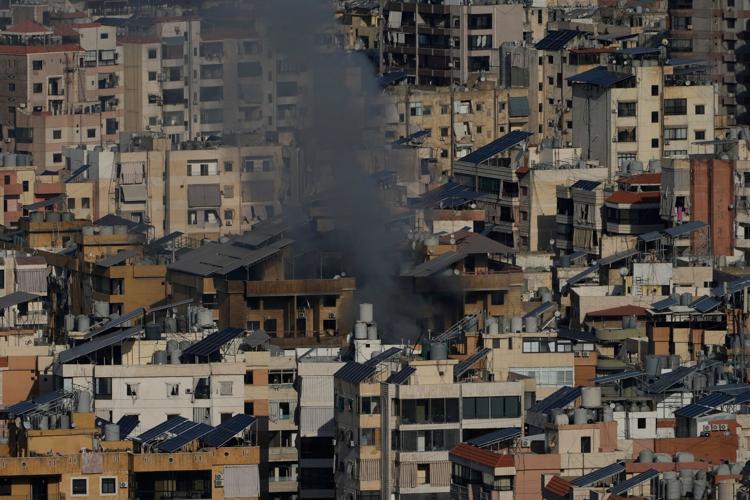
Smoke rises from an earlier Israeli airstrike on Friday, March 6, in Dahiyeh, Lebanon.
A moment of opportunity
Caroline Baxter, director of the Converging Risks Lab at the Council on Strategic Risks in Washington, said there has already been a “dramatic slowdown” in the movement of fossil fuels to various ports due to the conflict. And for countries like Japan or South Korea that depend on tankers arriving in their ports to deliver energy, this is a really big deal, she said.
Baxter said she “wouldn’t be surprised” if some shift to green energy because of the conflict, if only because renewable energy offers more stability than fossil fuels do.
“I think there is an opportunity, rightly or wrongly, for countries to really turn inward and try to power themselves in a way that cuts off their dependence on other nations for that source,” said Baxter, who was U.S. deputy assistant secretary of defense for force education and training from 2021 to 2024 under the Biden administration.
Baxter said if she’s right and if “everyone does it in their backyard,” it will limit future climate change “without the thorny diplomatic negotiations and the glad-handing and the machinations behind closed doors” of international climate conferences.
The war will lead to more solar panels and heat pumps installed in coming months, said energy analyst Ana Maria Jaller-Makarewicz of IEEFA Europe.

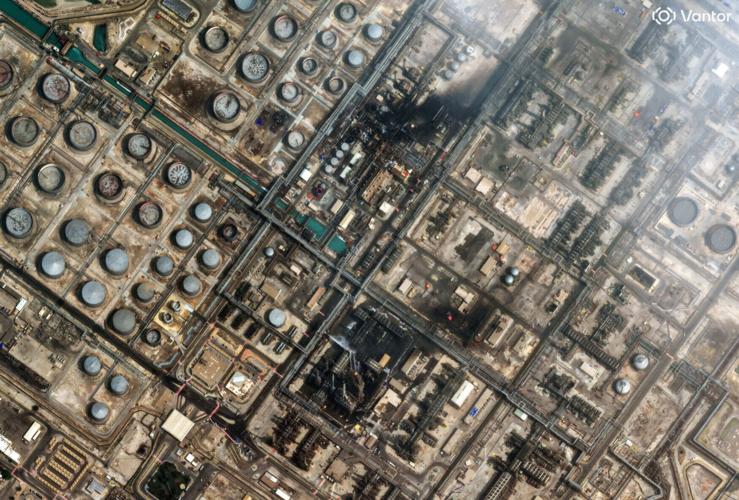
This satellite image provided by Vantor shows an overview of damage after a drone attack to Ras Tanura oil refinery on Monday, March 2, in Saudi Arabia.
Reality check from Ukraine
More skeptical analysts point to the Russian invasion of Ukraine a few years ago, which put a massive kink in Europe’s natural gas supply, yet didn’t change the world’s fossil fuel dependence. Politicians often pivot to other fossil fuels to address war-oriented energy insecurity, such as coal, which releases even higher amounts of heat-trapping gases.
“We have seen this at the European level where actors post-2022 slowly wanted to move away from the energy transition which is exactly the wrong lesson,” said war studies lecturer Pauline Heinrichs at King’s College in the United Kingdom.
Just as Europe did then, many countries, like China and India — already the world's No. 1 and No. 3 carbon-emitting countries — could turn to more coal use, said Ohio University's Geoff Dabelko, an expert on climate and conflict, and University of St. Andrews' Neta Crawford, author of “The Pentagon, Climate Change, and War: Charting the Rise and Fall of U.S. Military Emissions.”

War, militaries pollute air
Whatever happens with nations' energy choices, the war itself will spike emissions.
Even before it began, reports showed that the world's militaries are responsible for 5.5% of Earth's heat-trapping emissions each year, more than any country except China, the United States and India.
Crawford, co-founder of the Costs of War project at Brown University’s Watson Institute for International and Public Affairs, said fighter jets consuming vast quantities of fuel, releasing carbon dioxide and other pollutants, is just one example.
“The consequences of war on emissions will far exceed any incremental offset in emissions due to increased enthusiasm for a green transition,” she said.
Photos show US-Israeli strikes and Iran's response

Large fire and plume of smoke is visible after, according to the authorities, debris of an Iranian intercepted drone hit the Fujairah oil facility, in Fujairah, United Arab Emirates, Tuesday, March 3, 2026. (AP Photo/Altaf Qadri)

The sun sets behind a plume of smoke rising after a U.S.–Israeli military strike in Tehran, Iran, Tuesday, March 3, 2026. (AP Photo/Vahid Salemi)

The sun sets behind a plume of smoke rising after a U.S.–Israeli military strike in Tehran, Iran, Tuesday, March 3, 2026. (AP Photo/Vahid Salemi)

An Iranian flag is placed among the ruins of a police station struck Monday during the U.S.–Israeli military campaign in Tehran, Iran, Tuesday, March 3, 2026. (AP Photo/Vahid Salemi)

Residents and officials attend the funeral of people killed in what Iranian officials said was an Israeli-U.S. strike Feb. 28 on a girls' elementary school in Minab, Iran, Tuesday, March 3, 2026. (Abbas Zakeri/Mehr News Agency via AP)

A woman throws rose petals on the coffins during funeral of mostly children killed in what Iranian officials said was an Israeli-U.S. strike Feb. 28 on a girls' elementary school in Minab, Iran, Tuesday, March 3, 2026. (Amirhossein Khorgooei/ISNA via AP)

Coffins holding the bodies of mostly children are prepared for the funeral of those killed in what Iranian officials said was an Israeli-U.S. strike Feb. 28 at a girls' elementary school in Minab, Iran, Tuesday, March 3, 2026. (Amirhossein Khorgooei/ISNA via AP)

A woman crosses almost deserted square with a billboard at rear showing a portrait of the late Iranian Supreme Leader Ayatollah Ali Khamenei, who was killed in the U.S.–Israeli military campaign, in Tehran, Iran, Tuesday, March 3, 2026. (AP Photo/Vahid Salemi)

Large fire and plume of smoke is visible after, according to the authorities, debris of an Iranian intercepted drone hit the Fujairah oil facility, in Fujairah, United Arab Emirates, Tuesday, March 3, 2026. (AP Photo/Altaf Qadri)

Smoke rises on the skyline after an explosion in Tehran, Iran, Saturday, Feb. 28, 2026.(AP Photo)

People watch as smoke rises on the skyline after an explosion in Tehran, Iran, Saturday, Feb. 28, 2026.(AP Photo)

Paramedics evacuate wounded people from the site of a deadly Iranian missile strike in Beit Shemesh, Israel Sunday, March 1, 2026. (AP Photo/Leo Correa)

A black plume of smoke rises from a warehouse at the industrial area of Sharjah City in the United Arab Emirates following reports of Iranian strikes in Dubai, United Arab Emirates, Sunday, March 1, 2026. (AP Photo/Altaf Qadri)

A man walks away after watching as a black plume of smoke rises from a warehouse in the industrial area of Sharjah City, United Arab Emirates, Sunday, March 1, 2026, following reports of Iranian strikes in Dubai. (AP Photo/Altaf Qadri)

Israeli security forces inspect a damaged road after a missile launched from Iran struck Jerusalem, Sunday, March 1, 2026.(AP Photo/Mahmoud Illean)

A man holds an Iranian flag as he looks at the damaged façade of Gandhi Hospital, which was hit Sunday when a strike also struck a state TV communications tower and nearby buildings across the street during the ongoing joint U.S.–Israeli military campaign in Tehran, Iran, Tuesday, March 2, 2026. (AP Photo/Vahid Salemi)

Clerics and other government supporters mourn in a gathering after state TV officially announced the death of Iranian Supreme Leader Ayatollah Ali Khamenei, in Tehran, Iran, Sunday, March 1, 2026. (AP Photo/Vahid Salemi)

Government supporters gather in mourning after state TV officially announced the death of Iranian Supreme Leader Ayatollah Ali Khamenei, in Tehran, Iran, Sunday, March 1, 2026. (AP Photo/Vahid Salemi)

Rescue workers and military personnel survey the scene of a direct hit a day after an Iranian missile struck in Tel Aviv, Israel, Sunday, March 1, 2026. (AP Photo/Oded Balilty)

A plume of smoke rises after a strike in Tehran, Iran, Sunday, March 1, 2026. (AP Photo/Vahid Salemi)

Leah Guttmann holds her son, Teddy, as other people take shelter in an underground parking garage while air-raid sirens warn of incoming missiles launched by Iran toward Tel Aviv, Israel, Sunday, March 1, 2026. (AP Photo/Ohad Zwigenberg)

Rescue workers and military personnel operate at the scene where several people were killed in an Iranian missile strike in Beit Shemesh, Israel Sunday, March 1, 2026. (AP Photo/Leo Correa)

An Israeli rescue personal carries a child after missiles attack from Iran hit in Tel Aviv, Israel, Saturday, Feb. 28, 2026. (AP Photo/Ohad Zwigenberg)

An explosion is seen as an Iranian missile directly hits a building in Tel Aviv, Israel, Saturday, Feb. 28, 2026. (AP Photo/Tomer Neuberg)

Rescue workers bandage a wounded man and provide first aid at the site of a direct hit from an Iranian missile strike in Tel Aviv, Israel, Saturday, Feb. 28, 2026. (AP Photo/Tomer Neuberg)

Firefighters try to extinguish flames in a building after a direct hit by an Iranian missile strike in Tel Aviv, Israel, Saturday, Feb. 28, 2026. (AP Photo/Tomer Neuberg)

Officers from Israel's Home Front Command search through the rubble of a damaged apartment building after an Iranian missile strike, in Tel Aviv, Israel, early Sunday, March 1, 2026. (AP Photo/Ohad Zwigenberg)

Officers from Israel's Home Front Command search through the rubble of a damaged apartment building after an Iranian missile strike in Tel Aviv, Israel, early Sunday, March 1, 2026. (AP Photo/Ohad Zwigenberg)

Government supporters mourn during a gathering after state TV officially announced the death of Iranian Supreme Leader Ayatollah Ali Khamenei, shown in the poster, in Tehran, Iran, Sunday, March 1, 2026. (AP Photo/Vahid Salemi)

Firemen and rescue workers inspect the site of an explosion at the Fairmont The Palm Hotel in Dubai, United Arab Emirates, Saturday, Feb. 28, 2026. (AP Photo/Altaf Qadri)

This image provided by Airbus shows the strike on Iranian Supreme Leader's compound on Saturday, Feb. 28, 2026 in Iran. (Pléiades Neo (c) Airbus DS 2026 via AP)

This image from video provided by U.S. Central Command shows a missile being launched from a U.S. Navy ship in support of Operation Epic Fury on Saturday, Feb. 28, 2026. (U.S. Central Command via AP)

Rescue workers and residents search through the rubble in the aftermath of what Iranian officials said was an Israeli-U.S. strike on a girls' elementary school in Minab, Iran, Saturday, Feb. 28, 2026. (Abbas Zakeri/Mehr News Agency via AP)

A man hold a children's backpack as rescue workers and residents search through the rubble in the aftermath of what Iranian officials said was an Israeli-U.S. strike on a girls' elementary school in Minab, Iran, Saturday, Feb. 28, 2026. (Abbas Zakeri/Mehr News Agency via AP)

Traces of an air defense missile interception are seen, left, over Jerusalem's Old City, Saturday, Feb. 28, 2026. (AP Photo/Mahmoud Illean)

An incoming projectile explodes over the water as Israel issues a nationwide alert following its strikes on Iran, in Haifa Bay, northern Israel, Saturday, Feb. 28, 2026. (AP Photo/Leo Correa)

People rush to take shelter as warning sirens sound following missile fired towards Israel, in Tel Aviv, Israel, Saturday, Feb. 28, 2026. (AP Photo/Ohad Zwigenberg)

People take shelter in an underground metro station as air raid sirens warn of incoming strikes by Iran, in Ramat Gan, Israel, Saturday, Feb. 28, 2026. (AP Photo/Oded Balilty)

The flare of a projectile is seen over the skyline of Dubai, United Arab Emirates, Saturday, Feb. 28, 2026. (AP Photo/Fatima Shbair)

