

NEW YORK — Lashing out after his arraignment on federal charges last week, Donald Trump took aim at President Joe Biden and Democrats with language that seemed to evoke another era: He was being persecuted, he said, by “Marxists” and “communists.”
Trump has used the labels since he first appeared on the political scene, but it lately has become an omnipresent attack line that also has been deployed by other Republicans. The rhetoric is both inaccurate and potentially dangerous because it attempts to demonize an entire party with a description that has long been associated with America’s enemies.
Experts who study political messaging say associating Democrats with Marxism only furthers the country’s polarization — and is simply wrong: Biden has promoted capitalism and Democratic lawmakers are not pushing to reshape American democracy into a communist system.
That hasn’t mattered to Trump and other Republicans, who for years have used hyperbolic references to the associated political ideologies to spark fears about Democrats and the dangers they supposedly pose.
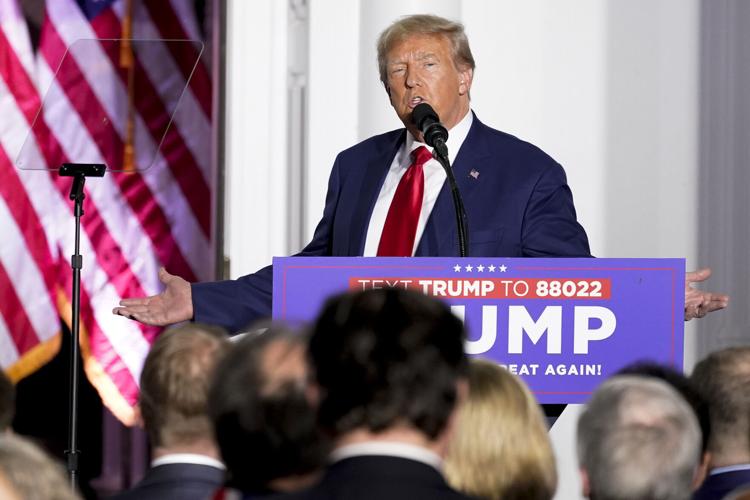
Hours after pleading not guilty in federal court, Trump told a crowd of his supporters at his golf club in Bedminster, New Jersey, that Biden, “together with a band of his closest thugs, misfits and Marxists, tried to destroy American democracy.”

Former President Donald Trump speaks to supporters at Trump National Golf Club Bedminster on June 13 in Bedminster, N.J. Trump repeatedly referred to Democrats “Marxists” and “communists in recent days, both in social media posts and in a speech after he pleaded not guilty in federal court.
He added, “If the communists get away with this, it won’t stop with me.”
He again hit on the Marxist theme days later during a telephone rally with Iowa voters. The comments came after numerous campaign emails and social posts in recent months in which Trump has claimed that Biden’s America could soon become a “third world Marxist regime” or a “tyrannical Marxist nation.”
Other Republicans have piled on with similar messaging. Georgia Rep. Marjorie Taylor Greene last week took to Twitter to lambast what she called the “CORRUPT AND WEAPONIZED COMMUNISTS DEMOCRAT CONTROLLED DOJ.” Florida Gov. Ron DeSantis, Trump’s closest rival for the GOP presidential nomination, has argued the U.S. risks falling victim to “woke” ideology, which he has defined in interviews as a form of “cultural Marxism.”
Experts say there is a long history of U.S. politicians calling opponents Marxist or communist without evidence — perhaps most infamously Sen. Joseph McCarthy, who led efforts to blacklist accused communists in the 1950s.

In a country that has historically positioned itself against Marxism, “red-baiting is as American as apple pie in political communications,” said Tanner Mirrlees, an associate professor at Ontario Tech University in Canada who has researched political discourse about “cultural Marxism.”
The attacks are carefully constructed to hit voters emotionally, said Steve Israel, a former U.S. congressman from New York who studied political messaging as chair of the House Democratic Policy and Communications Committee.
“Democrats tend to message to the part of the brain that is about reason and empirical evidence,” he said. “Republicans message to the gut.”
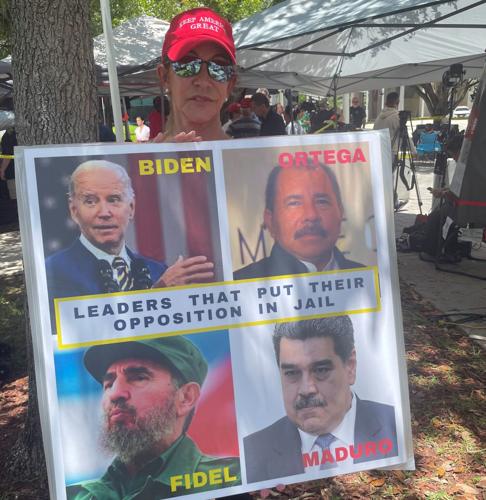
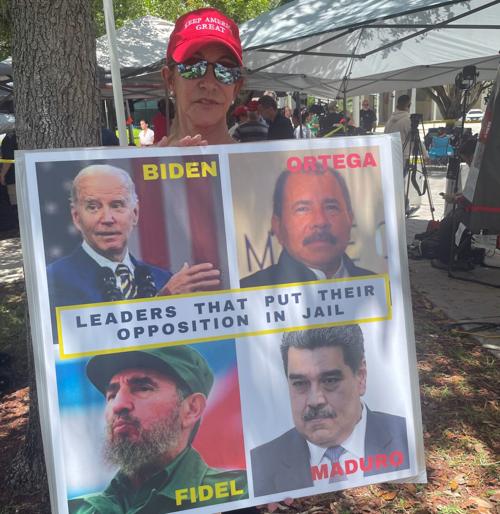
For some Hispanic Trump supporters who gathered outside the federal courthouse in Miami where the former president was arraigned, the charges evoked memories of political persecutions their family members had once escaped.
“This is what they do in Latin America,” said Madelin Munilla, 67, who came to Miami as a child when her parents fled Fidel Castro’s Cuba.
She carried a poster with a photo of Biden alongside Castro, Venezuela’s Nicolas Maduro and Nicaragua’s Daniel Ortega — leftist leaders whose jailing of opponents has driven immigration to south Florida for decades.
A surge in immigration from Southeast Asia after the Vietnam War also brought a population of staunchly anti-communist voters, some of whom have aligned with the Republican Party in part because of its forceful messaging on the issue.

Yet opposing an actual regime that suppresses individual freedom and opposes a free market economy is different from the way many Republicans use these terms now —- to falsely claim Marxists are U.S. society’s ruling class.
“Bluntly, there is no empirical ground beneath the Republican claim that Marxists rule the big institutions of American society,” Mirrlees said.
Other Republicans, from DeSantis to Texas Sen. Ted Cruz, have used another term, “cultural Marxism,” to characterize fights for gender or racial equity that they argue are “woke” and threaten a traditional American way of life. Cruz used it in the title of his book.
Though the term has become popular among mainstream Republicans, it has a darker past. Experts say the concept of “cultural Marxism” posing a threat was historically spread by antisemitic and white supremacist groups.
Still, while railing against communists and Marxists may be effective at animating voters who form the Republican base, it may not be an effective strategy in next year’s general election, Israel said.
That’s because it doesn’t as easily sway moderate and independent voters who don’t see evidence that ties Democrats to those ideologies.
“Moderate voters may succumb to the Republican argument that Democrats are for more spending, but they’re not going to fall for the argument that Democrats are Marxists,” Israel said. “The Republicans are overplaying their hand.”
The 2024 presidential field, in the order they've announced
Donald Trump, Republican
Updated
Donald Trump, Republican
Former President Donald Trump, aiming to become only the second commander-in-chief ever elected to two nonconsecutive terms, announced in November that he is seeking the Republican presidential nomination in 2024.
“In order to make America great and glorious again, I am tonight announcing my candidacy for president of the United States,” Trump told a crowd gathered at Mar-a-Lago, his waterfront estate in Florida, where his campaign will be headquartered. - CNN
Nikki Haley, Republican
Updated
Nikki Haley, Republican
Nikki Haley, the former South Carolina governor and United Nations ambassador, announced her candidacy for president on Feb. 14, becoming the first major challenger to former President Donald Trump for the 2024 Republican nomination.
The announcement, delivered in a video, marked an about-face for the ex-Trump Cabinet official, who said two years ago that she wouldn't challenge her former boss for the White House in 2024. But she changed her mind in recent months, citing, among other things, the country's economic troubles and the need for "generational change," a nod to the 76-year-old Trump's age.
"You should know this about me. I don't put up with bullies. And when you kick back, it hurts them more if you're wearing heels," Haley said. "I'm Nikki Haley and I'm running for president."
Vivek Ramaswamy, Republican
Updated
Vivek Ramaswamy, Republican
Vivek Ramaswamy, a biotech entrepreneur and author, launches his 2024 campaign Feb. 21.
“We’re in the middle of a national identity crisis,” his video announcement began. “Faith, patriotism and hard work have disappeared, only to be replaced by new secular religions like Covidism, climatism and gender ideology.”
He has voiced support for changing the overall U.S. voting age to 25, unless younger Americans fulfill at least six months of service in the military or as a first responder — or pass the same citizenship test administered to those seeking to become naturalized citizens.
Marianne Williamson, Democrat
Updated
Marianne Williamson, Democrat
Self-help author Marianne Williamson, whose 2020 White House campaign featured more quirky calls for spiritual healing than actual voter support, launched another longshot bid for the presidency March 4, becoming the first Democrat to formally challenge President Joe Biden for the 2024 nomination.
“We are upset about this country, we’re worried about this country,” Williamson told a crowd of more than 600 at a kickoff in the nation’s capital. “It is our job to create a vision of justice and love that is so powerful that it will override the forces of hatred and injustice and fear.”
Robert F. Kennedy Jr., Independent
Updated
Robert F. Kennedy Jr., Democrat
Robert F. Kennedy Jr., a member of one of the country’s most famous political families who has in recent years been linked to some far-right figures, kicked off his campaign in Boston on April 19 and likened his campaign to the American revolution.
“My mission over the next 18 months of this campaign and throughout my presidency will be to end the corrupt merger of state and corporate power that is threatening now to impose a new kind of corporate feudalism in our country,” Kennedy said.
Kennedy is a nephew of President John F. Kennedy and the son of his slain brother Robert F. Kennedy.
On Oct. 9, Kennedy dropped his bid for the Democratic nomination, deciding instead to run as an independent.
Larry Elder, Republican (dropped out)
Updated
Larry Elder, Republican
Conservative talk radio host Larry Elder, who sought to replace the California governor in a failed 2021 recall effort, announced April 20 he is running for the Republican presidential nomination in 2024.
Elder, 70, made the announcement on Fox News' “Tucker Carlson Tonight” and followed up with a tweet.
“America is in decline, but this decline is not inevitable. We can enter a new American Golden Age, but we must choose a leader who can bring us there. That’s why I’m running for President,” he wrote.
Elder announced Oct. 26, 2023, that he was ending his campaign and endorsing former President Trump.
President Joe Biden, Democrat
Updated
President Joe Biden, Democrat
President Joe Biden on April 25 formally announced that he is running for reelection in 2024, asking voters to give him more time to “finish this job” and extend the run of America’s oldest president for another four years.
Biden, who would be 86 at the end of a second term, is betting his first-term legislative achievements and more than 50 years of experience in Washington will count for more than concerns over his age. He faces a smooth path to winning his party’s nomination, with no serious Democratic challengers. But he’s still set for a hard-fought struggle to retain the presidency in a bitterly divided nation.
Asa Hutchinson, Republican
Updated
Asa Hutchinson, Republican
Former Arkansas Gov. Asa Hutchinson formally launched his Republican presidential campaign April 26, pledging to “bring out the best of America” and aiming to draw contrasts with other GOP hopefuls on top issues, including how best to reform federal law enforcement agencies.
Hutchinson kicked off his 2024 bid in his hometown of Bentonville, on the same steps where he launched an unsuccessful U.S. Senate campaign 30 years ago.
“I ran as a conservative Republican when being a Republican was like having a career-ending handicap,” Hutchinson said, adding, “And now, I bring that same vigor to fight another battle, and that battle is for the future of our country and the soul of our party.”
Tim Scott, Republican (dropped out)
Updated
Tim Scott, Republican
South Carolina Sen. Tim Scott launched his presidential campaign May 22, offering an optimistic message he hopes can contrast the two figures who have used political combativeness to dominate the early GOP primary field: former President Donald Trump and Florida Gov. Ron DeSantis.
Scott, the Senate's only Black Republican, made the announcement in his hometown of North Charleston at Southern University, his alma mater and a private school affiliated with the Southern Baptist Convention.
“Our party and our nation are standing at a time for choosing. Victimhood or victory?," he told cheering supporters, adding, "Grievance or greatness?"
Scott abruptly announced Sunday, Nov. 12, that he was dropping out of the 2024 race, a development that surprised his donors and stunned his campaign staff just two months before the start of voting in Iowa’s leadoff GOP caucuses.
Ron DeSantis, Republican
Updated
Ron DeSantis, Republican
Florida Gov. Ron DeSantis launched his 2024 presidential campaign May 24 with firm words but a disastrous Twitter announcement.
While he tried to project confidence, DeSantis' unusual decision to announce his campaign in an online conversation with Twitter CEO Elon Musk ultimately backfired. The audio stream crashed repeatedly, making it virtually impossible for most users to hear the new presidential candidate in real time.
“American decline is not inevitable — it is a choice. And we should choose a new direction — a path that will lead to American revitalization,” DeSantis said on the glitchy stream, racing through his conservative accomplishments. “I am running for president of the United States to lead our great American comeback."
Mike Pence, Republican (dropped out)
Updated
Mike Pence, Republican
Former Vice President Mike Pence opened his bid for the Republican nomination for president June 7 with a firm denunciation of former President Donald Trump, accusing his two-time running mate of abandoning conservative principles and being guilty of dereliction of duty on Jan. 6, 2021.
Pence is the first vice president in modern history to challenge the president under whom he served. While he spent much of his speech, delivered at a community college in a suburb of Des Moines, criticizing Democratic President Joe Biden and the direction he has taken the country, he also addressed Jan. 6 head-on, saying Trump had disqualified himself when he declared falsely that Pence had the power to keep him in office.
Pence dropped out of the race Saturday, Oct. 28, after struggling to raise money and gain traction in the polls.
Chris Christie, Republican
Updated
Chris Christie, Republican
Former New Jersey Gov. Chris Christie wasted no time going after Donald Trump while launching his presidential campaign June 6, calling the former president and current Republican primary front-runner a “lonely, self-consumed, self-serving mirror hog" and arguing that he's the only one who can stop him.
Kicking off his campaign with a town hall at Saint Anselm College, Christie suggested that other top Republicans have been afraid to challenge Trump or even mention his name much while campaigning — but made it clear he had no such qualms.
Doug Burgum, Republican (dropped out)
Updated
Doug Burgum, Republican (dropped out Dec. 4, 2023)
North Dakota Gov. Doug Burgum, a former software entrepreneur who enacted a slate of laws this year advancing conservative policies on culture war issues, highlighted his small-town roots and business experience as he announced his candidacy for the 2024 Republican presidential nomination on June 7.
The governor of the nation's fourth-least populous state kicked off his campaign in Fargo, near the tiny farm town of Arthur where he grew up.
“Small-town values have guided me my entire life,” Burgum told the crowd. “And frankly, big cities could use more ideas and more values from small towns right now.”
Burgum ended his campaign for the Republican presidential nomination on Monday, Dec. 4, after a stronger-than-expected showing fueled by a gift card-for-campaign donation gimmick that helped get him on the debate stage.
Francis Suarez, Republican (dropped out)
Updated
Francis Suarez, Republican (dropped out)
Miami Mayor Francis Suarez announced his bid for the Republican presidential nomination June 15, jumping into the crowded race just days after GOP front-runner Donald Trump appeared in court on federal charges in Suarez's city.
The 45-year-old mayor is the only Hispanic candidate in the race. He has gained national attention in recent years for his efforts to lure companies to Miami, with an eye toward turning the city into a crypto hub and the next Silicon Valley.
Suarez, who is married with two young children, is a corporate and real estate attorney who previously served as a city of Miami commissioner. He has also positioned himself as someone who can help the party further connect with Hispanics. In recent months, he has made visits to early GOP voting states as he weighed a possible 2024 campaign.
Will Hurd, Republican (dropped out)
Updated
Will Hurd, Republican (dropped out)
Former Republican Texas congressman Will Hurd suspended his presidential bid and endorsed fellow GOP primary candidate Nikki Haley, officially abandoning a brief campaign built on criticizing Donald Trump at a time when his party seems even more determined to embrace the former president.

