Historic October front pages from the Star's archives
From the Time machine special sections series
-
Johanna Eubank
Online producer
- Updated

Interesting news in Octobers past include the hysteria of "War of the Worlds," the death of Tom Mix in a traffic accident near Florence, Arizona, a jet crash near the University of Arizona and a deadly battle in Miracle Valley.
Introduction
Updated
The Arizona Daily Star offers a look back at some front pages that appeared in October throughout the newspaper’s history. Interesting news in Octobers in history include the hysteria of "War of the Worlds," the death of Tom Mix in a traffic accident near Florence, Arizona, a jet crash near the University of Arizona and a deadly battle in Miracle Valley, Arizona.
A single newspaper page earlier in the 20th century was much wider than they are today. To be able to print the entire page, we have been forced to shrink them so that they are too small for many to read. The centers of the two pieces of this section show pages that are much closer to the original size. On other pages where the reproduction is smaller, we've reprinted at least part of the stories we've highlighted.
If you want to be able to read the entire pages here, consider subscribing to newspapers.com where you can then download PDFs of pages that you can enlarge or clip stories of interest.
The Star began publishing in 1877. Most of the Star’s editions are available beginning in 1879 on Newspapers.com. Go to tucson.com/archives to learn about subscribing to the collection of more than 2 million pages.
Oct. 6, 1892: The Dalton Gang is exterminated
Updated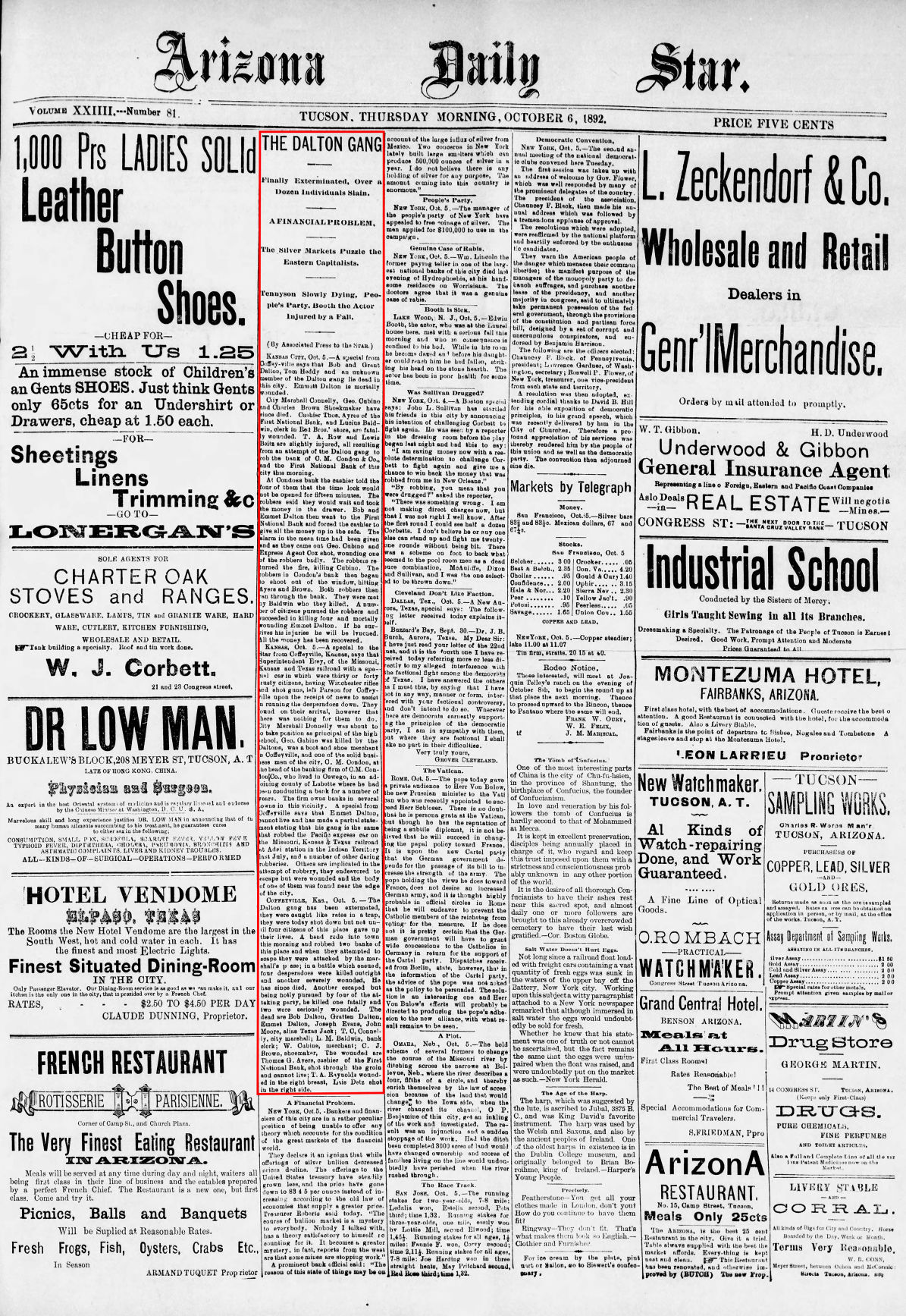
Download a PDF that you can enlarge for easier reading
THE DALTON GANG
Finally Exterminated, Over a Dozen Individuals Slain.
(By Associated Press to the Star)
KANSAS CITY, Oct., 5. ─ A special from Coffeyville says that Bob and Grant Dalton, Tom Heddy and an unknown member of the Dalton gang lie dead in this city. Emmett Dalton is mortally wounded.
City Marshall Connelly, Geo. Cubino and Charles Brown Shoekmaker have since died. Cashier Thos. Ayres of the First National Bank, and Lucius Baldwin, clerk in Red Bros.' store, are fatally wounded. T. A. Row and Lewie Beitz are slightly injured, all resulting from an attempt of the Dalton gang to rob the bank of C. M. Condon & Co., and the First National Bank of this city this morning.
At Condons bank the cashier told the four of them that the time lock would not be opened for fifteen minutes. The robbers said they would wait and took the money in the drawer. Bob and Emmet Dalton then went to the First National Bank and forced the cashier to give all the money up in the safe. The alarm in the meantime had been given and as they came out Geo. Cubino and Express Agent Cox shot, wounding one of the robbers badly. The robbers returned the fire, killing Cubino. The robbers in Condon's bank then began to shoot out of the window, hitting Ayers and Brown. Both robbers then ran through the bank. They were met by Baldwin who they killed. A number of citizens pursued the robbers and succeeded in killing four and mortally wounding Emmet Dalton. If he survives his injuries he will be lynched. All the money has been recovered.
KANSAS, Oct. 5. ─ A Special to the Star from Coffeyville, Kansas, says that Superintendent Erey, of the Missouri, Kansas and Texas railroad with a special car in which were thirty or forty trusty citizens, having Winchester rifles and shot guns, left Parson for Coffeyville upon the receipt of news to assist in running the desperadoes down. They found on their arrival, however that there was nothing for them to do. City Marshall Donnelly was about to go take position as principal of the high school, Geo. Gabine was killed by the Daltons, was a boot and shoe merchant in Coffeyville, and one of the solid business men in the city, C. M. Condon, at the head of the banking firm of C.M. Condon Co., who lived in Oswego, in an adjoining county of Labette where he had been conducting a bank for a number of years. The firm owns banks in several towns in this vicinity. A special from Coffeyville says that Emmet Dalton, cannot live and has made a partial statement stating that his gang is the same that robbed the Pacific express car on the Missouri, Kansas & Texas railroad at Adai station in the Indian Territory last July, and a number of other daring robberies. Others are implicated in the attempt of robbery, they endeavored to escape but were wounded and the body of one of them was found near the edge of the city.
COFFEYVILLE, Kas., Oct. 5. ─ The Dalton gang has been exterminated, they were caught like rats in a trap, they were today shot down but not until four citizens of this place gave up their lives. A band rode into town this morning and robbed two banks of this place and when they attempted to escape they were attacked by the marshal's posse; in a battle which ensued, four desperadoes were killed outright and another severely wounded, he has since died. Another escaped but being hotly pursued by four of the attacking party, he killed one fatally and two were seriously wounded. The dead are Bob Dalton, Gratten Dalton, Emmet Dalton, Joseph Evans, John Moore, alias Texas Jack; T.C. Connelly, city marshal; L. M. Baldwin, bank clerk; W. Cubino, merchant; C. J. Brown, shoemaker;. The wounded are Thomas G. Ayers, cashier of the First National Bank, shot through the groin and cannot live; T. A. Reynolds wounded in the right breast, Luis Detz shot in the right side.
Oct. 15, 1912: Teddy Roosevelt is shot
Updated
Download a PDF that you can enlarge for easier reading
Roosevelt Is Shot by Maniac Who Pushes Through Crowd As Colonel Leaves Hotel and Fires Revolver
MILWAUKEE, Wis., Oct. 14. ─ Colonel Roosevelt was shot and wounded tonight as he was leaving the Gilpatrick hotel for the Coliseum to make a speech.
It is not believed the wound is serious although the bullet has not been removed and is lodged against the wall of the chest. This was shown by an X-ray examination made at the emergency hospital at midnight by six physicians,
The colonel insists that he is not seriously injured, but the doctors say they do not know positively. He took the special train for Chicago and was resting quietly in bed as the special left Milwaukee.
The colonel did not know he was shot and went on to the auditorium to make is speech before it was discovered he was wounded.
Saw Assassin Caught.
He saw his private Secretary, Martin, jump on the man who fired the shot and saw the man turned over to the police before he started to the auditorium in the automobile.
When the policemen came up the crowd found out what had happened and they wanted to get at the man who was protected by Roosevelt and others of his party.
The man apparently is insane and said he shot at Roosevelt because Roosevelt was running for a third term.
"Any man looking for a third term ought to be shot," he declared to the police after he had been taken into the hotel.
In the man's pockets were found notes in which he stated he had been visited in a dream by the spirit of McKinley, who said, indicating Roosevelt, "This man is my murderer, avenge my death."
Man Evidently Insane.
After hours examination prisoner told police he was John Schrank, 370 West Tenth street New York.
The would-be assassin is five feet five inches in height, weight 170, light complexion, bald. A written proclamation found in his clothing reads:
"Sept. 15, 1901. 1:30 a. m. In a dream I saw President McKinley sit up in a monks attire; by him I recognized Theodore Roosevelt. The dead president said: 'This is my murderer, avenge my death.'"
Sept. 15, 1912. 1:30 a. m. While writing a poem someone tapped my on the shoulder and said: 'Let not a murderer take the presidential chair. Avenge my death.' I could plainly see Mr. McKinley's features. Before the Almighty God I swear this. The above writing is nothing but the truth."
…
Manuscript Saves Life.
Roosevelt's life probably was saved by the manuscript of the speech he delivered tonight. The bullet struck the manuscript which retarded the force as it passed through into the flesh. The assassin was prevented from firing the second shot by Albert H. Martin, one of Roosevelt's two secretaries. Roosevelt had just stepped into the automobile when the assassin pushed his way through the crowd into the street and fired. Martin, who was standing in the car with the colonel leaped at the man's shoulders and bore him to the ground.
Martin caught the flash of the revolver as the shot was fired and leaped over the car a second after the bullet sped on its way. Roosevelt barely moved as the shot was fired. Before the crowd knew what had happened Martin, who is six feet tall and a former football player, landed squarely on the assassin's shoulders, and bore him to the ground. He threw his right arm about the man's neck, with a deathlike grip, and with his left arm pinned the hand that held the revolver.
Roosevelt Remain Cool.
Roosevelt stood calmly looking on as through nothing had happened. Martin picked up the man as though he were a child and carried him a few feet, which separated them from the car, almost to the colonel's side.
"Here he is," said Martin. "Look at him, colonel."
All this happened within a few seconds and Roosevelt stood gazing curiously at the man who had attempted his life. Before the stunned crowd realized what was going on, then cries of rage went up, it seemed for a moment the assassin would be torn to pieces by the infuriated crowd and it was Roosevelt himself who interfered in behalf of the man.
…
Made His Speech.
In spite of the entreaties of physicians Roosevelt insisted upon delivering his address, "I will make this speech or die, one or the other."
Roosevelt completed his speech at 9:45 o'clock and was then taken to the emergency hospital. It is believed his injury is not serious. The colonel felt no pain at the time the shot was fired and was not aware he was shot until on the way to the auditorium. Attention was then called to a hole in his overcoat and he found his shirt soaked with blood. He insisted he was not badly hurt. A superficial examination of the wound was made when he reached the auditorium and three physicians agreed he was in no immediate danger.
Oct. 19, 1931: Thomas Edison dies
Updated
Download a PDF that you can enlarge for easier reading
Edison Wished For Death, Physician Reveals
By FRANK GERVASI
WEST ORANGE, N. J., Oct. 18. ─ (AP) ─ Thomas A. Edison died peacefully before dawn today at the hilltop estate where he labored to give light, work and recreation to millions.
The 84-year-old inventor, who lay deep in a coma at the end, did not wish to live, Dr. Hubert S. Howe disclosed, when he realized his complete recovery was improbable.
His wife and six children, close in attendance during the last stages of the 11 weeks' sickness, had been told by Mr. Edison that his work was finished. He would rather leave the world, he said, than burden them with the disabilities of age and illness.
In the quiet of the early morning on the Llewellyn Park estate a formal notice of Mr. Edison's passing was brought to newspaper men by Arthur L. Walsh, vice president of Thomas A. Edison Industries, Inc.
Pale and visibly shaken, Mr. Walsh walked down a tree-lined path from the home to press headquarters in the Edison Garage to read the bulletin.
Bulletin Read
"Thomas Alva Edison quietly passed away at 24 minutes after 8 a. m., October 18, 1931. (Signed) Dr. Hubert S. Howe."
Almost instantly the message circled the globe by telephone and telegraph systems which were a part of the industries valued at $15,000,000,000 to which Edison contributed major inventions.
Man Seriously Hurt In Brawl
Quick Action by Officers Results in Arrest of Suspect
In a brawl on West Alameda street, in the river bottom, Larry McCormick, 810 South Ninth avenue was critically injured and was taken to the Southern Methodist hospital Sunday evening about 9:15 o'clock.
About 25 minutes after the alleged fight Capt. Ben West apprehended Frank Machado, formerly of Tucson, and late of California in a rooming house on West Alameda and charged him with assault with a deadly weapon. With West were Officers Charles Hines and Walker Hyde as they arrested the alleged attacker.
Juan Estrada who was said by officers to be an eye witness to the attack, reported that several youths were in the act of accepting a drink from McCormick when Machado wandered up. It was said that he took the bottle and after taking a drink struck McCormick alongside of the head with the bottle. Someone reported the attack to Officer Herron and he investigated and called headquarters for the police car.
A few moments later the injured man was taken to the police station and there transferred to an ambulance of the Parker-Grimshaw company which took him to the Southern Methodist hospital.
Reports from the hospital told of a bad injury to the head of McCormick and the possibility of a fracture of the skull. This could not be determined however until X-ray pictures had been taken according to the attending physician. McCormick was unconscious.
The quick work of the officers in charge of the investigation led to the immediate arrest of Machado. Taking several blind leads as to the address of the attacker the officers at last tracked him to the rooming house on West Alameda near the police station.
Hines and Hyde looked out for the rear exits and as Capt. Ben West entered the front door he found Machado hiding behind a door.
Machado was taken to the police station where he was examined and found to have severe cuts upon the fingers of his right hand. The cuts were well wrapped up in a handkerchief, but not sufficiently to disguise the flow of blood from the hand.
Oct. 4, 1933: Isabella Greenway elected to Congress
Updated
Download a PDF that you can enlarge for easier reading
Mrs. Greenway Is Victor Over Two Opponents
PHOENIX, Oct. 3. ─ (AP) ─ Arizona, the nation's last frontier, elected Isabella Greenway of Tucson to congress today ─ for the first time in its 21 years as a state bestowing upon a woman one of the greatest honors in the power of the commonwealth.
It was, too, the first time a woman had sought high office, and the first time Mrs. Greenway had aspired to any elective public office.
She is a Democrat, since 1928 national committeewoman for Arizona, is a close friend of the family of Franklin D. Roosevelt, and was a friend also of the late President Theodore Roosevelt, with whom her late husband, Brig. Gen. John C. Greenway of the American Expeditionary Force in the World War, served in the "Rough Riders" of the Spanish-American conflict.
Aside from the romance and force of her victory ─ a more than two to one majority over the combined votes of two opponents with 60 per cent of the state's precincts counted ─ the feature of the special congressional election was the failure of the Republican party to defeat the Socialist candidate.
Republican leaders had conceded Mrs. Greenway's victory before the vote was either cast or counted, but the strength of the Socialist vote was neither foreseen nor considered possible. Dillworth Sumpter, Socialist, had polled more than four times the Socialist registration of the state, and was maintaining a strong lead over H. B. Wilkinson, Republican.
In 252 precincts of the state's 451, the count was:
Greenway (D) 18, 650.
Sumpter (S) 4,835.
Wilkinson (R) 3,337.
It was the first time in the history of the state that either of the major parties had failed to poll a larger vote than a minor party candidate. Sumpter's vote was the greatest ever accorded a Socialist in Arizona.
Mrs. Greenway succeeded Lewis W. Douglas, who resigned to become director of the federal budget last March. Since that time Arizona's lone congressional seat has been vacant.
Her consuming interests are rehabilitation of disabled war veterans, which she has made a vocation as well as a political issue, and a protective tariff for copper.
She established the "Arizona Hut" in Tucson where disabled veterans maintain themselves by manufacture of furniture and novelties.
Her late husband was a distinguished mining engineer. She and he together planned the town of Ajo, long considered a model copper mining town. It still is her voting residence. She cast her vote there today, and the town voted with her, giving her 319 ballots against 14 each for Sumpter and Wilkinson. In precinct 23 of the city of Tucson, where she lives, the vote was 82 for Mrs. Greenway, two for Sumpter and one for Wilkinson.
Oct. 23, 1934: Pretty Boy Floyd slain by police
Updated
Download a PDF that you can enlarge for easier reading
Pretty Boy Floyd, Slain by Police And U.S. Guns, Admits Identity
Public Enemy Trapped, Tries Flight, Fails
EAST LIVERPOOL, O., Oct. 22. ─ (AP) ─ The long arm of the department of justice caught up with Charles "Pretty Boy" Floyd, violent criminal of the Ozarks, near here today, and snuffed out his life in a hail of rifle, pistol and machine gun bullets.
Federal agents and police came upon the No. 1 public enemy at a lonely farm, seven miles north of this city, in a section much like the country where he was born and raised.
Fifty or more shots rang out as the officers halted the criminal's flight, and he fell mortally wounded, unable to use either of the two automatics he was carrying.
Quickly the officers, including four department of justice men and four East Liverpool policemen, came up to his prostrate form.
"Who the hell tipped you?" demanded the dying man as the approached him. The he inquired, "Where is Eddie?" (Apparently he referred to Adam Richetti, captured Saturday near Wellsville, O., when he and Floyd engaged other officers in a gun battle.)
Admits Identity
Just before he died, Floyd said to Melvin Purvis, head of the justice department's bureau of investigation in Chicago, "I am Floyd." It was apparent Floyd knew he was dying.
Police Chief Hugh J. McDermott of East Liverpool, who participated in the final run-down of the criminal, said Floyd was wounded at least eight times and possibly 20 by the officers' guns.
Floyd died about 15 minutes after he was shot while officers were carrying him to a nearby road where they had an automobile waiting to take him to a hospital.
Death came to Floyd in the same violent manner by which he had lived. At the time he was slain, he was the principal figure in a nationwide search, being sought as the trigger-man in the Kansas City union station machine gun massacre in which five men were shot to death in June, 1933.
The officers who finally caught up with Floyd today were led by Purvis, the same federal operative who tracked down the notorious John Dillinger.
When the officers came upon Pretty Boy he was talking to S. L. Dyke, a farm hand employed by Mrs. Ellen Conkle, endeavoring to persuade him to take him to Youngstown where he thought he might find refuge in the more populous city.
Oct. 31, 1938: 'War of the Worlds' hysteria
Updated
Download a PDF that you can enlarge for easier reading
Hysteria Sweeps Nation When Radio Reports Mythical War
Purely Fictional Account of Conquerors From Mars Is Taken Seriously at Widely Scattered Points With People Fleeing From Homes
By CHARLES E. HARNER
NEW YORK, Oct. 30. ─ (AP) ─ Hysteria among radio listeners throughout the nation and actual panicky evacuations from sections of the metropolitan area resulted from a too-realistic radio broadcast tonight describing a fictitious and devastating visitation of strange men from Mars. Excited and weeping persons all over the country swamped newspaper and police switchboards with the question:
"Is it true?"
It was purely a figment of H. G. Wells' imagination with some extra flourishes of radio dramatization by Orson Welles. It was broadcast by the Columbia broadcasting system.
But the anxiety was immeasurable.
Book Broadcast
The broadcast was an adaptation of Wells' "War of the World," in which meteors and gas from Mars menace the earth.
New York police were unable to contact the CBS studios by telephone, so swamped was its switchboard, and a radio car was sent there for information.
A woman ran into a church in Indianapolis screaming: "New York destroyed; it's the end of the world. You might as well go home to die. I just heard it on the radio." Services were dismissed immediately.
Five boys at Brevard (N.C.) college fainted and panic gripped the campus for a half hour with many students fighting for telephones to inform their parents to come and get them.
Panic Spreads
At Fayetteville, N.C., people with relatives in the section of New Jersey where the mythical visitation had its locale, went to a newspaper office in tears, seeking information.
A message from Providence, R.I., said:
"Weeping and hysterical women swamped the switchboard of the Providence Journal for details of the massacre and destruction at New York and officials of the electric company received scores of calls urging them to turn off all lights so that the city would be safe from the enemy."
Mass hysteria mounted so high in some cases that the people told police and newspapers they "saw" the invasion.
(The following is from the continuation on Page 10)
Woman "Sees" Fire
The Boston Globe told of one woman who "claimed she could 'see fire,'" and said she and many others in her neighborhood were "getting out of here."
Minneapolis and St. Paul police switchboards were deluged with calls from frightened people.
In Atlanta, there was worry in some quarters that "the end of the world" had arrived.
Police Act
It finally got so bad in New Jersey that the state police put reassuring messages on the state teletype, instructing their officers what it was all about.
And all this despite the fact that the radio play was interrupted four times for the announcement: "This is purely a fictional play."
Newspaper switchboard operators quit saying "Hello." They merely plugged in and said: "It's just a radio show."
The Times-Dispatch in Richmond, Va., reported some of its telephone calls came from people who said they were "praying."
The Kansas City Bureau of the Associated Press received queries on the "meteors" from Los Angeles, Salt Lake City, Beaumont, Tex., and St. Joseph, Mo., in addition to having its local switchboard flooded with calls.
People Flee
One telephone informant said he had loaded all his children into his car, had filled it with gasoline, and was going somewhere.
"Where is it safe?" he wanted to know.
Residents of Jersey City, N. J., telephoned their police frantically, asking where they could get gas masks. In both Jersey City and Newark, hundreds of citizens ran out into the streets.
Atlanta reported that listeners throughout the southeast "had it that a planet struck in New Jersey, with monsters and almost everything, and anywhere from 40 to 7,000 people reported killed." Editors said responsible people, known to them, were among the anxious information-seekers.
Prayers Offered
In Birmingham, Ala., people gathered in groups and prayed, and Memphis had its full quota of weeping women calling in to learn the facts.
After an introductory explanation by Welles at 8 p.m., an announcer gave a commpnplace weather forecast. Then, in standard fashion, came to the words: "We take you now to the ….. Hotel, where we will hear the music, etc."
After a few bars of dance music there came "a bulletin from the Intercontinental Radio News bureau" saying there had been a gas explosion in New Jersey.
"Attack" Explained
After that the bulletins came more and more rapidly with "Professor Pierson," played by Welles, explaining about the attack by Mars and the little men who were pouring out of their meteor-like airplanes.
For some time, warriors drove everything before them. Mere armies and navies were wiped out right and left, and the real radio audience were as frightened as the actors pretended to be. Then the little men acquired a lot of germs to which we men-of-the-world are virtually impervious. So the little men died, and everybody lived happily ever after.
Tucson Calls Are Numerous
Beginning at 6:20 o'clock last night, the switchboard of The Arizona Daily Star was kept busy for a half-hour period with calls from excited listeners to the radio dramatization of H. G. Wells' "War of the Worlds."
The first call was from a breathless woman who said she had just heard Secretary Ickes broadcast a statement that troops had surrounded a plane from Mars, which landed in New Jersey, and were keeping machine guns trained on the occupants.
Caught unawares, members of the newspaper's editorial department were unbelieving, but nonetheless took a quick look at the incoming Associated Press report for possible light on the subject before reassuring the woman and many who called in the next few minutes.
The Sunday night Orson Welles drama is regularly broadcast at 7 o'clock Monday by stations of the Arizona network. Officials of KGAR in Tucson said that so far as they knew, the men from Mars would stage a second invasion for Arizona listeners tonight.
Oct. 13, 1940: Tom Mix dies near Florence, Arizona
Updated
Download a PDF that you can enlarge for easier reading
Tom Mix Dies in Auto Crash Near Florence
FLORENCE, Ariz., Oct. 12. ─ (AP) ─ Tom Mix, 60, cowboy-actor and hero of scores of western thrillers of the silent film era, was killed 18 miles south of here today when he was pinned under his overturned automobile on a highway detour.
Mix, whose colorful career as a circus Performer, soldier, law enforcement officer and motion picture star made him the idol of millions the world over, was traveling alone from Tucson to Florence and Phoenix.
Coroner E. O. Devine said Mix apparently died instantly after losing control of his car. The body was brought here.
Body Is Found
Two highway employes, John Adams of Oracle, Ariz., and E. A. Armenta of Casa Grande, discovered the overturned vehicle.
Martin Younkers, Beloit, Wis., and Anthony Monts, Rockford, Ill., who said Mix had passed them on the highway north of Tucson, helped pull the actor's body from under his racing model car.
Younkers and Monts said a heavy suit case had fallen against Mix's head, burying his face in the soft ground. A physician reported later the blow broke his neck.
Local investigators said Mix, who left Tucson at 1 p.m., was serving as advance agent for a circus scheduled to show in Phoenix shortly. The cowboy star was carrying $6,000 in cash, $1,500 in travelers' checks and several valuable jewels.
Mix was a native of El Paso county, Texas. He worked as a cowboy in Texas, Arizona, Wyoming and Montana and won national riding and roping contests at Prescott, Ariz., and Canon City, Colo., in 1909 and 1910.
Cast as Hero
During the years when he was identified with pictures, Mix always was cast as a hard-riding, gun-toting hero out to thwart unlawful acts in the days of the wild west.
In recent years, he has appeared in wild west circus shows and for a time operated his own circus, the Tom Mix Wild West Show. He also made frequent vaudeville tours and in 1938 and 1939 made personal appearances in Europe.
Mix served with the United States Army in the Philippine Islands, in the Spanish American war and during the Boxer Rebellion in China, winning a medal and citation. He was with the British army at the siege of Ladysmith during the Boer war in South Africa.
Peace Officer
As a law enforcement officer, Mix was sheriff of Montgomery county, Kansas, and Washington county, Oklahoma, and later saw service as a deputy U.S. Marshal in the eastern Oklahoma district and with the Texas Rangers.
He was livestock foreman of the Miller brothers "101" ranch, Bliss, Okla., from 1906 to 1909.
With the advent of talking pictures, Mix turned to circus and vaudeville work exclusively.
Deputies of the Pinal county sheriff's office have contacted Mrs. Mix in Los Angeles. They said she was flying tonight to Tucson, and probably would come to Florence tomorrow. A daughter, Mrs. Ruth Mix Craig, was notified of the death in Oklahoma City, Okla. She also plans to come here.
Oct. 2, 1946: Nazis sentenced in Nuernberg trials
Updated
Download a PDF that you can enlarge for easier reading
Dozen Nazi Leaders To Hang for Crimes
NEURNBERG, Germany, Oct. 1. ─ (AP) ─ Hermann Goering and 11 other Nazi chiefs who helped Adolf Hitler plunge the world into the greatest war of all time were sentenced today to death by hanging. Seven other defendants, including Rudolf Hess, were sentenced to prison and three were acquitted by the four-power military tribunal in the first international war crimes trial.
The death sentences will be carried out in the Nuernberg jail, probably Oct. 16. The prison terms will be served in a four-power jail in Berlin.
Concluding the 10-month trial, the international military tribunal announced the sentences after completing the reading of a 100,000-word, history-making judgment ruling that aggressive warfare "is the supreme crime."
Hans Fritsche, Franz von Papen and Hjalmar Schacht were acquitted, with Russia dissenting.
12 Who Will Hang
Sentenced to hang, besides Goering, were Joachim von Ribbentrop, Field Marshal Wilhelm Keitel, Ernst Kaltenbrunner, Alfred Rosenberg, Hans Frank, William Frick, Julius Streicher, Fritz Sauckel, Col. Gen. Alfred Jodl, Arthur Seyss-Inquart and Martin Bormann (tried in absentia).
Sentenced to prison were Hess, Walter Funk and Grand Admiral Raeder, life terms; Baldur von Schirach and Albert Speer, 20 years; Constantin von Neurath, 15 years; and Grand Adm. Karl Doenitz 10 years.
Goering, whose guilt was declared by the court to be "unique in its enormity," put his head in his hands and appeared lost in thought, but his expression remained immobile as Chief Justice Sir Geoffrey Lawrence continued reading in a monotone.
Hess dashed the earphones from his head and did not even hear sentence pronounced.
Keitel gulped, lowered his sharp Prussian chin and stared blankly into space.
Funk's Knees Sag
The pudgy Funk alone appeared physically affected by the sentencing. His knees sagged as he walked out. Frick, an old Nazi street fighter, bowed curtly to the court as he received his sentence of death.
And all the other reacted much in the same way that has characterized their demeanor in all the long trial.
Shortly after their acquittal, Schacht, von Papen and Fritsche stalked smilingly out of jail and held a turbulent news conference at which Schacht was as cocky and belligerent as ever.
The financier of Hitler's war machine said that there used to be "laws and free opinion in Germany," but "there appeared to be neither laws nor free opinion now."
Their freedom may be short-lived, for they face possible trial before denazification boards. Dr. Wilhelm Hoegner, German minister-president of Bavaria, said that any of the three who remained in the American zone would be hauled promptly before such boards and added that "this certainly means several years at hard labor."
Ten-month Nuernberg Ordeal Left Accused Nazis Subdued
NUERNBERG, Germany, Oct. 1. ─ (AP) ─ On the morning of Nov. 20, 1945, 21 cocky, but curious, defendants walked into the prisoners' box of the courtroom in the Nuernberg palace of justice to await opening of the world's greatest war crimes trial.
At 10 a.m. on that historic day more than 10 months ago, the courtroom became churchly quiet as Sir Geoffrey Lawrence, tribunal president, made a brief opening statement on the manner in which the trials were to be conducted, the manner in which the tribunal had been set up, and its aims. Then he asked for a reading of the indictment.
Sidney S. Alderman, who had joined the American prosecuting staff from his position as general counsel for the Southern Railways, opened the case for the prosecution.
Alderman dealt only with count one of the indictment, the common plan or conspiracy. He was followed by Sir David Maxwell Fyfe of Great Britain with count two, crimes against peace, M. Mennier of France and General Rudenko of Russia with count three, war crimes, and a second Russian prosecutor with count four, crimes against humanity.
Defendants Plead
On the second day the defendants were given an opportunity to plead guilty or not guilty. Following a short recess to allow the defendants a final opportunity to consult their attorneys, pudgy Hermann Goering, former reichsmarshal,, was called upon to make his plea.
He began: "Before I answer the question of the high court whether or not I am guilty. . ."
Sir Geoffrey cut him short, "I informed the court that the defendants are not entitled to make a statement. You must plead guilty or not guilty."
Goering replied: "I declare myself, in the sense of the indictment, not guilty."
Rudolf Hess, one-time deputy fuehrer and the trial's mystery man, shouted a loud "no" into the microphone. Sir Geoffrey dryly remarked, "That will be entered as a plea of not guilty."
The other 19 defendants took their cue from Goering, most of them declaring that in the sense of the indictment they were not guilty.
Oct. 5, 1957: Sputnik launched
Updated
Download a PDF that you can enlarge for easier reading
Russians Launch Baby Moon
MOSCOW, Saturday, Oct. 5 (AP) ─ The Soviet Union announced today it has the world's first artificial moon streaking around the globe 560 miles out in space.
A multiple-stage rocket launched the earth satellite yesterday, the Russians said, shooting it upward at about five miles per second.
They said the satellite, a globe described as 23 inches in diameter and weighing 185 pounds, can be seen in its orbit with glasses and followed by radio through instruments it carries.
(Radio signals on the wavelength of the Soviet moon ─ sounding as a deep "beep, beep, beep" ─ were picked up by electronic engineers of the National Broadcasting Co., in New York and the British Broadcasting Corp. in London.)
In thus announcing the launching of the first earth satellite ever put in globe-girdling orbit under man's controls, the Soviet Union claimed a victory over the United States.
The two big powers had been in a hot but mainly secret race to be first to probe the high space realms with spheres laden with instruments.
The Moscow announcement said:
"The successful launching of the first man-made satellite makes a tremendous contribution to the treasure house of world science and culture . . .
"Artificial earth satellites will pave the way for space travel and it seems that the present generation will witness how the freed and conscious labor of the people of the new socialist society turns even the most daring of man's dreams into reality . . ."
In a special bulletin early this morning, the Soviet Tass agency said the Russian moon is now revolving around the earth at the rate of one circuit every hour and 35 minutes.
The launching occurred just three months and four days after the opening of the International Geophysical Year.
In Cambridge, Mass., the Smithsonian Astrophysical observatory said that sightings of the satellite have been reported by moonwatch stations in scattered parts of the country.
R. Fred Whipple, observatory director, announced the first sighting was reported by a station in Terre Haute, Ind., at 8:50 p.m. (EST).
Other sightings came from Columbus, Ohio at 10:28 p.m. (EST) and Whittier, Calif., at 10:47 (EST).
Moscow reported the satellite can be seen with the simplest kind of telescope glasses. Its velocity was given as something like five miles per second at a height of about 560 miles above the earth.
The broadcast said the Russians plan to launch several more earth satellites in the next year, It declared the developments will open a way for travel to the planets.
Moscow said the satellite is fitted with steel radio transmitters continuously sending signals earthward on the 15 and 7.5 meter wave lengths and easily received by a broad range of amateur sets.
Oct. 7, 1961: President Kennedy wants bomb shelters for all
Updated
Download a PDF that you can enlarge for easier reading
Shelter Plan For All Eyed By Kennedy
© 1961, New York Times News Service
WASHINGTON, Oct. 6 ─ President Kennedy Friday set a civil defense goal of "fall-out protection for every American as rapidly as possible." The President stressed for the first time the possibilities of "do-it-yourself" home shelters to back up administration's $207,600,000 group-shelter program.
It can be accomplished, the President said in a letter to the meeting here of the Civil Defense Committee of the Governors' Conference headed by Gov. Nelson Rockefeller, R-N.Y.
After the meeting, Gov. Rockefeller praised the administration survey to earmark shelter space for 50,000,000 Americans but added that there was still a long way to go before the entire population was protected.
Grandmother K Says Russ Not Planning War
© 1961, New York Times News Service
MOSCOW, Oct. 6 ─ Mme. Nina Petrovna Khrushchev told western peace marchers Friday that the Soviet Union was not building air raid shelters because "we are not getting ready for war."
She gave a tea party for the group who tried to convince her the Soviet Union should scrap all weapons and stop nuclear tests, all by itself, if no other country will do so, too.
She smiled and joked but rejected their suggestion. "We do not want to be the only ones who throw our bombs into the ocean," said the 61-year-old grandmother.
Oct. 23, 1962: Cuban missile crisis
Updated
Download a PDF that you can enlarge for easier reading
U.S. Begins Blockade of Cuba; Grim Warning Issued To Russia
Washington, Oct. 22 (AP) ─ President Kennedy put into effect a U.S. blockade of Cuba Monday night, after disclosing that the Soviets are shipping into Cuba long-range weapons able to rain nuclear destruction on all the Americas.
Kennedy spoke in a grim emergency nationwide radio-television address in which he disclosed that, despite past Soviet assurances to the contrary, offensive atomic missile sites are being built in Cuba and Soviet jet bombers capable of carrying nuclear weapons have arrived there.
Kennedy outlined a 7-point program for fast military and diplomatic action to stop Cuba from being built up as a Communist launching base against the hemisphere and sent a letter to Soviet Premier Khrushchev calling for a halt.
Speedy developments amid an atmosphere of deep crisis followed the President's somber announcement:
─ A Defense Department spokesman said the United States is ready to sink every Communist bloc ship headed for Cuba which refuses to stop for a search. The blockade, which could apply against planes later, applies against offensive weapons but not nonmilitary necessities like food or medicine.
─ The Navy said at San Juan, Puerto Rico, that the more than 40 ships and 20,000 men assembled for announced annual Caribbean exercises now are "sustaining the blockade" of Cuba.
─ The United States summoned the Organization of American States (OAS) to an emergency session here at 9 a.m. Tuesday in expectation that the inter-American group will approve the U.S. program, thereby giving it international legal standing.
─ Canada said it has stopped Soviet planes bound for Cuba and the Caribbean from landing at Canadian air bases, such as Gander, Nfld.
State department officials prepared a formal proclamation to be issued Tuesday after the OAS action.
Kennedy used the word "quarantine" to describe the naval ring around Cuba, since "blockade" implies an act of war. State Department authorities said, however, that the U. S. act included the essential elements of a blockade ─ inspection, visit and search.
At the United Nations, U.S. Ambassador Adlai E. Stevenson called for an emergency meeting of the U.N. Security Council, which is expected to take place Tuesday afternoon. He sought a Security Council order for "immediate dismantling and withdrawal" of all offensive weapons in Cuba.
A Defense Department spokesman said Soviet missilemen are manning 1,200-mile range rockets in Cuba on mobile launch pads aimed at key American cities including Washington.
Exhibiting reconnaissance photographs of missiles in place, he said that despite no firm information on whether the rockets are nuclear-tipped it is "inconceivable" that their warheads are other than atomic.
The spokesman said that air and sea patrols will be watching ships moving toward Cuba. Warships will move in to intercept. If the U.S. boarding party finds offensive weapons aboard, the ship's captain will be told to head for any port other than Cuba.
If the ship refuses to stop for a search, the Pentagon spokesman said, the United States is prepared to sink it. A State Department spokesman emphasized that short-of-attack measures will be tried first, such as firing a warning shot over the bow.
Kennedy warned in his speech that any atomic attack against any nation in the Western Hemisphere would bring full retaliation against the Soviet Union.
He couple with this an invitation to Khrushchev to join in "a search for peaceful and permanent solutions."
Oct. 15, 1964: Martin Luther King Jr. wins Nobel peace prize
Updated
Download a PDF that you can enlarge for easier reading
Nobel Peace Prize Awarded King, Nonviolent Civil Rights Leader
OSLO(AP) ─ Dr. Martin Luther King Jr., an American Negro leader in the national civil rights movement was awarded the 1964 Nobel Peace Prize Wednesday.
In announcing the 1964 winner of the award, the Oslo Nobel Institute said, "Martin Luther King has consistently asserted the principle of nonviolence."
In an Atlanta hospital for a routine checkup King said: "I'm deeply moved, gratified and honored to be chosen. . . ."
"I do not consider this merely an honor to me personally, but a tribute to the discipline, wise restraint, and majestic courage of the millions of gallant Negroes and white persons of good will who have followed a nonviolent course in seeking to establish a reign of justice and a rule of love across this nation of ours."
King said every dollar of the prize money would be spent on the civil rights movement.
Dr. Ralph J. Bunche, U.N. undersecretary for special political affairs, was the first American Negro so awarded, winning the prize in 1950.
King, 35, will receive the Nobel gold medal and diploma and the cash prize, which this year is $53,123, in Oslo Dec. 10.
King led the 1955 boycott of Montgomery's segregated city buses. The boycott lasted 381 days, touching off bombings of Negro churches and street attacks by whites. A court ruling finally desegregated the buses.
Congratulations began pouring from world leaders, and Protestant and Catholic churchmen. A dissenting note came from Birmingham's former police commissioner Eugene (Bull) Connor who said:
"They're scraping the bottom of the barrel" in picking King. "He's caused more strife and trouble in this country than any one I can think of." Connor directed efforts to break up massive anti-segregation demonstrations led by King in Birmingham last summer.
Ike Thinks Race Is Too Personal
© 1964 New York Times News Service
GETTYSBURG, Pa. ─ Former President Dwight D. Eisenhower complained Thursday that both President Johnson and Sen. Barry Goldwater were devoting too much time to criticizing each other and not enough to a discussion of the "issues" underlying the presidential campaign.
"This campaign is more personal than any I have ever known," Eisenhower told an impromptu press conference outside his office on the campus of Gettysburg College. "The candidates are just not debating the issues."
The former President suggested that one of the issues that was not being discussed to his satisfaction was the future of the Social Security program.
"I believe in a strong Social Security program," he said, "but I think it would be bad to put Medicare under it. It would break it down because of the heavier financial load. But if we could have catastrophic illness added, it would be a better program."
Eisenhower talked casually with newsmen before presentation of a birthday cake by the son of the Republican presidential candidate, Barry Goldwater Jr., and Libby Miller, daughter of his running-mate, William Miller.
In response to a question, Eisenhower discussed the possibility that he might be called upon to head a mission to South Viet Nam to bring an end to the conflict there in the event that Goldwater wins the election.
The Republican candidate said a week ago that he would ask Eisenhower to undertake such a mission if he was elected. The proposal came as a complete surprise to Eisenhower, although Goldwater had tried to reach him by telephone earlier the same day to discuss his intended announcement. The former President was out of town for the day.
Eisenhower said: "I doubt if they want an emeritus anything ─ emeritus military or emeritus president. When the time comes they probably will want a younger and more active fellow."
While he seemed critical of Goldwater's campaign technique ─ as well as that of Johnson ─ Eisenhower made it clear that he would do everything possible to further Goldwater's chances for election.
Oct. 1, 1968: CAP bill signed by President
Updated
Download a PDF that you can enlarge for easier reading
CAP Bill Signed By President
WASHINGTON (AP) ─ President Johnson Monday signed the $1.3 billion Colorado River water bill, which contains the Central Arizona Project, bringing to an end a two decade fight by Arizona for the legislation.
Sen. Carl Hayden, D-Ariz., who retires in January at the age of 91 after serving in Congress since 1912, called the signing "the highwater mark in my career as a senator."
President Johnson said it was "Carl Hayden Day, really, in the White House," adding that if any one man deserves credit for the legislation, it was Hayden.
"For an entire region of America this great rover is the lifeline of survival, of growth, of prosperity, of hope," said the President.
Hayden said the $932 million CAP goes a long way toward providing adequate water for Arizona's future.
"It is difficult for many to realize the many hours of hard, tedious work that have gone on behind the scenes in developing a workable piece of legislation," Hayden said in a statement.
"My special thanks go to those men who have given so much of themselves for the benefit of Arizona: Stew Udall, Mo Udall, John Rhodes, the CAP Task Force, Ernest McFarland, John R. Murdock and Roy Elson.
"This is a great day for Arizona and a tribute to hard work," Hayden said.
On behalf of President Johnson, a number of Arizonans connected with the long fight for the Central Arizona Project were invited by James R. Jones, the President's assistant, to attend the signing.
"For two decades the Colorado has been the subject of unrelenting controversy and competing claims," President Johnson said, "And now, because good and reasonable men have put aside their differences in favor of regional progress, this bill is about to become law.
"It is a landmark bill, a proud companion to the more than 250 conservation measures I have signed as President, for the million Americans west of the Continental Divide, it will provide more water for growing cities, for expanding industries and for the farmers' crops and ranchers' cattle. …And we will do all this without defiling and despoiling the ancient and spectacular landscapes along the Colorado."
The CAP will pump water from the Colorado River, near Parker, through a system of aqueducts and canals to central Arizona, particularly for Phoenix and Tucson ─ the major centers of population.
The bill includes a ban on the licensing of any power dams on the Colorado between Hoover Dam and the Glen Canyon Dam, and sets a 10-year moratorium on any study of ways to augment the river's water.
Oct. 3, 1978: TUSD teachers strike
Updated
Download a PDF that you can enlarge for easier reading
School strike injunction sought
67% of teachers, many students out
By JASON EBERHART-PHILLIPS
The Arizona Daily Star
Only hours after a teachers' strike partially paralyzed its schools, the Tucson Unified School District board yesterday told its attorney to seek a court injunction "in order to try to return the schools to normal and protect the rights of the students and taxpayers."
The school board took the action in a five-minute public session after 1,860 ─ almost 67 percent ─ of 2,780 district teachers stayed off the job, according to official district tallies. The Tucson Education Association, which represents about 2,400 district teachers, said 2,200 teachers were supporting the walkout in its first day.
William Brammer, the district's attorney, said he would file for a 10-day restraining order against the striking teachers in Superior Court today. A hearing is planned for 4 p.m. before Judge Jack Marks.
The district administration calls the walkout illegal, on the basis of a state attorney general opinion made during the 1971 Scottsdale teachers' strike.
The trustees also instructed Brammer yesterday to get a court ruling in whether the board can "summarily dismiss" teachers and classified employees for striking, on grounds of "abandoning their contracts." The last part of the board's motion calls for Brammer to seek compensatory and punitive damages against officers of the TEA, the Arizona Education Association and the National Education Association.
Brammer said compensatory damages would cover the district's legal fees, overtime pay, expenses for substitutes and possible vandalism of school property caused by the strike. He said punitive damages of $50,000 or $100,000 were "not unreasonable."
'We ain't gonna learn nothing'
(Arizona Daily Star reporters Keith Rosenblum and Jerry Mahoney were among the emergency substitute teachers hastily put into classrooms yesterday by Tucson Unified School District officials in the wake of the teacher strike. Neither reporter is trained or certified as a teacher. Neither reporter will collect the $55 per day pay that went with the job.)
"Mr. Rosenblum, you're a bore. This class is boring. This whole day has been boring. You mean to tell me they're paying you $55 to sit here and do nothing?
Unfortunately, what the question lacked in tact it made up in accuracy.
For the 30 percent of Cholla High School's student body who showed up for classes yesterday, school was boring.
It was boring because students sat idle. They sat idle because teachers had told them Friday to leave their books at home. Most students were bookless, and they accused teachers of being brainless.
In my case, my first day on the job as a substitute math teacher, I concurred.
"This algebra you're learning," I said grabbing one of the few texts I saw in my first class, "it looks rather peculiar to me. But I'm sure it's nothing too difficult; let's give it a try."
I had told the district I could handle a physical education or an English class.
"Well, you're a math teachers now," said an administrator at Cholla as if he were the Wizard of Oz handing me a brain.
It made little difference. It quickly became clear that maintaining order ─ "babysitting," the students called it for seven straight periods ─ was the true objective of Strike Day 1.
"We ain't gonna learn nothing in here," yelled a student. His peers concurred boisterously.
I admitted that we weren't headed for any algebraic revelations, so we tried a number of round-table discussions. Why had the students crossed the picket lines? How could they come to class unprepared? I tried to turn the tables.
A show of hands indicated that all of the students in class had been told to come by their parents. All said they would be on the picket line or at home if not for parental wishes.
Oct. 27, 1978: Jet crash near UA
Updated
Download a PDF that you can enlarge for easier reading
Jet kills 1, spares kids
Fiery debris spews over school area
By DIANE JOHNSEN
The Arizona Daily Star
An Air Force jet fighter crashed in a street just south of the University of Arizona shortly after noon yesterday, killing one person but narrowly missing students on the playground at Mansfeld Junior High School.
The plane's pilot suffered only a scraped ankle after he ejected 200 feet over the UA campus, but the aircraft ignited a wall of flames several stories high as it hit on one wing and skidded along North Highland Avenue south of East Sixth Street. Six persons were injured, one very critically.
After compression in his engines failed, the pilot aimed the plane for a UA football practice field just east of Highland, but instead it plummeted onto the street, showering cars in the area with burning fuel and debris.
Engines on his plane, an A-7D Corsair II, stalled eight miles north of the Davis-Monthan Air Force Base runway for which he was headed, said Brig. Gen. Robert S. Kelley, commander of the base.
Harry Brannon was sitting outside his home at 1019 E. Silver St., when he heard a popping sound from the plane as it passed over North Sixth Avenue and East Grant Road, then the engines died.
(The following is from the continuation on page 2)
"I thought he was turning on his afterburners to slow him down, but then he went to coasting," he said.
The crash raised anew questions of the safety of D-M flight paths over the university. Rep. Morris K. Udall, D-Ariz., called a meeting of city, county and Air Force officials for 9 a.m. today in the City Council chambers to discuss the incident.
The 40 A-7Ds at the base will not be grounded and will be flown normally pending the investigation and a review of the planes' maintenance history, said Maj. Myron Donald, assistant public relations officer at the base.
A long string of Air Force jet flights over the UA continued unbroken after the crash. Students cramming the sidewalks near the site had to shout on occasion to make themselves heard above the planes' roar.
The woman who died in the crash and the most seriously injured victim were in a compact car engulfed in flames from the plane. They have been identified as sisters, but hospital officials were not sure last night which had died. An imprint of the dead woman's teeth was taken, and positive identification was expected today.
Believed to have been burned to death was Leticia Felix Humphrey, 22, of N. Columbus Blvd. Her sister is Clarissa Felix, of E. Eighth St. The woman believed to be Clarissa was in extremely critical condition in University Hospital last night with third-degree burns over 90 percent of her body.
Alice Minder, 48, of N. Vine Ave., and her 18-year-old daughter, Joan, were in stable condition at St. Mary's Hospital after their moving car was ignited by debris from the plane several feet farther south on Highland.
Another daughter, Erin, 12, was walking nearby at the time and suffered cuts while pulling her older sister, crippled by a birth defect, from the car. Erin was treated at University Hospital and released.
In stable condition at University Hospital was Richard Flagg, 56, address unknown, who apparently was walking in the area when he was knocked unconscious by the force of the crash.
Mansfeld seventh-grader Christopher Duarte, 12, was released from University Hospital after being treated for bruises he received when he was thrown to the ground by the concussion.
The crash burned four unoccupied cars on Highland, officials said.
Though the plane is equipped to carry 20,000 pounds of weapons, it was unarmed.
The plane's pilot, Capt. Fredrick L. Ashler, 28, ejected as the plane soared powerless over the UA campus. Seen by scores of students from high-rise classroom windows, he parachuted down to land on a grassy area outside campus police headquarters at East Fifth Street and Highland.
Students lounging in the sun during the noon hour on the UA mall heard an explosion overhead as Ashler ejected, then rushed en masse the few blocks south the where his plane came to rest at about 12:16 p.m.
"Everybody was just looking at it — and it was like 'Oh, my God.' Then everybody was running over there," said UA student Frank Hunt, 23, from Tucson.
UA sophomore Danny Taylor, 21, said the plane hit the ground at an angle of 45-60 degrees. "I was walking back to my dorm. There was a loud explosion first when the pilot ejected, and then the plane crashed. It was the loudest thing I've ever heard."
Kelley said Ashler, an instructor pilot with more than 1,000 flying hours and 764 in the A-7D, had intended to set the plane down on the practice field. But witnesses said that after he ejected, the aircraft suddenly veered eastward to its right and slammed into the street between the field and the school. The plane was going about 200 mph on impact, Kelley said.
He said a compression failure caused the plane's engines to stop, and praised Ashler for doing all he could to land the plane safely. Witnesses at the UA agreed.
"He laid it down really nice," said Mario Zappia, 22, from Oracle. "He didn't know he was going to hit anybody. The cars turned onto the street after he had chosen it."
Oct. 1, 1982: Cyanide-laced Tylenol
Updated
Download a PDF that you can enlarge for easier reading
Tylenol laced with cyanide kills at least 4
By Brenda C. Coleman
The Associated Press
ARLINGTON HEIGHTS, Ill. ─ Five people in suburban Chicago died after swallowing capsules of Extra-Strength Tylenol, and at least four of them were poisoned by cyanide that had been put into the medicine, authorities said yesterday.
A sixth person was near death, and two others were hospitalized with possible cyanide-poisoning symptoms.
The manufacturer recalled nearly 4.7 million of the capsules with the lot number MC2880, and a medical examiner said the case is being investigated as "possible homicide."
Authorities said the cyanide ─ one of the deadliest poisons, capable of killing in minutes ─ was probably introduced sometime after the capsules left the plant in Fort Washington, Pa., where they are manufactured by McNeil Consumer Products Co. The poison is not used in production of the medicine.
Sgt. Michael R. Ossler of the police department in Arlington Heights, where two of the victims lived, said police and sheriff's deputies were searching all available records for clues to a likely suspect "such as someone who had poisoned medicine before."
The series of fatalities began with the deaths Wednesday of two brothers in Arlington Heights and a 12-year-old girl in the neighboring community of Elk Grove Village.
State didn't get tainted capsules
No bottles bearing the same lot number as the tainted capsules were distributed in Arizona, said John Street of the state Board of Pharmacy in Phoenix, but bottles printed with the lot number MC2880 have been ordered off pharmacists' shelves in the state nonetheless.
Street said health officials are concerned that winter visitors arriving in Arizona from the East, where the contaminated drug was distributed, might bring capsules with them.
"But to the best of our knowledge, none have been found in Arizona," he said.
Oct. 24, 1982: Battle in Miracle Valley
Updated
Download a PDF that you can enlarge for easier reading
2 die in Miracle Valley battle
Effort to arrest 3 leads to violence
By Paul Brinkley-Rogers, R.H. Ring and Don Dale
The Arizona Daily Star
MIRACLE VALLEY — A leader of a controversial all-black church here and another church member were shot to death yesterday in a wild melee that left at least two lawmen wounded and dozens more with broken arms, cuts and bruises.
Nine people were arrested after the bloody confrontation. It erupted shortly after 9 a.m. when deputies keeping watch on the community from the sheriff's substation across the road responded to a call for help from two other deputies, who were shot as they supported Deputy Pat Halloran, who was trying to serve three traffic-related arrest warrants.
An attempt to serve the same warrants Friday night failed when the two arresting officers were surrounded by scores of club-wielding church members and forced to withdraw.
One of those killed yesterday was William Thomas Jr., 33, son of the church pastor, the Rev. Frances Thomas, and the militant theoretical leader of the church. He suffered gunshots in the arm and the side. The other church member killed was identified as Augusta Tate, 52. Tate was William Thomas' father-in-law. Autopsies are to be performed today in Tucson.
At least five injured lawmen were taken to Sierra Vista Community Hospital, two suffering from gunshots and the rest suffering from broken bones, cuts and bruises. One sheriff's deputy, David Jones, was transferred to St. Joseph's Hospital in Tucson. He suffered shotgun wounds in the face and upper chest, and was reported in stable condition last night.
The other lawmen, including Sgt. Larry Dever, who was shot along with Jones, were treated at the Sierra Vista hospital and released.
Two injured church members were transferred from Sierra Vista hospital to Tucson hospitals. Roy Williams, whose spine was severed by a gunshot, was listed in critical condition at Tucson Medical Center in Tucson. And John Jamison, who was shot in the shoulder, was taken to University Hospital, where he was listed in serious condition.
Deputies who responded to the call for help were punched, beaten with pipes and sticks, stabbed with broken soda bottles and then shot at with shotguns and rifles.
Long expected, the shooting finally comes
By Paul Brinkley-Rogers
© 1982 The Arizona Daily Star
MIRACLE VALLEY — "You've got to kill us if you want us, man," Robert Luckett yelled at the sheriff's deputy backing away from a woman with a large rock in her hand.
Then Luckett screamed, "Wait right here till I come back with a gun, and then we'll see who's the dead man."
But by the time Luckett ran back, with nunchakus — an Oriental weapon — instead of a gun, Deputy Ray Thatcher was gone. He was lost in a sea of church members attacking him and 35 other deputies on Axehead Drive with everything from teeth to gun butts.
That's what Arizona Daily Star photographer Jim Davis and I saw first as we leaped from my pickup after following close on the heels of half a dozen sheriff's patrol cars responding to an urgent appeal for help.
A few minutes earlier, two deputies had driven into the valley to try to serve a warrant for a traffic violation on Frank Bernard, a member of the Christ Miracle Healing Center and Church. They were quickly surrounded by angry church members, and called for help.
We heard the backup sheriff's cars roaring into the valley from across Arizona 92, jumped into the truck, and stayed with them in the dust.
Standing there, watching the anger, the hate and the fury of the church members, it didn't really seem possible. Not in this quiet neighborhood of single-story homes built by ardent followers of Jesus Christ.
At times, in past months, deputies had told me that one day it would come to this — someone getting shot. I had agreed.
Johanna Eubank
Online producer
In this Series
Time machine special sections
1
Updated collection
From the Arizona Daily Star archives: Printable movie star paper dolls
2
Updated collection
Historic June front pages from the Star's archives
3