


Researchers at the University of Arizona want to find out how long it takes the Zika virus to move from the gut of the Aedes aegypti mosquito to its salivary glands — knowledge needed to predict the potential for its spread.
The work, being done in the lab of entomologist Mike Riehle, is funded by a National Science Foundation RAPID Response Research) grant. NSF and other federal agencies want to quickly find out as much as they can about Zika.
Another question Riehle wants to answer is whether Zika can be transmitted from a female mosquito to its eggs — that could be a “game changer,” he said, making it possible for the virus to spread more quickly.
Riehle, an associate professor of entomology, is one of several researchers and public-health investigators at the UA who have been studying mosquito-borne diseases for years.
In the case of Aedes aegypti, they have been trying to figure out why viruses transmitted just south of Arizona in Mexico — dengue and Chikungunya — have not taken hold here.
The working theory is that transmission is limited by factors including a lifestyle that allows us to spend summers in screened-in, air-conditioned comfort and a hot climate that shortens the mosquito’s life.
Whether our experience with the other viruses will hold true with Zika relies on too many unknowns, said epidemiologist Kacey Ernst, who, along with entomologist Kathleen Walker, is a co-investigator on the grant.
Information from this study and the eight others funded last week by NSF, along with ongoing research, will give public health officials tools to anticipate and prepare for outbreaks, said Ernst.
“We’re trying to integrate all of these things into one single model. It’s really important, and it’s really complicated,” she said. “We have a model for dengue. With Zika, there are too many unknowns.”
How the virus moves
Riehle’s research focuses on two critical questions.
In order to find out the incubation period for Zika, Riehle’s lab is cultivating several strains of the virus to feed as a blood meal to female A. aegypti mosquitoes.
They will test the gut and then the legs to see if the virus is transmitted and moving. Later, they will dip the mosquito’s proboscis into a capillary tube filled with mineral oil, which causes it to salivate.
“The idea is to figure out how long it takes the virus to get through the mosquito,” Riehle said. The longer it takes to make it to the salivary glands, the better off we are. Riehle has done previous research that showed the mosquitoes are not long-lived in this climate.
With dengue, the incubation period is 10-12 days, he said. If Zika is similar, “we’re in pretty good shape,” he said.
Transmission to the eggs would be a “game-changer” because it would mean the offspring could transmit the virus without first needing to bite an infected person.
In normal transmission, a mosquito must bite a person infected with Zika and then bite an uninfected person after the disease has moved from the gut to the salivary glands.
Riehle also will vary the temperature for different sets of infected mosquitoes. He expects, based on previous results, that the virus will mature faster in the heat.
“We’re trying to get some of the basic pieces of biological information to plug into the model,” he said.
That knowledge will allow public health officials to tweak the models for different times of year, climates, and infrastructure, said Sam Scheiner, a program director in the NSF’s biological sciences directorate.
Scheiner awarded the RAPID grants without peer review — a process NSF uses in emergencies. He said the current round of funding, nine grants of less than $200,000, won’t answer all of the questions needed to create a reliable model.
“Vigilant” mode
Ernst, an infectious disease epidemiologist with the UA’s Mel and Enid Zuckerman College of Public Health, said she is testifying before a congressional committee next week on the need to speed up research on the “unknowns” of Zika research.
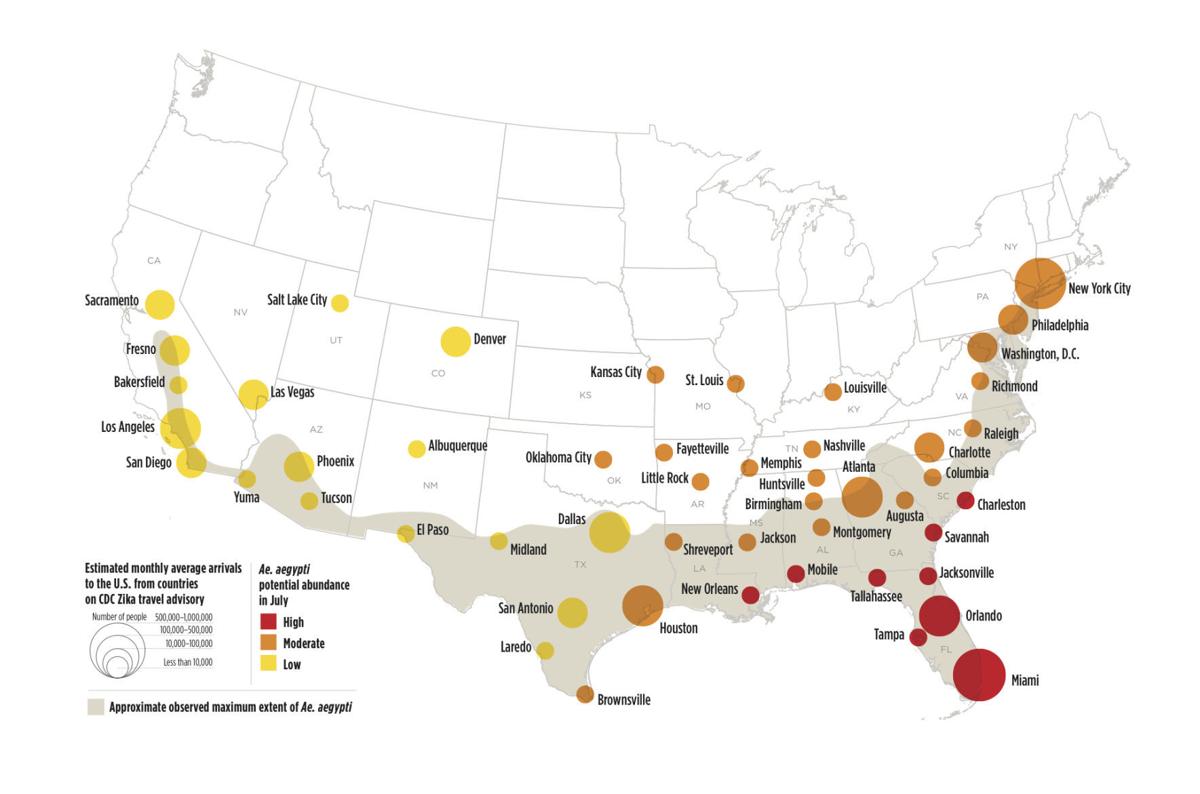
She called a recent model she and colleagues created as a baseline for the potential spread of Zika in U.S. cities a “sledgehammer” that needs to become more sophisticated.
Led by the National Center for Atmospheric Research (NCAR) in Boulder, Colorado, it gives the satellite view of climate conditions that could affect growth of mosquito populations. But what is needed is a view of the micro-climates created for the mosquitoes in urban areas, Ernst said.
The map identifies Tucson and Phoenix as places where there is a modest amount of travel from areas with Zika outbreaks and where the A. aegypti population is comparatively low.
She said Arizona and its residents need to be in a “vigilant” mode regarding mosquitoes and the diseases they carry. Public health officials need to beef up resources to monitor for the diseases and be ready to employ vector-control operations if needed.
Ernst has applied to the NSF for work she and Walker are already doing in Mexico with mosquito surveillance in the Sonoran cities of Nogales, Hermosillo and Obregón.
She also is working on ways to use social media to spread messages about how to prevent mosquito breeding and how to avoid being bitten. She has developed a mobile app, in conjunction with the Centers for Disease Control and Prevention and Skoll Global Threats Fund, for reporting symptoms of Zika, dengue and Chikungunya.
The app, which could provide early warning of disease transmission, will launch in July. You can sign up for notification at Kidenga.com
The website also includes information about mosquitoes that carry the viruses:
- Mosquitoes that spread these diseases bite aggressively during the day.
- Using insect repellent lessens your chance of being bitten.
- Using air conditioning or window and door screens minimizes mosquitoes at home.
- Wearing long-sleeved shirts and pants serves as an extra layer of protection.
- Emptying all standing water inside and outside of your home helps keep mosquitoes away.
- Standing water is a breeding ground for mosquitoes.

