

PHOENIX — Arizona House Republicans are playing a game of budget chicken with their GOP counterparts in the Senate, moving Wednesday to introduce a go-alone spending plan amid a looming deadline.
The move comes as House Speaker Steve Montenegro and his caucus remain at odds with Senate President Warren Petersen on how to cut a state budget deal with Democratic Gov. Katie Hobbs.
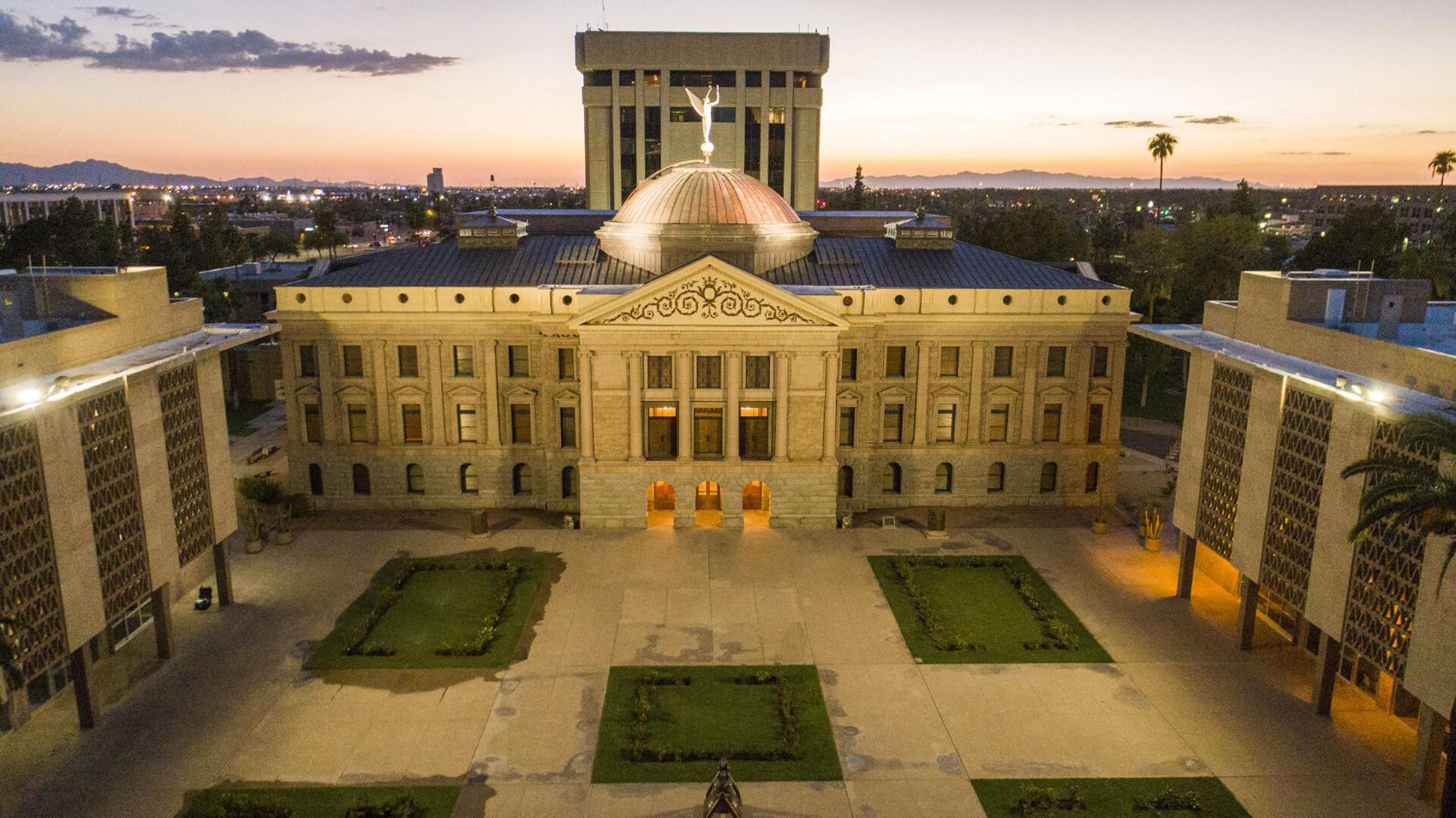
The Arizona Capitol complex in Phoenix.
Senate Republicans have been negotiating directly with Hobbs for more than two weeks — without their House counterparts — and are nearing a budget deal, a top Senate negotiator said Wednesday. Democrats are in the minority in each chamber and aren’t directly involved.
Sen. John Kavanagh, R-Fountain Hills, says the Senate GOP is sticking with its plan to split a $270 million budget surplus in the $17.6 billion budget three ways. House and Senate Republicans would get $90 million for each GOP member to spend and Hobbs and minority Democrats the other $90 million for their spending wishes.
The House has a far different idea of how to spend that surplus and it doesn’t involve splitting the money into different pots.
Exactly how House Republicans want to allocate the revenues — versus simply giving each chamber a pot of money for pet projects — will be disclosed as early as Thursday as the full budget package has to go through the chamber’s Appropriations Committee.
But Rep. Matt Gress, a key House budget negotiator who was former Gov. Doug Ducey’s budget director, gave some hints in a radio interview on KTAR Wednesday.
He said he and his colleagues want to prioritize things like raises for Department of Public Safety officers.
The package also contains “relief to Arizona families,’’ he said, though he provided no details.
Gress said there also is a desire to help students at state universities and their families whom he said have been hit with price increases.
Gress said he is looking at a plan to cut tuition for in-state students an average of $316, with a freeze in charges for the next three years.
“This is a responsible, structurally balanced budget,’’ said Gress, a Phoenix Republican. “I would consider it a law and order budget that invests in public safety and infrastructure and economic opportunity and limiting the scope and role of government.”
Deadline is June 30
Kavanagh, chair of the powerful Senate Appropriations Committee, said they’re just setting aside the House GOP’s $90 million for when Montenegro finally decides to talk to the Senate.
“We are still hoping for a reconciliation,’’ Kavanagh said. “And if the House budget negotiators want to hop on the train, they can select their $90 million, or if they want to give each of their members $3 million, they can do that.’’
And if House Republicans don’t make a choice?
“Then I don’t know. I’m not sure what we’ll do,’’ he said. “Maybe we’ll just try and guess what their members want. I don’t know.’’
All that presumes there are the necessary votes for a final budget. If the House balks, there is no bill to send to Hobbs.
The kerfuffle between the House and Senate GOP caucuses over a budget is something that hasn’t happened in many years and that Kavanagh called “totally new ground.’’ It is threatening to push a deal to the brink of the June 30 deadline for enacting a budget for the fiscal year starting July 1.
House Democratic Leader Oscar De Los Santos blasted the House GOP plan during a Wednesday committee hearing where permission to introduce the budget was granted.
“The fact is that these bills that we’re going to be introducing are not negotiated with the House Democrats,’’ he said.
“They’re not negotiated with the governor,” said the Laveen Democrat. “They’re not even negotiated with the Senate Republicans.’’
He said Democrats were working across the aisle and across the courtyard with the Senate on a budget. He blasted Montenegro’s plan to go it alone.
The way to get things done in shared government is bipartisan work, he said.
“This isn’t it,’’ De Los Santos said. “Not even Senate Republicans are on board. This is a sham and a farce.”
Will there be enough votes?
De Los Santos predicted the budget would never get out of the Senate and could even have problems getting the needed 31 House votes, despite the GOP’s 33-27 majority position.
But Gress predicted the budget has the votes and defended the move.
“We have to get the process started, and the Governor’s Office has been missing in action with respect to negotiating with the House, and so this is our way of advancing the conversation,’’ he said.
He called moving a House budget plan into the open and setting committee hearings a key transparency measure that moves negotiations into the public sphere.
“All the pieces work together, (the) funding sources. We have a balanced budget. We hit a lot of items that the Senate has asked for, that the executive has asked for,’’ he said. “So I think it’s a very robust document.’’
Hobbs' spokesman Christian Slater slammed the House action.
"It's another circus led by the Speaker, David Livingston, and Matt Gress where they have refused to participate with any caucuses, including their Republican counterparts in the Senate, in a meaningful manner and are once again just trying to score some political points even though they know their plan is going absolutely nowhere," Slater said. "Rather than being productive, the House Republican leadership continues to show they are in over their head and unserious about governing.”
The House and Senate have only been in session a handful of days since late April as they let most members stay home and GOP leadership focused on budget negotiations.
The split in the GOP caucuses became clear in recent weeks, with Capitol Media Services reporting that Gress and House GOP members were dead-set against doling out cash as the Senate wanted.
Gress said there were basic functions of government that all three groups needed to help fund, like raises for prison guards and state troopers.
“So when you do the 90-90-90 it basically gives the executive $90 million to use on things that I think are the responsibility of all of us — the House, the Senate and the governor,’’ Gress said last month. “That’s a challenge because the governor also has other executive initiatives, so she’ll blow through her $90 million in two seconds just on covering the basic costs of government.’’
That’s where things stood Wednesday, when the House returned and introduced its budget plan. Montenegro told members they plan to spend the rest of the week moving that budget to passage on their own.
Whether there are enough votes for that to happen without Democratic support is an open question. But Gress said the Senate can expect to see it soon.
“Our plan is to get it out of the House this week,’’ Gress said. “And we believe we have the votes.’’

