

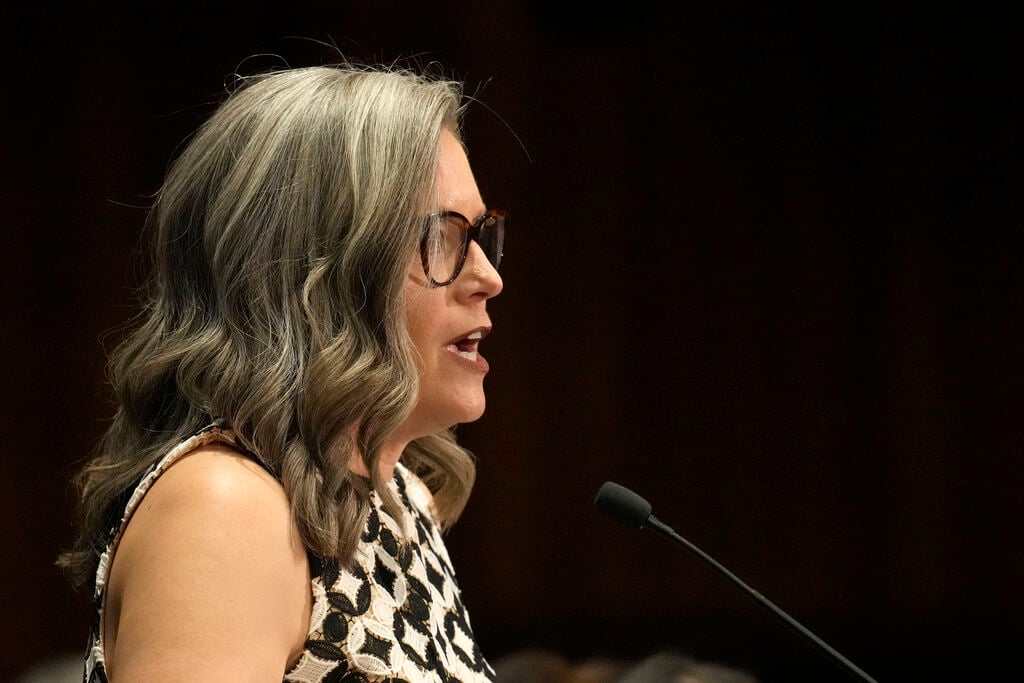
PHOENIX — Gov. Katie Hobbs is defending her call for lawmakers to impose caps on prescription drug price hikes despite her plan’s lack of specifics.
“Arizonans deserve access to more affordable medication,’’ she said Thursday.
The plan she unveiled in her budget proposal last week still lacks many details, including what drugs would be subject to state regulation. That would be determined by a yet-to-be-named board, said her press aide Christian Slater. The plan doesn’t say what interests would be represented on the board.
It would also be left up to the board to determine what would be a fair price increase.
Hobbs wants regulation as well of pharmacy benefit managers, the companies that purchase drugs for insurance companies that eventually wind up in the hands of their customers.
The Democratic governor said she wants rules to prevent what she calls “gouging.’’ That means excessive mark-up of the prices for the simple act of handling those drugs, she said.
This, too, would be left up to the board.
While Hobbs had no specifics Thursday, she said there is a role for the state in telling private drug manufacturers what they can charge for the medications they invent and produce.
“Arizonans today have to choose between life-saving medication and paying for rent,’’ she said. “This makes drugs more affordable for them.’’
She wants a law with some teeth to set costs for consumers, Slater said.
“They’ll be determined by the Prescription Drug Affordability and Transparency Board,’’ he said.
“The board will consider factors including the demand for the drug from consumers as well as the necessity of the drug,’’ Slater said. “So a drug like insulin is a drug that is really commonly used and it is also a life-saving medication.’’
Still unknown is how to determine what consumers will be charged which, by extension, means deciding how much is a reasonable margin of profit.
“A lot of these questions, I think, are going to get determined by the Prescription Drug Affordability and Transparency Board,’’ Slater said. “But, at the end of the day, we need cheaper prescription drugs for everyday Arizonans. And that’s what this plan will deliver.’’
‘Not a fan of price caps’
Slater acknowledged that means trying to get the Republican-controlled Legislature to approve the plan without specifics on how it would work.
“We can trust the affordability board to take a holistic look at this,’’ he said. “And we look forward to having those conversations with the Legislature.’’
As to who would be on the board, “That’s to be determined,’’ Slater said. “As we move through the legislative process, that’ll be a topic of conversation.’’
Legislative reaction so far includes Sen. T.J. Shope saying, “Generally speaking, I’m not a fan of price caps and don’t believe I’ve seen them work — unless you consider stifled innovation a good thing. I want to continue seeing advancements in modern medicine.”
Shope, a Coolidge Republican, chairs the Senate Committee on Health and Human Services.
There’s a related question of what happens if the state sets a maximum price for a drug and a company decides it’s unwilling to sell to Arizonans at that price.
“That’s not going to happen,’’ Slater insisted. If nothing else, he said, that will become part of what the board considers as part of its determination of whether price caps would be affordable but also available.
That’s what happened in Colorado, which has a system Slater said is probably the closest to what Hobbs wants.
Actions by other states
The Colorado board has picked five medications for review. But in its first vote last month, the board rejected a bid to limit the price of Trikafta, a four-year-old medication for cystic fibrosis that has been shown to cut the risk of death by 72%.
The board acknowledged that out-of-pocket costs nearly doubled in one year, to more than $8,900. But The Colorado Sun reports that members also heard from residents who feared that if the state were to take what was believed to be a first-in-the-nation action to set an upper limit, the company would simply pull the medication off the market.
The issue of “price gouging,’’ Slater said, is different from price caps on commonly used drugs, and would not apply to manufacturers. Instead it would be focused on pharmacy benefit managers or PBMs.
“The Prescription Drug Affordability and Transparency Board will look at the cost to the PBMs of filling and dispensing a prescription drug and make sure that they’re not overcharging for their services, and making sure that they’re not jacking up prices, just like a middle man, when they’re filling drugs for consumers,’’ he said.
Hobbs believes the state has a role in determining an acceptable margin of profit, Slater said.
Beyond the issue of price controls, whether for the drugs themselves or the mark-up costs for benefit managers, Slater said Hobbs wants transparency.
“It would also require advance notice of price increases for medications so Arizonans aren’t hit with new surprise costs,’’ regardless of whether it is subject to price caps, he said.
While there is no evidence any state has successfully capped the price of a prescription drug, there are indications transparency may help curb increases.
AARP reports that Vermont, which passed the nation’s first drug price transparency law in 2016, showed a nearly 80% decline in the number of drugs that saw price increases of 15% or more for its Medicaid program between 2016 and 2020. The organization also says there was a 70% drop in Oregon of price hikes of more than 10% for drugs priced at $100 or more between 2019 and 2020.
Aside from Colorado, there are some other models out there for Arizona to consider if the state wants to make a stab at controlling drug prices.
Legislators in Washington state, for example, voted in 2022 to create a five-member Prescription Drug Affordability Board.
According to the Washington State Health Care Authority, the board can conduct “affordability reviews’’ on selected drugs and determine whether a prescription drug is unaffordable for consumers in that state. If that is the case, the board can set an upper payment limit.
But the Washington State Hospital Association reports that while the board has created an initial list of drugs to review, it has yet to conduct any such studies.
A similar board in Maryland also has yet to establish any price caps.
The National Academy for State Health Policy reports that other states including Maine and New Hampshire have similar oversight boards. They lack any authority to set payment limits but instead focus on leveraging public purchasing power to lower drug costs.
Millions of Americans have admitted to not taking their medication as prescribed in order to save money. Most adults between the ages of 18 and 64 took some form of prescription medication in the past year. It has been found that roughly 8% (9.2 million) have skipped doses, delayed prescription fills, or taken less than prescribed to save on costs. This percentage increases to 23% when you isolate uninsured individuals. While the average prescription drug cost has not increased in the past year, the number of people being medicated has. With more than one-third of American adults taking at least three different medications last year. The danger arises when high-cost medication like insulin is used in this unsafe manner. One in six people with diabetes (1.3 million) have admitted to rationing their insulin to cut down on costs. Given that these medications are life-saving in most cases, misuse could have life-threatening consequences.

