


PHOENIX — State lawmakers are moving in a bipartisan fashion to restrict the ability of corporations and investors to buy up single-family homes in Arizona, in a bid to make housing more affordable for individuals.
The methods proposed by Republican Rep. Nick Kupper of Surprise and Democratic Rep. Oscar De Los Santos of Laveen to impose these limits do differ.

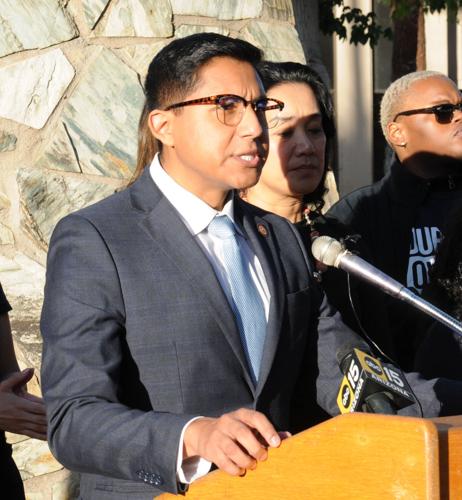
Rep. Oscar De Los Santos discussing his plan to limit the ability of corporations to buy up single-family homes.
But both involve giving individuals first crack at homes when they go on the market. And both would impose an absolute limit on the number of single-family homes any company could control.
The problem, according to both, is that corporate investors are buying up single-family homes. That has a ripple effect, Kupper said.
"If all the housing gets bought up over time by investment firms and they turn them into rentals, because it's more profitable for them long term, you won't have anything to buy,'' he said.

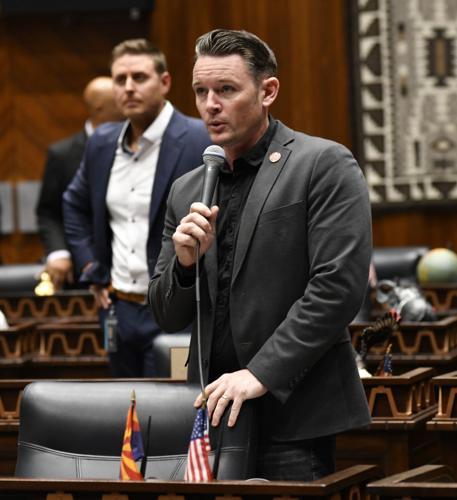
Rep. Nick Kupper on the floor of the Arizona House this week.
He said the four largest firms doing this are buying up a combined 1,000 homes a year in the state.
"The more that happens, the smaller your available market is to sell homes because your prices get jacked up,'' Kupper said. "And the people who maybe could have afforded them are forced into rentals now.''
That creates a "snowball effect," he said.
De Los Santos cited figures showing that the average price for a home in Arizona has gone from $170,000 a decade ago to $415,000.
Nearly 14% of homes bought by investors
Some of the blame is that developers aren't building as many homes as they used to, De Los Santos said.
Developers were taking out more than 9,000 permits a month for new homes in August of 2004, says the state Office of Economic Opportunity, citing data from the U.S. Census Bureau.
That slid to less than 1,000 when the housing bubble burst in 2008.
It climbed back, slowly, to more than 6,000 a month by 2022. But developers sought fewer than 2,600 permits in August 2025, the most recent figures available.
The reasons are complex, including availability of labor, as well as tariffs on some building materials.
But De Los Santos said the rest of the problem of higher home prices is linked to corporations and out-of-state investors buying up homes "and turning houses into a profit machine instead of a place to live.''
How big is the problem?
In a 2022 article, Law360 said of about 41,000 detached single-family rental homes in Phoenix, nearly one in five were owned by large corporations. Overall, it said that in Phoenix alone, the 25 largest corporate players owned more than 7,500 properties.

Opendoor mobile app showing hundreds of homes for sale in Phoenix.
And the Private Equity Stakeholder Project, which bills itself as a nonprofit watchdog organization, said more recently that about 13.8% of homes in Arizona have been bought by investors.
Limits on buys, timing of bids
The solutions that Kupper and De Los Santos propose fall into two areas.
One is to limit the number of homes that can be bought by certain entities.
Kupper's legislation says institutional investors cannot own more than 50 single-family homes in the state. He defines "institutional investors'' as any corporation, limited liability company, partnership, real estate investment trust or other similar entity that manages 10 or more single family homes in the state.
De Los Santos has a somewhat more flexible proposal, limiting corporations and those kinds of entitles to 50 purchases a year.
But he also proposes language designed to get around the possibility that anyone could set up multiple corporate entitles to skirt the cap. It would require corporations and limited liability companies to disclose the "beneficial owners.''
"That means we're tracking the real person who ultimately owns, controls or profits from a company or asset, even if legal title rests with someone else,'' said De Los Santos. And it is that owner, he said, who would be subject to the 50-purchase limit.
De Los Santos said there is precedent for that approach.
"This is similar to mechanisms used by the federal government to combat financial crimes that hide behind complex corporate structures,'' he said.
The other half of both proposals involves giving normal Arizonans a fighting chance of getting homes before they are outbid by corporations.
Kupper's proposal bars institutional investors from submitting a bid or purchase offer for a single-family home within the first 60 days after it is listed or otherwise publicly offered for sale.
De Los Santos has a similar concept, but with a 90-day window. And that clock could be reset infinite times each time a seller changes the price.
Trump's proposal on federal level
Both Arizona proposals parallel a concept Republican President Donald Trump promoted last week, in which he said the United States should bar large institutional investors from buying up single-family homes.
Trump provided no specifics for what he wants. Instead, he promised more details when he addresses the World Economic Forum later this month in Davos, Switzerland.
"I am immediately taking steps to ban large institutional investors from buying more single-family homes, and I will be calling on Congress to codify it,'' he said in a post on Truth Social. "People live in homes, not corporations.''
Whether he can get Congress to go along, however, remains unclear.
Sen. Tim Scott told CNBC he welcomes the president's desire "to create more homeowners, especially first-time homeowners.'' But Scott, a South Carolina Republican who heads a committee overseeing housing issues, said he remains focused on expanding housing supply through legislation proposed last year to streamline regulations, incentivize zoning changes and expand finance options.
Still, De Los Santos said the fact the issue is on the president's agenda is a good thing.
"Despite our many differences, I welcome the president's support,'' he said.
Support from leadership unclear
In Arizona, too, there is no assurance that either the Kupper or De Los Santos proposals will get through the process, or even get a vote of the full House. House Speaker Steve Montenegro was noncommittal when asked whether he would allow either to advance.
And then there's the question of whether Democratic Gov. Katie Hobbs would sign such a plan.
She has her own proposals for affordable housing, including new financing methods. There was no immediate response from gubernatorial press aide Christian Slater about the Kupper and De Los Santos proposals.

