


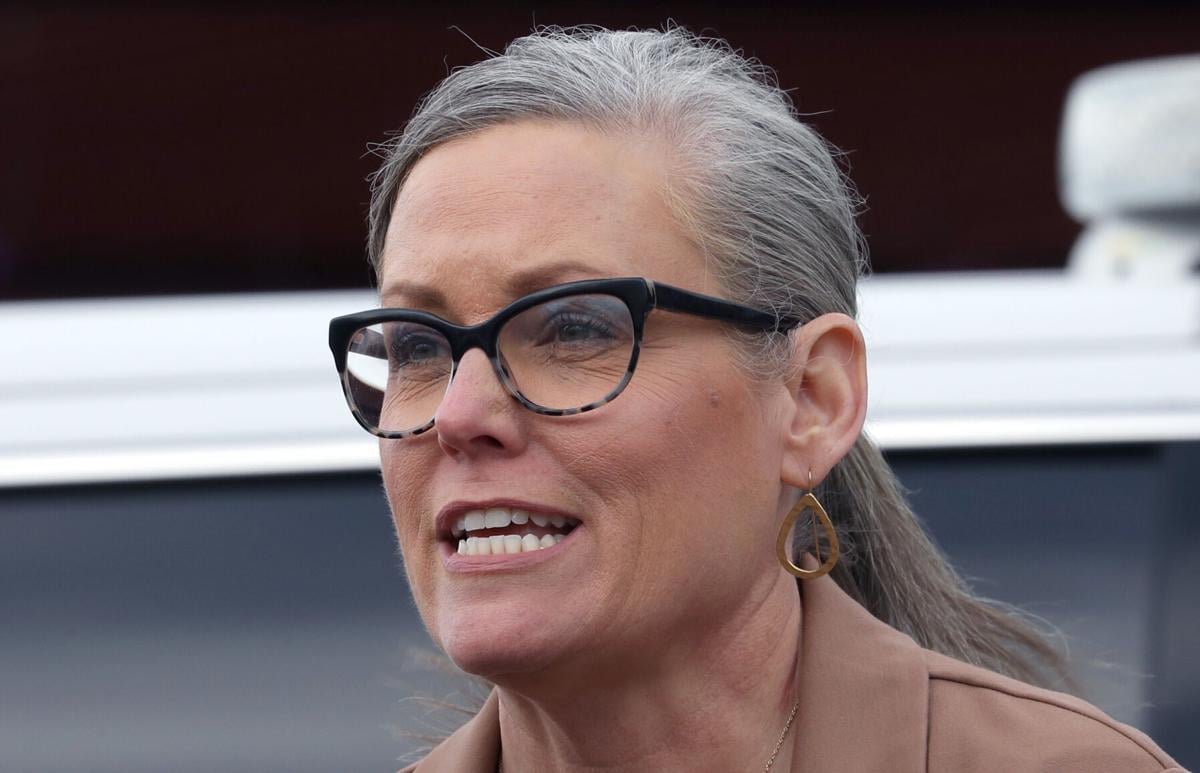
Gov. Katie Hobbs says she’s reviewing whether changes in state law could give her the authority to decide who can lease state lands and what activities can take place there.
In a wide-ranging interview after the legislative session ended Monday, Hobbs acknowledged that statutes generally require state trust lands to be managed to obtain their “highest and best use’’ and maximize their return to the state and the beneficiaries of the trust, mainly public education.
It was that requirement that resulted in the Fondomonte company being able to lease more than 6,000 acres and pump the water beneath it to grow alfalfa in western Arizona to feed dairy cows in Saudi Arabia. That country bans such farming because of its water use.
The lease has generated nationwide publicity and calls for Arizona officials to cancel it.
Hobbs said the issue isn’t that simple — or that discrete.
“Fondomonte is where all the eyes are,’’ she said. But she noted the company is not the only one growing crops on state land.
“It would be treating one leaseholder differently than others’’ to pull the one lease, Hobbs said.
There’s also a separate question: Can the state refuse to lease land for growing alfalfa for export when it also leases land for other crops, such as vegetables, that are shipped out of Arizona and, sometimes, out of the country?
“That’s a really valid question,’’ the Democratic governor said. “We can’t just unilaterally yank one lease because we don’t like that alfalfa’s going to Saudi Arabia.’’
The state was able, in April, to revoke a pair of well-drilling permits it issued last year to Fondomonte.
But that was based on a technicality that the company’s approval to make improvements on state land had expired. It does not bar Fondomonte from continuing to pump water from the wells it already has.
A related issue is that some of this farming — including by Fondomonte — is done on privately owned land where gaps in state laws limit the ability to restrict how much groundwater the owners can pump. All that makes the questions raised even more complex, Hobbs noted.
“If you look at curtailing farming in the Yuma region, that’s a huge food security issue for Arizonans and for a lot of Americans especially during the winter months,’’ she said. The area is estimated to produce 90% of the nation’s leafy green vegetables during the winter.
Even alfalfa could be considered part of “food security,” Hobbs acknowledged.
“We grow a lot of cattle here,’’ she said.
Another question is whether there is sufficient water for population growth.
That is addressed somewhat in urban “active management areas’’ where developers need to show access to a 100-year assured supply of water. Also, the state is not issuing building permits in some areas of Maricopa County that cannot meet that goal.
Rural areas, however, generally are unregulated. Hobbs said there is no simple and uniform fix.
“I don’t think the limits that would work for, say, Mohave County, are the same limits that would work in Cochise,’’ she said. “And there should be that local aspect to it.’’
That played out earlier this year when voters in Cochise County agreed to establish an active management area and state regulation of groundwater use in the Douglas Basin. A similar plan was rejected by residents of the Willcox Basin.
The Colorado River is vanishing before our eyes. The nation's two largest reservoirs are at dangerously low levels. This was one of them, Lake Mead, In 2001 and then in 2015. In just fourteen years, the lake dropped 143 feet and fires are devastating forests and homes from Oregon to Arizona.2022 has been a year of drought, but officials say the west has actually been in a megadrought since the year 2000.Why is it so dry out west? Should we blame climate change? And most importantly for the 79 million Americans that live in the U.S. West: Is this the new normal? Scientists have answered these questions by studying the silent witnesses to climate's annual fluctuations in trees. Fat rings usually mean wet years, thin rings mean dry years. Ancient trees have revealed that the West has suffered periods of drought for centuries, long before giant dams or human-caused climate change.But in February scientists wrote a paper in the journal Nature Climate Change putting the ongoing megadrought in historical perspective. SEE MORE: Weather Helping, But Threat From Western Fires PersistsThey found drought conditions in the west haven't been this severe in at least 1200 years. One driver of this megadrought is high temperatures. The blue line indicates the average temperature since 1895. Meanwhile, since 2000, the west has had mostly low precipitation. Notably, there's a shortage of snow. Snowpack is more valuable than rain, say scientists, since it moistens soils for months into the summer as it steadily melts.Robert Davies is an associate professor at Utah State University. "The snowpack is definitely declining over the last 40 years, particularly in the lower and mid elevations," said Davies. There's another factor, what scientists call vapor pressure deficit, or more simply, dry air. Over the last 22 years, the dry air has grown thirstier and thirstier, sucking moisture right out of the ground. As the drought has worsened, municipalities have desperately tapped their wells for water, but that's putting the system at severe risk. For example, in California's Central Valley, government data shows that groundwater is getting deeper and deeper to access. So how much of the blame can we pin on climate change? For the Nature paper, the scientists did two experiments using 29 climate models. In one they measured how a warming planet had exacerbated the megadrought. On the other, they simulated what soil moisture would be like if climate change had never happened. The warming planet, they found, made the drought worse by 19%. A few years of better snow and rain could break the western megadrought, the report says. But its authors expect the U.S. west's climate to become more and more arid. In the report it says the "increasingly dry baseline state" makes "future megadroughts increasingly likely" which will change the west for generations to come.

