


The decades-long effort to restore wolves to the wilds of Arizona and New Mexico could come to an abrupt halt under federal legislation sponsored by Rep. Paul Gosar.
On Thursday, the House Committee on Natural Resources advanced Gosar’s “Enhancing Safety for Animals Act,” which would remove the Mexican gray wolf from the endangered species list, despite population numbers still well below the recovery threshold set by the U.S. Fish and Wildlife Service.
The Arizona Republican introduced the measure in June and argued for its passage during Thursday’s hearing of the GOP-led committee. Gosar said it’s ranchers and their livestock that need protection, not wolves.
“In plain terms, the species is no longer on the brink of extinction,” he told his fellow committee members. “The people of Arizona and New Mexico have done their part. The wolf has been recovered. It’s time for Washington to do its part and admit that reality.”

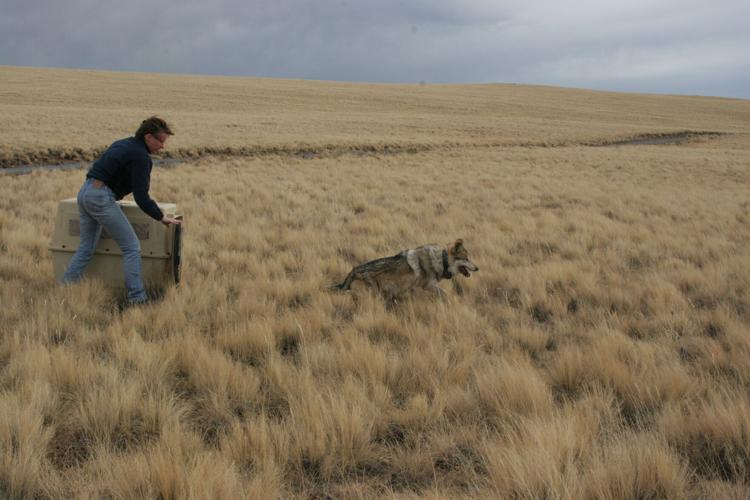
A Mexican wolf is released back into the wild with a radio collar on April 12, 2022. A bill from U.S. Rep. Paul Gosar, R-Arizona, seeks to remove the subspecies from the endangered species list although federal recovery goals for Mexican wolves haven't been met.
The Mexican subspecies of gray wolf was listed as endangered in 1976, after a century-long, government-sponsored, predator-eradication campaign that all but wiped it out in the southwestern United States.
In 1998, wildlife managers began releasing captive-bred wolves across eastern Arizona and western New Mexico, as part of a cooperative reintroduction effort among nine federal, state and tribal agencies.

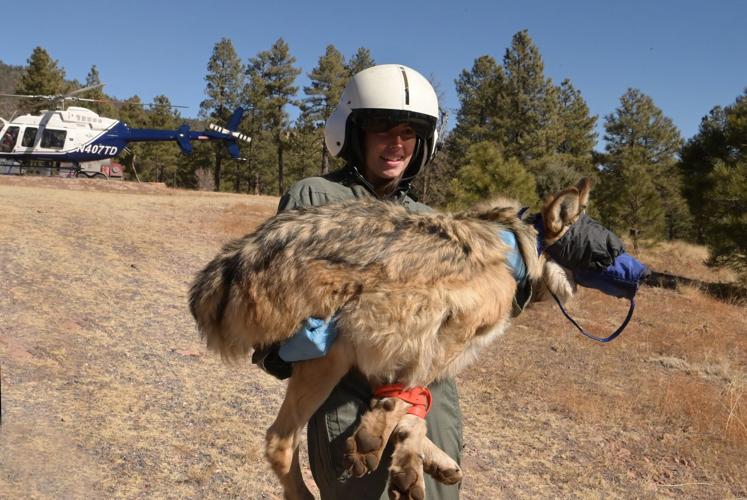
A sedated Mexican wolf is carried from a helicopter after being captured on Jan. 31, 2025. The endangered animal was given a health check and fitted with a tracking collar before being released in the same area where it was caught.
There are now at least 286 wolves roaming the two states in about 60 distinct packs, according to estimates released last March after the ninth straight year of population growth.
Another 350 animals currently live in captivity at facilities throughout the U.S. and Mexico as part of a binational breeding program designed to save the gray wolf subspecies.
To qualify for delisting under the current Fish and Wildlife Service recovery plan, the wild population of Mexican wolves must average at least 320 in the U.S. and 200 in Mexico over an eight-year span, while maintaining benchmark levels of genetic diversity. According to the agency’s own estimates, it could take up to 35 years and cost more than $200 million to reach those recovery goals.
Gosar accused federal wildlife officials of moving the goalposts for delisting and relying too heavily on a faltering wolf recovery program in Mexico that is largely out of their control. “U.S. landowners should not be held hostage to decisions made outside of their borders,” he said.
His bill passed out of committee with overwhelming support from Republicans and over the objections of Democrats.
Rep. Adelita Grijalva called the Mexican wolf reintroduction program “a conservation success story in progress, not yet complete.”
“We cannot legislate a recovery into existence when the biological reality does not support it,” said the Tucson Democrat, now serving on the committee her father, Raúl Grijalva, once chaired.
Rep. Jared Huffman of California, the ranking Democrat on Natural Resources, added that the protection of endangered species should be left up to science and the expertise of wildlife managers, not decided by partisans in Congress.
“I’m not here to say I oppose delisting, but I certainly oppose political delisting,” Huffman said. “Follow the recovery plan. Let the Fish and Wildlife Service do its job.”
To that end, Grijalva tried to head off Gosar’s bill with an amendment that would have replaced the delisting language with a directive to review and improve the federal programs that compensate ranchers for wolf attacks on livestock. “If the system is broken, let’s fix the system, not create a workaround,” she said.
Republicans on the committee struck down the amendment in a strict party-line vote during Thursday's hearing.
Conservationists are blasting the push to strip protections for the Mexican wolf before recovery goals are met.

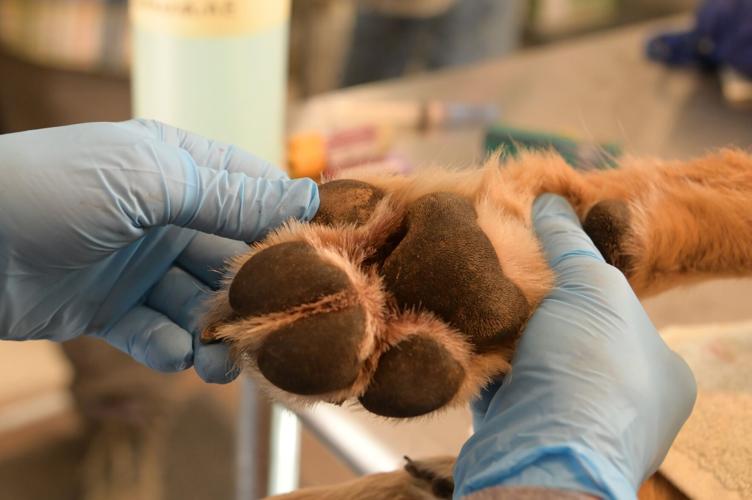
The paw of a sedated Mexican wolf is examined on Jan. 31, 2025.
Stephanie Kurose, deputy director of government affairs for the Tucson-based Center for Biological Diversity, accused Gosar and his fellow Republicans on the committee of “rubber-stamping extinction for one of America’s most iconic animals.”
Greta Anderson, the Tucson-based deputy director of Western Watersheds Project, called it “political theater” aimed at undermining the Endangered Species Act as a whole.
“This is the wishlist of the cattle industry, and Gosar just slapped it into the bill,” Anderson said. “It’s like red meat for his base.”
She added that the move comes amid a flurry of bills in the Arizona Legislature aimed at limiting future wolf releases in the state and allowing wolves to be killed in defense of property or hunted for sport. Such laws, if passed, are likely to run afoul of federal statutes governing Mexican wolves, leading to costly litigation the state is likely to lose, Anderson said.
She does agree with Gosar about one thing: While she supports wolf conservation in Mexico, she doesn’t think the recovery goals in the U.S. should be tied so closely to what happens south of the border.
Unlike the eight-term congressman, though, Anderson wants to see more wolves introduced over a wider swath of the American Southwest.
The best way to get the subspecies off the endangered species list, she said, is to establish several, self-sustaining populations in different areas, then give them the freedom and protection they need to move and mix across the entirety of their native landscape.

