


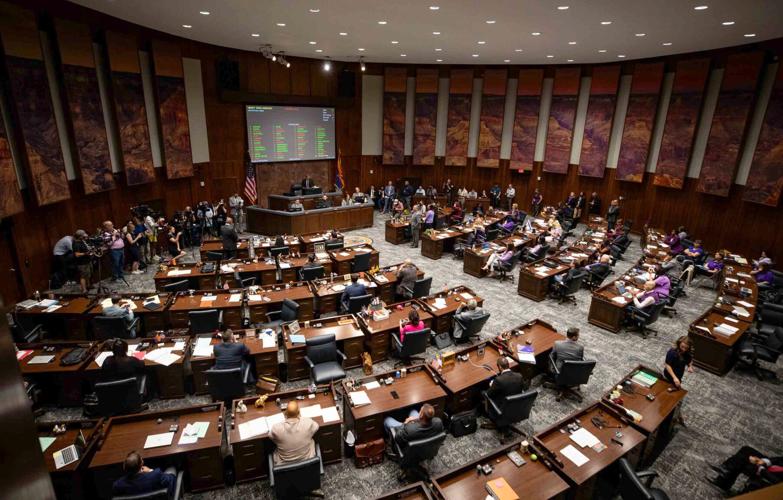
PHOENIX — The state House voted Wednesday to repeal the 1864 law that outlaws abortions except to save the life of the mother.
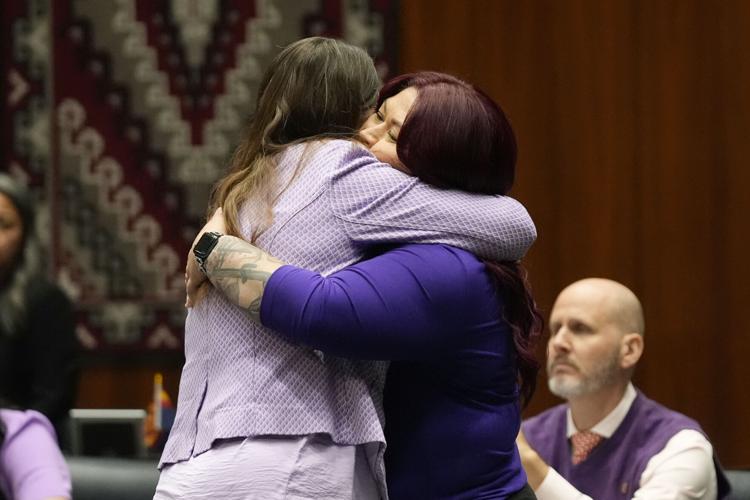
The 32-28 vote included three Republicans — Tim Dunn of Yuma, and Matt Gress and Justin Wilmeth of Phoenix — voting with all the Democrats for the repeal.
That sends the measure to the Republican-controlled Senate, where a preliminary vote last week shows there appear to be enough votes to approve identical language. The repeal would then go to Democratic Gov. Katie Hobbs who has said she will sign it.
Wednesday’s vote in the GOP-controlled House came after heated opposition from most Republicans, with foes of the repeal describing abortion as “barbaric,’’ comparing it to slavery, and linking it to attempts by eugenicists to control the Black population.
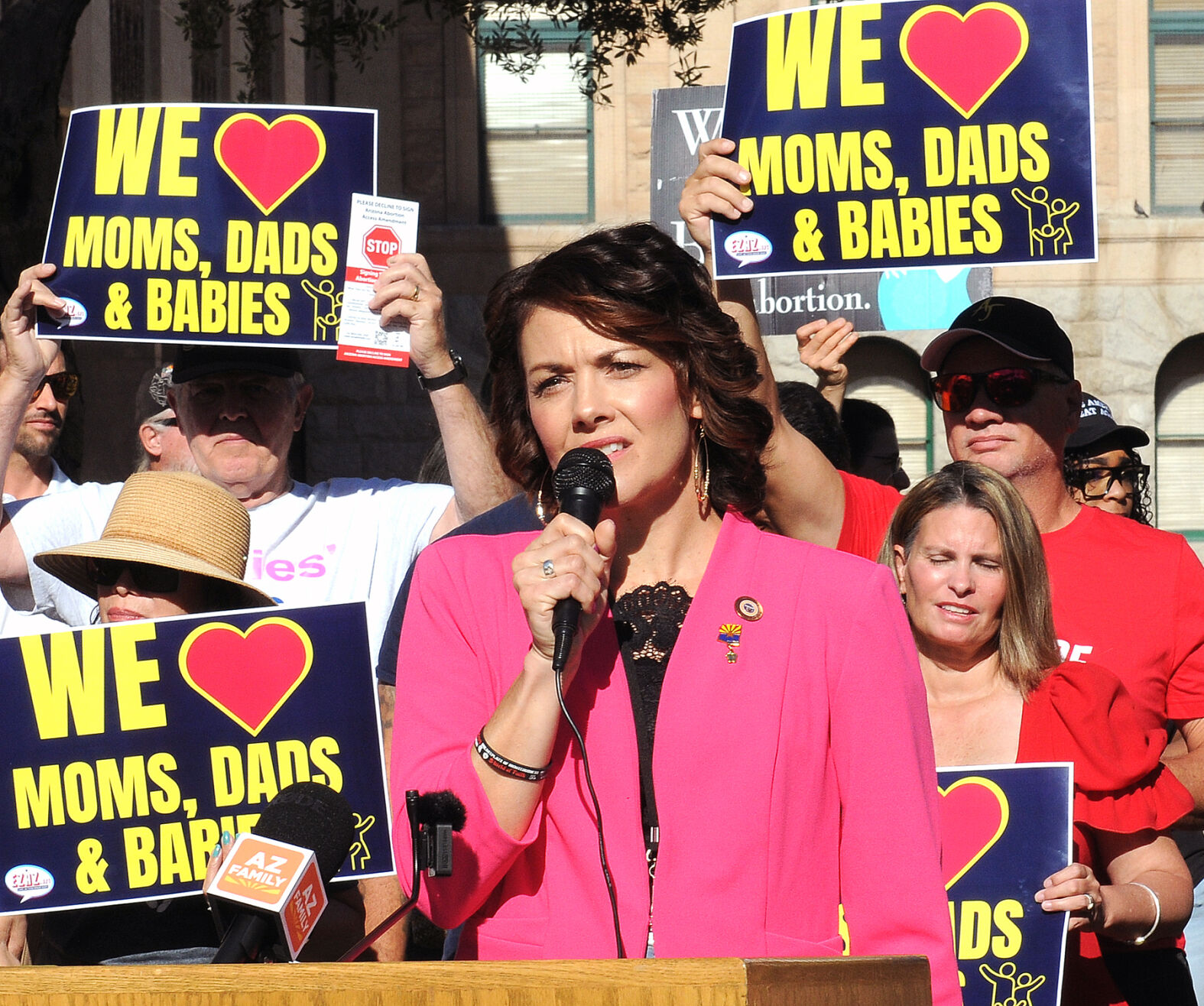
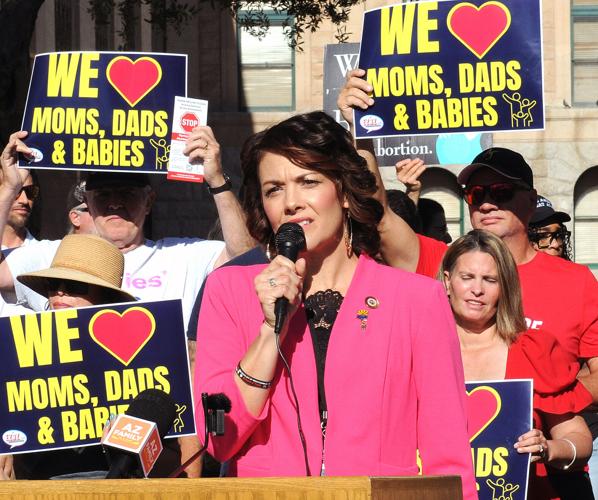
“We believe you need to make a choice before you have unprotected sex,” Tucson Republican Rep. Rachel Jones said during a rally Wednesday at the state Capitol against repealing the state’s ban on most abortions.
Supporters of repeal, meanwhile, who were beaten back in prior efforts in the past two weeks, pretty much stayed silent on Wednesday once they were sure they had the votes.
Even with Hobbs’ signature, the repeal would not take effect until 91 days after the Legislature’s 2024 session ends. At the current rate of progress at the Capitol, that could mean an effective date of August — or later.
That’s critical because court rulings allow enforcement of the 1864 law to begin on June 8.
Hobbs has issued an executive order stripping all 15 county attorneys of their authority to prosecute any law dealing with abortion, giving that power to Democratic Attorney General Kris Mayes. Mayes, in turn, has said she doesn’t intend to bring such charges against anyone.
Arizona House advances a repeal of the state's near-total abortion ban to the Senate
But it remains an open question whether that executive order is enforceable or whether, beginning that date, doctors could face liability under the law, which says anyone performing an abortion can be sentenced to up to five years in prison.
“My office continues to look at every legal option available to prevent that from ever happening,’’ Mayes said in a statement following the vote.
House speaker remains a hurdle
One possible hurdle remains for the repeal — even assuming Senate approval.
Under normal circumstances, it would be up to House Speaker Ben Toma to send the final version to Hobbs. But Toma, who voted against it and said life begins at conception, refused to commit to sending the final measure to the governor.
“I’m not guaranteeing nothing,’’ said Toma, a Peoria Republican.
If he refuses, that sets the stage for another fight next week, though it appears the votes would be there to force his hand.
Wednesday’s action stems from actions of the U.S. Supreme Court.
In 1973 the justices ruled in Roe v. Wade that women had a constitutional right to terminate a pregnancy. That allowed abortions through fetal viability, generally considered to be between 22 and 24 weeks, though there have been exceptions for the procedure beyond that.
But the high court overturned Roe in 2022, returning decisions to each state to make.
Arizona had never repealed its territorial-era law, even after the 1973 ruling Roe ruling that made it moot.
Earlier this month the Arizona Supreme Court ruled the old law not only remains enforceable but trumps a 2022 state law that permitted abortions until 15 weeks. The majority of the justices found that the 2022 law specifically said it was not overriding the older law.
If and when Hobbs signs the repeal, that will leave the 15-week law as the only one on the books when it takes effect later this year.
Republican split
Gress and Wilmeth have said many of their constituents do not support the 1864 law. But they also face a political reality: Both are in districts where voters have shown they are as likely to elect a Democrat as a Republican.
Rep. Alexander Kolodin, R-Scottsdale, lashed out at Republicans who appeared to be concerned about losing their 2024 elections if they back the old law.
“We’re talking about killing infants,’’ he said. “Let’s think about that. We’re willing to kill infants in order to win an election.’’
During Wednesday’s debate, multiple foes made it clear that, at 15 weeks or otherwise, they do not want abortions allowed in Arizona.
“Abortion is barbaric,’’ said Rep. Jacqueline Parker, R-Mesa. “It is akin to slavery. It is establishing a baby is mere property that can be disposed of as the property owner sees fit.’’
About half of all abortions are a surgical procedure, said Rep. Rachel Jones, R-Tucson.
And Rep. David Marshall, R-Snowflake, who is Black, said there is a disparity among races. He cited a decade-old report to Congress by the Centers for Disease Control which said Black women make up 14% of the child-bearing population “yet obtained 36.2% of reported abortions.’’
“Blacks have been unwitting victims of a hidden racist agenda of those behind abortion and birth control organizations because they believe they were receiving a new civil rights choice,’’ he said.
Hobbs put out a statement claiming credit for the repeal vote, saying lawmakers heeded the call she made in her State of the State speech in January to repeal the law.
What the governor did not say, though, is that Rep. Stephanie Stahl Hamilton, D-Tucson, had introduced the same repeal measure for years, including before Hobbs took office in 2023.
In each of these years, Stahl Hamilton could not even get a hearing. The same was true this legislative session.
But the Arizona Supreme Court decision declaring the 1864 law could again be enforced enabled her and other abortion rights advocates to get the support from a handful of Republicans to finally force a roll-call vote over the objections of foes, who used multiple procedural maneuvers for weeks to try to stop that from happening.
Political fallout
On Wednesday, Kolodin wanted to add an amendment to say that if Arizona is to allow abortions up to 15 weeks there also needs to be a private right of action. That would allow any Arizonan to file a complaint against any doctor who performed an abortion beyond that point if prosecutors did not.
Kolodin said that is necessary because of Hobbs’ executive order and Mayes’ promise not to bring charges in any case of abortion, even after that 15-week period. But he could not get the votes for his plan, paving the way for the final 32-28 vote for simple repeal.
Toma made it clear he was not happy with having his position on abortion overridden by a majority of House members.
He immediately removed Gress from his position on the House Appropriations Committee, as it was Gress who made the motion Wednesday to bring HB 2677 to the floor for a vote despite the fact it never went through he regular committee process.
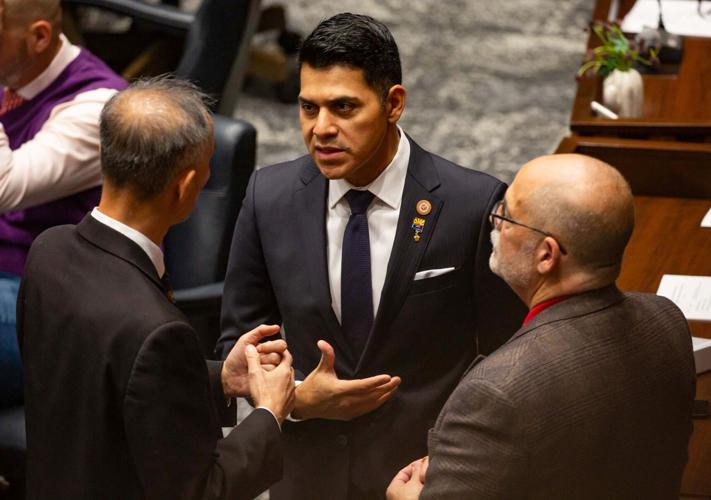
And Rep. Oscar De Los Santos, D-Laveen, who seconded that motion, also was stripped of his assignments to both the Appropriations and Rules committees.
“Because I decided it,’’ Toma said when asked why. As to whether it was a punishment, he said: “I’m not answering that.’’
Ballot alternatives
Even if the repeal is signed into law, that won’t end the debate in the Republican-controlled Legislature.
The Rules Committee on Wednesday agreed to allow House GOP leaders to introduce three new ballot proposals even though the deadline for that passed months earlier.
Toma said there is no specific plan. But he already circulated proposals by House Republican staff to put alternatives on the November ballot to an initiative that, if approved by voters, would place a right to abortion in the Arizona Constitution.
The initiative, which backers say already has more signatures than required, would allow abortion for any reason up until fetal viability. It also would permit the procedure beyond that point in cases of preserving the life or the mental or physical health of the mother.
Among the GOP alternative proposals, one would ban abortions at six weeks of pregnancy.
Proponents have made it clear the goal is not necessarily a more restrictive law than the initiative would allow but instead to provide multiple options on the ballot, which could dilute voter support for the initiative.
California measure
The gap between the effective date of the Supreme Court ruling allowing the old law to take effect and when a bill signed by Hobbs could become law already resulted in a proposal to be introduced Thursday in the California Legislature.
A spokesman for Democratic Gov. Gavin Newsom said SB 233 would temporarily allow licensed Arizona doctors to provide abortion and related care to patients traveling to California trough Nov. 30.
Under that measure, the Arizona doctors would be under the oversight of either California’s Medical Board or Osteopathic Medical Board and would be required to provide registration information to those boards. The bill also is written with a provision to take immediate effect when Newsom signs it.
Shouts of ‘Shame! Shame!’ during abortion fight in Arizona House in Phoenix, Arizona on April 10, 2024 Shouts of ‘Shame! Shame!’ during abortion fight in Arizona House in Phoenix, Arizona on April 10, 2024 Credit: Arizona State Rep. Analise Ortiz via The Associated Press Credit: Arizona State Rep. Analise Ortiz via The Associated Press

