

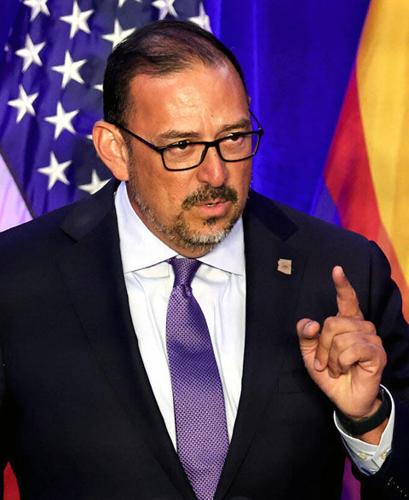
PHOENIX — The Trump administration has filed suit against Arizona Secretary of State Adrian Fontes for declining to hand over voter registration and election records.
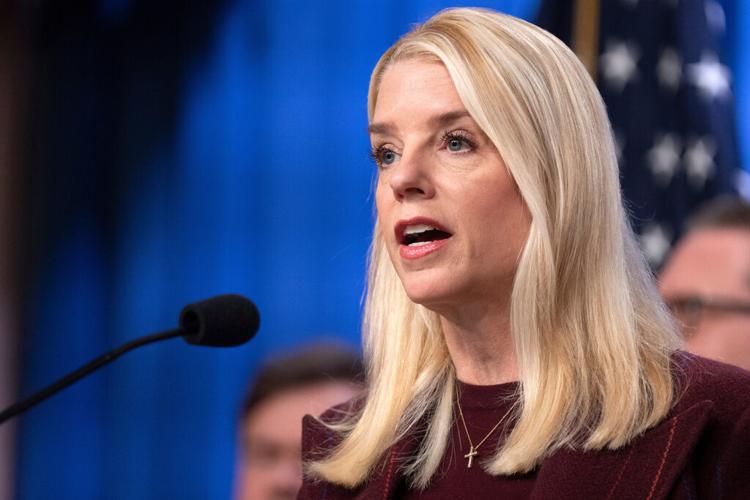
U.S. Attorney General Pam Bondi says it's to make sure voter rolls are accurate, but Fontes says her office is demanding sensitive personal information about Arizona voters.
Legal papers filed Tuesday in federal court by the Attorney General's Office contend Bondi's office has authority to enforce various federal election statutes, including a requirement that state officials conduct "list maintenance'' to keep voter registration lists current and accurate.
The office sent a letter to Fontes asking him to send various records and information, encrypted, to the Department of Justice, said Bondi's assistant attorney general in charge of the civil rights division, Harmeet Dhillon.

Attorney General Pam Bondi
The statewide voter registration list is specifically included. Dhillon said that includes everything in it, including a registrant's full name, date of birth, residential address, and the person's state driver's license number or last four digits of their Social Security number.
Fontes refused, citing state and federal privacy laws he contends prohibit him from producing everything that the Attorney General's Office is seeking.
Now Dhillon is asking U.S. District Court Judge Susan Bolton in Phoenix to declare Fontes' refusal violates the federal Civil Rights Act. She wants the judge to order him to produce all information she has demanded within five days of any court order.
Fontes: 'I'm willing to go to jail'
It was just a matter of time before Arizona, and Democratic elected official Fontes, found themselves in Bondi's crosshairs on the issue.
"The Department of Justice has now sued 23 states for failing to provide voter roll data and will continue filing lawsuits to protect American elections,'' Bondi said in a written statement. More lawsuits will come, "to protect American elections," she said.
"Accurate voter rolls are the foundation of election integrity,'' Bondi said. "Any state that fails to meet this basic obligation of transparency can expect to see us in court.''
Fontes said he is prepared for the legal fight.
"I don't necessarily want to go to jail,'' he told Capitol Media Services. "But I'm willing to go to jail.''
To drive home the point, Fontes said he will tell Jesus Oeste, a top official at the U.S. Department of Justice who has been pushing the issue, what he has told others.

Fontes
"He can pound sand,'' the secretary of state said.
Bondi's news release claims the attorney general is "uniquely charged by Congress'' with the enforcement of laws including the National Voter Registration Act and the Help America Vote Act, which her office says were designed by Congress "to ensure that states have proper and effective voter registration and voter list maintenance programs.''
'Personal identifying information'
The legal papers also say the 1960 federal Civil Rights Act requires state and local officials to retain and preserve voter registration and related records for 22 months after any election. Dhillon argues that law spells out that, on demand of the attorney general, anyone with custody of those records must make them "available for inspection, reproduction, and copying'' by the attorney general or her representative.
"None of those things are true,'' Fontes countered. "In fact, both state and federal laws prevent me from releasing information that they're asking for.''
He said those laws include the federal Privacy Act of 1974, which generally limits agencies from sharing personal data without written consent, as well as various state privacy laws.
"There's personal identifying information in what they're asking for,'' he said.
For example, he said, there is data including complete dates of birth and Social Security numbers in what is being requested. That kind of information could subject Arizonans to identify fraud or theft, Fontes said.
"And we're not going to do that,'' he said. "Part of my job is to protect this sensitive information.''
Fontes said it would be one thing if all that is being demanded were already public records in Arizona voter rolls, such as names, addresses and party affiliations, information anyone can access.
"We'd give it to them,'' he said.
Tied up in all of this is the question of why the Trump administration wants the information.
Republican President Donald Trump has continued to argue, since losing in 2020, that there was cheating and fraud, although dozens of judges rejected those claims, and he has pressured Bondi to investigate that year's election.
There are also concerns that the Department of Justice may be sharing voter registration data with the Department of Homeland Security.
"I don't know what their actual motive is since it has shifted several times,'' Fontes said.
"If you look back through the correspondence, they've used a variety of different justifications for their request, which means either they are hiding their actual justification or they don't have a real justification,'' he said. "In either of those cases, they don't get the information. Tough!''
Fontes said he is not worried about the litigation.
"The request is unprecedented,'' he said. "And they will lose in court.''
New ruling in separate case
The lawsuit filed Tuesday by the DOJ came the same day a federal judge ruled in a separate case that a private foundation is entitled to pursue its demand for certain voter records from Fontes, at least for the time being.
In a new order, U.S. District Court Judge Michael Liburdi said the Public Interest Legal Foundation has cited sufficient reasons to need information in certain reports given to the state by the national Electronic Registration Information Center. He said that includes allowing the foundation to evaluate Arizona's compliance with its obligations under state and federal laws to maintain accurate voter registration lists.
Liburdi acknowledged that Fontes claims it is federal law — and not his own decision — that precludes disclosure.
But the judge said that, at least at this point, the foundation's lawsuit is focused on Fontes denying release of the records. Liburdi said whether disclosure would violate federal law is a question to be answered later, once arguments are presented, rather than being a reason for him to simply toss the case now and preclude the foundation from pursuing its claim against the secretary.
Fontes had no immediate response to that ruling.
The National Voter Registration Act (NVRA) is central to the case.
One provision directs states to administer voter-registration lists to ensure eligible voters remain registered while permitting removal, through specified methods, of those who have died or moved.
Liburdi said the act requires states to maintain for at least two years — and make available for public inspection — "all records concerning the implementation of programs and activities conducted for the purpose of ensuring the accuracy and currency of official lists of eligible voters,'' though there are "limited exceptions.''
More to the point here, the judge said the federal law "authorizes private enforcement of these requirements.''
One way Arizona seeks to maintain accurate records is through the Electronic Registration Information Center (ERIC) system. It makes reports to the states of voters who have died, for example.
But ERIC also furnishes "retraction reports'' after learning that voters were erroneously listed as deceased. It is those reports that the foundation wants, and Fontes has refused to provide.
Under legal precedents, Liburdi said, it takes more than a simple denial of information to sue for records under the NVRA. What's needed is a showing of a "concrete and particularized harm from governmental failures to disclose," he said.
At this point, the judge said the foundation, which bills itself as a non-partisan public interest organization, has met the minimal standards.
One provision of its lawsuit claims the refusal prevents it from evaluating whether Arizona is complying with federal list-maintenance obligations, including removing dead registrants from the rolls. The foundation also argues that not getting the requested records interferes with its ability to speak to and educate people about matters of public importance, "namely, erroneous disenfranchisement of voters and voter roll accuracy.''
"The foundation's alleged injuries bear a sufficient nexus to the NVRA's purposes,'' Liburdi wrote. "The statute aims to 'protect the integrity of the electoral process' and 'ensure that accurate and current voter registration rolls are maintained','' the judge continued. In this case, he said the "retraction reports'' being sought concern voters who may have been erroneously removed from the rolls.
That means the allegations themselves are sufficient to form the basis of a federal court lawsuit, Liburdi said. At this point, "whether the foundation can ultimately prove its claim'' is legally irrelevant, the judge said.

