

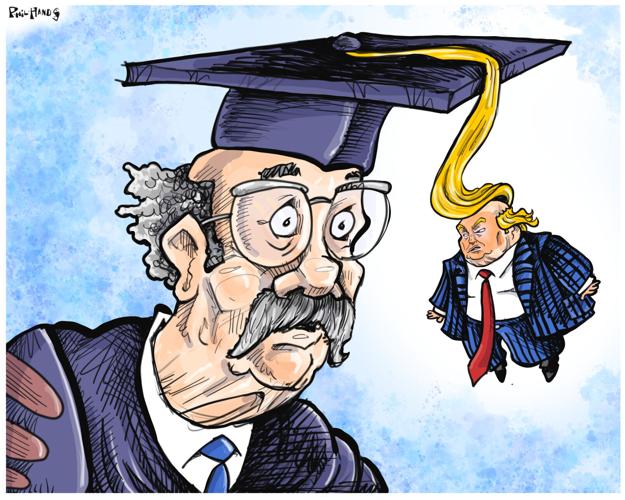

Among the many dangerous actions President Donald Trump has taken, his push to force some of the country’s best universities into signing a sweeping federal “compact” ranks just behind his pardons for the Jan. 6 insurrectionists.

James Rosen
The 10-part compact is a bizarre mix of bombast, authoritarianism and a few unremarkable ideas buried like pearls in a pile of dung.
The compact’s first sentence contradicts most of the 3,000-plus confused words that follow it: “American higher education is the envy of the world and represents a key strategic benefit for our nation.”
Combined with the subsequent laundry list of alleged faults, this is akin to a surgeon telling a patient: “You’re in perfect health — but we must operate immediately to save your life.”
The notion that universities should submit to federal dictates runs counter to the core of American higher education: open inquiry, freedom of thought and academic independence. Even if that weren’t true, the compact’s specific proposals would still warrant rejection.
Under the heading “Marketplace of Ideas & Civil Discourse,” the compact says signatories must commit “to transforming or abolishing institutional units that purposely punish, belittle and even spark violence against conservative ideas.”
The problem here is utter confusion over the meaning of “conservative ideas.” In April, Trump wrote on social media that the Smithsonian’s world-class museums in Washington focus too much on “how bad slavery was.” Is it now conservative orthodoxy that slavery wasn’t so bad?
Is it now conservative to send the military into our cities, and not just the National Guard but full-time troops such as the Marines he dispatched to Los Angeles? In his frequent broadsides about “an invasion” of immigrants, Trump might heed the warning of James Madison, the primary author of the Constitution and the nation’s fourth president: “The means of defense against foreign danger have been always the instruments of tyranny at home.”

American universities are at a crossroads.
Given Trump’s obsession with tariffs, should universities stop teaching that President Herbert Hoover’s imposition of them worsened the Great Depression? Or that unchecked financial greed fueled the 1929 crash?
Under “Equality in Education,” the compact bans any consideration, “explicitly or implicitly,” of race or sexual orientation in admissions. That goes further than the Supreme Court’s 2023 ruling, which ended direct affirmative action but allowed applicants to describe how such factors shaped them.

By threatening to withhold federal funding from universities that reject the compact, Trump overlooks that government support for academic research has yielded groundbreaking scientific, medical and technological breakthroughs. This innovation has made the U.S. the world’s preeminent power while improving the lives of people at home and abroad. From pacemakers and MRIs to the internet, university scientists and other researchers have created or developed some of our most impactful inventions.
Such funding isn’t a reward for compliance. It’s an investment in global leadership and innovation.
The Trump administration compact also poses national security risks. It could drive away international talent, creating a brain drain from our universities toward adversaries such as China.
In a letter to Education Secretary Linda McMahon, University of Southern California interim President Beong-Soo Kim wrote: “Other countries whose governments lack America’s commitment to freedom and democracy have shown how academic excellence can suffer when shifting external priorities tilt the research field away from free, meritocratic competition.”
History offers grim reminders: Universities in Nazi Germany and Stalinist Russia tried to placate dictators — and lost their autonomy anyway.
By Trump’s Oct. 20 deadline for feedback on the compact, seven of nine targeted schools had rejected it, with the University of Texas and Vanderbilt University the sole holdouts. MIT President Sally Kornbluth said it “would restrict freedom of expression and our independence as an institution.” Brown University President Christina H. Paxson wrote that it would “undermine the autonomy of Brown’s governance.”
Leaders of the acclaimed University of Virginia relied on its founder’s most cherished principles in rejecting the compact. As he planned the school near his Monticello estate in Charlottesville, Thomas Jefferson wrote that “this institution will be based on the illimitable freedom of the human mind, for here we are not afraid to follow truth wherever it may lead, nor to tolerate any error so long as reason is left free to combat it.”
For the government to dictate what universities can teach betrays conservatism and Jeffersonian ideals.

