


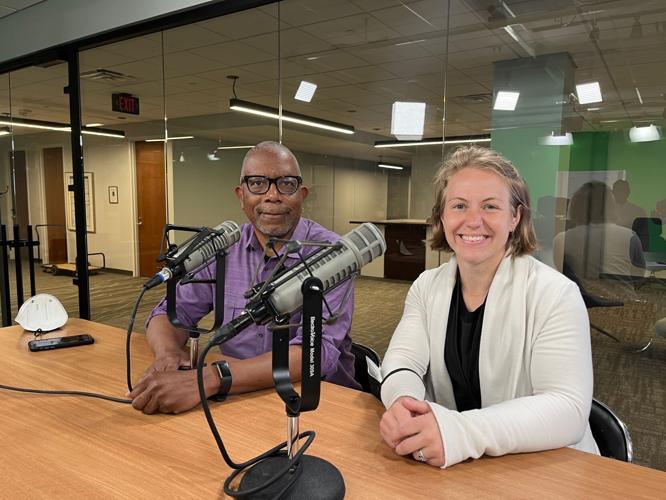
On the two year anniversary of George Floyd's murder, Kelli and Michael Paul catch up to talk about the civil unrest that took place in Richmond and across the country but also how so much of the world changed from that point. Since 2020, Confederate monuments have come down, conservatives have come to power in Virginia leading to things like critical race theory, banning divisive books and initiating teacher snitch lines. Kelli and Michael Paul cover it all in this episode of After the Monuments presented by Massey Cancer Center and supported by Team Henry Enterprises.
As a reporter from the former capital of the Confederacy prepared to depart for the former hub of German Nazism, insurrectionists stormed the U.S. Capitol.
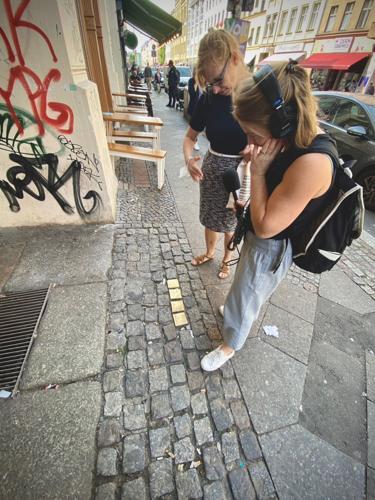
In January 2021, public radio reporter Mallory Noe-Payne was headed to Germany as a Fulbright Young Professional Journalist to compare and contrast how Germany and America confronted the sins of their past — Germany’s attempted extermination of Jewish people and America’s original sin of white supremacy.
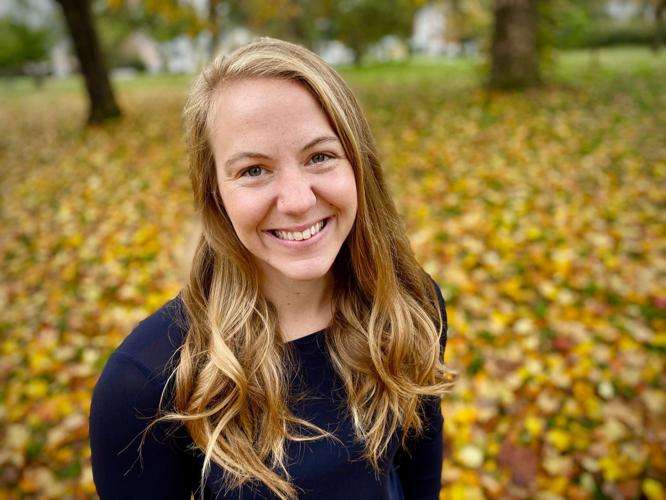
Seeing America in the midst of an apparent unraveling “made me feel like the task was more necessary,” Noe-Payne, the Richmond reporter for Radio IQ, said Tuesday, two days before the launch of “Memory Wars: A podcast exploring how society confronts sin.”
She had hoped helping people see historical sins from an outside perspective would lead Americans to confront their own complicity “because we can recognize when someone else has perpetrated evil better than we can recognize when we ourselves have,” she said before leaving for Germany.
“I bit off a lot,” she said Tuesday. “But I’m pleased with the fact it has all come together. I’m hopeful that people feel like they’ve learned something. I also hope it’s entertaining … that people just really want more, that they listen to it all.”
The five-part “Memory Wars,” featuring Noe-Payne’s interviews and in-depth reporting from her year in Germany, will have a new episode every other Thursday. “You can subscribe and listen along all summer,” Noe-Payne said.
I was delighted when she asked me to co-host the podcast as something of a sounding board. Two Richmonders who witnessed Virginia’s racial reckoning are observing its backlash and are looking for answers anywhere we can find them.
If Germany presented itself as a template in our nation’s journey from sin to redemption, history, as is often the case, was not quite as neat as imagined.
Germans, for one, resisted the prevailing narrative about the unabashed success of their reconstruction. As Noe-Payne put it: “There’s very little patting themselves on the back.”
“I was surprised by the depth of the challenges Germany faced and how many Germans are still convinced that they did not do a good job,” she said.
In hindsight, it was naïve to believe rebuilding a society after the horrors of the Holocaust would not be immensely challenging. “It’s just another example of how we simplify things we don’t understand outside of our borders,” she said.
Still, Germans seem to be earnestly engaged in the work, however difficult and incomplete. They are performing acts of reconciliation and, yes, reparations, that you’d be hard-pressed to find in America — all done with a humility America could learn from.
I was blown away by the extent in which American forces, during Germany’s post-war reconstruction, fed that nation a harsh dose of collective guilt. One example was posters, bearing images of dead bodies and concentration camps, with a message that translated into THESE ATROCITIES: YOUR FAULT.
The campaign was short-lived and, Germans would argue, ineffective. But, contextually, it was eye-opening.
Our nation’s Reconstruction after the Civil War caved as the nation prioritized the reconciliation of its white citizens over the lives of its new Black citizens. At the same time occupying U.S. forces were serving up guilt to Germans, Black Southerners remained under a reign of terror.
Whose fault was that?
Noe-Payne said this campaign was important to focus on because it demonstrated “Americans’ selective hearing to some extent — what we choose to turn a blind eye to and what we don’t.”
She remains haunted by her visit to the Dachau concentration camp and her time spent in a room designed expressly for killing. “And I stood in it and left feeling so nauseous” — but also with the knowledge that every German school child visits such sites.
She recalled childhood car trips up and down Route 5, between her Varina home and Williamsburg, passing the James River plantations that she would never visit. “Knowing that I had grown up in Virginia, never having that sort of same visceral reaction at a place of encounter, as part of my education ... I just felt it in such contradiction.”
If Virginia was once moving toward a more enlightened education, it has done a U-turn. Learning honest and accurate history, particularly about systemic racism, has become a bridge too far for some Republican politicians. Book banning is in vogue. Racism and antisemitism are ascendant.
“Feels like backward movement,” Noe-Payne said.
From the Lost Cause movement of the late 19th century to the current backlash of the 21st century, we are still fighting wars over memory — competing visions of a past that continues to inform and haunt our present.
Too often, America has felt it has little to learn from history and the rest of the world. Our perilous democracy illustrates the folly of myopia and amnesia. This is one war we can’t afford to lose.

