

The Star's longtime columnist checks in this week with the latest in Southern Arizona sports, including Khalil Tate's uphill climb to stay in the NFL, and the G League's future in basketball.
Less than a month after Dennis Polian was hired as Tulane’s director of football operations in 2005, Hurricane Katrina devastated the school’s campus and its football facilities.
Coaches, players and staff of Tulane’s football program had nowhere to play, train, eat, sleep or go to school. Every home game at the Superdome was canceled nine days before the season opener.
If you survive that in one piece — as Polian did, ultimately moving on to work in administrative roles for the Indianapolis Colts, Minnesota Vikings, Tennessee Titans and for Texas A&M’s football program — your experience at crisis management is valued.
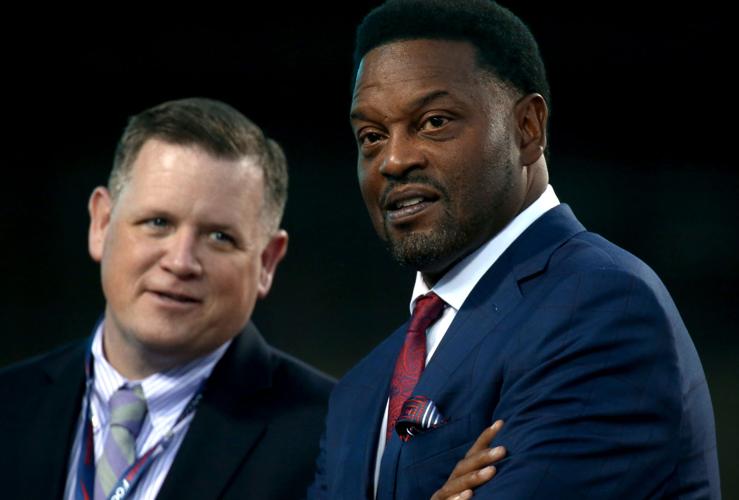
Polian is now the chief of staff of Arizona’s football program, an associate athletic director working with AD Dave Heeke and his chief operating officer, Derek van der Merwe, to steer the UA football program through the coronavirus pandemic.
“Hurricane Katrina was vastly different but in some ways eerily similar to what we’re going through now,” said Polian, in his second year at Arizona. “It taught me how you need to communicate and plan for different scenarios, hitting all the touch points from football to the emotional needs of all involved, and to make sure we’re on the same page with the administration.”
At Arizona, spring practice was canceled and about 100 players scattered to all parts of the map. No one knows with any certainty when and if college football will reopen.
“The difference between now and when I was at Tulane during Hurricane Katrina is that we now have greater connectivity, the technology to communicate more effectively,” said Polian. “At Tulane, it was difficult to get in touch with parents, friends, or even find out what happened to your dog after the hurricane.”
At Tulane, the Green Wave football program was forced to move 10 hours away to bunk at Jackson State in Mississippi. They later moved into a hotel in Dallas and then to an abandoned dormitory 300 miles away at Louisiana Tech. They played “home games” in the Louisiana cities of Shreveport, Ruston, Lafayette, Monroe, Baton Rouge and in Mobile, Alabama.
The Green Wave athletic department subsequently eliminated eight sports, although they were brought back in 2012.
“I remember it like yesterday,” said Polian. “I saw the worst of it.
“But now a lot of progress has been made; we are able to meet four days a week with the team in virtual (Zoom) meetings. On Thursday evening, we had a guest speaker, a motivational speaker, give the team a 12-minute speech. We think we’re maintaining relationships and connecting with our players in such a way that we can make those relationships better.”
Football players continue to receive academic tutoring sessions, participate in weekly grade checks, are assigned strength and conditioning programs, and are asked to reach out to two teammates per week in a team bonding program.
“Everybody’s in the same boat,” said Polian. “So let’s not spin our wheels.”
Fifteen years ago at Tulane, Polian’s Green Wave had their opening game moved from Sept. 4 to Sept. 17, but college football went on without stopping to pity Tulane. It was an enormous disadvantage, and it took a toll; the Green Wave, which had gone 18-18 the three previous seasons, finished 2-9. The coaching staff was fired a year later.
Now every FBS program faces the same obstacles.
Khalil Tate’s NFL opportunity isn’t overwhelming

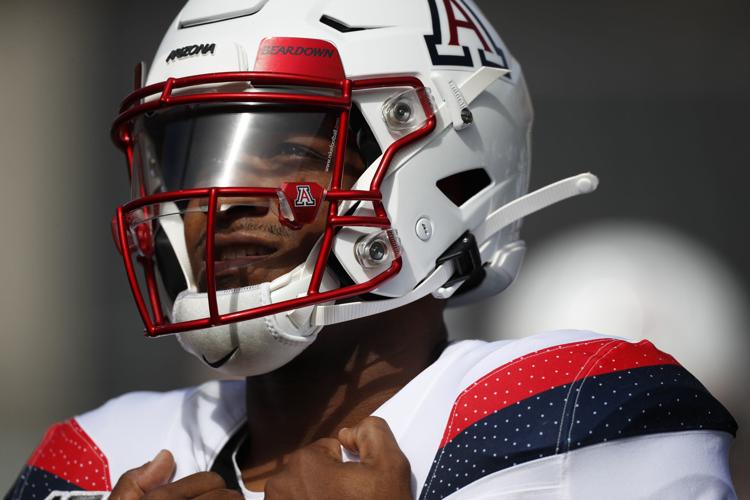
Khalil Tate would have a lot to learn about playing wide receiver, but he has the athleticism to play in the NFL.
Late in the 1987 NFL draft, Arizona’s three-year starting quarterback Alfred Jenkins received a call from the Washington Redskins informing him he was to be their eighth-round draft pick. There was a catch: the Redskins would be drafting the 6-foot 2-inch, 215-pound Jenkins as a tight end.
He balked. He told them he wasn’t interested. Jenkins, who led Arizona to consecutive seasons of 7-4, 8-3-1 and 9-3, insisted he was a quarterback.
After a conference with his agent, Jenkins changed his mind. He phoned the Redskins back and they drafted him in the ninth round, No. 248 overall, today’s equivalent of a seventh-round pick.
Jenkins was released before the NFL season began. He ultimately played briefly for the Canadian League’s Ottawa Rough Riders and the Arena League’s Dallas Texans.
Jenkins was a lot like Khalil Tate. He was a superior athlete, with size and speed, who was offered scholarships by hometown schools USC and UCLA to play defensive back, receiver or even linebacker. He insisted he was a quarterback — and he was a very good QB at Arizona.
Now comes Tate, who signed as a free agent with Philadelphia. Look at the Eagles roster. It is filled with experienced NFL receivers; the club also drafted three receivers. His chances of making the opening day roster are iffy.
But making an NFL team as an undrafted free agent has never been rare. Arizona has produced 23 modern era NFL players who were UDFAs, including multiyear starters such as linebacker Antonio Pierce, punter Josh Miller, defensive back Brandon Sanders, running back Mike Bell, safety Tony Bouie, lineman Van Tuinei and special team/situational regulars like Robert Golden, Ray Wells and Phil Freeman.
A lot of it depends on a UDFA’s perseverance, approach and mentality. Will Tate be coachable? Will he exhibit NFL-level toughness? Will he be a capable route-runner or someone who can run the jet sweep? Can he pluck the ball out of the air instead of catching it against his body? Can he be deployed in multiple ways?
Tate’s physical dimensions attracted the Eagles, which is step one. But remember this: Every NFL team last week signed about 20-25 free agents. That’s at least 600 men like Tate trying to beat the odds.
UCLA recruit bolts for G League in what could be a glimpse at the future
UCLA’s top incoming recruit, point guard Daishen Nix, decommitted from the Bruins last week to sign with the G League pathway program. That’s the new, best alternative for developing prospects like Nico Mannion, Josh Green and Zeke Nnaji to proceed after their AAU and high school basketball days. It’s a good option so that schools like Arizona don’t get caught in the one-and-done cycle that — as Tucsonans have witnessed — can diminish a program’s reputation and success.
The best local example of success comes from baseball, which allows high school seniors to turn pro. Sahuaro High School shortstop Sam Khalifa, the No. 7 overall draft pick in 1982, was the equivalent of a Nico Mannion. Sabino High School shortstop J.J. Hardy, the No. 56 overall selection in 2001, was at the level of an 18-year-old Josh Green. Canyon del Oro High School first baseman Chris Duncan, selected No. 45 overall in 1999, was valued the way Nnaji is today. Khalifa became an MLB starter at 21, Hardy at 22, Duncan at 24.
It should take Mannion, Green and Nnaji at least that long to become NBA starters, if they do at all. Baseball’s draft process has made so much sense for more than 40 years. If you don’t sign out of high school, you cannot enter pro baseball until you turn 21. Bingo.
Former Arizona DC returns to old stomping grounds

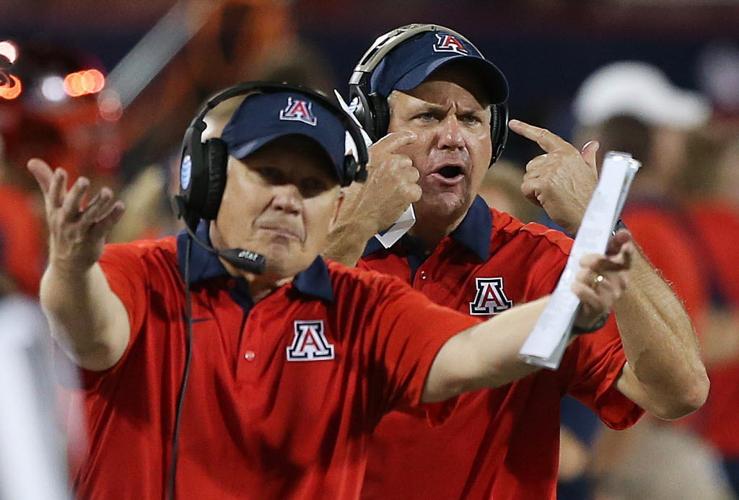
Arizona Wildcats head coach Rich Rodriguez, right, and defensive coordinator Jeff Casteel plead with the defense after a UCLA Bruins drive found the red zone during the fourth quarter of the No. 16 Arizona Wildcats vs. No. 9 UCLA Bruins college football game at Arizona Stadium in Tucson, Ariz. The Bruins won 56-30. Photo taken Saturday, Sept. 26, 2015. Mike Christy / Arizona Daily Star
Former Arizona defensive coordinator Jeff Casteel, 2012-16, has returned to West Virginia, where he built his career under Rich Rodriguez from 2001-07. Casteel is a defensive analyst; he was fired by Nevada after the 2019 season. His son, former Salpointe Catholic High School state championship linebacker Jake Casteel, who played at NAU, will begin the 2020 season as a grad assistant coach at Boise State. Currently, Boise State head coach Bryan Harsin is sitting out a two-week furlough to help with BSU’s athletic budget problems.
ASU men's hockey facility project 'full speed ahead' for November, per AD

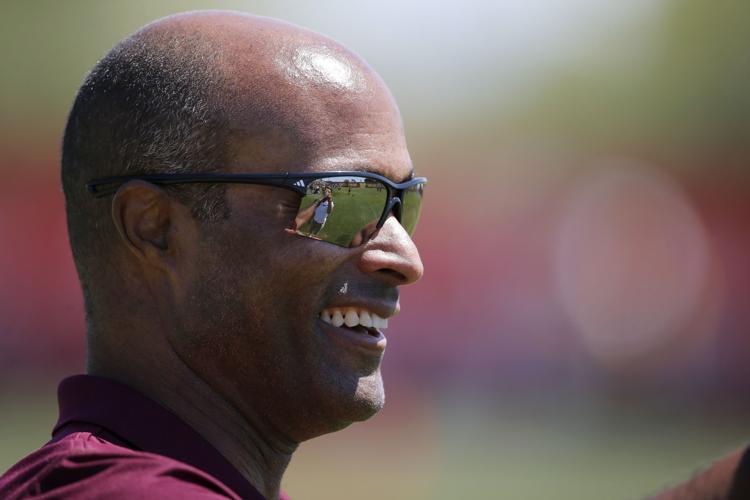
Arizona State's athletics director Ray Anderson smiles as he watches the Arizona State spring NCAA college football game Saturday, April 16, 2016, in Tempe, Ariz. (AP Photo/Ross D. Franklin)
Arizona State athletic director Ray Anderson has yet to announce if any of the Sun Devils’ highly-paid coaches will be given salary reductions or go on furlough. Oregon, OSU, Washington State, USC and Colorado have done so; Arizona announced significant pay cuts to its athletic department, but has not specified if Sean Miller and Kevin Sumlin are included.
Most schools have paused capital projects, but last week, ASU’s Anderson moved against the financial grain by saying that groundbreaking for a $120 million multipurpose arena — home to the ASU men’s hockey team — will go on as scheduled in November. “It’s a vital enough project for not just athletics but the university and community as a whole that it should be full speed ahead,” Anderson told The Arizona Republic. “It is designed to be a revenue producer beyond hockey because you’ll have concerts and other events in there. It’s a financial facility that makes sense.” Deficit spending in college sports strikes again.
Knight Commission recommendation could hurt Arizona Bowl, other games

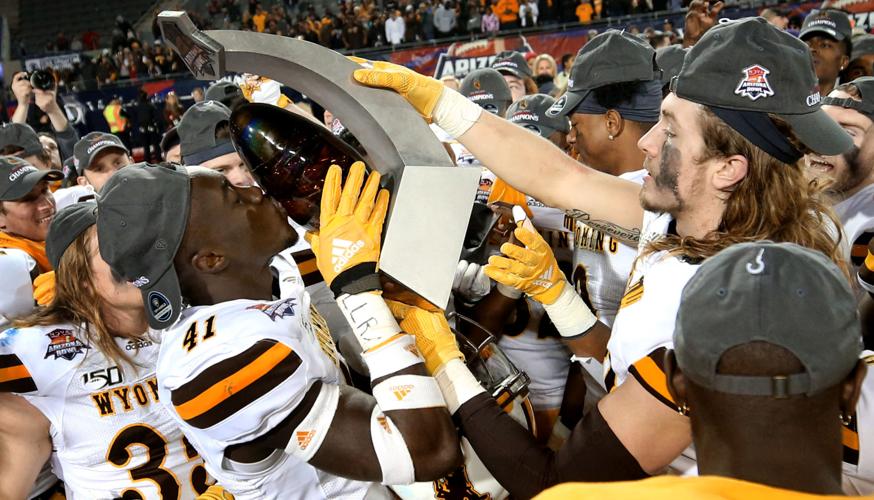
Wyoming defensive end Davon Wells-Ross gets to kiss the championship trophy after the Cowboys' 38-17 win against Georgia State in the Arizona Bowl, Arizona Stadium, December 31, 2019.
It’s inevitable that the Nova Home Loans Arizona Bowl will be affected by the uncertainty of the 2020 college football season. Last week the Knight Commission on Intercollegiate Athletics spoke against the practice of bowl teams being required to fulfill “ticket guarantees” that has been customary for every bowl game for decades.
Most bowl games require participating teams to guarantee purchase of 8,000 to 12,000 tickets. Knight Commission co-chair Carol Cartwright said “we urge the NCAA and its member FBS conferences to immediately address this issue with the 44 bowls slated for 2020 and in the future.” If adopted someday by the NCAA, it would likely financially cripple smaller games like the Arizona Bowl and reduce the number of bowl games from 44 to probably 15 or 20.
Local sports talk show gains another sports historian

Jay Gonzales
Former Star sportswriter Jay Gonzales has joined longtime Tucson Citizen sports reporter Steve Rivera as co-host of the “Eye on the Ball” sports talk show Monday through Friday at 6 p.m. on 1030-AM. The Gonzales-Rivera tandem immediately gives “Eye on the Ball” the most historical sports perspective on any Tucson sports talk show ever, covering four decades of sports talk in Tucson.
They are connected and knowledgeable. It’s one sports talk show that will be Tucson-centric without the seemingly endless chatter about LeBron James and NFL quarterbacks.
Mountain West faces financial struggles during coronavirus pandemic

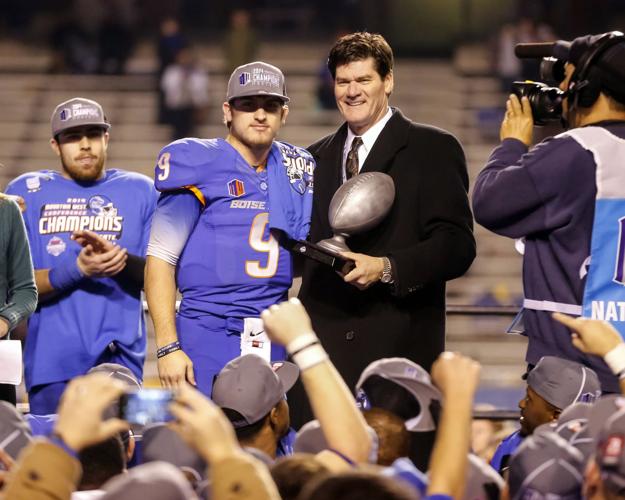
Boise State quarterback Grant Hedrick (9) receives the offensive MVP trophy from MWC Commissioner Craig Thompson after the Mountain West Conference championship NCAA college football game against Fresno State in Boise, Idaho, on Saturday, Dec. 6, 2014. Boise State won 28-14. (AP Photo/Otto Kitsinger)
Mountain West Conference commissioner Craig Thompson last week told reporters the MWC headquarters in Colorado Springs requires a rental agreement of $400,000 per year. By comparison, Pac-12 commissioner Larry Scott pays $6.9 million per year for the league’s downtown San Francisco plant, which covers 90,000 square feet.
“Lavish Larry,” so named by former Washington State AD Bill Moos, might not understand what Thompson is going through as the MWC faces significant financial problems.
“We have 10,000 square feet, 15 private offices, six or eight or 10 cubicles, a studio,” Thompson said. “Why do we need that coming back after the coronavirus issue? I think a lot of people are questioning that. Do we need to pay $400,000 a year for rent?” Hello, Larry? Are you listening?
My two cents: Pima College's newest signee has Wildcat lineage
A few days ago, Pima College men’s basketball coach Brian Peabody announced he has signed 6-foot 4-inch Quinn Atazhoon of Gallup High School in New Mexico to play for the Aztecs in 2020-21. It probably didn’t ring a bell.
Atazhoon is the son of former Arizona basketball player Cliff Johns, who made the UA’s 17-1 Pac-10 championship team of 1992-93 as a walk-on discovered at the UA Campus Rec center by assistant coach Jim Rosborough.
“I spoke to a Native American event at the rec center before the season and then watched a game or two,” Rosborough remembers. “Once I saw Cliff play I thought he could help us. He was a very good shooter. We got him to McKale, let him mix in during a few practices and saw right away he could contribute.”
Johns played in nine games for the Wildcats that year. He went on to earn his degree and become an architect. He moved back to northeast Arizona and ultimately became the head coach of Shiprock High School in New Mexico and, later, was an assistant coach on his son Quinn’s team at Gallup. Quinn, who grew up in Tucson, was a first-team all-state player in Class 4A, averaging 24 points per game, in New Mexico.
Johns is now the project manager for Fort Defiance Medical Center near Gallup.
Peabody will conduct a free basketball camp at the Navajo reservation’s spacious gymnasium, “The Rez,” and is planning to schedule a regular-season game there in the 2020-21 season.
Good move.
Arizona State’s women’s basketball team played a regular-season game against No. 4 Baylor at the Navajo Nation’s “Fighting Saints Events Center” in November of 2018 and drew 5,609 fans.

