


As Forrest Gump said, “Life is like a box of chocolates; you never know what you’re gonna get.”
And on any given Thursday (or Saturday), you never knew what you were getting when it came to Pac-12 basketball this season.
For the third time in five seasons, Oregon — led by head coach Dana Altman and star point guard Payton Pritchard — was crowned Pac-12 regular-season champion. That was almost expected: the Ducks were voted to finish first in the Pac-12 preseason poll.
Oregon was one of just two conference teams that finished exactly where it was supposed to according to preseason predictions. Washington State, which finished 11th, was the other.
The Ducks are the only team from the league ranked in the AP Top 25 heading into the Pac-12 Tournament, but the league’s depth and talent make it one of the toughest in the country. ESPN’s bracketologist Joe Lunardi projects the Pac-12 to earn seven bids in next week’s NCAA Tournament, with Arizona State, UCLA and Stanford among the last bubble teams in.
Lunardi isn’t the only analyst bullish on the Pac-12. Washington is ranked 55th in the NCAA Evaluation Tool (NET) rankings despite sitting in last place in the league. Arizona, the No. 5 seed in the Pac-12, ranks 14th nationally in NET rankings.
The Wildcats and Huskies will play Wednesday in the first round of the Pac-12 Tournament.
To sum up a chaotic year in the Pac-12, here are some superlatives:

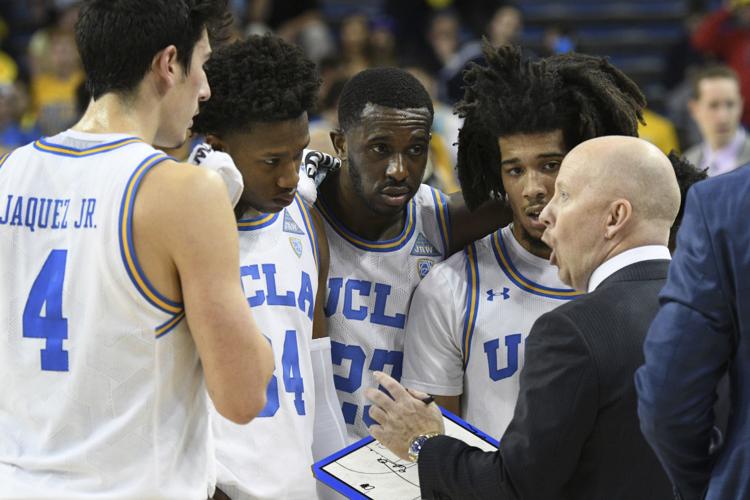
UCLA head coach Mick Cronin talks with, from left, Jaime Jaquez Jr., David Singleton, Prince Ali and Tyger Campbell.
Biggest surprise: UCLA
For two weeks, Stanford was the trending pick for the biggest surprise. Picked to finish 10th in the Pac-12, the Cardinal started conference play 4-0, but then won only one of its next eight games. No team in the Pac-12 climbed further than UCLA: First-year coach Mick Cronin implemented his defensive-minded style of play with Steve Alford’s players, and after a few ugly losses, the Bad News Bears got good. UCLA won seven of its final eight conference games, and finished second in the Pac-12.
Biggest disappointment: Washington
Mike Hopkins won Pac-12 Coach of the Year honors a year ago as Washington made the NCAA Tournament. The Huskies were predicted to finish third in the Pac-12, thanks in part to a stellar recruiting class headlined by five-star prospects Isaiah Stewart and Jaden McDaniels and the addition of Kentucky transfer Quade Green.
But Green was ruled academically ineligible for the season, and Washington struggled, losing nine straight at one point.
However, the Huskies won three of their final four games. Maybe UW becomes the dark horse in Las Vegas and adds another chapter to the wacky 2020 Pac-12 season?
Best coaching performance: Mick Cronin (UCLA)
Raise your hand if you thought a UCLA team with a 7-6 nonconference record would be in contention to win the Pac-12 regular-season title. Anybody? UCLA squeaked by Long Beach State (11-21) by four points in the season opener, lost to Hofstra by 10 at home and fell to Cal State Fullerton.
As the calendar flipped to January, however, Cronin and the Bruins had found their identity.
UCLA won nine out of its final 11 games and leap-frogged a number of teams, including UA, to second place in the Pac-12 standings. ASU’s Bobby Hurley was a close second for this pick, but considering the Bruins could be an NCAA Tournament team after the program climbed out of irrelevance three months ago, makes what Cronin did this season the best performance in the Pac-12.
Best freshman: Onyeka Okongwu (USC)
For those who struggle to pronounce his name, follow Bill Walton’s lead and just call him “Big O.” Okongwu entered the season as a projected top-10 pick in the NBA draft and will leave USC as a likely top-10 choice. The 6-foot-9-inch rim protector is in the top five of rebounds (8.6), blocks (2.7) and field goal percentage (61.6%) per game among other Pac-12 players. While Zeke Nnaji won Pac-12 Freshman of the Year, Okongwu displayed better statistics close to the basket.

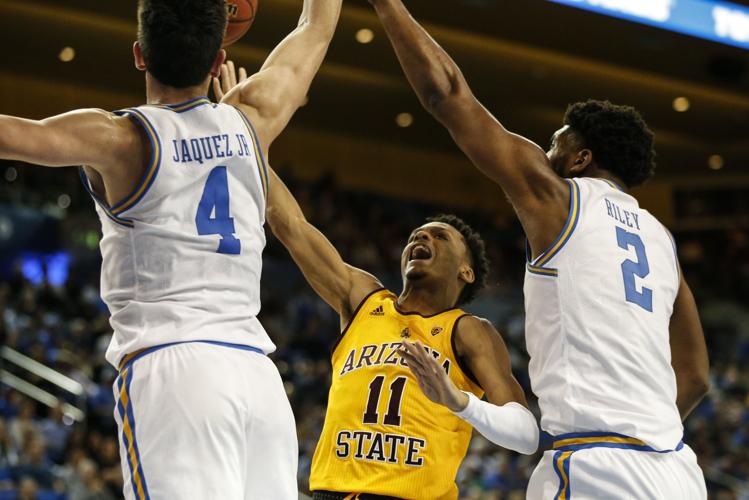
Arizona State guard Alonzo Verge (11) shoots between UCLA guard Jaime Jaquez Jr. (4) and UCLA forward Cody Riley (2) during an NCAA college basketball game Thursday, Feb. 27, 2020, in Los Angeles. (AP Photo/Ringo H.W. Chiu)
Breakout player: Alonzo Verge (ASU)
The legend of Alonzo Verge didn’t begin until Dec. 18, when he scored 43 points in a 40-point loss to St. Mary’s. Verge shot 18 of 29 from the field, including one 3-pointer and six free throws; the rest of his teammates combined to hit just five shots. Verge played his way into the rotation and molded into the ideal complimentary piece for Remy Martin. Verge is averaging 14.6 points, 3.5 rebounds and 2.3 assists per game. He also scored the go-ahead basket in a come-from-behind win over rival Arizona in Tempe.
Best performance: Payton Pritchard (Oregon) vs. Arizona
Oregon’s do-everything point guard was a Pac-12 Player of the Year favorite before the season even started, but ASU’s Martin snuck into the conversation after leading the Sun Devils to seven straight wins in February. Pritchard then stamped his application for the conference’s top player when he scored a career-high 38 points on 43%-shooting from 3-point range in an overtime win at Arizona. The Wildcats threw every perimeter defender they had at Pritchard — even Christian Koloko — but couldn’t stop the Oregon star from knocking down 3-pointers. Pritchard’s 38 points against Arizona were the most by a Duck since Luke Jackson in 2004.
Best player: Payton Pritchard (Oregon)
The Pac-12 Player of the Year is a prime example of what staying in school can do for basketball players. As a freshman in 2017, Pritchard was the point guard that orchestrated passes to then-Pac-12 Player of the Year Dillon Brooks, Jordan Bell, Tyler Dorsey and Chris Boucher.
Fast forward to 2020, Pritchard became Oregon’s career assists leader and is the only player in Pac-12 history to have over 1,500 career points, 600 assists and 500 rebounds. He’s also the best player on the best team in the Pac-12, and he just might be an All-American.

