


Only after he played for some of the best Arizona basketball teams in history, and began representing high-level athletes from all over the world, Jason Ranne said it sank in how good the talent level really was when the Wildcats reached the 2001 Final Four.
He did have an early clue, though.
After arriving as a freshman walk-on to Arizona’s 2000-01 Final Four team, which was scheduled to be honored Saturday at McKale Center during the UA-Oklahoma State game, Ranne lined up against Richard Jefferson in a preseason drill run by then-UA associate head coach Jim Rosborough.
“It was one-dribble pullups at the elbow, and the defender was supposed to stay in front and then get a hand up to sort of contest the shot," Ranne said. “Richard jumped, and his crotch was at my face. Contesting the shot was a little bit challenging.”
Ranne said Jefferson, who was coming off a foot injury that sidelined him for much of the previous season, wasn't even at his best then.
"He got so much better and better as he went the rest of his career," Ranne said. "It was a very clear wake-up call that all of these guys were at a very, very high level athletically. The program was really excellent.”
Jefferson became an NBA lottery pick the next spring, then played 17 seasons in the league and is now among the top broadcasters in the game. Also on that 2001 team: Four other NBA Draft picks, an undisputed floor leader who later became an overseas pro in Jason Gardner and capable role players.
Also, a head coach in Lute Olson, who was on his way to the Basketball Hall of Fame.
“In the moment, you know it's good,” Ranne said. “But you don't have the same appreciation for it that you do now, having seen a lot more teams and being around the business. The ability to amass that much talent and also have it work together to go achieve like that is hard. You don't see it much.
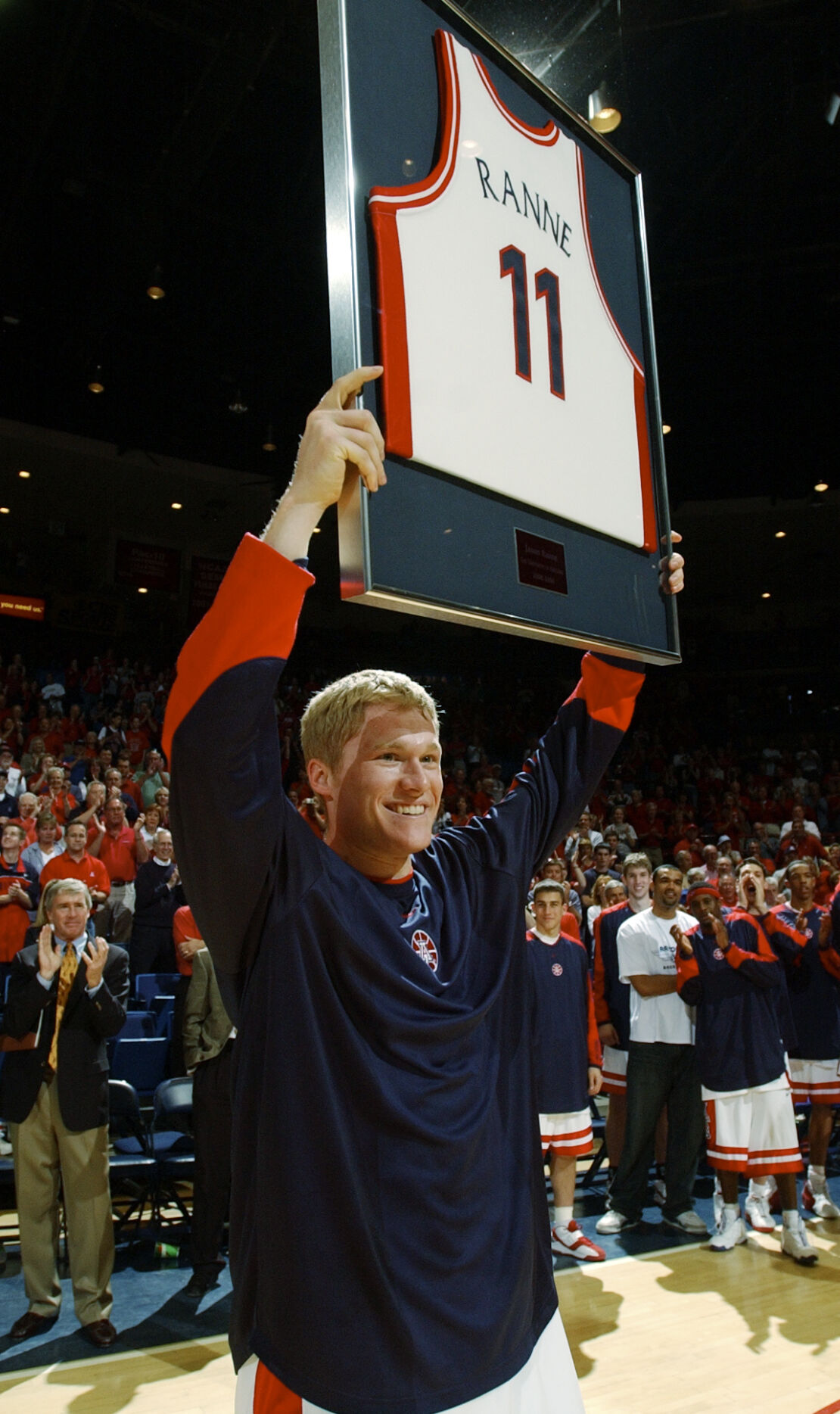
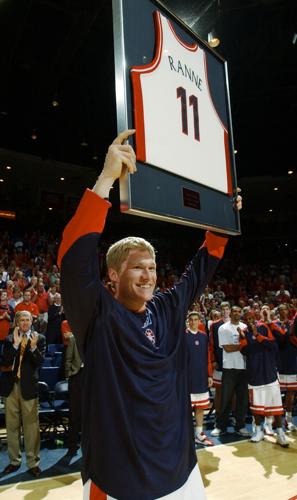
Arizona senior guard Jason Ranne holds up his framed jersey as he is recognized for his last home game with the team after their win against Arizona State University at McKale Center, March 7, 2004.
“I don't know if you'll ever see it again in college basketball, that kind of group. That Duke team and that Arizona team, it’s hard to replicate the amount of depth that both of those teams had.”
Duke wound up beating UA 82-72 in the 2001 title game. While most of his teammates went into pro basketball careers upon leaving Arizona, Ranne went to law school and began climbing upward on the representation side of the business, to the point where he is now the president of global talent representation at the Los Angeles-based Wasserman Media Group.
It all started, Ranne said, after he met Rosborough while playing in a club-ball tournament in Florida. Ranne had grown up in Oklahoma but was born in Tucson to parents who both attended UA, with grandparents who were longtime Tucsonans.
Rosborough said Ranne's grandfather had asked him to check Jason out sometime, and that he offered him a walk-on opportunity after seeing him in Florida. Ranne spent four seasons with the Wildcats, earning a scholarship for the final two and playing spot minutes in 22 games as a senior in 2003-04.
"He actually had a title. He was the bench captain," Rosborough said. "He got some time. He was a little undersized for a three, a little bit slow for a two, but he was a good player."

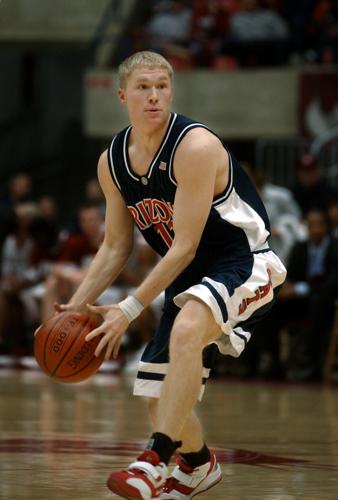
Arizona guard Jason Ranne looks to pass against Washington State University in Pullman, Wash., Jan. 31, 2004.
Later, when Ranne was finishing up law school at the University of Minnesota, Rosborough also facilitated an interview with renowned agent Arn Tellum that launched Ranne's representation career.
“Lute, Roz, all my teammates there, it changed my life for sure,” Ranne said. “Still affects my life in a positive way. I’m very appreciative.”
During an interview with the Star before the 2001 team reunion, Ranne discussed how it has all played out, including his three-year stopover with the Oklahoma City Thunder, and the friendship he developed with UA coach Tommy Lloyd along the way:
That first Arizona team that Ranne was a part of in 2000-01 was ranked No. 1 in the preseason. The Wildcats struggled when Olson missed a total of six games in the first half of the season while his wife Bobbi was fighting, and eventually dying, from cancer, but the Wildcats rebounded from it to reach the NCAA title game.
“Those guys were tremendous personalities, and knowing how much talent was on that team, it was truly fascinating to be a part of. We had all that preseason hype and the normal things those personalities can run into with big expectations.
“When Bobbi passed away, the team was not necessarily functioning at the highest level at that time. Lute was gone, and Roz was holding it all together. Then that team really gelled around that. It was very obvious that the culture and the narrative shifted towards everyone being unified and maximizing that talent. No agendas, no egos. Watching all that was very obvious — that team played to its potential.
“But for another team that was as loaded and amazing in the last game — in two (second-half) minutes of that game, there were a couple offensive fouls, and then three 3s in a row by Mike Dunleavy – otherwise, it would have been a national championship.”
Ranne returned to UA the next three seasons to be a part of more transformation. The Wildcats made a surprising Sweet 16 run in 2002 despite losing all but Gardner from their 2001 starting lineup, thanks in part to the arrival of freshmen Salim Stoudamire and Channing Frye.
That led to one of the Wildcats’ other best seasons in history, the Gardner-and-Luke Walton-led 2002-03 team that carried the No. 1 ranking most of the season. It featured leaders in Gardner and Walton, seasoned sophomores in Stoudamire and Frye — and more high-level freshmen talent in Andre Iguodala and Hassan Adams.
“(The 2002 team) was the foundation for the next year, with Luke and Jason really foundational pieces. Then you added these freshmen who were very, very talented and got to play because there was so much exodus in the previous year that it really gave them a little bit of continuity to come back for the 2002-03 season, because they had all kind of played together, been around, learned it.”

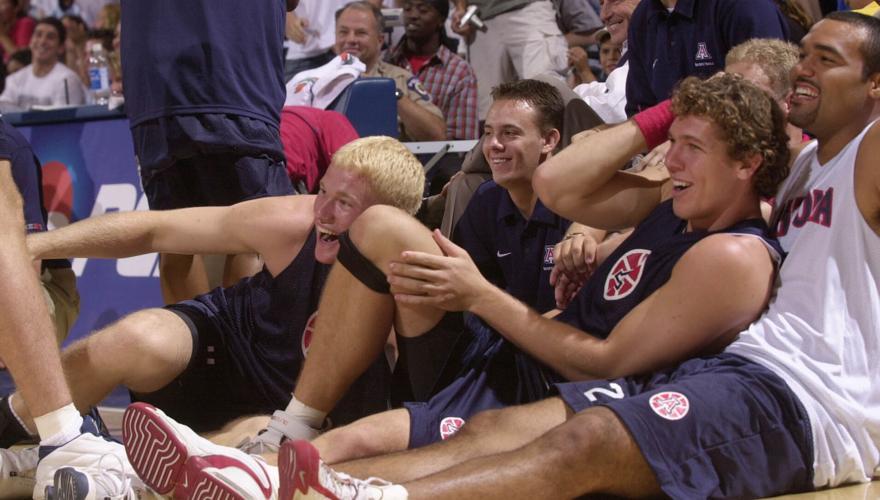
UA's Jason Ranne, left, Luke Walton and Isaiah Fox, right, react to a dunk by teammate Andre Iguodala during the slam dunk contest, Oct. 12, 2002, at McKale Center during Midnight Madness.
Ranne earned a scholarship for the 2002-03 and 2004-05 seasons, saying Olson and Rosborough “gave him the benefit of the doubt” when roster turnover had left openings, then took off for law school. But he didn’t attend the school he thought he might, nor wind up doing litigation or other more typical law work as he initially expected to.
“I wanted to be a lawyer since eighth grade. I was gonna go to Arizona’s law school and actually had gotten a scholarship there. But I was dating Katie (former UA gymnast Katie Johnson), my wife, and she’s from Minnesota. So the grand plan was to go there and figure it out.
“When I was starting my third year of law school, I was going to accept a law firm job at Fennemore Craig in Phoenix. But Arn Tellum called Jim and asked if there was anybody with a law degree who had come through the program. There weren't that many of us.
“Intelligently, (Tellum) wanted people out of programs that had influence, so he targeted a couple programs. I started with another guy that year who came out of Duke, and I think that's what he was looking for. It worked it out where I ended up learning how to do legal work inside Wasserman initially.”
Ranne has spent his entire career since then at Wasserman, except for when he spent nearly three years with the Oklahoma City Thunder as its director of strategic planning from 2013 to 2015.
“I grew up in Tulsa, and just had my first child, so the idea of moving back to where you grew up and where your family is was intriguing at that time. You pair that with the fact that the Thunder was an elite organization and an elite team led by an elite executive in Sam Presti … it was a very stable, successful place where I could learn from another really excellent mentor. I had Lute, Arn, then Sam Presti. That’s a very good trio that had taught me. I learned a lot from each place.
“The role that I went back to at Wasserman (in 2015) was really more leadership. I was leading a lot of different things, still doing agent work, but also growing and building businesses. A lot of that is what I learned from Sam and the Thunder — creating a vision, strategic planning, building something for the future, creating a culture around it, having a standard and trying to have what you do mean something to the world.
“We’ve built a very diverse representation business across many countries, multiple continents, in about 15 different disciplines, men's and women's. That's most of the day but I still represent a number of top talent of my own.”
Along the way, Ranne struck up a friendship with Lloyd when he was an assistant at Gonzaga. The two also now have a business relationship, since Wasserman represents Lloyd, who signed a reworked five-year deal last spring that is valid through 2029-30.
“I would call Tommy a friend, a confidant. Our company does represent him, and I do oversee the division that represents him. The belief I had in him and I still have in him, and the connection I have with him...he’s very like-minded in everybody I’ve ever been around. You’re just very proud to be associated with him.”
In his fifth season with the Wildcats, Lloyd also may now have a team that could reach the Final Four for the first time since Ranne’s eye-opening freshman year of 2000-01.
But that’s hardly the only reason Ranne says he supports Lloyd for the job. Ranne knows the local culture. And, he says, so does Lloyd.
“He has a tremendous reflection of what Tucson and Arizona basketball is and has been for the vast majority of its successful existence. That's why the community, the students, the players have rallied around him. Arizona basketball and that community is a very specific fit.
“He identifies with that community, the school and what it is, and they do with him. Which is what’s really great about the whole thing.”

