



Three months before Arizona men's basketball reached the 2001 Final Four, the Wildcats were holding a shootaround to prepare for a Fiesta Bowl Classic matchup against Mississippi State at McKale Center.
It was supposed to be a routine nonconference game, a final tuneup before Pac-10 play began … at least until normally composed coach Lute Olson showed up in a different way than usual.
“In comes coach, who’d been crying, and he goes into the locker room and tells the kids that he's taking time off to be with his wife,” then-UA associate head coach Jim Rosborough said. “That was not real pleasant.”
So much about the Wildcats’ 2000-01 season was not, because Olson’s wife Bobbi died of ovarian cancer two days after that shootaround, on New Year’s Day 2001.
Loaded with talent that Olson was better positioned to recruit after winning the 1997 national title, the Wildcats were the No. 1 pick in the Associated Press preseason Top 25 that year. Five of them later became NBA Draft picks, too — Gilbert Arenas, Loren Woods, Michael Wright, Luke Walton and Richard Jefferson — while point guard Jason Gardner remains one of UA's most decorated players ever.

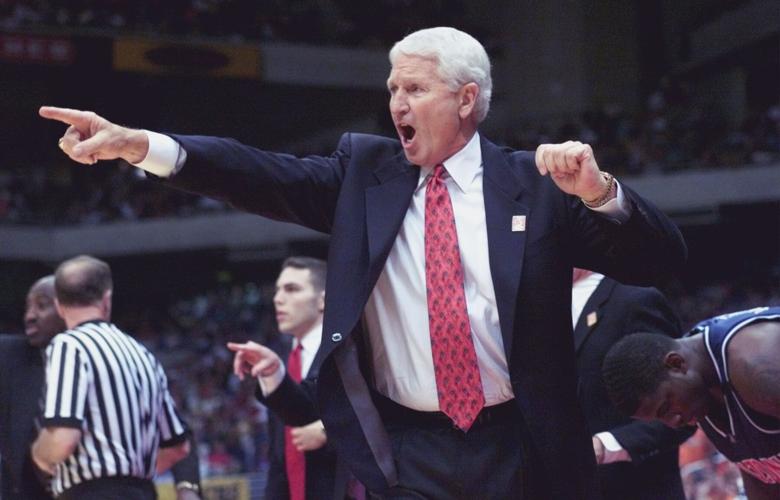
Arizona coach Lute Olson directs his team from the sidelines during the first half of the NCAA Midwest Regional championship game in 2001. With Jason Gardner, Luke Walton, Richard Jefferson and more leading the way, the Wildcats made the 2001 Final Four.
“It was the best team in the country” that season, Rosborough said more than once during an interview earlier this week, before the 2001 team was scheduled to be honored at McKale Center on Saturday during UA's game with Oklahoma State.
But while the Wildcats overcame the absence of Olson for a total of six games in the first half of the season, they also saw it end with a different sort of heartbreak: An 82-72 loss to Duke in the national championship game, when they were torpedoed at least to some extent by an injury to leading scorer Arenas and a controversial no-call against Duke’s Jason Williams.
"Of course, there was an effect, especially early," then-UA men's basketball publicist Richard Paige said of Bobbi Olson's death. "But 20-year-olds are resilient and despite never fully escaping that topic throughout the season, the guys managed to turn things around enough to win 13 of 14 games heading into the Final Four.
"We were rolling. Even with Gilbert’s injury in the semifinal, those guys were two or three plays away from winning the national championship. Those guys were far better, and tougher, than they get credit for."
It was a tough season; they knew it would be different before it even started.
Married to Lute for 47 years and a well-regarded mother of sorts to his entire program, Bobbi Olson contracted ovarian cancer in 1998. After a year of treatment, she was declared cancer-free, but the disease returned in 2000, before the next season started.
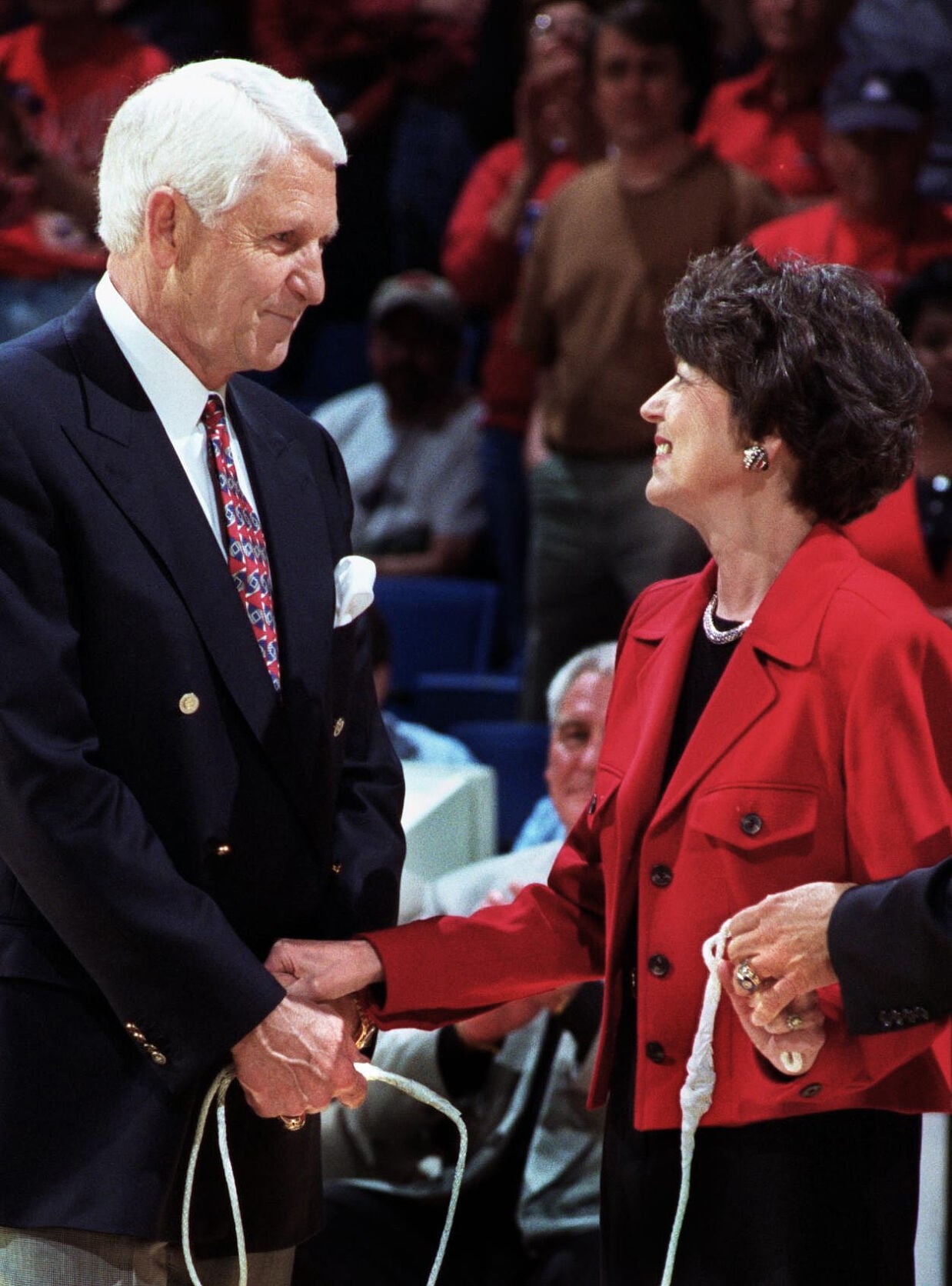
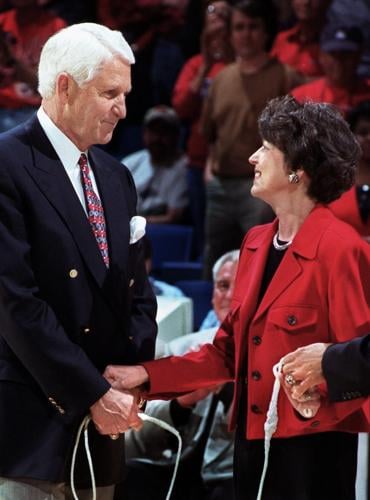
Coach Lute Olson shares a moment with wife Bobbi before the unveiling the new "Lute and Bobbi Olson" floor at McKale Center on Feb. 26, 2000, ahead of the 2000-2001 season that saw the Wildcats in the national championship game.
Players "came back to school and everybody knew that Bobbi was not well,” Rosborough said. “I looked into their eyes a lot. I didn’t see that they were going to fall over, but they knew she was sick.”
Inside, Gardner indicated, they felt it. Now the Wildcats' player relations director, Gardner said Bobbi was "half the reason why a lot of guys came here," her warm personality having been known to ideally complement Lute's more distant approach while players were being recruited, during their UA careers and afterward.
"Maybe being from Indianapolis, Indiana, it was important to me, because it felt like you had a mother who was around and was very supportive," Gardner said. "It was a tough process, but I think what he had was his family, the community, and the support of the support of our team. I think we all kind of rallied through that."
Lute Olson initially charged into that 2000-01 season as usual, with Arizona edging Illinois to win a riveting Maui Invitational title, reality soon pulled him off it. The coach stayed behind during the Wildcats’ trip to play at UConn on Dec. 9, 2000, while Bobbi underwent a medical procedure.
That trip ended in UA heartbreak on the court, too: UConn edged Arizona 71-69 after Pac-10 official Richie Ballesteros controversially whistled UA center Woods for goaltending with 1.8 seconds left, assigning a game-winning bucket to the Huskies.
Rosborough said Ballesteros “sort of apologized” for the call several years later but at the time it was the beginning of a rough stretch. The Wildcats also lost 81-73 a week later to Illinois in Chicago, and two weeks after that, dropped that game to Mississippi State.
Rosborough said he thought about Pete Gaudet, the Duke assistant who was just 4-15 while taking over Duke during the 1994-95 season because of back surgery and exhaustion to head coach Mike Krzyzewski.
“I told the kids in the locker room after the loss to Mississippi State that nothing like Pete Gaudet will happen here,” Rosborough said. “That was kind of my goal, just to keep the lid on it with the games coming up — two at home, two away. We needed to win those and just keep it going just like it had been.”
They won three of the four, beating California at McKale Center in the first game after Bobbi Olson died, but losing to eventual league champ Stanford two days later. Then UA swept a trip to Washington State and Washington.
When the Wildcats returned from Seattle, Olson walked in again.
“We did get off to a 3-1 start, which was good, and then coach called and said, 'Jim, would you allow me to come back?'" Rosborough said, chuckling at the memory, noting, “Well, coach, it’s your team for God’s sake.”
The Wildcats lost only two more games the rest of the regular season, and one went to overtime at UCLA.
The Wildcats were still the Wildcats. Olson was still Olson.
“He's a competitor, and he's a tough guy, and I don't mean to belittle this, but he knew for some period of time that this was going to happen,” Rosborough said of Olson. “He knew it was coming. Everybody mourned, and friends got together and there were hugs and all that.
“Then the first day back, he was about 99.9% normal, getting on kids’ butts and coaching. It helped get his mind off it. And we had a good team; the parts were there. We had to keep Loren under wraps perhaps a little bit. But Michael Wright was solid, Richard was solid, Jason and Gilbert, solid. Luke coming off the bench (with) Gene Edgerson, Justin Wessel, all those guys."

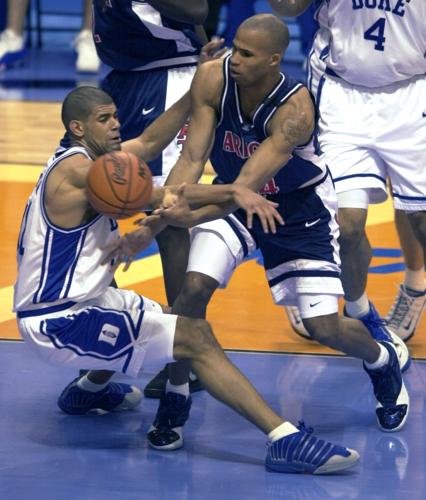
Arizona's Richard Jefferson and Duke's Shane Battier battle for the ball in the first half of the championship game of the 2001 men's NCAA Tournament on April 2, 2001.
By “under wraps,” Rosborough explained, the goal was to contain Woods' sometimes pronounced emotions. Woods actually had been suspended for the first six games of the season because the NCAA ruled he accepted extra benefits; Wessel started in his place, even as he battled a knee injury that eventually shelved him for the season.
There were other extremes, too — Jefferson’s sharp wisecracks, Arenas’ never-ending playfulness — but those also tended to forge a tighter knit within the team.
“Loren you had to calm down to get him to be as good a player as he could, but he was good, and he was a good teammate,” Rosborough said. “Everybody got along. That was a close, close, close team. Everybody loved Michael Wright. Gilbert pulled every prank you could come up with, but they loved Gilbert. And Richard, Luke and Jason were big-time friends. It was a close team.”
UA coach Tommy Lloyd said he's heard from multiple 2001 players about how Gardner was the clear leader, and that was certainly how Rosborough explained it. Rosborough said sometimes Gardner would even grab Woods’ jersey to implore him to play harder even as “he could hardly see Loren’s belly button.”
Arenas was known at UA as the guy who routinely unscrewed lightbulbs from teammates’ rooms if they left the door open, then became known nationally as an NBA star for his off-court hijinks, which sometimes landed him into legal trouble. He pleaded guilty to a 2010 charge for carrying a gun without a license and was indicted last year on charges of operating an illegal gambling business.
Tragically, 14 years later, the well-liked Wright was murdered after establishing a successful overseas professional career. He was found dead in the backseat of an SUV in New Jersey, and two men were charged in the killing, which investigators said involved blunt force trauma to the head with an ax.
“To this day, nobody knows what was going on,” Rosborough said. “He was a great kid, great young man, great player, nice, sensitive, everything.”
On the court, Wright led the Wildcats in rebounding (7.8) and was the Wildcats’ second leading scorer (15.6) behind only Arenas (16.2).
All five starters averaged in double figures, while Walton was the glue off the bench. Together, while their early loss to Stanford ultimately cost them the Pac-10 title, the Wildcats still managed a No. 2 NCAA Tournament seed and wound up winning a rubber-match game with Illinois in the Elite Eight.

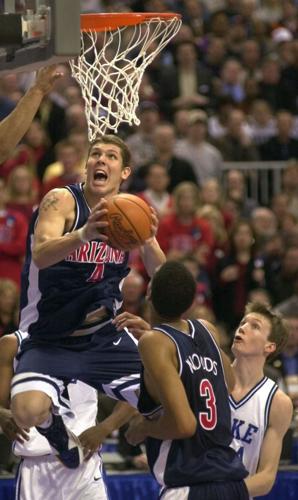
Arizona's Luke Walton (4) goes to the basket above teammate Loren Woods (3) and Duke's Mike Dunleavy, right, in the second half of the Final Four Championship in Minneapolis, Monday, April 2, 2001.
That win put Arizona in its fourth Final Four under Olson — still the program's last one to date — and the Wildcats extended the run when they clobbered Michigan State 80-61 in the national semifinal.
But Arenas suffered a chest injury in that game, limiting his mobility in the final against Duke. Rosborough said he wasn’t even able to shoot during a workout the day before the final, and Arenas shot 4 for 17 against the Blue Devils
Meanwhile, Gardner was 2 for 11 — and couldn’t manage to draw a foul when Duke’s Williams infamously crawled on his back, a move that could have resulted in a third first-half foul for Williams.

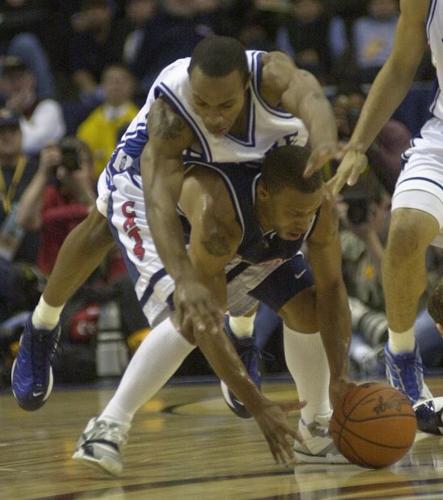
Jason Gardner doesn't draw a foul from Duke's Jason Williams in the first half despite Williams falling over him during Duke's 82-72 win in the 2001 NCAA championship game in Minneapolis.
Asked about the no-call Thursday, Gardner said "I definitely think it was a foul," and, during a 2015 visit to McKale Center with ESPN’s GameDay, Williams fessed up to some extent.
“It’s not my job as a player, back in 2001, to call a foul on myself,” Williams told the Star. “They didn’t call it, we won the game. That was a hell of a game though, man.”
It was a game, no matter how you viewed it, that ended one of Arizona’s best seasons just short of winning it all. Gardner says it's "crazy to walk in here sometimes" and wonder if a 2001 national championship banner might be hanging inside McKale if not for Arenas' injury and that no-call.
Rosborough has to wonder, too.
He always will.
“This was the best team in the country,” Rosborough said again. "I don’t mind saying it, but there were three gentlemen there that made it really, really tough on us. It was just a horribly reffed game. That hurt us, and Gilbert being hurt also hurt us.
“I thought we were the best team in the country. Far and away, we were the best team in the country.”

